
Perceived life stress, 2010

Archived Content
Information identified as archived is provided for reference, research or recordkeeping purposes. It is not subject to the Government of Canada Web Standards and has not been altered or updated since it was archived. Please "contact us" to request a format other than those available.

Stress carries several negative health consequences, including heart disease, stroke, high blood pressure, as well as immune and circulatory complications1. Exposure to stress can also contribute to behaviours such as smoking, over-consumption of alcohol, and less-healthy eating habits2.
In 2010, 23.5% of Canadians aged 15 and older reported that most days were 'extremely or quite a bit stressful,' up from 22.3% in 2008.
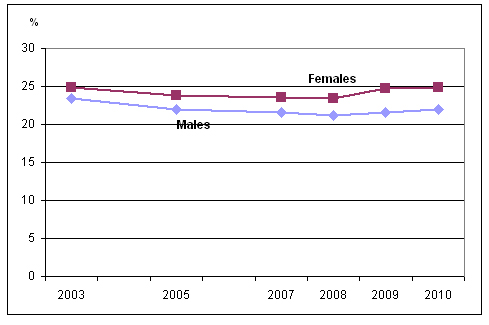
In 2010, 24.9% of females reported that most days were quite a bit or extremely stressful, compared with 22.0% of males (Chart 1).
Chart 1
Percentage reporting most days quite a bit or extremely stressful, by sex, household population aged 15 or older, Canada, 2003 to 2010
Source: Canadian Community Health Survey, 2003, 2005, 2007, 2008, 2009, 2010.
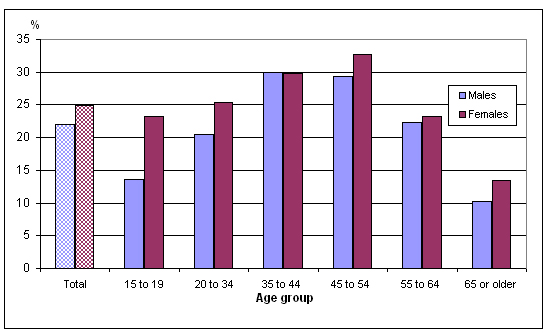
In particular, 23.2% of females aged 15 to 19 reported stress in their daily lives, compared with 13.7% of males in that age group (Chart 2).
Chart 2
Percentage reporting most days quite a bit or extremely stressful, household population aged 15 or older, by age group and sex, Canada, 2010
Source: Canadian Community Health Survey, 2010.
Daily stress rates were highest in the core working ages (35 to 54), peaking at about 30% in the 35 to 44 and 45 to 54 age groups. People in these age groups are most likely to be managing multiple career and family responsibilities.
Reported stress decreased at older ages, with seniors the least likely to find their days stressful (12.0%).
Among those who reported that their days were quite a bit or extremely stressful, 83.5% said that they were satisfied or very satisfied with life, compared with 95.8% of those who did not find their days very stressful.
Residents of Quebec (26.8%) reported daily stress at rates higher than the national average. Residents of Ontario, Alberta, British Columbia and Nunavut3 reported daily stress at about the same as Canada's average; the remaining provinces and territories reported stress rates lower than the national level.
End notes
- Heart and Stroke Foundation. "Heart Disease." Health Information. Last updated April 2010. http://www.heartandstroke.ca (accessed May 11, 2010)
- Statistics Canada. 2001. "Stress and well–being." Health Reports. Vol. 12, no. 3. Statistics Canada Catalogue no. 82-003. page 22. /studies-etudes/82-003/archive/2001/5626-eng.pdf (accessed May 11, 2010).
- Use with caution (coefficient of variation 16.6% to 33.3%).
References
Heart and Stroke Foundation. "Heart Disease." Health Information. Last updated April 2010. http://www.heartandstroke.ca (accessed May 11, 2010).
Orpana, Heather, Louise Lemyre and Ronald Gravel. 2009. "Income and psychological distress: The role of the social environment." Health Reports. Vol. 20, no. 1. March. Statistics Canada Catalogue no. 82-003. /bsolc/olc-cel/olc-cel?lang=eng&catno=82-003-X200900110772 (May 11, 2010).
Shields, Margot. 2006. "Stress and depression in the employed population." Health Reports. Vol. 17. no. 4. October. Statistics Canada Catalogue no. 82-003. pages 11–29. /studies-etudes/82-003/archive/2006/9495-eng.pdf (accessed May 11, 2010).
Shields, Margot. 2004. "Stress, health and the benefit of social support." Health Reports. Vol. 15, no. 1. January. Statistics Canada Catalogue no. 82-003. pages 9–38. /studies-etudes/82-003/archive/2004/6763-eng.pdf (accessed May 11, 2010).
Statistics Canada. 2001. "Stress and well–being." Health Reports. Vol. 12, no. 3. Statistics Canada Catalogue no. 82-003. page 22. /studies-etudes/82-003/archive/2001/5626-eng.pdf (accessed May 11, 2010).
Data
Additional data from the Canadian Community Health Survey are available from CANSIM table 105–0501 and summary tables Perceived life stress, by age group and sex and Perceived life stress, by sex, provinces and territories.
- Date modified: