Archived - Potato Area and Yield Survey - June

General Information

This information is collected under the authority of the Statistics Act, Revised Statutes of Canada, 1985, Chapter S-19. Completion of this questionnaire is a legal requirement under this act.

Survey purpose

The purpose of this survey is to obtain information to produce national and provincial level estimates of potato production. These estimates will be used by producer organizations, government departments and others. Your information may also be used by Statistics Canada for other statistical and research purposes.

Confidentiality

Your answers are confidential.

The Statistics Act protects the confidentiality of information collected by Statistics Canada. Statistics Canada is prohibited by law from releasing any information it collects which could identify any person, business, or organization, unless consent has been given by the respondent or as permitted by the Statistics Act. Statistics Canada will use the information from this survey for statistical purposes.

Record linkages

To enhance the data from this survey, Statistics Canada may combine it with information from other surveys or from administrative sources.

Fax or e-mail transmission disclosure

Statistics Canada advises you that there could be a risk of disclosure during the transmission of information by facsimile or e-mail. However, upon receipt, Statistics Canada will provide the guaranteed level of protection afforded all information collected under the authority of the Statistics Act.

Data-sharing agreements

To reduce respondent burden, Statistics Canada has entered into data-sharing agreements with provincial and territorial statistical agencies and other government organizations, which have agreed to keep the data confidential and use them only for statistical purposes. Statistics Canada will only share data from this survey with those organizations that have demonstrated a requirement to use the data.

Section 11 of the Statistics Act provides for the sharing of information with provincial and territorial statistical agencies that meet certain conditions. These agencies must have the legislative authority to collect the same information, on a mandatory basis, and the legislation must provide substantially the same provisions for confidentiality and penalties for disclosure of confidential information as the Statistics Act. Because these agencies have the legal authority to compel businesses to provide the same information, consent is not requested and businesses may not object to the sharing of the data.

For this survey, there are Section 11 agreements with the provincial statistical agencies of New Brunswick, Quebec, Ontario and Alberta.

The shared data will be limited to information pertaining to business establishments located within the jurisdiction of the respective province or territory.

Section 12 of the Statistics Act provides for the sharing of information with federal, provincial or territorial government organizations. Under Section 12, you may refuse to share your information with any of these organizations by writing a letter of objection to the Chief Statistician and returning it with the completed questionnaire. Please specify the organizations with which you do not want to share your data.

For this survey, there are Section 12 agreements with the statistical agency of Prince Edward Island as well as with the New Brunswick Department of Agriculture, Aquaculture and Fisheries, the Saskatchewan Ministry of Agriculture and the British Columbia Ministry of Agriculture and Lands.

Please return the completed questionnaire within one week by facsimile to 1-888-883-7999 or by mail to Statistics Canada, Operations and Integration Division, Central Reception – SC-0505
150 Tunney’s Pasture Driveway, Ottawa, Ontario, K1A 0T6.
If you have any questions, please call 1-800-565-1685.

Main respondent

  • Given name and initial(s)
  • Family name
  • Telephone number
  • Fax number
  • Other telephone number
  • Number and street name
  • Post office (name of city, town or village where mail is received)
  • Province
  • Postal code
  • E-mail address (if applicable)

Alternate respondent

  • Given name and initial(s)
  • Family name
  • Telephone number
  • Fax number
  • Other telephone number
  • Number and street name
  • Post office (name of city, town or village where mail is received)
  • Province
  • Postal code
  • E-mail address (if applicable)

Alternate respondent

  • Given name and initial(s)
  • Family name
  • Telephone number
  • Fax number
  • Other telephone number
  • Number and street name
  • Post office (name of city, town or village where mail is received)
  • Province
  • Postal code
  • E-mail address (if applicable)

Potato Area

SECTION A - AREA PLANTED 20XX

  1. Are you growing any potatoes for sale this year?
    1. Yes (Please go to question 2.)
    2. No (Please return in the envelope provided.)
  2. What is the total area planted to potatoes in 20XX?
    Please report for entire operation, area planted to potatoes on land owned or rented by all partners in the operation.
    1. Total area planted to potatoes
    2. What was the unit of measure that you reported in (acres or hectares)?

SECTION B - QUANTITY SOLD AND PRICE RECEIVED (BASED ON THE 20XX CROP YEAR)

  1. Did you sell any potatoes in the 2013 crop year?
    1. Yes (Please go to question 2.)
    2. No (Please return in the envelope provided.)
  2. The following questions are for the quantity of potatoes sold and the average price received for the 2013 crop year.
    • Do not include any potatoes purchased for re-sale.
    • Please report the price received after any deductions or bonuses were made.
    • Please report an average price received taking into account all grades.

Quantity sold and average price received for the 2013 crop year

  1. Tablestock potatoes
    1. Quantity sold
    2. Quantity sold unit of measure
      • Metric tonnes
      • Hundredweight (cwt)
      • Imperial tons
      • Barrels
      • Pounds
      • Kilograms
      • Other  (Please Specify)
    3. Average price received
    4. Average price received unit of measure
      • $/Metric tonne
      • $/Hundredweight (cwt)
      • $/Imperial ton
      • $/Barrel
      • ¢/Pound
      • ¢/Kilogram
      • Other (Please Specify)
  2. Seed potatoes
    1. Quantity sold
    2. Quantity sold unit of measure
      • Metric tonnes
      • Hundredweight (cwt)
      • Imperial tons
      • Barrels
      • Pounds
      • Kilograms
      • Other  (Please Specify)
    3. Average price received
    4. Average price received unit of measure
      • $/Metric tonne
      • $/Hundredweight (cwt)
      • $/Imperial ton
      • $/Barrel
      • ¢/Pound
      • ¢/Kilogram
      • Other (Please Specify)
  3. Processing potatoes
    1. Quantity sold
    2. Quantity sold unit of measure
      • Metric tonnes
      • Hundredweight (cwt)
      • Imperial tons
      • Barrels
      • Pounds
      • Kilograms
      • Other  (Please Specify)
    3. Average price received
    4. Average price received unit of measure
      • $/Metric tonne
      • $/Hundredweight (cwt)
      • $/Imperial ton
      • $/Barrel
      • ¢/Pound
      • ¢/Kilogram
      • Other (Please Specify)

Comments

Thank you for completing this questionnaire.


Potato area and yield survey 2009

The purpose of this survey is to obtain information to produce national and provincial level estimates of potato production. These estimates will be used by producer organizations, government departments and others.

Confidential when completed. Collected under the authority of the Statistics Act, 1985, Chapter S19.

  1. Jun
  2. Oct
  • Still farming
  • No longer farming
  • Change of operator
  • Produces potatoes
  • No longer growing potatoes
  • No potatoes this year

If any of the above information is incorrect or missing, please make any necessary corrections below.

  • Farm Name (if applicable)
  • Surname or Family Name
  • Home Phone Number
  • Usual First Name and Initial
  • Cell Phone Number
  • R.R.
  • Box No.
  • Number and Street Name
  • Postal Code
  • Post Office (name of city, town or village where mail is received)
  • Partner's Name if Applicable
  • Partner's Phone Number if Applicable
  • Partner's Name if Applicable
  • Partner's Phone Number if Applicable
  • CORP Corporation Name if Applicable
  • Business Phone Number if Applicable

Record of calls (area in June)

  • Date
  • Time
  • Result

Record of calls (yield in October)

  • Date
  • Time
  • Result

Potato area survey 2009

1. Are you growing potatoes for sale this year?

  • Yes - go to question 2
  • No - complete potato operation status and end interview

2. Is this farming operation a partnership?

  • Yes (Update partner information in operator identification section on first page, then proceed to question 4)
  • No

Ask question 3 only in June. If calling in fall skip to question 4:

3. What is the total area planted to potatoes in 2009? (Please report for entire operation, area planted to potatoes on land owned or rented by all partners in the operation)

  1. Total area planted to potatoes
  2. Was the area reported in:
    • acres
    • hectares

End interview here in June

  1. Comments

4. What was the total area planted to potatoes in 2009? (Please report for the entire operation, area planted to potatoes on land owned and rented by all partners in the operation).

  1. Will the area be reported in:
    • acres
    • hectares
  2. Total area planted to potatoes

5. What was the total area of potatoes harvested in 2009?

6. What was the average field run yield for your potatoes? Please report the average yield on the acres harvested, not total area and please report the yield based on product moving into storage, not the marketable yield.

Or

7. What was the total field run production of harvested potatoes?

Please report the production from the entire operation and the production moving into storage, not the marketable production

  • Was the yield or production reported in:
    • tons
    • cwts
    • tonnes
    • barrels (165 pounds)
    • other (please note)

8. What percentage of your harvested crop do you expect to make grade?

The percentage that you expect to make grade for table, seed or processing as defined by the grading standard of the Canadian Food Inspection Agency, your provincial grading standards or your processor.

Comments

Agreement to Share Information (N.B., Sask. And B.C. only)

This survey is being conducted under a cooperative agreement between Statistics Canada and your provincial ministry of agriculture.

Do you agree to share this information?

  • Yes
  • No

CVs for Total Sales by Geography

CVs for Total Sales by Geography
Table summary
This table displays the results of CVs for Total Sales by Geography. The information is grouped by Geography (appearing as row headers), Month, 201603, 201604, 201605, 201606, 201607, 201608, 201609, 201610, 201611, 201612, 201701, 201702 and 201703 (appearing as column headers).
Geography Month
201603 201604 201605 201606 201607 201608 201609 201610 201611 201612 201701 201702 201703
percentage
Canada 0.46 0.49 0.51 0.50 0.56 0.51 0.55 0.57 0.57 0.60 0.68 0.65 0.62
Newfoundland and Labrador 1.41 1.82 1.78 1.49 1.74 1.88 1.46 1.28 1.14 1.25 1.66 1.60 1.83
Prince Edward Island 1.46 1.57 1.73 2.99 3.28 3.69 3.60 3.11 2.79 3.53 3.73 3.98 3.61
Nova Scotia 1.85 2.11 1.70 2.96 3.15 2.71 2.78 2.96 2.94 2.86 3.09 2.92 3.15
New Brunswick 1.56 2.00 1.45 1.71 2.01 1.27 1.85 2.05 1.76 1.25 1.99 3.86 1.45
Québec 0.88 1.07 1.20 1.20 1.43 1.08 1.22 1.21 1.28 1.33 1.54 1.38 1.08
Ontario 0.79 0.84 0.87 0.84 0.91 0.90 0.95 1.06 1.05 1.07 1.18 1.17 1.14
Manitoba 1.97 2.30 2.27 2.24 2.67 1.34 1.94 1.68 1.46 1.98 2.29 1.75 1.80
Saskatchewan 1.73 1.81 1.74 1.38 1.49 1.62 1.74 1.59 1.40 1.58 1.75 1.99 1.95
Alberta 0.91 0.97 0.97 0.97 0.99 1.00 1.13 1.07 0.88 0.96 1.25 1.14 1.11
British Columbia 1.52 1.57 1.56 1.52 1.68 1.60 1.69 1.59 1.64 1.92 2.14 1.93 2.00
Yukon Territory 2.16 2.21 2.74 3.90 3.79 3.76 4.16 3.16 2.41 3.22 3.68 4.09 4.07
Northwest Territories 0.78 0.78 0.57 0.08 0.13 0.15 0.09 0.26 0.29 0.34 0.64 0.36 0.33
Nunavut 0.05 0.00 0.00 0.00 0.00 0.00 0.00 0.00 0.00 0.00 0.00 0.00 0.00

Archived - Update of the National Occupational Classification

Consultation objectives

As part of continuous improvement, Employment and Social Development Canada (ESDC) and Statistics Canada have decided to increase the frequency of National Occupational Classification (NOC) updates. Updates contain non-structural changes. A non-structural change means adding new occupational titles to current groups, modifying the descriptions of the unit groups, or improving the correspondence between English and French versions of the classification.

Revisions, on the other hand, will continue to take place every 10 years. Unlike updates, revisions can include structural changes. A structural change means changing the conceptual boundaries of occupational groups, moving occupations to different groups, or changing the hierarchical classification structure. The next NOC revision is scheduled for 2021.

Consultation method

ESDC and Statistics Canada invite users of the NOC, such as industry representatives and experts in the field of employment research, to submit proposals for changes to the NOC.

The proposals aim to collect input from users as an integral part of the NOC update process, and to fuel research in preparation for the NOC revision. All proposals received will be shared between ESDC and Statistics Canada, which will be working jointly on the update of the NOC.

How to get involved

Respondents are invited to provide their comments, feedback and suggestions on how to improve the NOC content to NC-CONSULT-GD@hrsdc-rhdcc.gc.ca before November 30, 2017. Proposals must contain the name, address, email address and phone number of the respondent.

Canada will not reimburse respondents for expenses incurred in developing their proposal. Please note that there will be other consultation periods in the future.

Respondents are encouraged to follow these guidelines when developing their proposal. Proposals may be written in either of Canada's official languages, English or French.

Proposals should:

  • clearly identify the proposed addition, change or modification;
  • outline the rationale and include supporting information for the change suggested, such as:
    • approximate population of workers across the country;
    • duties;
    • requirements for certification (if any);
    • educational background, tools and technology used, as well as experience required for entry into the occupation;
    • current job titles used in the labour market;
  • provide details about experts, related associations or representatives within the sector;
  • be consistent with classification principles such as mutual exclusivity, exhaustiveness, and homogeneity within unit groups;
  • be relevant, that is:
    • present analytical interest;
    • enhance the usefulness of data;
    • be based on appropriate statistical research or subject matter expertise.

Treatment of proposals

A team of representatives from ESDC and Statistics Canada will review all proposals received. Canada reserves the right to use independent consultants, or government employees, if deemed necessary, to assess proposals.

If deemed appropriate, Canada will contact the respondents to ask additional questions or ask for clarification on a particular aspect of their proposal.

The review of proposals will not necessarily result in changes to the NOC. However, if Canada adopts changes, non-structural changes will be implemented in future NOC updates while structural changes will occur as part of the NOC 2021 revision.

Privacy

Statistics Canada is committed to respecting the privacy of its participants. All personal information collected during this consultation is protected under the Privacy Act. For more information on Statistics Canada's privacy policies, please consult the Privacy notice.

Archived - 2016 Annual Retail Trade Survey

Integrated Business Statistics Program (IBSP)

Reporting Guide

This guide is designed to assist you as you complete the 2016 Annual Retail Trade Survey. If you need more information, please call the Statistics Canada Help Line at the number below.

Help Line: 1-800-858-7921

Table of contents

Skip to text

Reporting instructions
Business or organization and contact information
Reporting period information
Revenue
Expenses
Industry Characteristics
Sales by type of client
Distribution of operating revenue by method of sale
E-commerce
Appendix 1 - Gasoline service station guide
Appendix 2 - Beer, wine and liquor chains

Text begins

Reporting instructions

1. Please report all dollar amounts in thousands of Canadian dollars ('000 CAN$).

2. Do not include sales tax.

3. Percentages should be rounded to whole numbers

4. When precise figures are not available, please provide your best estimates.

Business or organization and contact information

This section verifies or requests basic identifying information of the business or organization such as legal name, operating name (if applicable), contact information of the designated contact person, current operational status, and main activity(ies).

Legal Name
The legal name is one recognized by law, thus it is the name liable for pursuit or for debts incurred by the business or organization. In the case of a corporation, it is the legal name as fixed by its charter or the statute by which the corporation was created.

Modifications to the legal name should only be done to correct a spelling error or typo.

To indicate a legal name of another legal entity you should instead indicate it in question 3 by selecting 'Not currently operational' and then choosing the applicable reason and providing the legal name of this other entity along with any other requested information.

Operating Name
The operating name is a name the business or organization is commonly known as if different from its legal name. The operating name is synonymous with trade name.

Verify or provide the requested contact information of the designated business or organization contact person. The designated contact person is the person who should receive this questionnaire. The designated contact person may not always be the one who actually completes the questionnaire. If different than the designated contact person, the contact information of the person completing the questionnaire can be indicated later in the questionnaire.

Verify or provide the current operational status of the business or organization identified by the legal and operating name in question 1. If indicating the operational status of the business or organization is 'Not currently operational' then indicate an applicable reason and provide the requested information.

This question verifies the business or organization's current main activity as classified by the North American Industry Classification System (NAICS). The North American Industry Classification System (NAICS) is an industry classification system developed by the statistical agencies of Canada, Mexico and the United States. Created against the background of the North American Free Trade Agreement, it is designed to provide common definitions of the industrial structure of the three countries and a common statistical framework to facilitate the analysis of the three economies. NAICS is based on supply-side or production-oriented principles, to ensure that industrial data, classified to NAICS, are suitable for the analysis of production-related issues such as industrial performance.

The target entity for which NAICS is designed are businesses and other organizations engaged in the production of goods and services. They include farms, incorporated and unincorporated businesses and government business enterprises. They also include government institutions and agencies engaged in the production of marketed and non-marketed services, as well as organizations such as professional associations and unions and charitable or non-profit organizations and the employees of households.

The associated NAICS should reflect those activities conducted by the business or organizational unit(s) targeted by this questionnaire only, as identified in the 'Answering this questionnaire' section and which can be identified by the specified legal and operating name. The main activity is the activity which most defines the targeted business or organization's main purpose or reason for existence. For a business or organization that is for-profit, it is normally the activity that generates the majority of the revenue for the entity.

The NAICS classification contains a limited number of activity classifications; the associated classification might be applicable for this business or organization even if it is not exactly how you would describe this business or organization's main activity.

Please note that any modifications to the main activity through your response to this question might not necessarily be reflected prior to the transmitting of subsequent questionnaires and as a result they may not contain this updated information.

  1. Legal name and Operating name
  2. Designated contact person
  3. Current operational status
  4. Main activity
  5. If the current NAICS associated with this business or organizations is not correct, please provide a brief description of the main activity and provide any additional information as requested.

Reporting period information

Here are twelve common fiscal periods that fall within the targeted dates:

  • May 1, 2015 to April 30, 2016
  • June 1, 2015 to May 31, 2016
  • July 1, 2015 to June 30, 2016
  • August 1, 2015 to July 31, 2016
  • September 1, 2015 to August 31, 2016
  • October 1, 2015 to September 30, 2016
  • November 1, 2015 to October 31, 2016
  • December 1, 2015 to November 30, 2016
  • January 1, 2016 to December 31, 2016
  • February 1, 2016 to January 31, 2017
  • March 1, 2016 to February 28, 2017
  • April 1, 2016 to March 31, 2017

Here are other examples of fiscal periods that fall within the required dates:

  • September 18, 2015 to September 15, 2016 (e.g., floating year-end)
  • June 1, 2016 to December 31, 2016 (e.g., a newly opened business)

Revenue

  1. Sales of goods and services (e.g., fees, admissions, services revenue)

Sales of products and services are defined as amounts derived from the sale of products and services (cash or credit), falling within a business's ordinary activities. Sales should be reported net of trade discount, value added tax and other taxes based on sales.

Include: Sales from Canadian locations (domestic and export sales); Transfers to other business units or a head office of your firm.
Exclude: Transfers into inventory and consignment sales; Federal, provincial and territorial sales taxes and excise duties and taxes; Intracompany sales in consolidated financial statements.

  1. Rental and leasing

Include: Rental or leasing of apartments, commercial buildings, land, office space, residential housing, investments in co-tenancies and co-ownerships, hotel or motel rooms, long and short term vehicle leasing, machinery or equipment, storage lockers, etc.

  1. Commissions

Include: Commissions earned on the sale of products or services by businesses such as advertising agencies, brokers, insurance agents, lottery ticket sales, sales representatives, and travel agencies – (Compensation could also be reported under this item (for example, compensation for collecting sales tax)).

  1. Subsidies (including grants, donations and fundraising)

Include: Non-repayable grants, contributions and subsidies from all levels of government; Revenue from private sector (corporate and individual) sponsorships, donations and fundraising.

  1. Royalties, rights, licensing and franchise fees

A royalty is defined as a payment received by the holder of a copyright, trademark or patent.

Include: Revenue received from the sale or use of all intellectual property rights of copyrighted materials such as musical, literary, artistic or dramatic works, sound recordings or the broadcasting of communication signals.

  1. Dividends

Include: Dividend income; Dividends from Canadian sources; Dividends from foreign sources; Patronage dividends.
Exclude: Equity income from investments in subsidiaries or affiliates.

  1. Interest

Include: Investment revenue; Interest from foreign sources; Interest from Canadian bonds and debentures; Interest from Canadian mortgage loans; Interest from other Canadian sources.
Exclude: Equity income from investments in subsidiaries or affiliates.

  1. Other revenue (please specify)

Include: Amounts not included in questions (1) to (7)

  1. Total revenue

The sum of questions (1) to (8).

Expenses

  1. Cost of goods sold

Many business units distinguish their costs of materials from their other business expenses (selling, general and administrative). This item is included to allow you to easily record your costs/expenses according to your normal accounting practices.

Include: Cost of raw materials and/or goods purchased for re-sale – net of discounts earned on purchases; Freight in and duty.

  1. Employment costs and expenses
  1. Salaries, wages and commissions

Please report all salaries and wages (including taxable allowances and employment commissions as defined on the T4 – Statement of Remuneration Paid) before deductions for this reporting period.

Include: Vacation pay; Bonuses (including profit sharing); Employee commissions; Taxable allowances (e.g., room and board, vehicle allowances, gifts such as airline tickets for holidays); Severance pay.
Exclude: All payments and expenses associated with casual labour and outside contract workers (report these amounts at question 3 - Subcontracts).

  1. Employee benefits

Include contributions to: Health plans; Insurance plans; Employment insurance; Pension plans; Workers' compensation; Association dues; Contributions to any other employee benefits such as child care and supplementary unemployment benefit (SUB) plans; Contributions to provincial and territorial health and education payroll taxes.

  1. Subcontracts

Subcontract expense refers to the purchasing of services from outside of the company rather than providing them in-house.

Include: Hired casual labour and outside contract workers; Custom work and contract work; Subcontract and outside labour; Hired labour.

  1. Research and development fees

Expenses from activities conducted with the intention of making a discovery that could either lead to the development of new products or procedures, or to the improvement of existing products or procedures.

  1. Professional and business fees 

Include: Legal services; Accounting and auditing fees; Consulting fees; Education and training fees; Appraisal fees; Management and administration fees; Property management fees; Information technology (IT) consulting and service fees (purchased); Architectural fees; Engineering fees; Scientific and technical service fees; Other consulting fees (management, technical and scientific); Veterinary fees; Fees for human health services; Payroll preparation fees; All other professional and business service fees.
Exclude: Service fees paid to Head Office (report at question 21 - All other costs and expenses).

  1. Utilities 

Utility expenses related to operating your business unit such as water, electricity, gas, heating and hydro.

Include: Diesel, wood, natural gas, oil and propane; Sewage. 
Exclude: Energy expenses covered in your rental and leasing contracts; Telephone, Internet and other telecommunications (report this amount at question 8 - Telephone, Internet and other telecommunication expenses); Vehicle fuel (report at question 21 - All other costs and expenses).

  1. Office and computer related expenses

Include: Office stationery and supplies, paper and other supplies for photocopiers, printers and fax machines; Postage and courier (used in the day to day office business activity); Diskettes and computer upgrade expenses; Data processing.
Exclude: Telephone, Internet and other telecommunication expenses (report this amount at question 8 - Telephone, Internet and other telecommunication expenses).

  1. Telephone, Internet and other telecommunications

Include: Internet; Telephone and telecommunications; Cellular telephone; Fax machine; Pager.

  1. Business taxes, licenses and permits

Include: Property taxes paid directly and property transfer taxes; Vehicle license fees; Beverage taxes and business taxes; Trade license fees; Membership fees and professional license fees; Provincial capital tax.

  1. Royalties, franchise fees and memberships

Include: Amounts paid to holders of patents, copyrights, performing rights and trademarks; Gross overriding royalty expenses and direct royalty costs; Resident and non-resident royalty expenses; Franchise fees.
Exclude: Crown royalties

  1. Crown charges

Federal or Provincial royalty, tax, lease or rental payments made in relation to the acquisition, development or ownership of Canadian resource properties.

Include: Crown royalties; Crown leases and rentals; Oil sand leases; Stumpage fees.

  1. Rental and leasing

Include: Lease rental expenses, real estate rental expenses, condominium fees and equipment rental expenses; Motor vehicle rental and leasing expenses; Studio lighting and scaffolding; Machinery and equipment rental expenses; Storage expenses; Road and construction equipment rental; Fuel and other utility costs covered in your rental and leasing contracts.

  1. Repair and maintenance

Include: Buildings and structures; Machinery and equipment; Security equipment; Vehicles; Costs related to materials, parts and external labour associated with these expenses; Janitorial and cleaning services and garbage removal.

  1. Amortization and depreciation

Include: Direct cost depreciation of tangible assets and amortization of leasehold improvements; Amortization of intangible assets (e.g., amortization of goodwill, patents, franchises, copyrights, trademarks, deferred charges, organizational costs).

  1. Insurance

Insurance recovery income should be deducted from insurance expenses.

Include: Professional and other liability insurance; Motor vehicle and property insurance; Executive life insurance; Bonding, business interruption insurance and fire insurance.

  1. Advertising, marketing, promotion, meals and entertainment

Include: Newspaper advertising and media expenses; Catalogues, presentations and displays; Tickets for theatre, concerts and sporting events for business promotion; Fundraising expenses; Meals, entertainment and hospitality purchases for clients.

  1. Travel, meetings and conventions

Include: Travel expenses; Meeting and convention expenses, seminars; Passenger transportation (e.g., airfare, bus, train, etc.); Accommodations; Travel allowance and meals while travelling; Other travel expenses.

  1. Financial services

Include: Explicit service charges for financial services; Credit and debit card commissions and charges; Collection expenses and transfer fees; Registrar and transfer agent fees; Security and exchange commission fees; Other financial service fees.
Exclude: Interest expenses (report at question 19 - Interest expense).

  1. Interest expense

Report the cost of servicing your company's debt.

Include: Interest; Bank charges; Finance charges; Interest payments on capital leases; Amortization of bond discounts; Interest on short-term and long-term debt, mortgages, bonds and debentures.

  1. Other non-production-related costs and expenses

Include: Charitable donations and political contributions; Bad Debt expense; Loan losses; Provisions for loan losses (minus Bad debt recoveries); Inventory adjustments

  1. All other costs and expenses (including intracompany expenses)

Include:
Production costs; Pipeline operations, drilling, site restoration; Gross overriding royalty; Other producing property rentals; Well operating, fuel and equipment; Other lease rentals; Other direct costs; Equipment hire and operation; Log yard expense, forestry costs, logging road costs; Freight in and duty; Overhead expenses allocated to costs of sales; Other expenses; Cash over/short (negative expense); Reimbursement of parent company expense; Warranty expense; Recruiting expenses; General and administrative expenses; Interdivisional expenses; Interfund transfer (minus expense recoveries); Exploration and Development (including prospect/geological, well abandonment & dry holes, exploration expenses, development expenses); Amounts not included in questions 1 to 20 above.

  1. Total expenses

The sum of lines 1 to 21

Industry Characteristics

All revenue reported should exclude sales taxes (GST/HST, PST and TVQ) and be net of returns, discounts, sales allowances, and charges for outward transportation by common or contract carriers. Do not deduct the value of trade-ins.

  1. Sales of all goods purchased for resale, net of returns and discounts

Include:

  • Excise taxes (such as those on gasoline, liquor, and tobacco) and other taxes that are levied on the manufacturer/importer and included in the cost of products purchased by this business unit;
  • Sales of all goods purchased for resale; please report gross sales of new and used goods less returns and discounts;
  • Parts used in generating repair and maintenance revenue; report the labour portion of repair and maintenance at question 3.

Do not deduct the value of trade-ins.

Exclude:

  • Taxes collected directly from customers and paid directly by this operating unit to provincial and federal tax agencies;
  • Sales and revenue from concessions.
  1. Sales of goods manufactured as a secondary activity by this retailing business unit

Report revenue from sales of goods of own manufacture.

  1. Labour revenue from repair and maintenance

Include:

  • Labour revenue from installations, warranty and repair work;
  • Parts used in generating installation, repair and maintenance revenue are to be included at question 1.
  1. Revenue from rental and leasing of goods and equipment

Include:

  • Video/computer game rental;
  • Rug shampoo equipment rental;
  • Tool rental.
  1. Revenue from rental of real estate

Include:

  • Revenue received from renting out or leasing property owned by this business unit.

Sales by type of client

This section is designed to measure which sector of the economy purchases your services.
Please provide a percentage breakdown of your sales by type of client.
Please ensure that the sum of percentages reported in this section equals 100%.

  1. Clients in Canada

a. Individuals and households
Please report the percentage of sales to individuals and households who do not represent the business or government sector.

b. Businesses
Percentage of sales sold to the business sector should be reported here.
Include:
• Sales to Crown corporations.

c. Governments, not-for-profit organizations and public institutions (e.g., hospitals, schools)
Percentage of sales to federal, provincial, territorial and municipal governments should be reported here.
Include:
• Sales to hospitals, schools, universities and public utilities.

  1. Clients outside Canada

Please report the percentage of total sales to customers or clients located outside Canada including foreign businesses, foreign individuals, foreign institutions and/or governments.
Include:
• Sales to foreign subsidiaries and affiliates.

Distribution of operating revenue by method of sale

  1. In-store sales

Please report total operating revenue of goods and services which are purchased in a fixed point-of-sale location accessible to the public.

Include: sales at pumps for gasoline stations.

  1. E-commerce

Please report total operating revenue of goods and services conducted over the Internet with or without online payment.

Include: all revenue where the order is received and the commitment to purchase is made via the Internet, although payment can be made by other means, orders made in web pages, extranet, mobile devices or Electronic Data Interchange (EDI).

Exclude: orders made by telephone calls, facsimile or e-mail.

  1. Catalogue and mail-order or telephone

Please report total operating revenue of goods and services generated from customer ordering their goods from catalogues and mail order flyers.

Include: sales purchased via telephone and fax.

  1. All other methods

Please report total operating revenue of goods and services generated from all other methods.

Include: sales at trade shows, special events, in-home sales and card lock.

E-commerce

Mobile app

Include sales through any app, or application, that is downloaded and designed to run on a handheld device such as a smartphone or tablet (for example, places where a user may download these apps include Apple's App Store, Google Play or Blackberry App World).

Company website

Include sales through a browser-based website where your organization maintains control of the content.

Third-party website

Include sales through a browser-based website where a third-party maintains the structure of the website and control of the look and feel while your company only provides the product to be sold (for example, Amazon, Expedia, Etsy).

Electronic Data Interchange (EDI)

A standard format for exchanging business data. EDI is based on the use of message standards, ensuring that all participants use a common language.

APPENDIX 1 - GASOLINE SERVICE STATION GUIDE

I - Independent retail dealer

An independent retail dealer purchases gasoline for resale from a supplier (e.g., an oil refinery or wholesaler), i.e., owns the inventories.

An independent dealership is a typical retail operation and should report all data as requested on the questionnaire.

A franchisee is usually an independent retail dealer.

Reporting instructions:

Section - Revenue

Exclude:

  • provincial sales taxes (PST and TVQ);
  • goods and services tax (GST) or harmonized sales tax (HST).

Include:

  • excise taxes;
  • revenue from repairs, rentals, car washes and other services.

II - Retail commissioned agent

A retail commissioned agent sells petroleum products on consignment and does not own the inventory of gasoline; may also purchase and carry inventories of other merchandise for resale.

A retail commissioned agent also receives a commission or flat fee from supplier of products sold on consignment.

Reporting instructions:

Section - Revenue

Please report only the commissions or fees received for consignment sales, plus excise taxes, and total sales of other merchandise not on consignment, as well as revenue from repairs, rentals, car washes and other services.

Exclude:

  • provincial sales taxes (PST and TVQ);
  • goods and services tax (GST), or harmonized sales tax (HST).

Section - Expenses, questions 1 a), b), c) and d) (Cost of goods sold)

Exclude:

  • inventories and purchases of goods held on consignment.

Include:

  • all other merchandise, preferably valued at cost price.

Section - Expenses, questions 2 a) and b) (Employment costs and expenses)

Report as requested on questionnaire.

III - Lessee

For purposes of the survey, a lessee can be either an independent dealer or a retail commissioned agent.

If a lessee purchases gasoline for resale, i.e., he owns the inventories, he should report as an independent dealer.

If a lessee sells gasoline on consignment, i.e., he does not own the inventories, he should report as a retail commissioned agent.

IV - Oil refinery or other wholesale supplier

An oil-producing company, refinery or other wholesale supplier involved in gasoline retailing through:

a) company owned-and-operated gasoline service stations;
or
b) retail commissioned agents or lessees who sell company-owned gasoline on consignment.

Reporting instructions:

Report for each location, depending upon its type, i.e.:

a) company-owned;
or
b) retail commissioned agent or lessee.

Section - Revenue

a) Company owned-and-operated stations

Include:

  • total retail sales of petroleum products;
  • sales of all other merchandise;
  • receipts from repairs, rentals, car washes and other services;
  • excise taxes.

Exclude:

  • provincial sales taxes (PST and TVQ);
  • goods and services tax (GST) or harmonized sales tax (HST).

b) Retail commissioned agents or lessees who sell on consignment

Include:

  • only the value of retail sales of petroleum products sold on consignment, including excise taxes.

Exclude:

  • commissions or fees paid to agents or lessees;
  • provincial sales taxes (PST and TVQ);
  • goods and services tax (GST) or harmonized sales tax (HST).

Section - Expenses, questions 1 a), b), c) and d) (Cost of goods sold)

Report total inventories of petroleum products held at retail locations (both company owned-and-operated and retail commissioned agents or lessees), as well as at any other locations where the inventories are segregated pending sale on consignment or through company owned-and-operated outlets.

Inventories should be reported at transfer or wholesale value.

For company owned-and-operated stations, inventories of other merchandise held for resale (e.g., food, auto parts, etc.) should also be reported.

Section - Expenses, question 1 b) (Purchases)

Report the transfer or wholesale value of all petroleum products sold on consignment or through company owned-and-operated stations.

Purchases of other merchandise sold through company owned-and-operated outlets should also be included, at cost of goods sold.

Section - Expenses, questions 2 a) and b) (Employment costs and expenses)

Report for all employees of company owned-and-operated stations, plus a portion of the administrative salaries (overhead) applicable to both the company owned-and-operated outlets as well as to the stations operated by retail commissioned agent or lessees who sell on consignment.

Important

If none of the above categories applies to your service station business, please enclose a note with your questionnaire.

APPENDIX 2 - BEER, WINE AND LIQUOR CHAINS

The information in this appendix applies, if and only if, your company is requested to complete the Monthly Survey on Sales and Inventory of Alcoholic Beverages.

If you are not sure whether your company receives the Monthly Survey on Sales and Inventory of Alcoholic Beverages, please call us at 1 800 858 7921 for clarification.

If you are primarily a retailer of beer, wine and/or liquor and your company also receives the Monthly Survey on Sales and Inventory of Alcoholic Beverages, you are requested to complete the entire questionnaire for both your retail and wholesale trade operations.

The definition of store retailers is included in 'Business activity' section. Your retail stores should be reported in the section 'Details on this business's locations' of the questionnaire with NAICS code 445310 - Beer, Wine and Liquor Stores.

Your wholesale distribution centers (i.e., distribution outlets that are not retail stores and that sell directly to commercial accounts) should be reported in the section 'Details on this business's locations' of the questionnaire with NAICS code 413220 - Alcoholic Beverage Wholesaler-Distributors.

It is expected that the total operating revenue that you report on this questionnaire will be similar to the total sales, excluding taxes that have been reported for the relevant months on the Survey on Sales and Inventory of Alcoholic Beverages. If there is a substantial difference and you have not provided an explanation in the Comments section, it is likely that Statistics Canada will telephone you in an attempt to understand the reasons for the differences.

Record Linkage Application Process for the Social Data Linkage Environment (SDLE)

On this page

Getting started 

Record linkage proposals involve a significant amount of initial analysis and discussion to develop a formal project contract. Information is provided to Statistics Canada so that project feasibility can be assessed before the formal record linkage application for approval can begin. To facilitate the experience through all project steps, applicants are encouraged to familiarize themselves with the requirements for approval, understand their data sources and what is needed for record linkage, as well as giving thought early on about desired outputs and data access protocols.

Here are some questions to consider before starting a record linkage project at Statistics Canada:

For approval

  1. Do you have a clear research question?
  2. Do you have a research protocol? Do you have an ethics approval?
  3. Does your study meet the expected results from Statistics Canada's Directive on Microdata Linkage? Can you clearly demonstrate how the public interest is served by your project and why a record linkage is the best means to achieve this public benefit? Are you sure that the data you expect from linkage are not otherwise available?

Feasibility of linkage

  1. Have you examined the available source data file documentation to ensure that the variables of interest will serve your needs and that the sample (if applicable) is adequate for your study?
  2. If applicable, does your microdata file have personal identifiers that would enable record linkage?
  3. If your project requires an external microdata file, have you received permission from the data owner to provide it to Statistics Canada?

Final deliverables and access

  1. Have you thought about the structure of your final linked analysis file? Are derived variables needed? Will you need to person-orient records? How will different reference periods be treated? Will you be using longitudinal data?
  2. What are your plans to identify and address the data quality issues associated with record linkage and with the specific sources that you have in mind?
  3. How do you intend to access the linked microdata? Have you considered access through the Research Data Centres (RDC) Program? 

Phase 1: Feasibility of the study and calculating time and cost estimates

In Phase 1 of the record linkage application process, the applicant needs to provide information about the proposed study so that Statistics Canada can assess the feasibility and prepare a preliminary cost and time estimate for conducting the record linkage.

SDLE Proposal Form

The SDLE Proposal Form collects contact information, description of the study, details on data files required, and expected timelines and deliverables. The client is required to identify the personal identifiers that are available on the cohort file to be linked.

Feasibility

The feasibility of the study will be assessed against the conditions of Statistics Canada's Directive on Microdata Linkage, and whether the content and coverage of the data files to be used in the linkage would meet the needs of the study's objectives. In some cases, this may require a more in-depth analysis (feasibility study) which would be conducted on a cost-recovery basis.

Initial cost estimate

If the study is deemed to be feasible, Statistics Canada will provide a preliminary cost estimate so that the applicant can secure appropriate funding. Preliminary cost estimates may be subject to change based on changes to the initial timelines and assumptions. Statistics Canada provides custom services, including the Social Data Linkage Environment (SDLE), on a cost recovery basis (fee-for-service). This means that clients are responsible for covering the full costs of the work required to deliver their project. Each SDLE project is unique. Fees are determined by the scope, technical complexity, data requirements, and level of effort associated with the proposed work. As a result, costs vary from project to project and reflect the specific requirements of the client.

Phase 2: Formal approval

Upon funding being secured for the proposed study, phase 2 will commence. It involves preparation of the application to link proposal, review and approval of the record linkage. During this process, applicants may be contacted with comments or questions for the purpose of clarifying the submission.

Approval by the Chief Statistician of Canada

When the application is considered complete after the review by the Social Data Linkage Environment (SDLE) team, subject-matter experts and Information Management Division, it is submitted to the Chief Statistician of Canada for review and approval. If approved, a summary will be published on Approved record linkages. These are posted to demonstrate transparency and to inform the Canadian public how information on individuals is used. The same summaries are included in the Annual Report to Parliament on Privacy.

Contract(s)

A letter of agreement (contract) will be prepared that will outline the terms and conditions of the work to be undertaken by Statistics Canada in order to complete the proposed linkage. It will be sent to the applicant for signature. The anticipated start time and duration of the record linkage project will be negotiated with the applicant and will be part of the letter of agreement.

Phase 3: Record linkage and deliverables

Once all necessary approvals are in place and a contract is signed by all parties, the record linkage will be conducted and a microdata file will be constructed and will reside at Statistics Canada.

Deliverables

The output of the record linkage project will be a microdata file without any personal identifiers. In other words, a file containing records on individuals but will all of the personal details (names, addresses, phone numbers, etc.) removed. This file will be deemed sensitive statistical information (SSI) and will be subject to the confidentiality requirements of the Statistics Act. SSI is any information from surveys or other sources about a person, business or organization held by Statistics Canada – with or without name or other direct identifiers – as well as any aggregation of that information that could directly or indirectly identify a person, business or organization.

The deliverables to be generated from the SDLE need to be considered in phase 1 and specified in the contract. These can take many forms, depending on the applicant's requirements. The outputs options are:

  • Linked analysis file - This type of file contains analytical variables from both the cohort and outcome file(s) (flat file or relational file format) with supporting documentation.
  • Linked outcome file(s) - This type of file contains cohort unique ID with specified analytical file variables. Additional merge with the cohort file is required to generate a linked analysis file. Supporting documentation is provided.
  • Linked keys file(s) - This file contains only the unique associated identifiers of the source micro-records resulting from the linkage of two or more source data setsof the cohort and outcome files(s) that were linked. Additional merge of cohort file variables with outcome file(s) variables is required to generate a linked analysis file.
  • Feasibility study - For example, when research requires extensive explorative analysis to determine feasibility of linkage and costing.

The deliverables will be supported with documentation.

Access

The applicant can apply to access the microdata file in a Research Data Centre (RDC). RDCs provide access, in a secure university setting, to microdata from population and household surveys, as well as from linked microdata files. The centres are staffed by Statistics Canada employees. They are operated under the provisions of the Statistics Act in accordance with all the confidentiality rules and are accessible only to applicants with approved projects who have been sworn in under the Statistics Act as 'deemed employees' of Statistics Canada. As is the case with employees of Statistics Canada, a deemed employee does not get access to all information held by Statistics Canada. Access to confidential information is strictly on a need-to-know-basis. The applicant will need to sign a microdata research contract which will specifically indicate the microdata files that can be consulted for the project. Having access to the files in the RDC allows the applicant to perform inferential statistical analysis on the confidential microdata. A Statistic Canada analyst will review all outputs to ensure they meet the confidentiality requirements of the Statistics Act before they are taken out of the RDC.

It is recommended that applicants contact Microdata Access Division well before delivery of the linked data outputs to start the access process.

Consult the RDC program website to get more information on the application process and guidelines.

Phase 4: Retention of linked files, keys and identifiers

As stated in Statistics Canada's Directive on the Management of Statistical Microdata Files, the linked files are retained until no longer required. The linkage keys and direct identifiers are to be retained until the possibility of re-use for linkage purposes is considered low.

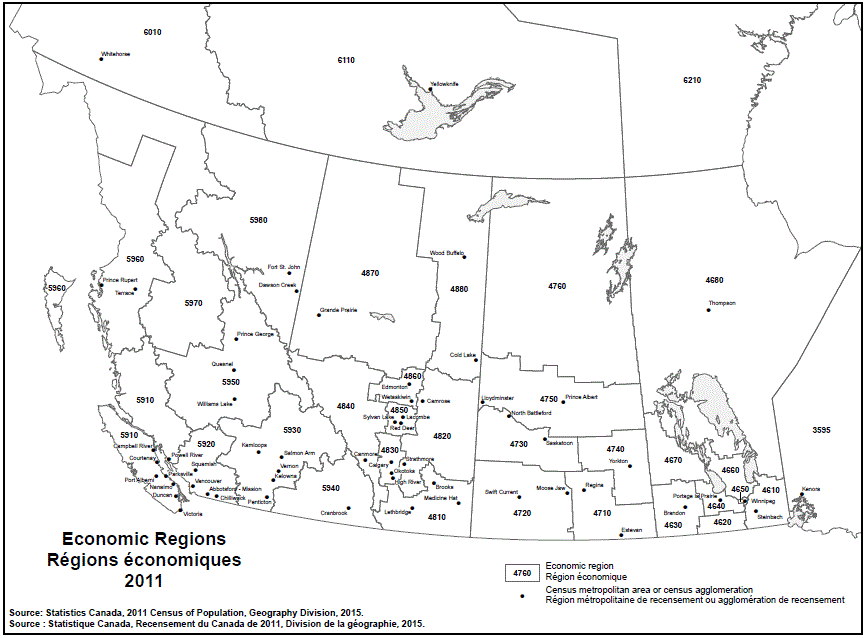
Geographical map of the 2011 Western Economic regions

Geographical map of the 2011 Western Economic regions.

Geographical map of the 2011 Western Economic regions. See the table below for more detail on the names of the Economic regions, Census metropolitan areas (CMAs), and Census agglomerations (CAs) by province.

Ontario
Table summary
This table displays the results of Ontario. The information is grouped by Economic Region (appearing as row headers), CMA/CA (appearing as column headers).
Economic Region CMA/CA
Northwest (3595) Kenora
Manitoba
Table summary
This table displays the results of Manitoba. The information is grouped by Economic Region (appearing as row headers), CMA/CA (appearing as column headers).
Economic Region CMA/CA
Southeast (4610) Steinbach
South Central (4620) Note ...: not applicable
Southwest (4630) Brandon
North Central (4640) Portage la Prairie
Winnipeg (4650) Winnipeg
Interlake (4660) Note ...: not applicable
Parklands (4670) Note ...: not applicable
North (4680) Thompson
Saskatchewan
Table summary
This table displays the results of Saskatchewan. The information is grouped by Economic Region (appearing as row headers), CMA/CA (appearing as column headers).
Economic Region CMA/CA
Regina–Moose Mountain (4710) Estevan
Regina
Swift Current–Moose Jaw (4720) Moose Jaw
Swift Current
Saskatoon–Biggar (4730) North Battleford
Saskatoon
Yorkton–Melville (4740) Yorkton
Prince Albert (4750) Lloydminster
Prince Albert
Northern (4760) Note ...: not applicable
Alberta
Table summary
This table displays the results of Alberta. The information is grouped by Economic Region (appearing as row headers), CMA/CA (appearing as column headers).
Economic Region CMA/CA
Lethbridge–Medicine Hat (4810) Brooks
Lethbridge
Medicine Hat
Camrose–Drumheller (4820) Camrose
Strathmore
Calgary (4830) Calgary
High River
Okotoks
Banff–Jasper–Rocky Mountain House (4840) Canmore
Red Deer (4850) Lacombe
Red Deer
Sylvan Lake
Edmonton (4860) Edmonton
Wetaskiwin
Athabasca–Grande Prairie–Peace River (4870) Grande Prairie
Wood Buffalo–Cold Lake (4880) Cold Lake
Wood Buffalo
British Columbia
Table summary
This table displays the results of British Columbia. The information is grouped by Economic Region (appearing as row headers), CMA/CA (appearing as column headers).
Economic Region CMA/CA
Vancouver Island and Coast (5910) Campbell River
Courtenay
Duncan
Nanaimo
Parksville
Port Alberni
Powell River
Victoria
Lower Mainland–Southwest (5920) Abbotsford–Mission
Chilliwack
Squamish
Vancouver
Thompson–Okanagan (5930) Kamloops
Kelowna
Penticton
Salmon Arm
Vernon
Kootenay (5940) Cranbrook
Cariboo (5950) Prince George
Quesnel
Williams Lake
North Coast (5960) Prince Rupert
Terrace
Nechako (5970) Note ...: not applicable
Northeast (5980) Fort St. John
Dawson Creek
Territories
Table summary
This table displays the results of Territories. The information is grouped by Economic Region (appearing as row headers), CMA/CA (appearing as column headers).
Economic Region CMA/CA
Yukon (6010) Whitehorse
Northwest Territories (6110) Yellowknife
Nunavut (6210) Note ...: not applicable

Note: ... not applicable for this specific location.
Source: 2011 Census of Canada. Produced by the Geography Division, Statistics Canada, 2015.

Weighted Asset Response Rate

Weighted Asset Response Rate
Table summary
This table displays the results of Weighted Asset Response Rate. The information is grouped by Release date (appearing as row headers), 2016, 2017, Q1, Q2, Q3 and Q4, calculated using quarterly (percentage) units of measure (appearing as column headers).
Release date 2016 2017
Q1 Q2 Q3 Q4 Q1
quarterly (percentage)
May 25, 2017 87.3 85.7 84.5 83.2 71.5
February 23, 2017 81.8 79.7 76.7 67.2 Note ..: not available for a specific reference period
November 24, 2016 80.3 77.7 65.6 Note ..: not available for a specific reference period Note ..: not available for a specific reference period
August 25, 2016 77.5 66.1 Note ..: not available for a specific reference period Note ..: not available for a specific reference period Note ..: not available for a specific reference period
May 26, 2016 64.4 Note ..: not available for a specific reference period Note ..: not available for a specific reference period Note ..: not available for a specific reference period Note ..: not available for a specific reference period

CVs for Total Sales by Geography

CVs for Total Sales by Geography
Table summary
This table displays the results of CVs for Total Sales by Geography. The information is grouped by Geography (appearing as row headers), Month, 201603, 201604, 201605, 201606, 201607, 201608, 201609, 201610, 201611, 201612, 201701, 201702 and 201703, calculated using percentage units of measure (appearing as column headers).
Geography Month
201603 201604 201605 201606 201607 201608 201609 201610 201611 201612 201701 201702 201703
percentage
Canada 0.9 1.0 0.9 0.9 1.0 0.9 0.9 0.9 0.9 0.8 0.8 0.7 0.8
Newfoundland and Labrador 1.2 0.8 0.8 0.9 1.0 1.1 0.9 1.2 0.6 0.5 0.4 0.3 0.2
Prince Edward Island 0.7 0.5 0.8 0.8 0.5 0.5 0.5 0.4 0.5 0.0 0.0 0.0 0.0
Nova Scotia 1.6 1.5 1.9 1.8 1.4 1.7 1.6 2.5 2.4 4.2 1.8 3.1 1.3
New Brunswick 1.3 1.0 1.1 1.3 0.9 1.6 1.5 1.1 1.3 2.5 1.1 1.1 1.6
Québec 2.5 2.6 2.5 2.5 2.5 2.4 2.3 2.6 2.3 2.1 2.9 2.3 2.2
Ontario 1.5 1.5 1.4 1.4 1.7 1.4 1.5 1.4 1.5 1.2 1.1 1.0 1.2
Manitoba 2.2 2.3 2.2 2.3 2.3 2.3 2.1 2.1 2.0 1.6 3.1 1.6 1.1
Saskatchewan 2.5 4.3 4.0 3.0 3.5 4.2 3.3 3.8 2.3 0.5 0.6 0.3 0.5
Alberta 1.8 1.5 1.6 1.5 1.7 2.0 2.1 1.8 1.7 1.3 0.9 1.4 1.6
British Columbia 1.6 1.8 1.7 1.7 1.6 1.6 1.6 1.6 1.5 1.3 1.7 1.9 1.6
Yukon Territory 0.0 0.0 0.0 0.0 0.0 0.0 0.0 0.0 0.0 0.0 0.0 0.0 0.0
Northwest Territories 0.0 0.0 0.0 0.0 0.0 0.0 0.0 0.0 0.0 0.0 0.0 0.0 0.0
Nunavut 0.0 0.0 0.0 0.0 0.0 0.0 0.0 0.0 0.0 0.0 0.0 0.0 0.0