This information is collected under the authority of the Statistics Act, Revised Statutes of Canada, 1985, Chapter S-19.
Although your participation in this survey is voluntary, your cooperation is important so that the information collected will be as accurate and complete as possible.
Purpose of the survey
This survey collects financial information (income and expenditures) on all universities and degree-granting colleges in Canada. Your information may also be used by Statistics Canada for other statistical and research purposes.
Confidentiality
Statistics Canada is prohibited by law from releasing any information it collects which could identify any person, business, or organization, unless consent has been given by the respondent or as permitted by the Statistics Act. Statistics Canada will use the information from this survey for statistical purposes.
Fax or e-mail transmission disclosure
Statistics Canada advises you that there could be risk of disclosure during the transmission of information by facsimile or e-mail. However, upon receipt, Statistics Canada will provide the guaranteed level of protection afforded all information collected under the authority of the Statistics Act.
Record linkages
To enhance the data from this survey, Statistics Canada may combine it with information from other surveys or from administrative sources.
General information
Name of University (or College)
Address of preparer
Street
City
Province
Postal Code
Fiscal year ending: Day Month Year
Name and title of preparer
Telephone
Area code
Number
Local
Fax
Area code
Number
E-mail address
Name of Senior Administrative Officer (if different from above)
Instructions
Please read carefully the accompanying Guidelines.
All amounts should be expressed in thousands of dollars ($'000).
In the "Observations and Comments" section, please explain financial data that may not be comparable with the prior year.
Please do not fill in shaded areas. All non-shaded cells should be completed.
A nil entry should be indicated with a zero.
Reserved for Statistics Canada
Full-time equivalent
Report Status
Institution Code: nceYYIII
Comments
Table 1
Income by fund Table summary
This is an empty data table used by respondents to provide data to Statistics Canada. This table contains no data.
Types of income
Funds
General operating
Special purpose and trust
Sponsored research
Ancillary
Capital
Endowment
Total funds
Entities consolidated
Entities not consolidated
Sub-total
(thousands of dollars)
Government departments and agencies - grants and contracts
Federal
1. Social Sciences and Humanities Research Council
2. Health Canada
3. Natural Sciences and Engineering Research Council
Table 2 Expenditures by fund
Table summary
This is an empty data table used by respondents to provide data to Statistics Canada. This table contains no data.
Table 3
Statement of changes in net assets by fund Table summary
This is an empty data table used by respondents to provide data to Statistics Canada. This table contains no data.
Total interfund transfers and interfund reallocations in column Total funds must net to zero for lines Interfund transfers and Interfund reallocations.
The Total funds in Net asset balances, end of year (Net asset balances are comprised of:) must agree with the Total funds in Net asset balances, end of year (Objects).
Table 4
General operating expenditures by function Table summary
This is an empty data table used by respondents to provide data to Statistics Canada. This table contains no data.
Notice of release of the Classification of Instructional Programs (CIP) Canada 2021 Version 1.0
Structural Revision
The Classification of Instructional Programs (CIP) Canada 2021 Version 1.0 is released. CIP Canada 2021 Version 1.0 replaces CIP Canada 2016. This version represents the ten-year structural revision to this standard classification, which is used to classify instructional programs according to field of study.
The Generic Statistical Information Model (GSIM) has been used for this revision to identify the types of changes made to the classification: real changes and virtual changes. Real changes are those affecting the scope of the existing classification items or categories, whether or not accompanied by changes in the title, definition and/or the coding. Virtual changes are those made in coding, titles and/or definitions, while the meaning or scope of the classification item remains the same.
The classification revision includes structural changes, clarifications of titles and definitions, changes to examples and exclusions, and the creation of new classification items.
CIP Canada 2021 Version 1.0 reflects various changes and improvements, such as the move of Veterinary instructional programs to Series 01 - Agriculture and veterinary sciences/services/operations and related fields from Series 51 - Health professionals and related programs, as well as the move of medical doctor residencies/fellowships from Series 60 - Health professions residency/fellowship programs to a new Series of their own, Series 61 - Medical residency/fellowship programs. There has also been a significant addition of 73 subseries and 438 instructional program classes in emerging fields of study.
Opened: November 2022 Updated: March 2025 Closed: September 2025 Results posted: April 2026
Consultative engagement objectives
Canadians are increasingly concerned about the economic, social and health risks and impacts posed by climate change and other environmental issues. These changes are reflected in Canada's ecosystems— like our coastal areas, wetlands, forests, lakes and prairies —where all living things (plants, animals) and non-living things (rocks, water) function together as a unit to make up a community of life.
Statistics Canada has been asked by the Government of Canada to develop a Census of Environment that will provide a robust picture of Canada's ecosystems and their benefit to our well-being and the economy. It will catalogue ecosystems in Canada, tracking their size and condition over time and measuring the ecosystem services provided such as clean air, food and recreation. This important program will inform decisions that will help protect, rehabilitate, enhance and sustain our environment and provide the information needed to understand the benefits of Canada's ecosystems.
How to get involved
Statistics Canada will be further engaging with Canadians in 2025-2026.
Statistics Canada is committed to respecting the privacy of participants. All personal information created, held or collected by the agency is protected by the Privacy Act. For more information on Statistics Canada's privacy policies, please consult the privacy notice.
The Privacy Act gives Canadian citizens and people living in Canada the right to access their personal information being held by federal government institutions. The Act also protects against unauthorized disclosure of that personal information and it strictly controls how the government collects, uses, stores, discloses, and disposes of any personal information.
The Annual Report on the Administration of the Privacy Act is prepared and submitted, in accordance with section 72 of the Act, and it covers the period from April 1, 2021, to March 31, 2022. The report is tabled in Parliament.
Administration of the Privacy Act
The Privacy Act, which concerns itself with personal information, stipulates that government institutions can collect personal information only if it relates to the operation of programs or activities of these institutions. In the case of Statistics Canada, the Statistics Act provides the authority to collect personal information. In addition, institutions are required to protect the collected information from disclosure.
The Director of the Office of Privacy Management and Information Coordination administers the Access to Information and Privacy legislations within Statistics Canada, and is also the Access to Information and Privacy (ATIP) Coordinator and Chief Privacy Officer for the Agency.
Organization and mandate of Statistics Canada
Statistics Canada's mandate derives primarily from the Statistics Act. The Act requires that the Agency collect, compile, analyze and publish statistical information on the economic, social, and general conditions of the country and its citizens. The Act also requires that Statistics Canada coordinate the national statistical system, in particular, to avoid duplication in the information collected by government. To this end, the Chief Statistician may enter into joint data collection or sharing agreements with provincial and territorial statistical agencies, as well as with federal, provincial and territorial government departments, pursuant to provisions of the Act.
The Statistics Act specifically requires Statistics Canada to conduct a Census of Population and a Census of Agriculture every five years as it did in 2021. The Act also gives the Agency substantial powers to request information through surveys of Canadian businesses and households. Under the Act, the Chief Statistician determines whether a survey will be mandatory or voluntary. Statistics Canada has generally made voluntary household data collection other than the Census of Population and the Labour Force Survey, as the latter produces key economic data. The Census of Agriculture and most other business surveys are mandatory. Refusal to participate in a mandatory survey is subject to legal penalties.
By law, Statistics Canada can also access administrative records, including personal and business tax data, credit information, customs declarations, and birth and death records. Such records are critical sources of statistical information that enable the Agency to reduce the reporting burden on businesses and individual respondents. Statistics Canada is considered a leader among the world's statistical agencies in reducing reporting burden by using administrative data.
Statistics Canada is ensuring that privacy protection methods and protocols continue to evolve as new data sources with varying levels of sensitivity emerge. The Necessity and Proportionality framework was implemented to ensure increasing transparency in the data acquisition process, to provide stronger justification (necessity) for data acquisition, and to be more explicit about the efforts used to gather data in a manner that is both efficient and proportional to its necessity and sensitivity. This includes ensuring that necessity (requirement for data or information) is well-defined; applying the scientific approach and a series of checkpoints on sensitivity, ethics and proportionality (quality, sample size, content and risk mitigation); considering alternative methods; and requiring a privacy impact assessment and communication throughout the process to ensure transparency.
Statistics Canada adopted a Responsible Privacy approach to honour the commitment made to Canadians to protect their personal information. These mechanisms help Statistics Canada to fulfill this commitment while ensuring that Canadians have all the key information on Canada's economy, society and environment that they require to function effectively as citizens and decision-makers in a rapidly evolving world.
Delegation instrument
The delegation instrument exercises the powers and functions of the Minister as the head of a government institution, pursuant to section 73 of the Privacy Act. The current detailed list of authorities under the Privacy Act has been formally delegated by the Minister of Innovation, Science and Economic Development as of May 18, 2021, (Appendix A) and provides full delegated authority to the Director and Assistant Director of the Office of Privacy Management and Information Coordination.
Resources
The Access to Information and Privacy (ATIP) Office operates within an allocation of 4.5 persons/year. One ATIP Manager, two Senior ATIP analysts, and two ATIP analysts work full time on the processing of requests.
Statistical report
The statistical report provides aggregate data on the application of the Privacy Act. This information is made public annually and is included with the annual report (Appendix B).
Implementation: Privacy
The Privacy Act has a substantial impact on Statistics Canada, but the impact cannot be measured only by the number of requests processed. Although society seeks a broader range of detailed information, it also demands more accountability on the part of government about the collection of personal information and the purposes served by the information.
The Agency has a strong track record of respecting the privacy of Canadians and has taken a number of initiatives to address the privacy challenges this dichotomy raises.
Statistics Canada has internal directives that reflect the basic principles found in the Privacy Act. The Agency's Directive on Informing Survey Respondents requires that all respondents be informed of the expected use of the statistics produced from the survey results, the authority under which the survey is taken, their obligation to respond, the confidentiality protection given to all information collected under the Statistics Act, and any data-sharing arrangements pursuant to provisions of the Statistics Act.
Statistics Canada also developed the Directive on Microdata Linkage to respond to concerns of both respondents and privacy advocates on the potential of matching an individual's information gathered from a variety of sources.
These two directives not only support compliance with the letter and the spirit of the Privacy Act, but also demonstrate the Agency's commitment to the protection and appropriate use of the personal information under its control, while still meeting its mandate.
The Agency has also developed and implemented a Necessity and Proportionality framework that ensures that any collection of personal information for its statistical programs is duly justified.
As we chart new paths and methods of collecting data, respecting and protecting the rightful privacy of Canadians sit at the heart of everything we do. Statistics Canada's Trust Centre underlines how we meet Canadians' information needs while keeping their data safe and private.
Recent unexpected events such as the pandemic and current societal changes (political, legislative, social and technological) are challenging Statistics Canada to adapt and lead as we continue our modernization journey and as we strive to meet the demands of a digital world in the 21st century.
Statistics Canada continues to work diligently to ensure that the confidentiality it has committed to in law and in principle, is upheld. This includes ensuring that privacy remains at the forefront of all our activities.
In the new reality of instant information over social media, meeting legal requirements is no longer sufficient. Institutions must pro-actively engage with Canadians regarding what is socially acceptable under a social contract.
Statistics Canada's very mandate requires that it produce information that helps Canadians better understand their country – its population, resources, economy, environment, society and culture. To achieve this, the Agency must collect a considerable amount of personal information directly from Canadians through surveys, or indirectly from private and public organizations. Parliament has given Statistics Canada this mandate to better serve Canadians, but with such authority comes great responsibility. Statistics Canada continually adjusts to new realities and adapts existing mechanisms, or develops new ones to protect Canadians' privacy and ensure that their data will not be misused. The Agency must demonstrate and provide assurances to Canadians that it can be trusted with their information.
As Statistics Canada continues to modernize, it is committing to Responsible Privacy. Responsible Privacy is instrumental in honouring our promise to diligently collect, use, disclose and protect Canadians' personal information. It ensures that we indefatigably strive to go beyond what is required, and encompasses innovative privacy checks and balances that ensure due diligence when handling personal information. It requires that privacy be imprinted in all our activities.
To foster the Responsible Privacy approach and meet the demands of a digital world in the 21st century, senior management at Statistics Canada has committed to a formalized Privacy Management Program (PMP).
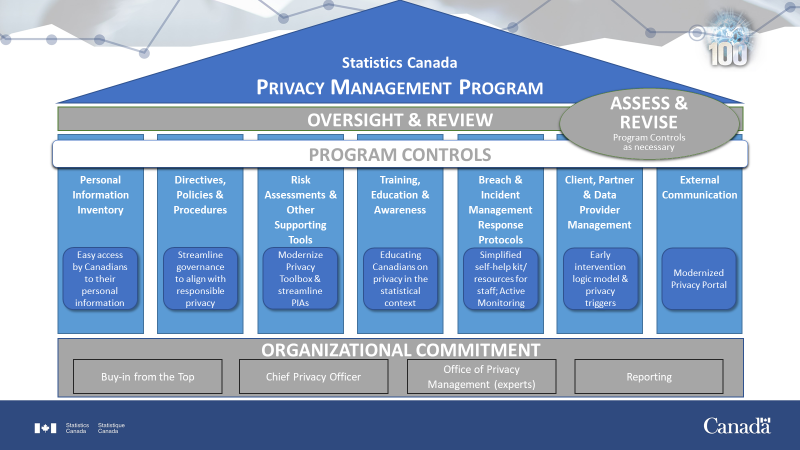
Privacy Management Program
Description - Privacy Management Program
Statistics Canada
Privacy Management Program
Oversight & Review
Assess & Revise
Program Controls as neccessary
Program Controls
Personal information inventory
Easy access by Canadians to their personal information
Directives, Policies & Procedures
Streamline governance to align with responsible privacy
Risk Assessments & Other Supporting Tools
Modernize Privacy Toolbox & streamline PIAs
Training, Education & Awareness
Educating Canadians on privacy in the statistical context
Breach & Incident Management Response Protocols
Simplified self-help kit/resources for staff; Active Monitoring
Client, Partner & Data Provider Management
Early intervention logic model & privacy triggers
External Communication
Modernized Privacy Portal
Organizational Commitment
Buy-in from the Top
Chief Privacy Officer
Office of Privacy Management (experts)
Reporting
While many of its components were already part of the Agency's regular activities, the PMP instils a systematic and strategic approach that reinforces our commitment to Canadians regarding their personal information.
Privacy requests
Disposition of requests completed
All disclosed: 9
Disclosed in part: 5
Nothing disclosed (exempt): 0
Does not exist: 15
Abandoned: 36
Total:65
The Agency received 161 new requests in 2021-2022 and 36 requests were carried over from the previous reporting period. During this period, 65 requests were completed and 132 requests were carried forward to the next reporting period.
For 9 requests, information was disclosed completely and for 5 requests, information was partially disclosed, having redactions applied to protect personal information pertaining to other individuals. For 15 requests, the information did not exist, and 36 requests were abandoned as applicants did not respond to requests for additional information or chose to withdraw them entirely. The public is the largest privacy client group for Statistics Canada.
In addition to requests from the general public, the Agency receives requests from current and former federal public servants regarding personal or staff relations issues. Statistics Canada responds to a number of requests for personal information through its pension search program. This program provides members of the public with information from their own census records, and from the 1940 National Registration records, to support their applications for pensions, citizenship, passports and other services when other administrative records, such as birth certificates, are required but no longer exist or were never issued. Regulations permit duly authorized representatives to act on behalf of a minor or an incompetent person to administer their affairs or estate. To do so, the trustees and estate administrators seek personal information from the census or from 1940 national registration records of deceased individuals, minors, or dependent adults. In the case of the deceased, the administrator of the estate may exercise these rights, but only for the purposes of estate administration.
For the 2021-22 fiscal year, and in relation to the 2021 Census of Population, of the 161 new Privacy requests received, 81 were related to individuals requesting copies of their completed census questionnaires. It should be noted as well that, of the 132 requests carried over to the next fiscal year, 81 of those are due to the fact that extracts of the 2021 Census of Population information, are not yet available for distribution.
Responding to privacy requests involved reviewing more than 1,744 pages, of which 1,416 pages were released. Fourteen (14) requestors received information electronically by email or e-post and zero (0) requestors received the information in paper format.
Privacy requests
Fiscal Year
Requests Received
Requests Completed
Number of Pages Processed
Number of Pages Released
2021/2022
161
65
1,744
1,416
2020/2021
86
138
4,076
2,983
2019/2020
283
210
5,586
3,364
2018/2019
1,012
1,007
15,244
13,595
2017/2018
157
148
20,216
10,886
Other requests
During this period, Statistics Canada did not receive any Privacy Act consultation requests from other departments.
Disposition of completed requests
The disposition of the 65 requests completed in 2021-2022 was as follows:
9 were fully disclosed (19%)
5 were disclosed in part (3%)
15 information did not exist (12%)
36 were abandoned by applicants (66%)
Completion time and extensions
In 2021-2022 the number of privacy requests completed was 65 for an average of 313 over the last five years. Over half of all completed requests in 2021-22 (35 requests or 54%) processed in 2021-2022 were within the time period and as prescribed by the Act. Several factors contributed to the timely response; information and training sessions with senior leaders and sector contacts, and a streamlined delegation order. There were no extensions taken.
The 65 requests completed in 2021-2022 were processed in the following time frames:
20 within 1 to 15 days (31%)
15 within 16 to 30 days (23%)
6 within 31 to 60 days (9%)
2 within 61 to 120 days (3%)
6 within 121 to 180 days (9%)
11 within 181 to 365 days (17%)
5 more than 365 days (8%)
Due to the exceptional measures taken to curb the spread of COVID-19 and to protect federal employees, Statistics Canada employees have been operating with significantly-reduced on-site workforces since April 2020. This impact brought forward new electronic changes to procedures that were implemented in order to facilitate the processing of requests remotely.
Exemptions invoked
In 2021-2022, one exemption was invoked as per the Privacy Act, which was as follows:
Section 26: Exempting personal information about individuals other than the requestor (5).
Costs
During 2021-2022, the ATIP Office incurred an estimated $79,421 in salary costs and 0$ in administrative costs to administer the Privacy Act. With the introduction of Statistics Canada's return to work place plan entitled "virtual-by-design environment" the ATIP division has been able to reduce administrative costs for the fiscal year 2021-22 by reducing the use of paper, completing virtual training courses, lowering the cost of travel and reducing the costs of office supplies.
Training initiatives for privacy
In 2021-2022, the Access to Information and Privacy (ATIP) Office began developing a formal training program for all staff across the Agency, which began in April 2020. Informal one-on-one training was made available, until such time as the formal training was implemented. The informal training assists staff in understanding their obligations under the Act, as well as informs them about policies and directives related to personal information at Statistics Canada.
Statistics Canada's Office of Privacy Management and Information Coordination offers courses on a variety of subjects related to the Statistics Act and the Privacy Act as well as supporting policies and directives. These include sessions on "Privacy Impact Assessment" and "Privacy and Confidentiality", with a focus on personal information collected about employees of Statistics Canada, clients or the public, and appropriate use of such personal information.
Statistics Canada also requires employees to complete computer-based courses on confidentiality. A mandatory course for new employees offers a brief overview of confidentiality, illustrating its importance at the Agency.
Policies, guidelines and procedures
The ATIP Office has a variety of tools in place to ensure that ATIP sector contacts are well informed about their roles and responsibilities for coordinating privacy requests. These tools include a concise checklist outlining steps to follow when providing responsive records for privacy requests, and a responsible contact from the ATIP team throughout the process. There are also a variety of directives and policies provided by the Treasury Board Secretariat, about the protection of personal information. Personal and confidential information is protected by the Privacy Act and the Statistics Act and will only be disclosed as permitted by these Acts.
Statistics Canada developed and published a privacy framework that identifies the full scope of privacy controls within the operations of Statistics Canada as a collection of approved practices, procedures and governance related to privacy. This includes the identification of the Director, Office of Privacy Management and Information Coordination, as the Chief Privacy Officer (CPO) for Statistics Canada, as designated by the Chief Statistician. The CPO provides leadership on matters related to privacy, develops business strategies and processes that ensure that privacy is considered and accounted for in business decision, and ensures the safeguarding of the information through administrative policy instruments and best practices.
Given its unique position in the federal government in collecting personal information solely for statistical and research purposes, Statistics Canada has determined that the privacy issues associated with its statistical activities undertaken under the authority of the Statistics Act could be addressed by means of a Generic Privacy Impact Assessment (PIA).
Although the Generic PIA is comprehensive and reflects the vast majority of Statistics Canada's operations, in the instance of extraordinary activities, specific PIAs are conducted with input from the Office of the Privacy Commissioner (OPC). Statistics Canada prepares supplements to the Generic PIA for all new and significantly redesigned surveys and statistical programs involving the collection, use or disclosure of personal information that raise unique or additional privacy, confidentiality or security risks that have not been addressed in the Generic PIA.
Complaints and investigations
There was one (1) time delay complaint made against Statistics Canada lodged with the OPC. The ATIP Office has responded to the complaint as identification was missing at the time from the complainant, and while the investigation has not yet been finalized, review of the records is on-going.
Monitoring of the requests
At Statistics Canada, the ATIP Office processes and monitors requests by registering them in a comprehensive system known as Privasoft – Access Pro Case Management. An acknowledgement of the request is sent to the client and a retrieval form is forwarded to the relevant program area, Office of Primary Interest (OPI), for responsive records. If the OPI and/or the ATIP Office need to clarify the request, the ATIP Office contacts the client.
The retrieval form was created by the ATIP Office at Statistics Canada and is based on the Policy on Privacy Protection and the Directive on Privacy Practices from the Treasury Board Secretariat. The form includes the text of the request, the name and phone number of the ATIP Officer, and the date by which records are required (normally 5 to 10 days). The form states that the ATIP Office is obligated to report annually on the administrative costs related to requests and thus information is needed on the group(s) and level(s) of those involved in the retrieval process, and the amount of time spent working on the request (including time for search, retrieval, internal review (relevant or not to the request) and photocopying). The individuals providing the records are asked to identify any areas which may be sensitive in nature (e.g., personal information, legal issues), and the Director General or responsible delegate of the program area signs the form.
The ATIP Office assists the program areas with the retrieval of records from day one. As 5 to 10 days are allowed for the retrieval, a follow-up is made on the fifth day. If additional time is required for the retrieval, this is when the program area is to notify the ATIP Office. An additional 1 to 5 days may be granted depending on the amount of work remaining. Once the documents are received from the OPI, the ATIP Office ensures the form is duly completed and that it has been signed by the appropriate manager. The ATIP Office takes 5 to 10 days to review and process the records. Once the work from the ATIP Office is completed, the final version is released to the client. The OPI and management are very aware of the importance of ATIP requests.
Privacy breaches
The Privacy and Information Breach Protocol provides clear identification of the various roles and responsibilities in the event of a breach. It includes the requirement to complete a standard template which incorporates the elements suggested in the Treasury Board Secretariat's guidelines on how to respond to a privacy breach. The template has been approved by the Agency's senior management. At a minimum, the incident report will contain the following information:
a description of the incident (who, what, when, where, why, how)
the actions already taken and planned for the future
a description of the risks/impacts
any other information that might be helpful in locating any lost item(s) or in assessing the consequences of loss or compromise
recommendations for reducing or eliminating the risk of the event reoccurring in future
information on whether the individuals or organizations whose information was breached were informed of the incident
indication if the individuals, Office of the Privacy Commissioner (OPC) and Treasury Board Secretariat will be informed of the incident and if not, rationale for not informing them.
Best practices to eliminate or reduce future recurrences that are identified during an investigation must be communicated to other employees to prevent a recurrence of the breach.
Breaches are coordinated by a centralized group to ensure that all programs impacted by the breach provide input.
There were 18 privacy breaches at Statistics Canada during the reporting period, of which 3 were material in nature. A total of 410 people were affected by these 18 breaches. Amongst the 410 people affected, 200 were a result of 1 incident related to employment candidates email information that was not material in nature.
Three material breaches were reported to the OPC, affecting a total of 5 individuals:
A Census Enumerator's vehicle was stolen including two completed Census long-form questionnaires.
Two completed Census long-form questionnaires were stolen from a Census Enumerator's home during a break-in.
A minor's name was erroneously disclosed through an invitation letter to participate in a Statistics Canada survey.
Additional measures, specific to the areas which experienced a breach were implemented, including the following:
retraining of Census Enumerators on proper storage of Census materials;
exploring and updating methodologies for the creation of survey frames for all surveys involving children.
Privacy impact assessments
The Statistics Canada Directive on Conducting Privacy Impact Assessments (PIAs) specifies the roles and responsibilities of its senior managers and privacy specialists with regard to the collection, use and dissemination of personal information. This directive applies to all statistical and non-statistical programs that engage in the collection, use or disclosure of personal information.
Statistics Canada's Generic PIA covers all aspects of the Agency's statistical programs that collect, use and disseminate information in support of the mandate under the Statistics Act. The Generic PIA addresses the ten privacy principles, and includes a threat and risk assessment for various collection and access modes.
Supplements to the Generic PIA are produced for new and significantly redesigned collections, uses or disclosures of personal information that raise unique or additional privacy, confidentiality or security risks. The Generic PIA and its supplements are posted on the Statistics Canada website: Generic privacy impact assessment.
Specific PIAs are also conducted for new or redesigned administrative programs and services that involve the collection, use and disclosure of personal information that are not addressed in the Generic PIA. Summaries of completed privacy impact assessments can be found on the Statistics Canada website: Privacy impact assessments.
In the current reporting period, 6 PIAs and 10 supplements were approved and submitted to the Office of the Privacy Commissioner and the Treasury Board Secretariat. The following are brief descriptions:
Client Relationship Management System
A PIA was conducted to determine if there were any privacy, confidentiality or security issues associated with updates to Statistics Canada's Client Relationship Management (CRM) system. Statistics Canada has been leveraging a Client Relationship Management (CRM) solution to help support the provision of client service delivery, business respondent relations, microdata access and Census respondent relations. The CRM system was updated to adapt to new realities and to support a strategic, holistic and consistent approach to the collection of quality client business intelligence data that can help to strategically respond to clients' needs and better serve Canadians. The assessment did not identify any privacy risks that cannot be managed using existing safeguards.
Employee Wellness Surveys and Pulse Check Surveys
A PIA was conducted to determine if there were any privacy, confidentiality or security issues associated with the Employee Wellness Surveys and associated Pulse Check Surveys. These internal surveys are administered only to Statistics Canada and Statistical Survey Operations employees and seek to offer up-to-date and representative measurement of the state of Statistics Canada's psychological health and safety. The results help the organization better understand where challenges to psychological health and safety reside, where resources to help bolster psychological health and safety exist, and how to best improve overall psychological health and safety, and ultimately, performance. The assessment did not identify any privacy risks that cannot be managed using existing safeguards.
Engaging Disability Innovation Study
A PIA was conducted to determine if there were any privacy, confidentiality or security issues associated with the Engaging Disability Innovation Study which consists of the quantitative Employment and Accessibility Survey and associated qualitative asynchronous online engagement. This internal study is conducted only with Statistics Canada and Statistical Survey Operations employees. It aims to help Statistics Canada's Accessibility Secretariat understand where challenges of accessibility and safety reside, where resources to help bolster accessibility exist, and how to best improve overall accessibility of Statistics Canada's recruitment, retention and promotion process, operational practices, and ultimately, employee performance. The assessment did not identify any privacy risks that cannot be managed using existing safeguards.
Meltwater: Social Media Communications Tool
A PIA was conducted to determine if there were any privacy, confidentiality or security issues associated with Statistics Canada's use of the Meltwater Social Media Communications Tool. The tool serves to search, monitor and analyze social media and traditional media traffic on issues and topics relevant to Statistics Canada. Using Application Programming Interfaces (APIs), Meltwater performs searches of social and traditional media content based on specific search query keywords relevant to the agency's mandate, indexes the related information found and then presents the results to the agency. The use of Meltwater allows the Agency to better understand current opinion, sentiment and overall conversation on specific Statistics Canada issues to create communications products that resonate with target audiences. While information publicly posted by social media users could include information such as profile picture, comments or opinions, personal preferences or interests, only information pertinent to public relations and communications are retained and used, and are never disseminated in identifiable format. The reports generated through Meltwater only include information in aggregate non-identifiable form. The assessment did not identify any privacy risks that cannot be managed using existing safeguards.
Microsoft 365
A PIA was conducted to determine if there were any privacy, confidentiality or security issues associated with the implementation of Microsoft 365. Microsoft 365 is an enterprise-level, cloud-based version of the Microsoft office productivity tools for creating documents, presentations, and spreadsheets, for internal communications, for managing emails, for work planning, and for other common administrative tasks. This integrated suite of tools supports the daily activities of Statistics Canada's employees, including collaboration within the organization. The assessment did not identify any privacy risks that cannot be managed using existing safeguards.
Vitali-T-Stat Mobile Application
A PIA was conducted to determine if there were any privacy, confidentiality or security issues associated with the Vitali-T-Stat Mobile Application. Statistics Canada developed and implemented a mobile application as a new means of inviting respondents to access the agency's secure survey collection infrastructure and complete a survey. The application itself does not collect any personal information; it simply prompts respondents and points them to the secure collection environment housed at Statistics Canada where they complete the survey questionnaire. The application does not utilise geo-location tracking, camera or microphone access, calendar integration, barcode scanning or beacon technology. It will first be used in the context of the longitudinal Pilot Study on Everyday Well-being which will collect data on the well-being of Canadians, and for which a separate supplement to Statistics Canada's Generic PIA supplement was developed. The assessment did not identify any privacy risks that cannot be managed using existing safeguards.
2021 Census of Population
A supplement to the Generic PIA was conducted to determine if there were any privacy, confidentiality or security issues associated with new content for the 2021 Census of Population. The Census of Population's purpose is to provide statistical information, analyses and services that measure changes in the Canadian population and demographic characteristics. It serves as a basis for public and private decision making, research and analysis in areas of concern to the people of Canada. Under the Statistics Act (R.S.C., 1985, c. S-19), Statistics Canada is responsible for conducting the Census of Population every five years. As in past censuses, extensive consultations on the questions to include in the 2021 Census of Population were held with Canadians. New and modified questions, developed to reflect new needs identified in the consultations, were qualitatively tested by Statistics Canada in 2018. The assessment concluded that, with the existing Statistics Canada safeguards, any remaining risks are such that Statistics Canada is prepared to accept and manage the risk.
Canadian Child Welfare Information System
A supplement to the Generic PIA was conducted to determine if there were any privacy, confidentiality or security issues associated with the Canadian Child Welfare Information System. The CCWIS is a national public health information system on child welfare, and its purpose is to support nationally standardized analyses and reporting on child maltreatment; investigations and outcomes; the number of children in need of protection; and passage through the child welfare system, including referral to services, placement in foster care, connections to family, reunification, and other requests for family services. Data on these issues inform regional and national child welfare prevention and protection policies and practices. Data-informed child welfare is crucial to protect and improve the lives of many Canadian children and their families. The assessment concluded that, with the existing Statistics Canada safeguards, any remaining risks are such that Statistics Canada is prepared to accept and manage the risk.
Supplement to the Canadian COVID-19 Antibody and Health Survey for Cycle 2
A supplement to the Canadian COVID-19 Antibody and Health Survey was conducted to determine if there were any privacy, confidentiality or security issues associated with Cycle 2 of the survey. The content of the Cycle 2 questionnaire is slightly different, and includes, in addition to gathering information on COVID-19 status and related health concerns, questions on use of the health care system, prescribed medications, active infections (nucleic acid-based testing) and previous infections (antibody testing). Participants may also be asked to participate in a self-administered collection of microbial nucleic acids from saliva. The collected specimen would be used to assess current SARS-CoV-2 infection status via a polymerase chain-reaction (PCR) test. Only with informed consent from respondents, results from the PCR test are sent to the respondents and local health authorities may be notified when results are positive. All other personal information collected is the same as in the previous cycle of the survey. The assessment concluded that, with the existing Statistics Canada safeguards, any remaining risks are such that Statistics Canada is prepared to accept and manage the risk.
Canadian Human Trafficking Hotline Feasibility Study Data Acquisition Project
A supplement to the Generic PIA was conducted to determine if there were any privacy, confidentiality or security issues associated with the Canadian Human Trafficking Hotline Feasibility Study Data Acquisition Project. In response to the National Strategy to Combat Human Trafficking's call for enhanced data to help inform policy and programs that help victims and survivors, Statistics Canada is working with the Canadian Centre to End Human Trafficking to acquire and examine administrative data related to their operation of the Canadian Human Trafficking Hotline. The hotline has specific procedures in place to seek consent from callers and to inform why and how their information will be used. No information that directly identifies a victim or caller will be provided to Statistics Canada, and the agency will not publish any information that could potentially identify an individual based on the characteristics of victims or location of incidents. The assessment concluded that, with the existing Statistics Canada safeguards, any remaining risks are such that Statistics Canada is prepared to accept and manage the risk.
Childhood National Immunization Coverage Survey
A supplement to the Generic PIA was conducted to determine if there were any privacy, confidentiality or security issues associated with the Childhood National Immunization Coverage Survey. The main objectives of this survey are to determine if children are being vaccinated in accordance with the recommended immunization schedules for publicly-funded vaccines and to measure to what degree recent public health recommendations are being adopted to increase vaccination against the flu and pertussis during pregnancy. Results help health authorities focus vaccination campaigns for the under-vaccinated and vulnerable populations. Results also allow Canada to meet its commitment to provide the World Health Organization and the Pan American Health Organization with estimates of national coverage for childhood vaccines such as measles, diphtheria, pertussis, tetanus and polio. For the 2021 cycle, questions were added to help understand the impact the COVID-19 pandemic has had on immunization and vaccine coverage for children and pregnant women. The assessment concluded that with the existing Statistics Canada safeguards, any remaining risks are such that Statistics Canada is prepared to accept and manage the risk.
Update to the Longitudinal Immigration Database
A supplement to the Generic PIA was conducted to determine if there were any privacy, confidentiality or security issues associated with updates to the Longitudinal Immigration Database. The Database was implemented in 1997, and integrates immigration and citizenship data provided by Immigration, Refugees and Citizenship Canada with tax information provided by the Canada Revenue Agency. It is used for statistical research on the socioeconomic performance of non-permanent residents and immigrants in Canada, and supports public policy development on population migration, cultural diversity and the challenges of immigrant integration. The Database originally only included permanent resident data for immigrants admitted since 1980, and did not include information on non-permanent residents. With this update to the Database, coverage has been expanded to include immigrants admitted since 1952, and non-permanent residents. Statistics Canada only releases anonymized, aggregated statistical information on immigrants and non-permanent residents. Individuals will not be identifiable in any product disseminated to the public. The assessment concluded that with the existing Statistics Canada safeguards, any remaining risks are such that Statistics Canada is prepared to accept and manage the risk.
Mental Health and Access to Care Survey
A supplement to the Generic PIA was conducted to determine if there were any privacy, confidentiality or security issues associated with the Mental Health and Access to Care Survey. This voluntary survey collects information about the mental health status of Canadians, as well as their access to and need for services and support, whether formal or informal. It also assesses the impact of the COVID-19 pandemic on population health as well as evaluate changes in patterns of mental health, service use and functioning in the last ten years. Results help inform government decision‐making and policy development in order to support vulnerable Canadians and their families dealing with mental health issues. Survey results regarding the unmet need for mental-health services also help guide decisions about which parts of the mental-health services system need to be improved, where awareness and treatment programs are most needed, and how such targeted treatment programs should be developed. The assessment concluded that with the existing Statistics Canada safeguards, any remaining risks are such that Statistics Canada is prepared to accept and manage the risk.
Pilot Study on Everyday Well-Being
A supplement to the Generic PIA was conducted to determine if there were any privacy, confidentiality or security issues associated with the Pilot Study on Everyday Well-Being. Canadians who opt to participate in this voluntary pilot study are asked to download Statistics Canada's mobile application (Vitali-T-Stat) and customize their setting to receive up to a maximum of five prompts a day over a thirty day period. Upon receiving and accepting a prompt, respondents are redirected to Statistics Canada's secure collection infrastructure and the Pilot Study on Everyday Well-being questionnaire that asks in-the-moment questions about their activities and feelings. The app itself, for which a PIA was conducted, does not collect any personal information. The results are used to fill key gaps in national-level subjective well-being and can inform governments' decisions regarding publicly-funded cultural and other programs that contribute to Canadians' well-being. The assessment concluded that with the existing Statistics Canada safeguards, any remaining risks are such that Statistics Canada is prepared to accept and manage the risk.
Survey of Employees under Federal Jurisdiction
A supplement to the Generic PIA was conducted to determine if there were any privacy, confidentiality or security issues associated with the Survey of Employees under Federal Jurisdiction. This voluntary targeted survey collects information on the quality of employees' work conditions, access to benefits and flexible work arrangements, labour relations, work-related well-being and workplace health and safety including harassment and discrimination. The information from this survey guides research and analysis to update the Canada Labour Code. The assessment concluded that with the existing Statistics Canada safeguards, any remaining risks are such that Statistics Canada is prepared to accept and manage the risk.
Survey on Health Care Workers' Experiences During the Pandemic
A supplement to the Generic PIA was conducted to determine if there were any privacy, confidentiality or security issues associated with the Survey on Health Care Workers' Experiences During the Pandemic. The purpose of this voluntary survey is to understand the impact of the COVID-19 pandemic on health care workers in Canada. It covers topics such as job type and setting, personal protective equipment and infection prevention and control practices and protocols, COVID-19 vaccination and diagnosis, and the impacts of the pandemic on personal health and work life. It also includes general demographic questions. The results of this survey help inform health care workforce planning, the delivery of health care services, and to better understand what health care workers need in terms of equipment, training and support. The assessment concluded that with the existing Statistics Canada safeguards, any remaining risks are such that Statistics Canada is prepared to accept and manage the risk.
Microdata linkage
As outlined in Statistics Canada's Directive on Microdata Linkage, linkages of different records pertaining to the same individual are carried out only for statistical purposes and only in cases where the public good is clearly evident. One of the primary objectives of these linkages is to produce statistical information that facilitates a better understanding of Canadian society, the economy and the environment.
All microdata linkage proposals must satisfy a prescribed review process as outlined in the directive. In addition to demonstrating the public benefit, each submission must provide details of the output. The public dissemination of any information resulting from microdata linkage, like all other statistical information, is only at an aggregate level which protects the confidentiality of the information of individuals.
In 2021-2022, there were 27 approved microdata linkages that involved personal information. A summary of these record linkages is found in Appendix C.
8(2)(m) of the Privacy Act
No disclosures were made under paragraph 8(2)(m) of the Privacy Act during the reporting period.
Appendix A: Delegation Order
Access to Information and Privacy Acts Delegation Order
The Minister of Innovation, Science and Industry, pursuant to section 73 of the Access to Information Act and section 73 of the Privacy Act, hereby designates the persons holding the positions set out in the schedule hereto, or the persons occupying on an acting basis those positions, to exercise the powers and functions of the Minister as the head of Statistics Canada, under the section of the Act set out in the schedule opposite each position. This Delegation Order supersedes all previous Delegation Orders.
Schedule
Schedule
Position
Access to Information Act and Regulations
Privacy Act and Regulations
Chief Statistician of Canada
Full authority
Full authority
Chief of Staff, Office of the Chief Statistician
Full authority
Full authority
Director, Office of Privacy Management and Information Coordination
Full authority
Full authority
Assistant Director, Office of Privacy Management and Information Coordination
Full authority
Full authority
Senior Access to Information and Privacy Project Manager
The original version was signed by
The Honourable François-Philippe Champagne
Minister of Innovation, Science and Industry
Dated, at the City of Ottawa
May 18, 2021
Appendix B: Statistical Report on the Privacy Act
Name of institution: Statistics Canada
Reporting period: 2021-04-01 to 2022-03-31
Section 1: Requests Under the Privacy Act
1.1 Number of requests recevied
Number of requests recevied
Number of Requests
Received during reporting period
161
Outstanding from previous reporting periods
36
Outstanding from previous reporting period
35
Outstanding from more than one reporting period
1
Total
197
Closed during reporting period
65
Carried over to next reporting period
132
Carried over within legislated timeline
1
Carried over beyond legislated timeline
131
1.2 Channels of requests
Channels of requests
Source
Number of Requests
Online
109
E-mail
0
Mail
52
In person
0
Phone
0
Fax
0
Total
161
Section 2: Informal requests
2.1 Number of requests received
Number of requests recevied
Number of Requests
Received during reporting period
0
Outstanding from previous reporting periods
0
Outstanding from previous reporting period
0
Outstanding from more than one reporting period
0
Total
0
Closed during reporting period
0
Carried over to next reporting period
0
2.2 Channels of informal requests
Channels of informal requests
Source
Number of Requests
Online
0
E-mail
0
Mail
0
In person
0
Phone
0
Fax
0
Total
0
2.3 Completion time of informal requests
Completion time of informal requests
1 to 15 Days
16 to 30 Days
31 to 60 Days
61 to 120 Days
121 to 180 Days
181 to 365 Days
More Than 365 Days
Total
0
0
0
0
0
0
0
0
2.4 Pages released informally
Pages released informally
Less Than 100 Pages Released
101-500 Pages Released
501-1000 Pages Released
1001-5000 Pages Released
More Than 5000 Pages Released
Number of Requests
Pages Released
Number of Requests
Pages Released
Number of Requests
Pages Released
Number of Requests
Pages Released
Number of Requests
Pages Released
0
0
0
0
0
0
0
0
0
0
Section 3: Requests Closed During the Reporting Period
3.1 Disposition and completion time
Disposition and completion time
Disposition of Requests
Completion Time
1 to 15 Days
16 to 30 Days
31 to 60 Days
61 to 120 Days
121 to 180 Days
181 to 365 Days
More Than 365 Days
Total
All Disclosed
4
3
0
1
0
1
0
9
Disclosed in part
0
1
2
0
1
0
1
5
All exempted
0
0
0
0
0
0
0
0
All excluded
0
0
0
0
0
0
0
0
No records exist
5
6
3
0
1
0
0
15
Request abandoned
11
5
1
1
4
10
4
36
Neither confirmed nor denied
0
0
0
0
0
0
0
0
Total
20
15
6
2
6
11
5
65
3.2 Exemptions
Exemptions
Section
Number of Requests
18(2)
0
19(1)(a)
0
19(1)(b)
0
19(1)(c)
0
19(1)(d)
0
19(1)(e)
0
19(1)(f)
0
20
0
21
0
22(1)(a)(i)
0
22(1)(a)(ii)
0
22(1)(a)(iii)
0
22(1)(b)
0
22(1)(c)
0
22(2)
0
22.1
0
22.2
0
22.3
0
22.4
0
23(a)
0
23(b)
0
24(a)
0
24(b)
0
25
0
26
0
27
0
27.1
0
28
0
3.3 Exclusions
Exclusions
Section
Number of Requests
69(1)(a)
0
69(1)(b)
0
69.1
0
70(1)
0
70(1)(a)
0
70(1)(b)
0
70(1)(c)
0
70(1)(d)
0
70(1)(e)
0
70(1)(f)
0
70.1
0
3.4 Format of information released
Format of information released
Paper
Electronic
Other
E-record
Data set
Video
Audio
0
14
0
0
0
0
3.5 Complexity
3.5.1 Relevant pages processed and disclosed for paper and e-record formats
Relevant pages processed and disclosed
Number of Pages Processed
Number of Pages Disclosed
Number of Requests
1744
1416
50
3.5.2 Relevant pages processed by request disposition for paper and e-record formats by size of requests
Relevant pages processed and disclosed by size of requests
Disposition
Less Than 100 Pages Processed
101-500 Pages Processed
501-1000 Pages Processed
1001-5000 Pages Processed
More Than 5000 Pages Processed
Number of Requests
Pages Processed
Number of Requests
Pages Processed
Number of Requests
Pages Processed
Number of Requests
Pages Processed
Number of Requests
Pages Processed
All disclosed
9
76
0
0
0
0
0
0
0
0
Disclosed in part
4
65
0
0
0
0
0
1603
0
0
All exempted
0
0
0
0
0
0
0
0
0
0
All excluded
0
0
0
0
0
0
0
0
0
0
Request abandoned
36
0
0
0
0
0
0
0
0
0
Neither confirmed nor denied
0
0
0
0
0
0
0
0
0
0
Total
49
141
0
0
0
0
1
1603
0
0
3.5.3 Relevant minutes processed and disclosed for audio formats
Relevant minutes processed and disclosed for audio formats
Number of Minutes Processed
Number of Minutes Disclosed
Number of Requests
0
0
0
3.5.4 Relevant minutes processed per request disposition for audio formats by size of requests
Relevant minutes processed per request disposition for audio formats by size of requests
Disposition
Less than 60 Minutes processed
60-120 Minutes processed
More than 120 Minutes processed
Number of requests
Minutes Processed
Number of requests
Minutes Processed
Number of requests
Minutes Processed
All disclosed
0
0
0
0
0
0
Disclosed in part
0
0
0
0
0
0
All exempted
0
0
0
0
0
0
All excluded
0
0
0
0
0
0
Request abandoned
0
0
0
0
0
0
Neither confirmed nor denied
0
0
0
0
0
0
Total
0
0
0
0
0
0
3.5.5 Relevant minutes processed and disclosed for video formats
Relevant minutes processed and disclosed for video formats
Number of Minutes Processed
Number of Minutes Disclosed
Number of Requests
0
0
0
3.5.6 Relevant minutes processed per request disposition for video formats by size of requests
Relevant minutes processed per request disposition for audio formats by size of requests
Disposition
Less than 60 Minutes processed
60-120 Minutes processed
More than 120 Minutes processed
Number of requests
Minutes Processed
Number of requests
Minutes Processed
Number of requests
Minutes Processed
All disclosed
0
0
0
0
0
0
Disclosed in part
0
0
0
0
0
0
All exempted
0
0
0
0
0
0
All excluded
0
0
0
0
0
0
Request abandoned
0
0
0
0
0
0
Neither confirmed nor denied
0
0
0
0
0
0
Total
0
0
0
0
0
0
3.5.7 Other complexities
Other complexities
Disposition
Consultation Required
Legal Advice Sought
Interwoven Information
Other
Total
All disclosed
0
0
0
0
0
Disclosed in part
0
0
0
0
0
All exempted
0
0
0
0
0
All excluded
0
0
0
0
0
Request abandoned
0
0
0
0
0
Neither confirmed nor denied
0
0
0
0
0
Total
0
0
0
0
0
3.6 Closed requests
3.6.1 Number of requests closed within legislated timelines
Number of requests closed within legislated timelines
Number of requests closed within legislated timelines
35
Percentage of requests closed within legislated timelines (%)
53.84615385
3.7 Deemed refusals
3.7.1 Reasons for not meeting legislated timelines
Reasons for not meeting legislated timelines
Number of requests closed past the legislated timelines
Principal Reason
Interference with operations / Workload
External Consultation
Internal Consultation
Other
30
30
0
0
0
3.7.2 Request closed beyond legislated timelines (including any extension taken)
Number of requests closed within legislated timelines
Number of days past legislated timelines
Number of requests past legislated timeline where no extension was taken
Number of requests past legislated timeline where an extension was taken
Total
1 to 15 days
6
0
6
16 to 30 days
2
0
2
31 to 60 days
3
0
3
61 to 120 days
3
0
3
121 to 180 days
5
0
5
181 to 365 days
6
0
6
More than 365 days
5
0
5
Total
30
0
30
3.8 Requests for translation
Number of requests closed within legislated timelines
Translation Requests
Accepted
Refused
Total
English to French
0
0
0
French to English
0
0
0
Total
0
0
0
Section 4: Disclosures Under Subsections 8(2) and 8(5)
Number of requests closed within legislated timelines
Paragraph 8(2)(e)
Paragraph 8(2)(m)
Subsection 8(5)
Total
0
0
0
0
Section 5: Requests for Correction of Personal Information and Notations
Number of requests closed within legislated timelines
Disposition for Correction Requests Received
Number
Notations attached
0
Requests for correction accepted
0
Total
0
Section 6: Extensions
6.1 Reasons for extensions
Reasons for extensions
Number of requests where an extension was taken
15(a)(i) Interference with operations
15 (a)(ii) Consultation
15(b)
Translation purposes or conversion
Further review required to determine exemptions
Large volume of pages
Large volume of requests
Documents are difficult to obtain
Cabinet ConfidenceSection (Section 70)
External
Internal
0
0
0
0
0
0
0
0
0
6.2 Length of extensions
Reasons for extensions
Number of requests where an extension was taken
15(a)(i) Interference with operations
15 (a)(ii) Consultation
15(b)
Translation purposes or conversion
Further review required to determine exemptions
Large volume of pages
Large volume of requests
Documents are difficult to obtain
Cabinet ConfidenceSection (Section 70)
External
Internal
1 to 15 days
0
0
0
0
0
0
0
0
16 to 30 days
0
0
0
0
0
0
0
0
31 days or greater
0
0
0
0
0
0
0
0
Total
0
0
0
0
0
0
0
0
Section 7: Consultations Received From Other Institutions and Organizations
7.1 Consultations received from other Government of Canada institutions and other organizations
Other complexities
Consultations
Other Government of Canada Institutions
Number of Pages to Review
Other Organizations
Number of Pages to Review
Received during the reporting period
0
0
0
0
Outstanding from the previous reporting period
0
0
0
0
Total
0
0
0
0
Closed during the reporting period
0
0
0
0
Carried over within negotiated timelines
0
0
0
0
Carried over beyond negotiated timelines
0
0
0
0
7.2 Recommendations and completion time for consultations received from other Government of Canada institutions
Recommendations and completion time for consultations received from other Government of Canada institutions
Recommendation
Number of days required to complete consultation requests
1 to 15 Days
16 to 30 Days
31 to 60 Days
61 to 120 Days
121 to 180 Days
181 to 365 Days
More Than 365 Days
Total
Disclose entirely
0
0
0
0
0
0
0
0
Disclose in part
0
0
0
0
0
0
0
0
Exempt entirely
0
0
0
0
0
0
0
0
Exclude entirely
0
0
0
0
0
0
0
0
Consult other institution
0
0
0
0
0
0
0
0
Other
0
0
0
0
0
0
0
0
Total
0
0
0
0
0
0
0
0
7.3 Recommendations and completion time for consultations received from other organizations outside the Government of Canada
Recommendations and completion time for consultations received from other organizations outside the Government of Canada
Recommendation
Number of days required to complete consultation requests
1 to 15 Days
16 to 30 Days
31 to 60 Days
61 to 120 Days
121 to 180 Days
181 to 365 Days
More Than 365 Days
Total
Disclose entirely
0
0
0
0
0
0
0
0
Disclose in part
0
0
0
0
0
0
0
0
Exempt entirely
0
0
0
0
0
0
0
0
Exclude entirely
0
0
0
0
0
0
0
0
Consult other institution
0
0
0
0
0
0
0
0
Other
0
0
0
0
0
0
0
0
Total
0
0
0
0
0
0
0
0
Section 8: Completion Time of Consultations on Cabinet Confidences
8.1 Requests with Legal Services
Requests with Legal Services
Number of Days
Fewer Than 100 Pages Processed
101-500 Pages Processed
501-1000 Pages Processed
1001-5000 Pages Processed
More Than 5000 Pages Processed
Number of Requests
Pages Disclosed
Number of Requests
Pages Disclosed
Number of Requests
Pages Disclosed
Number of Requests
Pages Disclosed
Number of Requests
Pages Disclosed
1 to 15
0
0
0
0
0
0
0
0
0
0
16 to 30
0
0
0
0
0
0
0
0
0
0
31 to 60
0
0
0
0
0
0
0
0
0
0
61 to 120
0
0
0
0
0
0
0
0
0
0
121 to 180
0
0
0
0
0
0
0
0
0
0
181 to 365
0
0
0
0
0
0
0
0
0
0
More than 365
0
0
0
0
0
0
0
0
0
0
Total
0
0
0
0
0
0
0
0
0
0
8.2 Requests with Privy Council Office
Requests with Privy Council Office
Relevant pages processed and disclosed by size of requests
Fewer Than 100 Pages Processed
101-500 Pages Processed
501-1000 Pages Processed
1001-5000 Pages Processed
More Than 5000 Pages Processed
Number of Requests
Pages Disclosed
Number of Requests
Pages Disclosed
Number of Requests
Pages Disclosed
Number of Requests
Pages Disclosed
Number of Requests
Pages Disclosed
1 to 15
0
0
0
0
0
0
0
0
0
0
16 to 30
0
0
0
0
0
0
0
0
0
0
31 to 60
0
0
0
0
0
0
0
0
0
0
61 to 120
0
0
0
0
0
0
0
0
0
0
121 to 180
0
0
0
0
0
0
0
0
0
0
181 to 365
0
0
0
0
0
0
0
0
0
0
More than 365
0
0
0
0
0
0
0
0
0
0
Total
0
0
0
0
0
0
0
0
0
0
Section 9: Complaints and Investigations Notices Received
Complaints and Investigations Notices Received
Section 31
Section 33
Section 35
Court action
Total
0
0
0
0
0
Section 10: Privacy Impact Assessments (PIAs) and Personal Information Banks (PIBs)
10.1 Privacy Impact Assessments
Privacy Impact Assessments
Number of PIAs completed
16
Number of PIAs modified
0
10.2 Institution-specific and Central Personal Information Banks
Complaints and Investigations Notices Received
Personal Information Banks
Active
Created
Terminated
Modified
Institution-specific
54
0
0
0
Central
0
0
0
0
Total
54
0
0
0
Section 11: Privacy Breaches
11.1 Material Privacy Breaches reported
Material Privacy Breaches reported
Number of material privacy breaches reported to TBS
3
Number of material privacy breaches reported to OPC
3
11.2 Non-Material Privacy Breaches
Non-Material Privacy Breaches
Number of non-material privacy breaches
15
Section 12: Resources Related to the Privacy Act
12.1 Allocated Costs
Non-Material Privacy Breaches
Expenditures
Amount
Salaries
$79,421
Overtime
$0
Goods and Services
$0
Professional services contracts
$0
Other
$0
Total
$79,421
12.2 Human Resources
Human Resources
Resources
Person Years Dedicated to Privacy Activities
Full-time employees
1.135
Part-time and casual employees
0.000
Regional staff
0.000
Consultants and agency personnel
0.000
Students
0.000
Total
1.135
Note: Enter values to three decimal places.
Appendix C: Microdata linkages 2021-2022
Approved record linkages containing personal information
Canadian Forces Cancer and Mortality Study II (CF CAMS II) and the Veteran Suicide Mortality Study (VSMS) (005-2021)
Purpose: Canadian Forces (CF) are tasked with protecting Canada and its citizens from threats to security. CF members may be involved in combat, peace-keeping and observer missions, post-conflict peace building and humanitarian assistance. The very nature of these operations can pose unusual and uncommon exposures with known and unknown risks. Adverse outcomes, including death, may be immediate or delayed. In order to identify risks, Department of National Defence (DND) and Veterans Affairs Canada (VAC) must be able to conduct on-going analysis and interpretation of health information for CF personnel during and after their active military service period.
DND and VAC do not currently have access to complete information on mortality and cancer outcomes of serving and retired CF personnel.
The Canadian Forces Cancer and Mortality Study II, and the Veteran Suicide Mortality Study address major gaps in the health surveillance of CF personnel (serving and released). The general objectives of the studies are to describe the mortality and cancer experience in order to inform:
Health promotion and health protection policies and programs for serving personnel
Programs that deliver care for veterans (released), and their families.
Output: Only aggregate tabular statistics that conform to the confidentiality provisions of the Statistics Act and any applicable requirements of the Privacy Act will be released outside of Statistics Canada.
Findings from the Canadian Forces Cancer and Mortality Study, and the Veterans Suicide Mortality Study will be disseminated through DND and VAC publications, in peer-reviewed journals, through Veterans Associations publications and in scientific meetings/conferences. All information and reports will contain non-confidential aggregate statistics that will not result in the identification of individual members. If required, additional presentations of study results will be provided by the Canadian Forces Health Services Group at DND to CF leadership and employees; and by VAC's Research Directorate to the Department of Veterans Affairs' leadership and employees.
Record linkages for the 2021 Census of Population (007-2021)
Purpose: The purpose of this linkage project is to obtain specific detailed information to supplement or replace the data collected through the 2021 Census questionnaires and to improve overall the data quality of the Census Program. This use of record linkage provides better-quality, detailed information for small communities and populations, saves time and money, and ensures that the census remains accurate, relevant and efficient. By expanding the use of administrative data in the 2021 Census through record linkage, the burden of response is also reduced as Canadians are spared from supplying the same information they have already provided elsewhere.
Output: The data from these linkages are integrated with collected census data and used to produce estimates for dissemination as part of the standard census product line. Outputs for the census include a wide range of analysis and standard data tables, as well as custom tabulations. Only aggregate statistical estimates and analyses conforming to the confidentiality provisions of the Statistics Act and any applicable requirements of the Privacy Act are released outside of Statistics Canada.
Linkage of emergency and recovery programs and other administrative files with individual and family characteristics from the 2016 Census and selected household surveys (008-2021)
Purpose: This linkage project will help to measure the extent of income support provided during the pandemic. This project will benefit all Canadians on various levels.
Canadians will be better informed to discuss the context surrounding the measures. Furthermore, it will inform discussions about diversity and equity. In addition, it will provide relevant information to the academic community and policy-makers to better serve Canadians.
It will be possible to obtain the level of participation in the programs compared with all workers in the previous year. The integration of selected sociocultural characteristics, level of education and labour market activities that are not available in the administrative databases will enable the analysis to focus on vulnerable or discriminated populations as well as persons with a disability.
Output: To ensure compliance with the provisions of the Statistics Act and the Privacy Act, any data that will be published outside Statistics Canada and its network of Research Data Centres will first be assessed against pre-established confidentiality rules and will be censored to comply with these suppression criteria.
Once these statistical products are certified as compliant with the suppression rules, they will be verified with partner agencies and, where appropriate, published on the Statistics Canada's website.
The products will include a series of characteristic tables in spring 2021. Written analyses will follow.
Ontario Social Assistance Data Linkage Project (009-2021)
Purpose: The Ontario Ministry of Children, Community and Social Services has elaborated a research plan focusing on a better understanding of the characteristics of social assistance recipients, the recipients' interactions with the social assistance and income security systems and the impact of social assistance across a range of recipient outcomes. The project focuses in particular on the earnings, income, and health trajectories of social assistance recipients and their dependents before, during, and after their time in Ontario's caseload. As part of this project, a linkage between the Ontario Social Assistance Member Information File to multiple administrative sources held by Statistics Canada will be performed. The development of analytical research projects are also expected to help researchers, the general public and government to understand and to improve assistance policies or programs.
Output: The analysis file, once identifiers are removed, and the linkage keys will be placed in the Research Data Centre (RDC) network where deemed employees will be able to conduct specific analyses.
All access to the linked microdata file will be restricted to Statistics Canada personnel (including Statistics Canada deemed employees) whose work activities require access. Research reports and presentations to various groups will be generated from the analysis files. Only non-confidential aggregate data or tables conforming to the confidentiality provisions of the Statistics Act and any applicable requirements of the Privacy Act will be released outside of Statistics Canada.
The impact of preterm birth on socioeconomic and educational outcomes of children and families (010-2021)
Purpose: To account for the complex nature of the data and outcomes, we will employ longitudinal methods, multistate models and parametric survival models. We will answer the following questions:
What is the impact of preterm birth on short-term outcomes such as family income, maternal labor market participation, and maternal educational attainment?
What is the impact of preterm birth on long-term outcomes such as the preterm-birth survivor's educational attainment and income?
Output: Only aggregate data that conform to the confidentiality provisions of the Statistics Act will be released outside of Statistics Canada. Analytical datasets will be placed in the Research Data Centres (RDCs) and access will be granted following the standard RDC approval process. The source datasets will be anonymized and will respect variable restrictions in effect for the source datasets (e.g., hospital, vital statistics, and tax files). Major findings will be used to create research papers for publication in peer-reviewed journals and presentations at workshops and conferences.
Linkage of the 2017 Canadian Survey on Disability (CSD) to select T1FF data and Disability Tax Certificate (DTC) holders. (011-2021)
Purpose: The federal personal income tax system recognizes the additional costs borne by persons with disabilities and provides tax relief to this population through several tax expenditures (e.g., the Disability Tax Credit (DTC)). However, due to the specific eligibility criteria of these measures, using them as proxies for identifying persons with disabilities in tax data may underestimate this population in Canada. On the other hand, while the Canadian Survey on Disability (CSD) may allow a better identification of persons with disabilities, it contains few details on the disability benefit programs such as the DTC. Using these two data sources separately limits the ability to study the impacts of federal income tax expenditures on persons with disabilities.
Output: Results from this data linkage will inform around the current economic context for persons with disabilities in Canada and be instrumental in the development of the Government of Canada's Disability Inclusion Action Plan.
Addition of the Diversity and Skills Database (DSD) to the Linkable File Environment (LFE) of Statistics Canada (012-2021)
Purpose: The purpose of the project is to better understand the ownership and employee characteristics of Canadian enterprises, particularly those supported by the federal government. In the initial usage of this linkage, to be conducted by Statistics Canada's Economic Analysis Division in conjunction with the Treasury Board Secretariat (TBS) of Canada at Statistics Canada's Business Data Access Centre, ownership and employee characteristics of government-supported enterprises in the Business Innovation and Growth Support (BIGS) program will be analysed. This will allow TBS and federal policy makers to determine if the demographic distribution of federal business funding is equitable, reasonable and fair, and how it should be adjusted to maximize the common good of all sectors of Canadian society.
Output: Only non-confidential aggregate statistical outputs and analysis that conform to the confidentiality provisions of the Statistics Act will be released outside Statistics Canada.
These outputs will include aggregate statistical tabulations showing diversity and skills characteristics of owners and employees of enterprises in government support programs such as those included in the Business Innovation and Growth Support program conducted by Statistics Canada on behalf of TBS. The characteristics currently in the DSD are gender, age, immigration status, and business experience.
Military Veteran Status File (013-2021)
Purpose: The purpose of this project is to establish, for the first time, a longitudinal status file that captures all Veterans who have served in the Canadian Armed Forces. This information will be used to expand the research and analysis on the socio-economic status of the entire Veteran population and their families.
Output: Only non-confidential data and analytical products, conforming to the confidentiality provisions of the Statistics Act and any applicable requirements of the Privacy Act will be released outside of Statistics Canada.
Integration of parent and child records from the National Longitudinal Survey of Children and Youth (NLSCY) to data from the T1 Family File (T1FF). (014-2021)
Purpose: The purpose of this project is to answer numerous questions related to parents and children and their outcomes over time, including those that require a long period of observation. These answers can help to improve government program design (for example, parental leave programs) and identify where intervention or solutions could be beneficial (for example, in relation to acceptable levels of air pollution). The NLSCY is Canada's best source of information on children. Linking the NLSCY to the T1FF information of the children and youth and their parents will make it possible to better understand what helps and does not help children over the life course which can benefit the society. Children that are born now will not enter the labour market for another 15 to 30 years, while those of the NLSCY are entering the labour market as we speak.
Output: Dissemination plans may include research papers, data tables, workshops or conferences, media (various forms). Only non-confidential statistical aggregates will be disseminated outside of Statistics Canada.
Alberta Interprovincial Talent Mobility (015-2021)
Purpose: The Alberta Interprovincial Talent Mobility project objective is to understand the current landscape of talent supply and retention in Alberta. In particular, the project will help quantify the talent exodus, if any, from Alberta and help inform interventions that are targeted towards retaining talented high school graduates in the Alberta post-secondary education system and the labour force. It will also inform the adequacy of current post-secondary education programming available to Albertans.
Output: The linked outcome file, with all identifiers removed, will be made available to the Alberta Ministry of Advanced Education in the Statistics Canada, Alberta Secure room, located in the Alberta Office of Statistics and information (OSI).
Linkage of APEX-AMI clinical cohort to hospitalization and socioeconomic data (016-2021)
Purpose: The purpose of this project is to create a series of outcome files resulting from the APEX-AMI files being linked to DAD, CVSD, and T1FF data.
The specific aims of this project are to study the:
Differences in characteristics of patients from Canada enrolled in a clinical trial known as the Assessment of Pexelizumab in Acute Myocardial Infarction (APEX AMI) and not enrolled in the trial during the same time period (e.g. age, sex, urban/rural residence, marital status, socio-economic status (SES));
Differences in health care resource (e.g. number of hospitalizations, days in hospital, cardiovascular procedures) and long-term mortality among patients enrolled in the trial compared to those not enrolled in the trial;
Impact of marital status on long-term mortality in patients with a ST-Elevation Myocardial Infarction (STEMI); and
Impact of SES on long-term mortality in patients with a STEMI.
The integrated dataset will fill an existing data gap by examining enrollment in clinical trials through an equity, diversity, and inclusiveness (EDI) lens. For example, if we find the ratio of men to women enrolled in the trial is significantly different from the proportion of men to women who could have been enrolled in the trial, it would inform the design and conduct of future clinical trials. The integrated data will also be able to shed light on the long-term health outcomes of patients enrolled in the trial and compare them to those who were not enrolled in the trial. The linkage will allow for the examination of how social determinants of health (such as urban/rural residence, marital status, and socio-economic status) which were not captured as part of the trial, affect long-term outcomes in patients hospitalized with a STEMI.
Output: Only aggregate data that conform to the confidentiality provisions of the Statistics Act will be released outside of Statistics Canada. Analytical datasets will be placed in the Research Data Centres (RDCs) and access will be granted following the Microdata Access Portal application process. Patient identifiers resulting from the linkage will be removed from the linked datasets and the datasets will respect variable restrictions in effect for the source datasets (e.g. Discharge Abstract Database, Vital Statistics – Death Database, and T1 Family File). All linked datasets that will be produced will have their identifiers removed before they are placed in the RDCs. Major findings will be used to create research papers for publication in peer-reviewed journals and presentations at workshops and conferences.
The Impact of Surgery on Work and Earnings for those with Degenerative Conditions of the Spine, Hip and Knee (017-2021)
Purpose: The specific aim of this project is to study the impact of surgery on employment and earnings for patients with osteoarthritis of the spine, hip and knee.
Our central hypothesis is that surgical intervention for end-stage osteoarthritis of the spine, hip and knee will result in elevated workforce participation and increased earnings. We will evaluate this using linked longitudinal health and earnings data. Healthcare data will be derived from the Canadian Institute for Health Information Discharge Abstract Database (DAD), the National Ambulatory Care Reporting System (NACRS), and the Canadian Community Health Survey (CCHS). Earnings data will be obtained from the T1 Family File, which contains yearly tax returns for all Canadians.
Output: Only aggregate data that conform to the confidentiality provisions of the Statistics Act will be released outside of Statistics Canada. Analytical datasets will be placed in the Research Data Centres (RDCs) and access will be granted following the standard RDC approval process. The source datasets will be anonymized and will respect variable restrictions in effect for the source datasets (e.g., hospital, vital statistics, and tax files). All linked file(s) that will be produced will have their identifiers removed before they are placed in the RDC. Major findings will be used to create research papers for publication in peer-reviewed journals and presentations at workshops and conferences.
Atlantic Student Tracking System (ASTS) project (019-2021)
Purpose: The objective of the Atlantic Student Tracking System project is to understand the pathways of current and prospective students in the Atlantic provinces, from Kindergarten to Grade 12 through to postsecondary education.
In particular, the project will provide policy-relevant statistical information by identifying the pathways Atlantic K-12 students follow as they enter, move through and complete their postsecondary education as well as to the labour market. The project builds upon what is currently available in the Atlantic provinces by including postsecondary and apprenticeship enrolment of students in all Canadian provinces, so that movement of high school graduates outside the Atlantic provinces can be fully understood. It also allows study of graduate outcomes related to earnings and employment.
Output: The regional linked outcome file, with all identifiers removed, will be made available to the clients in the New Brunswick University Research Data Centre.
Graduate Outcome Indicators, Project (020-2021)
Purpose: The Graduate Outcome Indicators aims to provide policy-relevant statistical aggregates on students and graduates of Alberta's universities and colleges. In particular, the project will focus on the outcomes and pathways of students and graduates. The expected result is that Alberta will have a greater understanding of student pathways, transitions to the labour market and outcomes over time.
Output: The linked outcome file, with all identifiers removed, will be made available to the Alberta Ministry of Advanced Education in the Statistics Canada, Alberta Secure room, located in the Alberta Office of Statistics and information (OSI).
Linkage of the 2020 Canadian Internet Use Survey (CIUS) data to the 2019 T1 Family File, and Longitudinal Immigration database (IMDB) (021-2021)
Purpose: The purpose of the linkage is to respond to the data needs of the Government of Canada to measure the digital economy, including informing the Universal Broadband Fund. As the barriers to accessing digital technologies and their impacts can vary by different socioeconomic and demographic characteristics, it is important to include this perspective when producing statistics where possible in order to inform relevant policies and programs. Income and Immigration statistics are very important when looking at differences in Internet access and use to determine barriers and to address issues specific to the digital divide. These data are not collected in the questionnaire and can only be obtained through microdata linkage.
The CIUS collects information on internet access and use amongst Canadians 15 years of age or older in the 10 provinces. Historically, data on household income and other sociodemographic characteristics have been collected through self-report. Linkage through the SDLE offers the opportunity to link to administrative data sources to reduce respondent burden and increase data quality, following a well-proven method used by many other social surveys.
Variables from the T1FF file and the IMDB database will be linked to the CIUS data to provide a more comprehensive dataset.
Output: Only aggregate data that conform to the confidentiality provisions of the Statistics Act will be released outside of Statistics Canada. Findings are expected to be used to inform policy, for research papers, internal and external reporting documents, presentations at workshops and conferences, and external publications.
Data will be released in the following products:
Microdata file in the Research Data Centres (RDC)
Public Use Microdata File (PUMF)
Aggregates in client tables
Developing a Socio-Demographic Profile of Recipients of the Wage Earner Protection Program to Support Program Evaluation (023-2021)
Purpose: The main objective of this study is to develop a profile of key socio-demographic characteristics for recipients of the Wage Earner Protection Program (WEPP). The linkage will provide information about income, employment, disability and ethnicity. The socio-demographic profile will be used to evaluate the demographics of individuals benefitting from the Wage Earner Protection Program in order to inform future policy decisions. The evaluation will be presented to ESDC's Performance Measurement and Evaluation Committee in 2022. Based on the analysis of the linked files, observations about the program will be made that could result in changes to how the program operates.
Output: All access to the linked microdata file will be restricted to Statistics Canada personnel (including Statistics Canada deemed employees) whose work activities require access. Only aggregate data that conform to the confidentiality provisions of the Statistics Act will be released outside of Statistics Canada. The linked outcome files will be made available in Statistics Canada's Research Data Centre. Findings will be used in research papers and in presentations at workshops and conferences. Statistics Canada will also explore opportunities to collaborate with the client, as well as other partners, on data releases on this topic.
Evaluation of Federally-Funded Drug Treatment Courts (2015-2018 Cohort) (024-2021)
Purpose: Drug Treatment Courts (DTCs) are specialized problem-solving courts that provide individuals involved in non-violent crime related to substance use with an alternative to the conventional justice system by offering them the opportunity to complete a judicially-supervised substance use treatment program. The objective of this study is to estimate the extent to which federally funded DTCs are associated with reductions in re-contact with the criminal justice system compared to the conventional criminal justice process. The results will inform future criminal justice policy and program decisions aimed at improving public safety.
Output: Only non-confidential aggregate statistics and analyses that will not result in the identification of an individual person, business or organization will be released outside of Statistics Canada. Findings will be reported in the form of an analytical report, which may be published by the Department of Justice Canada.
A profile of the Canadian quantum sector (028-2021)
Purpose: The goal of this project is to produce the first profile of the quantum computing sector in Canada. This first profile will serve as a baseline to assess the impact of the Government of Canada's National Quantum Strategy.
A list of businesses in the quantum sector in 2021 from Innovation, Science and Economic Development Canada will be linked to the Canadian Employer–Employee Dynamics Database to create a profile of the sector, specifically, on aspects pertaining to the business, such as revenue and employment, and on aspects of the workers, such as gender and age.
Output: Statistics Canada will provide the following output to Innovation, Science and Economic Development Canada:
A methodology report explaining the file matching processes, constraints and key issues related to the quality of the data;
A document containing non-confidential statistics for the quantum sector, such as: the total revenue; sales; net income; average number of years in business; total employment; as well as the number of workers by sex, age, income-level and geography.
Only non-confidential aggregate statistical outputs and analyses that conform to the confidentiality provisions of the Statistics Act will be released outside of Statistics Canada.
Improving residence information on Canadian Vital Statistics – Deaths Database (029-2021)
Purpose: The specific near-term aim of this project is to address the gaps in the understanding of COVID-19 mortality related to the characteristics of the decedent's residence and, in particular, better identify deaths occurring to residents of nursing and residential care facilities in the COVID-19 pandemic.
This will be performed by linking the decedent in the Canadian Vital Statistics – Deaths (CVSD) database to the Address Register (AR)/Statistical Building Register (SBgR), Business Register (BR), Canadian Housing Statistics Program (CHSP) data, and Nursing and Residential Care Facilities Survey (NRCFS) through the decedent's address of residence.
The demand for such information is high and the Public Health Agency of Canada (PHAC) and other stakeholders have explicitly communicated this data need to Statistics Canada to help support their responses to the pandemic.
Additionally, in the longer term, the purpose of the linkage is to fill data gaps and improve knowledge related to:
The influence of collective or structural characteristics of the dwelling on broader mortality outcomes.
The influence of neighbourhood characteristics on mortality outcomes.
Output: -
A derived categorical variable that describes, at a high level, the characteristics of the dwelling of the decedent will be added to the master file of the Canadian Vital Statistics – Deaths database.
Non-confidential aggregate statistics and analyses that conform to the confidentiality provisions of the Statistics Act intended for release outside of Statistics Canada.
Analytical datasets may also be placed in the Research Data Centres (RDCs) and access will be granted following the standard RDC approval process. The source datasets will be anonymized and will respect variable restrictions in effect for the source datasets (e.g., vital statistics).
A Comprehensive Analysis of the Pathways to Education Program on Health and Crime Outcomes of Eligible Participants (033-2021)
Purpose: The study will examine the average outcomes of the Pathways to Education Canada (Pathways) program on its participants. It builds upon the previous studies focusing on the economic and academic outcomes of Pathways, and extends to other non-pecuniary outcomes, such as health and crime. Specifically, it will examine the channels through which Pathways improves the health and mitigates crime outcomes of its participants. This study will contribute to the academic literature on identifying the channels through which comprehensive interventions delivered at the high school level improve outcomes. The findings from the study will be used by ESDC to more accurately evaluate the Pathways program. More generally, they will enable the Department to better design and deliver the program in helping students in disadvantaged communities in Canada. In addition, the project will contribute to building the Department's capacity – as part of the departmental evaluation plan in 2022 – monitoring and evaluating early intervention and social partnership initiatives.
Output: Only non-confidential aggregate statistical outputs and analyses that conform to the confidentiality provisions of the Statistics Act will be released outside of Statistics Canada. The information will be presented in the form of tables of regression results and summary statistics related to the project's goal of evaluating the Pathways program.
Access to the analytical file by researchers who have become deemed employees of Statistics Canada, will be by following the approved standard procedures for access via Statistics Canada's Federal Research Data Centre or Research Data Centre.
Linkage of the 2020 General Social Survey (cycle 35), T1FF, Emergency and Recovery Benefits (ERB) file, and Longitudinal Immigrant Database (IMDB) (037-2021)
Purpose: This integrated analytical dataset will allow researchers to provide new insights into the impacts of the pandemic on diverse population groups. The linked dataset will be used to examine the role government transfer payments play in reducing inequality and the societal impacts of long-term economic exclusion (e.g., lack of social cohesion).
Output: The integrated data, which will not contain any direct personal identifiers, will be available to deemed employees to use in a Research Data Centre (RDC). Access will be granted following the standard RDC process. All data and analytical products to be released outside of Statistics Canada will conform to the confidentiality provisions of the Statistics Act.
Linkage of the Canadian Correctional Services Survey to the Census of Population and the National Household Survey for Disaggregated Data Evaluation (038-2021)
Purpose: The Canadian Correctional Service Survey (CCSS) collects comprehensive microdata from correctional service programs in Canada, including whether persons supervised self-report as Indigenous or to a racialized group. Over-representation of Indigenous persons and other racialized groups, in particular Black Canadians, is one of the most important issues facing the criminal justice system. To better understand Indigenous and Racialized group information being collected by correctional service programs, and whether or not there may be under-reporting in the correctional data, CCJCSS proposes a record linkage between the CCSS and the Census of Population. The project will identify individuals responding to both the corrections survey and the Census, to compare how consistently Indigenous and racialized group information is being reported overall between the two data collection mechanisms.
Output: Only non-confidential aggregated tables, conforming to the confidentiality provisions of the Statistics Act, will be released outside of Statistics Canada. Confidentiality rules for the Census would be applied to all products before release.
Canadian Perinatal Health Surveillance (001-2022)
Purpose: The report on Canadian maternal and infant health indicators and their determinants, with a focus on the social determinants of health. Specific research questions include, but are not limited to, the following:
What are the rates of infant/fetal outcomes such as stillbirth, preterm birth and neonatal mortality for various sociodemographic subgroups (e.g., income quintiles, maternal educational attainment, immigrant status) and by birthweight.
What are the rates and causes of death among women who have given birth (live or stillbirth) in the 12 months prior to their death? How do these rates compare to conventional maternal mortality statistics?
How do the underlying cause of death in vital statistics compare to the diagnoses and interventions recorded in hospital discharge data for pregnancy-related deaths?
What are the underlying cause(s) of death for infants in the neonatal and post-neonatal periods, and how do these compare over time?
Output: Only aggregate data that conform to the confidentiality provisions of the Statistics Act will be released outside of Statistics Canada. Analytical datasets will be placed in the Research Data Centres (RDCs) and access will be granted following the standard RDC approval process. The source datasets will be anonymized and will respect variable restrictions in effect for the source datasets (e.g., hospital, vital statistics, and tax files). Major findings will be used to create research papers for publication in peer-reviewed journals and presentations at workshops and conferences.
Microdata Linkage for the Canadian Fishing Fleet Cost and Earnings Study (Phase 3) (003-2022)
Purpose: This study is carried out on a cost-recovery basis by Statistics Canada for Fisheries and Oceans Canada. Its purpose is to develop a methodological framework that will allow Fisheries and Oceans Canada to evaluate the financial performance of a subset of fishing fleets across Canada in a more efficient and cost-effective manner and to test it by preparing aggregate-level statistical tables.
Output: Statistical tables will be prepared at the aggregate level while meeting the confidentiality provisions of the Statistics Act. Only statistics such as averages, standard deviations, etc., will be provided to the client. The linkage will be performed at Statistics Canada by Statistics Canada staff, and the linked files will be kept on a secure, password-protected server.
Analysis of the profile of recipients of a Guaranteed Income Supplement (GIS) mail-out and the determinants of their response through record linkage with Census and T1FF data. (004-2022)
Purpose: The main objective of this study is to develop a profile of key socio-demographic characteristics of respondents and non-respondents to the GIS mail-out. The proposed study will link the records of mailing recipient list to their background and survey information from the 2016 Census and income data from the T1 Family File (T1FF). The linkage results will allow us to conduct a comparative analysis of the profiles of the two groups and uncover relevant differences between them. It will also allow us to assess the importance of recipients' personal characteristics and attributes for response to the mail-out and the determinants of response probability.
Output: All access to the linked microdata file will be restricted to Statistics Canada employees (including Statistics Canada deemed employees) whose work activities require access. Only aggregate data that conform to the confidentiality provisions of the Statistics Act will be released outside of Statistics Canada. The linked outcome files will be made available in Statistics Canada's Research Data Centre, with access limited to authorized analysts from ESDC Chief Data Office. The results of linked data analyses will be used to inform ESDC senior management, relevant program areas and internal stakeholders on the topic, as well as to advise on outreach activities related to the Reaching All Canadians initiative. Key highlights, high-level findings, and aggregate summary statistics of the data may also be shared with the Office of the Auditor General of Canada upon request.
Exploring the Demographic and Socio-Economic Characteristics Associated with Repeated Convictions among Individuals who have been Supervised by a Correctional Program (005-2022)
Purpose: The purpose of this microdata linkage project is to explore the extent and nature of new criminal convictions among individuals who have been supervised by a correctional program. This project will also explore the demographic and socio-economic factors associated with repeated convictions, including employment, education, household composition, health, and use of social services. Previous research has shown that a small group of individuals is responsible for a disproportionate amount of crime, and that these individuals are more likely to be economically marginalized, have higher mortality rates, and be hospitalized more frequently. Therefore, understanding the characteristics associated with repeated convictions is important for criminal justice policy, programs, and initiatives aimed at preventing and reducing crime. Furthermore, the current project will inform the development of integrated, multi-agency interventions to improve socio-economic outcomes for at-risk populations.
Output: Analytical files will be used by Statistics Canada to produce non-confidential aggregate statistical tables and analytical reports, such as reports for Statistics Canada's flagship justice and public safety publication, Juristat. Anonymous justice data will also be placed in Statistics Canada's Research Data Centres, along with key files allowing integration with other Statistics Canada files, to facilitate research on the demographic and socioeconomic factors associated with repeated convictions within a secure research environment. Researchers must become deemed employees of Statistics Canada in order to access the files in the Research Data Centres. Additionally, access will only be granted once a research proposal has been approved.
Microdata linkage for community-level analysis of fishing incomes and communities (006-2022)
Purpose: This study is being carried out on a cost-recovery basis by Statistics Canada for Fisheries and Oceans Canada (DFO). Its purpose is to improve the geographic accuracy of tax files by combining them with census location data at the municipal level to allow DFO to better assess the situation of fishing communities in Canada in order to support policy development and decision making. The outputs will be aggregate-level statistical tables that will allow DFO to evaluate the fishing reliance of communities in British Columbia as a pilot to see if this type of linkage can improve the geographic accuracy of tax data by appending census geographic information.
Output: Statistical tables will be prepared in conjunction with the International Cooperation and Methodology Innovation Centre at the aggregate level while meeting the confidentiality provisions of the Statistics Act. Only aggregate statistics such as counts, percentages and sums will be provided to the client and only after appropriate suppression has been applied. A total of three tables will be provided to the client, one for each tax year of interest, giving information at the community level for all communities in British Columbia for which data can be published. A short report on the methodology and results will also be delivered to the client.
The Access to Information Act establishes the principle that the general public has the right to access information controlled by federal government institutions, and that exceptions should be limited and specific.
The Annual Report on the Administration of the Access to Information Act is prepared and submitted, in accordance with section 94(1) of this Act and covers the period from April 1, 2021, to March 31, 2022. The report is tabled in Parliament.
Administration of the Access to Information Act
By virtue of section 24 of the Access to Information Act, which is a mandatory provision, information collected under the Statistics Act, and protected by section 17 of that Act, cannot be made available to anyone attempting to obtain it using the Access to Information Act. This exception enables the Agency to continue giving a clear and unqualified assurance to its respondents that the confidentiality provisions of the Statistics Act are preserved by the Access to Information Act.
The administration of the access to information legislation within Statistics Canada is the responsibility of the Director of the Office of Privacy Management and Information Coordination, who is also the ATIP Coordinator and the Chief Privacy Officer for the Agency.
Administration of the Service Fees Act
The Statistics Canada Annual Report is prepared and tabled in Parliament in accordance with section 20 of the Service Fees Act, as listed in Schedules I, I.1 and II of the Financial Administration Act (FAA).
Organizational Structure and Mandate
Statistics Canada's mandate derives primarily from the Statistics Act. The Act requires that the Agency collect, compile, analyze and publish statistical information on the economic, social, and general conditions of the country and its citizens. The Act also requires that Statistics Canada co-ordinate the national statistical system, specifically to avoid duplication in the information collected by government. To this end, the Chief Statistician may enter into joint data-collection or data-sharing agreements with provincial and territorial statistical agencies, as well as with federal, provincial, and territorial government departments pursuant to provisions of the Act.
Statistics Canada is also working with Canadians to help educate the population on the differences between requests for datasets, data tables and custom data tabulations and requests for Access to Information for existing records under the control of the institution. Data requests are handled by the Statistics Canada InfoStats program specifically.
The Statistics Act specifically requires Statistics Canada to conduct a Census of Population and a Census of Agriculture every five years as it did in 2021. The Act also gives the Agency substantial powers to request information for statistical purposes through surveys of Canadian businesses and households. Under the Act, the Chief Statistician determines whether a survey will be mandatory or voluntary. Statistics Canada has generally made voluntary household data collection other than the Census of Population and the Labour Force Survey, as the latter produces key economic data. The Census of Agriculture and most other business surveys are mandatory. Refusal to participate in a mandatory survey is subject to legal penalties.
By law, Statistics Canada can also access administrative records, including personal and business tax data, credit information, customs declarations, and birth and death records. Such records are critical sources of statistical information that enable the Agency to reduce reporting burden on businesses and individual respondents. Statistics Canada is considered a leader among the world's statistical agencies in reducing reporting burden by using administrative data
These mechanisms help Statistics Canada fulfill its commitment to ensuring that Canadians have all of the key information on Canada's economy, society, and environment that they require to function effectively as citizens and decision makers in a rapidly evolving world. Information is important to Canadians and the Statistics Canada's Trust Centre is committed to protecting it. For more than 100 years, Statistics Canada has collected, analyzed and reported the data obtained from the public, respecting and protecting the rightful privacy of Canadians.
Delegation Order
The delegation order exercises the powers and functions of the Minister as the head of a government institution, pursuant to section 95(1) of the Access to Information Act. The current detailed list of authorities under the Access to Information Act was formally delegated by the Minister of Innovation, Science and Economic Development as of May 2021 (Appendix A), provides full delegated authority to the Director and Assistant Director of the Office of Privacy Management and Information Coordination.
Resources
The Access to Information and Privacy (ATIP) Office operates within an allocation of 4.5 persons/year. One ATIP Manager, two Senior ATIP analysts, and two ATIP analysts work full time on the processing of requests. There were no service agreements under section 73.1 of the Privacy Act to which Statistics Canada was party during the reporting period
Statistical report
The statistical report provides aggregate data on the application of the Access to Information Act (Appendix B). This information is made public annually and is included with the annual report.
Implementation: Access to Information
Disposition of requests completed during reporting period
Fully disclosed: 26
Partially disclosed: 16
Nothing disclosed: 2
No records exist: 33
Abandoned: 18
Transferred: 2
Total: 97
Access to Information requests
During the reporting period, from April 1, 2021, to March 31, 2022, Statistics Canada received 79 new access to information requests. In addition, 56 requests were carried forward from the previous reporting period, for a total of 135 requests. Of the total, 97 requests were completed; leaving 38 to be carried forward to the next reporting period.
Business and the public were the largest client groups, as they represented 54 of the 79 requests that were received during the reporting period.
For the completed requests, all records were either disclosed in full or in part for 42 requests, the information was fully exempted/excluded for 2 requests, no records existed for 33 requests, 18 requests were abandoned by the requestors and 2 requests were transferred to another federal institution.
In responding to the formal access to information requests, 25,550 pages were reviewed and 4,849 pages were released. A total of 41 requestors received information electronically via e-post, and 1 was provided in paper format.
The following table shows the latest five-year trend of the Agency's processing of access to information requests.
Statistics Canada processing of access to information requests, 2012/2013 - 2018/2018
Fiscal Year
Requests Received
Requests Completed
Number of Pages Processed
Number of Pages Released
2021/2022
79
97
25,550
4,849
2020/2021
98
84
5,888
4,480
2019/2020
141
134
5,031
3,748
2018/2019
154
128
6,020
5,467
2017/2018
115
116
10,254
7,222
Types of records requested
The substance of the requests covered the entire range of matters pertaining to Statistics Canada's role and included the following types of records relating to:
Census and various other statistical information;
the administration and communications of the Agency;
data breaches;
professional service contracts;
Briefing notes to the Chief Statistician.
Other requests
From April 1, 2021, to March 31, 2022, Statistics Canada also received 75 Access to Information Act consultation requests from other departments and organizations. The Agency was asked to review 6,900 pages of information. The Access to Information and Privacy Office processed 75 consultations, including some reported from the previous year. Forty-six (46) consultations were completed within 1-15 days, twenty-three (23) consultations were completed within 16-30 days, four (4) consultations were completed within 31-60 days, one (1) was completed within 61-120 days, and one (1) was completed within 181-365 days.
Summaries of completed Access to Information Act requests are available on the "Open Government Portal". Requests for copies of these completed requests, as well as requests not processed under the Act, are classified as informal requests. This fiscal year, forty-one (41) requests were processed informally. Zero (0) requests were carried over to the next fiscal year.
The ATIP Office acted as a resource for Statistics Canada officials, offering advice and guidance on the provisions under the legislation. The office was consulted on the disclosure and collection of data on a wide range of matters, including:
proactive publications to be posted on the open government portal;
proactive disclosures on travel and hospitality;
Management Accountability Framework assessments;
security of information;
reviews of audits to be posted on the internet;
reviews of parliamentary questions and responses;
updates to the ATIP internet and intranet sites;
reviews of and updates to ATIP business practices and procedures.
support to raise awareness on information management
Trends in the disposition of completed requests
The disposition of the 97 requests completed in 2021-2022 was as follows:
26 were fully disclosed (27%)
16 were partially disclosed (16%)
2 were exempt/excluded in entirety (2%)
18 were abandoned by applicants (19%)
33 information did not exist (34%)
2 were transferred to another department (2%)
Access to Information Requests (Fiscal Year)
2021-22
Requests Received
79
Requests Completed
97
Requests Completed On-Time
54.6%
Due to the exceptional measures taken to curb the spread of the COVID-19 pandemic and to protect the health and safety of federal employees, Statistics Canada maximized telework granting only limited employee access on-site. As a result, the lockdown restrictions further prevented employees from entering the building for lengthy periods of time which resulted in additional delays of being able to process requests. Staff also experienced connectivity and ATIP software accessibility issues that impeded the ATIP process. To address some of these challenges, new electronic procedures were created and implemented in order to accommodate remote work. On November 15, 2021, the ATIP office reached full processing capacity with the introduction of Statistics Canada's return to work place plan entitled "virtual-by-design environment".
Public Interest Disclosure
No disclosures were made under paragraph 8(2)(m) of the Privacy Act during the reporting period.
Completion time and extensions
Over half of all completed requests in 2021-22 (53 requests or 54%) were processed as prescribed by the Act and within the time required for all of them. Factors that contributed to Statistics Canada's timely response rate over the past year are the training and information sessions held with senior leaders, and a new delegation order.
The compliancy rate for completed requests is as follows:
26 within 1 to 15 days (27%)
23 within 16 to 30 days (24%)
7 within 31 to 60 days (7%)
7 within 61 to 120 days (7%)
7 within 121 to 180 days (7%)
12 within 181 to 365 days (12%)
15 more than 365 days (16%)
Out of the 97 requests processed, an extension was taken in 34 cases for interference with operations of the department, and to consult with other federal institutions and third parties.
Exemptions and exclusions invoked
The Access to Information Act allows and in some case requires that certain data not be released. In 2021-2022 the following sections of the Act were invoked:
Section 13(1) – Information obtained in confidence (2)
Section 16(2) – Law enforcement and investigations (7)
Section 18 – Economic interest of Canada (2)
Section 19(1) – Personal information (10)
Section 20(1) – Third party information (7)
Section 21(1) – Operations of government, advice, etc. (7)
Section 24(1) – Statutory prohibition against disclosure (6)
Fees
The Service Fees Act requires a responsible authority to report annually to Parliament on the fees collected by Statistics Canada.
With respect to fees collected under the Access to Information Act, the information below is reported in accordance with the requirements of section 20 of the Service Fees Act.
In accordance with the Interim Directive on the Administration of the Access to Information Act, issued on May 5, 2016, and the changes to the Access to Information Act that came into force on June 21, 2019, Statistics Canada waives all fees prescribed by the Act and Regulations, other than the $5 application fee set out in paragraph 7(1)(a) of the Regulations. During the reporting period, $395 was collected in application fees.
Costs
During 2021-2022, the ATIP Office incurred an estimated $238,263 in salary costs and $0 administrative costs to administer the Access to Information Act. With the introduction of Statistics Canada's return to work place plan entitled "virtual-by-design environment", coupled with a remote workplace, the ATIP division has been able to reduce administrative costs for the fiscal year 2021-22.
Training initiatives for Access to Information
In 2021-2022, the ATIP Office began developing a formal training program for all staff across the Agency, which began in April 2020. This included training to senior executives on ATIP processes and procedures in order to streamline records retrieval and approvals. ATIP also provided advice and expertise to senior leaders on their responsibilities under the Act and the related delegated authorities for proper records management, document retrieval and approval procedures. Information management awareness was also at the forefront of these discussions at the senior management tables, focusing heavily on best practices and the differences between transitory and information of business value. We also had targeted discussions and training towards the proper use of safe guarding of sensitive information in GCDOCS, including limited access rights, types of information and security classifications. Informal one-on-one and formal group training was made available to all staff within the Agency. The informal training assists staff in understanding their obligations under the Act, as well as informing them about policies and directives related to information at Statistics Canada. ATIP training, both formal and informal, was provided to approximately 12 employees. Approximately 600 employees were trained in the previous fiscal year (20-21), which reduced the amount of training needed this year (21-22), however ATIP training through the Canada School of Public Service was widely recommended.
Policies, guidelines and procedures
The ATIP Office has a variety of tools in place to ensure that ATIP contacts are well informed about their roles and responsibilities for coordinating ATIP requests. These tools include a checklist outlining proper protocol when providing responsive records to the ATIP office for access to information requests, and the appropriate contact from the ATIP team to seek clarification and guidance from throughout the process.
In 2021-2022, more concise and streamlined procedures were implemented in order to improve efficiencies with the retrieval of information and protocol for the overall ATIP process. This included modifying, updating and creating new templates, procedures, weekly workplans and achievable targets with key metrics that increased overall pages reviewed and processed as time went on.
Complaints and investigations
There were five (5) complaints lodged against Statistics Canada with the Office of the Information Commissioner of Canada (OIC) during the reporting period. Four (4) complaints pertained to a time delay when providing records, and one (1) complaint related to the improper application of exemptions. The OIC deemed one (1) complaint pertaining to a time delay as resolved and no further investigation was to be conducted. Three (3) complaints regarding time delays and one (1) complaints regarding exemptions invoked are still ongoing. In order to address some of these issues, training and awareness has been offered both to employees within Statistics Canada, as well as those in the ATIP Office.
Monitoring of the requests
At Statistics Canada, the ATIP Office processes and monitors requests by registering them in a comprehensive system known as Privasoft – Access Pro Case Management. An acknowledgment of the request and of the application fee of $5.00 is sent to the client and a retrieval form is forwarded to the relevant program area (Office of Primary Interest (OPI)). If the OPI and/or the ATIP Office need to clarify the request, only the ATIP Office contacts the client, unless prior approval is provided by the client. Client names are always kept confidential.
The retrieval form provided to the OPI was created by the ATIP Office at Statistics Canada and is based upon the Policy on Access to Information and the Directive on the Administration of Access to Information from the Treasury Board Secretariat of Canada. The form includes the text of the request, the name and phone number of the ATIP Officer, and the date by which records are required (normally 5 to 10 days). It is noted on the form that the ATIP Office is required to report annually on the administrative costs related to requests and thus information is needed on the group(s) and level(s) of those involved in the retrieval, the amount of time spent working on the request (this includes time for search, retrieval, internal review (relevant or not to the request) and photocopying). The individuals providing the records are asked to identify any records which may be sensitive in nature (e.g., legal issues, Cabinet confidences, personal information, company information, advice to the Minister), which may require consultations, and/or which may generate media interest. The Director General, or appropriate delegate, of the program area sign-off the form.
The ATIP Office assists the program areas with the retrieval of records from day one. As 5 to 10 days are allowed for the retrieval, a follow-up is made on the fifth day. If additional time is required for the retrieval, this is when the program area is to notify the ATIP Office. An additional 1 to 5 days may be granted depending on the amount of work remaining. Once the documents are received from the OPI, the ATIP Office ensures the form is duly completed and that it has been signed by the appropriate manager. The ATIP Office then takes 5 to 10 days to review and process the records. If sensitive issues are identified in the submitted materials, 1-3 days prior to the release of the final version to the client, an e-mail is sent to Strategic Communications and Outreach Branch and to any other relevant programs to inform them of the release. The OPI and management are continually reminded of the importance of responding to ATIP requests in a timely and comprehensive manner.
Appendix A: Delegation order
Access to Information and Privacy Acts Delegation Order
The Minister of Innovation, Science and Industry, pursuant to section 73 of the Access to Information Act and section 73 of the Privacy Act, hereby designates the persons holding the positions set out in the schedule hereto, or the persons occupying on an acting basis those positions, to exercise the powers and functions of the Minister as the head of Statistics Canada, under the section of the Act set out in the schedule opposite each position. This Delegation Order supersedes all previous Delegation Orders.
Schedule
Schedule
Position
Access to Information Act and Regulations
Privacy Act and Regulations
Chief Statistician of Canada
Full authority
Full authority
Chief of Staff, Office of the Chief Statistician
Full authority
Full authority
Director, Office of Privacy Management and Information Coordination
Full authority
Full authority
Assistant Director, Office of Privacy Management and Information Coordination
Full authority
Full authority
Senior Access to Information and Privacy Project Manager
The original version was signed by
The Honourable François-Philippe Champagne
Minister of Innovation, Science and Industry
Dated, at the City of Ottawa
May 18, 2021
Appendix B: Statistical Report on the Access to Information Act
Name of institution: Statistics Canada
Reporting period: 2021-04-01 to 2022-03-31
Section 1: Requests Under the Access to Information Act
1.1 Number of requests
Number of requests recevied
Number of Requests
Received during reporting period
79
Outstanding from previous reporting periods
56
Outstanding from previous reporting period
48
Outstanding from more than one reporting period
8
Total
135
Closed during reporting period
97
Carried over to next reporting period
38
Carried over within legislated timeline
4
Carried over beyond legislated timeline
34
1.2 Sources of requests
Sources of requests
Source
Number of Requests
Media
14
Academia
9
Business (private sector)
15
Organization
2
Public
39
Decline to Identify
0
Total
79
1.3 Channels of requests
Channels of requests
Source
Number of Requests
Online
79
E-mail
0
Mail
0
In person
0
Phone
0
Fax
0
Total
79
Section 2: Informal requests
2.1 Number of requests received
Number of requests recevied
Number of Requests
Received during reporting period
33
Outstanding from previous reporting periods
8
Outstanding from previous reporting period
6
Outstanding from more than one reporting period
2
Total
41
Closed during reporting period
41
Carried over to next reporting period
0
2.2 Channels of informal requests
Channels of informal requests
Source
Number of Requests
Online
33
E-mail
0
Mail
0
In person
0
Phone
0
Fax
0
Total
33
2.3 Completion time of informal requests
Completion time of informal requests
1 to 15 Days
16 to 30 Days
31 to 60 Days
61 to 120 Days
121 to 180 Days
181 to 365 Days
More Than 365 Days
Total
17
2
3
5
2
5
7
41
2.4 Pages released informally
Pages released informally
Less Than 100 Pages Released
101-500 Pages Released
501-1000 Pages Released
1001-5000 Pages Released
More Than 5000 Pages Released
Number of Requests
Pages Released
Number of Requests
Pages Released
Number of Requests
Pages Released
Number of Requests
Pages Released
Number of Requests
Pages Released
28
582
12
2296
0
0
1
1197
0
0
2.5 Pages re-released informally
Pages released informally
Less Than 100 Pages Released
101-500 Pages Released
501-1000 Pages Released
1001-5000 Pages Released
More Than 5000 Pages Released
Number of Requests
Pages Released
Number of Requests
Pages Released
Number of Requests
Pages Released
Number of Requests
Pages Released
Number of Requests
Pages Released
0
0
0
0
0
0
0
0
0
0
Section 3: Applications to the Information Commissioner on Declining to Act on Requests
Applications to the Information Commissioner on Declining to Act on Requests
Number of Requests
Outstanding from previous reporting period
0
Sent during reporting period
0
Total
0
Approved by the Information Commissioner during reporting period
0
Declined by the Information Commissioner during reporting period
0
Withdrawn during reporting period
0
Carried over to next reporting period
0
Section 4: Requests Closed During the Reporting Period
4.1 Disposition and completion time
Disposition and completion time
Disposition of Requests
Completion Time
1 to 15 Days
16 to 30 Days
31 to 60 Days
61 to 120 Days
121 to 180 Days
181 to 365 Days
More Than 365 Days
Total
All Disclosed
0
7
5
5
6
3
0
26
Disclosed in part
0
1
0
1
1
9
4
16
All exempted
0
1
0
1
0
0
0
2
All excluded
0
0
0
0
0
0
0
0
No records exist
21
10
2
0
0
0
0
33
Request transferred
2
0
0
0
0
0
0
2
Request abandoned
3
4
0
0
0
0
11
18
Neither confirmed nor denied
0
0
0
0
0
0
0
0
Declined to act with the approval of the Information Commissioner
0
0
0
0
0
0
0
0
Total
26
23
7
7
7
12
15
97
4.2 Exemptions
Exemptions
Section
Number of Requests
13(1)(a)
1
13(1)(b)
1
13(1)(c)
0
13(1)(d)
0
13(1)(e)
0
14
0
14(a)
0
14(b)
0
15(1)
1
15(1) - I.A.
0
15(1) - Def.
0
15(1) - S.A.
0
16(1)(a)(i)
0
16(1)(a)(ii)
0
16(1)(a)(iii)
0
16(1)(b)
0
16(1)(c)
1
16(1)(d)
0
16(2)
4
16(2)(a)
0
16(2)(b)
0
16(2)(c)
3
16(3)
0
16.1(1)(a)
0
16.1(1)(b)
0
16.1(1)(c)
0
16.1(1)(d)
0
16.2(1)
0
16.3
0
16.31
0
16.4(1)(a)
0
16.4(1)(b)
0
16.5
0
16.6
0
17
0
18(a)
1
18(b)
0
18(c)
0
18(d)
1
18.1(1)(a)
0
18.1(1)(b)
0
18.1(1)(c)
0
18.1(1)(d)
0
19(1)
10
20(1)(a)
0
20(1)(b)
3
20(1)(b.1)
0
20(1)(c)
4
20(1)(d)
0
20.1
0
20.2
0
20.4
0
21(1)(a)
3
21(1)(b)
4
21(1)(c)
0
21(1)(d)
0
22
0
22.1(1)
0
23
0
23.1
0
24(1)
6
26
0
I.A.: International Affairs
Def.: Defence of Canada
S.A.: Subversive Activities
4.3 Exclusions
Exclusions
Section
Number of Requests
68(a)
0
68(b)
0
68(c)
0
68.1
0
68.2(a)
0
68.2(b)
0
69(1)
0
69(1)(a)
0
69(1)(b)
0
69(1)(c)
0
69(1)(d)
0
69(1)(e)
0
69(1)(f)
0
69(1)(g) re (a)
0
69(1)(g) re (b)
0
69(1)(g) re (c)
0
69(1)(g) re (d)
0
69(1)(g) re (e)
0
69(1)(g) re (f)
0
69.1(1)
0
4.4 Format of information released
Format of information released
Paper
Electronic
Other
E-record
Data set
Video
Audio
1
41
0
0
0
0
4.5 Complexity
4.5.1 Relevant pages processed and disclosed for paper and e-record formats
Relevant pages processed and disclosed
Number of Pages Processed
Number of Pages Disclosed
Number of Requests
25550
4849
62
4.5.2 Relevant pages processed by request disposition for paper and e-record formats by size of requests
Relevant pages processed and disclosed by size of requests
Disposition
Less Than 100 Pages Processed
101-500 Pages Processed
501-1000 Pages Processed
1001-5000 Pages Processed
More Than 5000 Pages Processed
Number of Requests
Pages Processed
Number of Requests
Pages Processed
Number of Requests
Pages Processed
Number of Requests
Pages Processed
Number of Requests
Pages Processed
All disclosed
22
227
3
966
1
863
0
0
0
0
Disclosed in part
9
326
5
1096
1
922
0
0
1
21042
All exempted
1
1
1
117
0
0
0
0
0
0
All excluded
0
0
0
0
0
0
0
0
0
0
Request abandoned
18
0
0
0
0
0
0
0
0
0
Neither confirmed nor denied
0
0
0
0
0
0
0
0
0
0
Declined to act with the approval of the Information Commissioner
0
0
0
0
0
0
0
0
0
0
Total
50
544
9
2179
2
1785
1
21042
0
0
4.5.3 Relevant minutes processed and disclosed for audio formats
Relevant minutes processed and disclosed for audio formats
Number of Minutes Processed
Number of Minutes Disclosed
Number of Requests
0
0
0
4.5.4 Relevant minutes processed per request disposition for audio formats by size of requests
Relevant minutes processed per request disposition for audio formats by size of requests
Disposition
Less than 60 Minutes processed
60-120 Minutes processed
More than 120 Minutes processed
Number of requests
Minutes Processed
Number of requests
Minutes Processed
Number of requests
Minutes Processed
All disclosed
0
0
0
0
0
0
Disclosed in part
0
0
0
0
0
0
All exempted
0
0
0
0
0
0
All excluded
0
0
0
0
0
0
Request abandoned
0
0
0
0
0
0
Neither confirmed nor denied
0
0
0
0
0
0
Declined to act with the approval of the Information Commissioner
0
0
0
0
0
0
Total
0
0
0
0
0
0
4.5.5 Relevant minutes processed and disclosed for video formats
Relevant minutes processed and disclosed for video formats
Number of Minutes Processed
Number of Minutes Disclosed
Number of Requests
0
0
0
4.5.6 Relevant minutes processed per request disposition for video formats by size of requests
Relevant minutes processed per request disposition for audio formats by size of requests
Disposition
Less than 60 Minutes processed
60-120 Minutes processed
More than 120 Minutes processed
Number of requests
Minutes Processed
Number of requests
Minutes Processed
Number of requests
Minutes Processed
All disclosed
0
0
0
0
0
0
Disclosed in part
0
0
0
0
0
0
All exempted
0
0
0
0
0
0
All excluded
0
0
0
0
0
0
Request abandoned
0
0
0
0
0
0
Neither confirmed nor denied
0
0
0
0
0
0
Declined to act with the approval of the Information Commissioner
0
0
0
0
0
0
Total
0
0
0
0
0
0
4.5.7 Other complexities
Other complexities
Disposition
Consultation Required
Legal Advice Sought
Interwoven Information
Other
Total
All disclosed
24
0
0
0
24
Disclosed in part
16
0
0
0
16
All exempted
2
0
0
0
2
All excluded
0
0
0
0
0
Request abandoned
13
0
0
0
13
Neither confirmed nor denied
0
0
0
0
0
Declined to act with the approval of the Information Commissioner
0
0
0
0
0
Total
55
0
0
0
55
4.6 Closed requests
4.6.1 Number of requests closed within legislated timelines
Number of requests closed within legislated timelines
Number of requests closed within legislated timelines
53
Percentage of requests closed within legislated timelines (%)
54.63917526
4.7 Deemed refusals
4.7.1 Reasons for not meeting legislated timelines
Reasons for not meeting legislated timelines
Number of requests closed past the legislated timelines
Principal Reason
Interference with operations / Workload
External Consultation
Internal Consultation
Other
44
44
0
0
0
4.7.2 Request closed beyond legislated timelines (including any extension taken)
Number of requests closed within legislated timelines
Number of days past legislated timelines
Number of requests past legislated timeline where no extension was taken
Number of requests past legislated timeline where an extension was taken
Total
1 to 15 days
3
1
4
16 to 30 days
2
1
3
31 to 60 days
4
6
10
61 to 120 days
1
3
4
121 to 180 days
3
1
4
181 to 365 days
4
1
5
More than 365 days
4
10
14
Total
21
23
44
4.8 Requests for translation
Number of requests closed within legislated timelines
Translation Requests
Accepted
Refused
Total
English to French
0
0
0
French to English
0
0
0
Total
0
0
0
Section 5: Extensions
5.1 Reasons for extensions and disposition of requests
Reasons for extensions and disposition of requests
Disposition of Requests Where an Extension Was Taken
9(1)(a) Interference With Operations
9(1)(b) Consultation
9(1)(c) Third-Party Notice
Section 69
Other
All disclosed
0
0
11
3
Disclosed in part
2
0
4
1
All exempted
0
0
1
1
All excluded
0
0
0
0
No records exist
6
0
5
0
Request abandoned
0
0
0
0
Decline to act with the approval of the Information Commisioner
0
0
0
0
Total
8
0
21
5
5.2 Length of extensions
Length of extensions
Length of Extensions
9(1)(a) Interference With Operations
9(1)(b) Consultation
9(1)(c) Third-Party Notice
Section 69
Other
30 days or less
3
0
3
0
31 to 60 days
0
0
5
2
61 to 120 days
4
0
13
3
121 to 180 days
1
0
0
0
181 to 365 days
0
0
0
0
365 days or more
0
0
0
0
Total
8
0
21
5
Section 6: Fees
Fees
Fee Type
Fee Collected
Fee Waived
Fee Refunded
Number of Requests
Amount
Number of Requests
Amount
Number of Requests
Amount
Application
79
$395.00
0
$0.00
0
$0.00
Other fees
0
$0.00
0
$0.00
0
$0.00
Total
79
$395.00
0
$0.00
0
$0.00
Section 7: Consultations Received From Other Institutions and Organizations
7.1 Consultations received from other Government of Canada institutions and organizations
Consultations received from other Government of Canada institutions and organizations
Consultations
Other Government of Canada Institutions
Number of Pages to Review
Other Organizations
Number of Pages to Review
Received during reporting period
75
6900
0
0
Outstanding from the previous reporting period
4
35
0
0
Total
79
6935
0
0
Closed during the reporting period
78
6919
0
0
Pending at the end of the reporting period
1
16
0
0
Carried over beyond negotiated timelines
0
0
0
0
7.2 Recommendations and completion time for consultations received from other Government of Canada institutions
Recommendations and completion time for consultations received from other Government of Canada institutions
Recommendation
Number of Days Required to Complete Consultation Requests
1 to 15 Days
16 to 30 Days
31 to 60 Days
61 to 120 Days
121 to 180 Days
181 to 365 Days
More Than 365 Days
Total
Disclose entirely
46
21
5
1
0
0
0
73
Disclose in part
2
2
0
0
0
1
0
5
Exempt entirely
0
0
0
0
0
0
0
0
Exclude entirely
0
0
0
0
0
0
0
0
Consult other institution
0
0
0
0
0
0
0
0
Other
0
0
0
0
0
0
0
0
Total
48
23
5
1
0
1
0
78
7.3 Recommendations and completion time for consultations received from other organizations
Recommendations and completion time for consultations received from other organizations
Recommendation
Number of Days Required to Complete Consultation Requests
1 to 15 Days
16 to 30 Days
31 to 60 Days
61 to 120 Days
121 to 180 Days
181 to 365 Days
More Than 365 Days
Total
Disclose entirely
0
0
0
0
0
0
0
0
Disclose in part
0
0
0
0
0
0
0
0
Exempt entirely
0
0
0
0
0
0
0
0
Exclude entirely
0
0
0
0
0
0
0
0
Consult other institution
0
0
0
0
0
0
0
0
Other
0
0
0
0
0
0
0
0
Total
0
0
0
0
0
0
0
0
Section 8: Requests with Legal Services
8.1 Requests with Legal Services
Requests with Legal Services
Number of Days
Fewer Than 100 Pages Processed
101-500 Pages Processed
501-1000 Pages Processed
1001-5000 Pages Processed
More Than 5000 Pages Processed
Number of Requests
Pages Disclosed
Number of Requests
Pages Disclosed
Number of Requests
Pages Disclosed
Number of Requests
Pages Disclosed
Number of Requests
Pages Disclosed
1 to 15
0
0
0
0
0
0
0
0
0
0
16 to 30
0
0
0
0
0
0
0
0
0
0
31 to 60
0
0
0
0
0
0
0
0
0
0
61 to 120
0
0
0
0
0
0
0
0
0
0
121 to 180
0
0
0
0
0
0
0
0
0
0
181 to 365
0
0
0
0
0
0
0
0
0
0
More than 365
0
0
0
0
0
0
0
0
0
0
Total
0
0
0
0
0
0
0
0
0
0
8.2 Requests with Privy Council Office
Requests with Privy Council Office
Number of Days
Fewer Than 100 Pages Processed
101‒500 Pages Processed
501-1000 Pages Processed
1001-5000 Pages Processed
More Than 5000 Pages Processed
Number of Requests
Pages Disclosed
Number of Requests
Pages Disclosed
Number of Requests
Pages Disclosed
Number of Requests
Pages Disclosed
Number of Requests
Pages Disclosed
1 to 15
0
0
0
0
0
0
0
0
0
0
16 to 30
0
0
0
0
0
0
0
0
0
0
31 to 60
0
0
0
0
0
0
0
0
0
0
61 to 120
0
0
0
0
0
0
0
0
0
0
121 to 180
0
0
0
0
0
0
0
0
0
0
181 to 365
0
0
0
0
0
0
0
0
0
0
More than 365
0
0
0
0
0
0
0
0
0
0
Total
0
0
0
0
0
0
0
0
0
0
Section 9: Investigations and Reports of finding
9.1 Investigations
Investigations
Section 32 Notice of intentions to investigate
Subsection 30(5) Ceased to investigate
Section 35 Formal Representations
4
0
0
9.2 Investigations and Reports of finding
Investigations
Section 37(1) Initial Reports
Section 37(1) Final Reports
Received
Containing recommendations issued by the information Commissioner
Containing orders issued by the information Commissioner
Received
Containing recommendations issued by the information Commissioner
Containing orders issued by the information Commissioner
0
0
0
0
0
0
Section 10: Court Action
10.1 Court actions on complaints
Investigations
Section 41
Complainant (1)
Institution (2)
Third Party (3)
Privacy Commissioner (4)
Total
0
0
0
0
0
10.2 Court actions on third party notifications under paragraph 28(1)(b)
Court actions on third party notifications under paragraph 28(1)(b)
Section 44 - under paragraph 28(1)(b)
0
Section 11: Resources Related to the Access to Information Act
11.1 Allocated Costs
Number of requests recevied
Number of Requests
Salaries
$238,263
Overtime
$3,328
Goods and Services
$0
Professional services contracts
$0
Other
$0
Total
$241,591
11.2 Human Resources
Human Resources
Resources
Person Years Dedicated to Access to Information Activities
Full-time employees
3.404
Part-time and casual employees
1.000
Regional staff
0.00
Consultants and agency personnel
0.00
Students
0.00
Total
4.404
Note: Enter values to two decimal places.
Legacy Content
Introduction to the Classification of Instructional Programs (CIP) Canada 2021 Version 1.0
The Classification of Instructional Programs (CIP) Canada 2021 is the fourth Canadian version of the CIP. The CIP Canada 2021 revision was accomplished through the joint efforts of Statistics Canada and the National Center for Education Statistics (NCES) of the United States Department of Education. NCES is the primary entity in the United States for collecting, analysing, and reporting data related to education.
This revision is based on research and consultation conducted separately by Statistics Canada and NCES in their respective countries. The information thus gathered informed the joint decision-making process during which Statistics Canada and NCES agreed on the revisions to be adopted for the common structure, as well as on various additional classes for distinctly Canadian content. Comparability between educational data from the two countries was thus maintained, while continuing to address Canada's distinct needs and circumstances. CIP 2020 and CIP Canada 2021 are respectively the American and Canadian versions of the same CIP revision.
The collaborative relationship between Statistics Canada and NCES, as well as the significant contribution of CIP users who provided input through the consultation process, have made the development of this revised classification possible.
Acknowledgements
This CIP 2021 revision was accomplished through the time, effort, and co-operation of numerous people in Canada and the United States.
In Canada, CIP 2021 was revised and published by Statistics Canada. The revision was developed by Sandra Mialkowski of the Centre for Statistical and Data Standards (CSDS), working closely with Jennifer Flack of the Canadian Centre for Education Statistics (CCES), and supported by Milena Lopez of CCES and Lauren Gomes of CSDS.
Purpose of CIP
The Classification of Instructional Programs (CIP) Canada is a classification of instructional programs used to classify postsecondary educational programs according to field of study. It is Statistics Canada's official standard for the organizing, collection, processing, dissemination, and analysis of field of study statistics in its education statistics programs.
Background
The Classification of Instructional Programs (CIP) was developed in 1980 by the National Center for Education Statistics (NCES) in the United States. NCES released updates in 1985, 1990, 2000, 2010 and 2020. CIP Canada 2021 is the fourth Canadian version of this classification; the others being CIP Canada 2000, 2011 and 2016.
CIP is designed to classify 'instructional programs', which are defined as:
A combination of courses and experiences that is designed to accomplish a predetermined objective or set of allied objectives such as preparation for advanced study, qualification for an occupation or range of occupations or simply the increase of knowledge and understanding (Chismore and Hill, A Classification of Educational Subject Matter, 1978, NCES, p. 165).
Although CIP was specifically designed for the classification of instructional programs, it has been used to classify instructional courses as well. CIP can also be used to classify and understand other units. For example, CIP could be used to classify institutions by programs offered, students and graduates by programs studied, or faculty by programs taught.
The organizing principle behind CIP is 'field of study'. At Statistics Canada, a field of study is defined as a "discipline or area of learning or training associated with a particular course or program of study." (Statistics Canada. (2021). Field of study of person).
Prior to adopting CIP, Statistics Canada had several field of study classifications. CIP was chosen to replace them because it was a detailed and proven classification with a 20-year history, was up to date, had an established mechanism for updates and a track record of regular updates, and a proper hierarchical coding structure. As an added advantage, it provides comparability with the United States. CIP has been Statistics Canada's standard for classifying field of study since 2005.
The classification structure and coding system
Classification levels
CIP Canada 2021 is a three-level hierarchical arrangement of classification items or categories with successive levels of disaggregation.
The first level is made up of 'series', which are identified using two-digit codes. The series are the most general groupings of related programs. CIP Canada 2021 contains 50 series.
The second level is made up of 'subseries', which are identified using four-digit codes. The subseries provides an intermediate grouping of programs that have comparable content and objectives. CIP Canada 2021 contains 454 subseries.
The third level is made up of 'instructional program classes', which are identified using six-digit codes. Instructional program classes represent the specific instructional programs and are the most detailed level within CIP. They are the basic unit of analysis used in reporting instructional programs. CIP Canada 2021 contains 2119 instructional program classes.
Coding system
CIP Canada 2021 has a numeric coding system.
The code format at the series level consists of a two-digit code followed by a period. For example, 01.
The code format at the subseries level consists of the two-digit series code, followed by a period, then by a further two digits. There is at least one subseries within each series. For example, 01.01
The code format at the instructional program class (class) level consists of the four-digit subseries code, followed by a further two digits. There is at least one class within each subseries. For example, 01.0102.
Occasional gaps may occur in the numerical sequence of categories. They result either from deletions of categories that appeared in previous editions of CIP or from moves of categories to new locations in the classification.
Within each series, subseries are listed in numerical order.
Within each subseries, instructional program classes are listed in numerical order. Classes with a general focus are listed first. Residual classes are listed last and include instructional programs that belong in the subseries but are not covered in a specific instructional program class. For example, within subseries 01.01, Agricultural business and management, class 01.0101 Agricultural business and management, general, appears first and class 01.0199 Agricultural business and management, other, appears last.
Titles
Titles are generally one word or phrase, such as 'Psychology' or 'Civil engineering', that conveys the most commonly used or accepted name describing a program.
Use of the slash (/) in titles
In some cases, more than one title may be used for the same instructional program. To reflect this, the title of the corresponding category uses words or phrases separated by slashes. This is done in the following situations:
two or more commonly accepted names exist for the same program, or
the same program has different names at different educational levels, or
the program has undergone a recent name change but many institutions still use the older name for the program.
For example:
series 30. Multidisciplinary/interdisciplinary studies, includes multidisciplinary and interdisciplinary programs
subseries 26.07 Zoology/animal biology, includes programs that focus on the study of zoology and/or animal biology
class 12.0510 Wine steward/sommelier, includes programs that prepare individuals to become wine stewards and/or sommeliers.
Descriptions
The series descriptions broadly identify the objectives and content of the two-digit series.
The subseries descriptions identify the six-digit classes included in the four-digit subseries.
The instructional program class descriptions identify the objectives and content of the six-digit classes.
Program descriptions using the phrase "any program that focuses on" describes academic and general programs. Program descriptions using phrases such as "program that prepares individuals to" or "program that generally prepares individuals to" describe programs designed to prepare individuals for specific occupations.
Class descriptions are intended to be general categories, not exact duplicates of majors or programs offered at individual postsecondary educational institutions. In most cases, classes may be used for postsecondary educational programs at various levels and are not intended to correspond exclusively to a specific credential.
Example descriptions
Level
Code
Title
Description
Series
01.
Agricultural and veterinary sciences/services/operations and related fields
This series comprises instructional programs that focus on agriculture, animal, plant, veterinary and related sciences and that prepare individuals to apply specific knowledge, methods, and techniques to the management and performance of agricultural and veterinary operations.
Subseries
01.01
Agricultural business and management
This subseries comprises instructional program classes 01.0101 to 01.0199.
Class
01.0102
Agribusiness/agricultural business operations
This instructional program class comprises any program that prepares individuals to manage agricultural businesses and agriculturally related operations within diversified corporations. These programs include courses in agriculture, agricultural specialization, business management, accounting, finance, marketing, planning, human resources management, and other managerial responsibilities.
Illustrative examples
Illustrative examples accompany the CIP Canada 2021 instructional program classes and appear under the heading "Illustrative example(s)". When a class has more than ten illustrative examples a list of all the illustrative examples for the class can be found by clicking the "All examples" link when using the CIP HTML format on the Statistics Canada web site, or in the alphabetical index when using the CIP PDF format.
Some of the examples are based on program names provided in response to the Census of Population of Canada and reflect the way respondents typically describe programs, and some are based on the program titles used at Canadian postsecondary educational institutions.
The examples are intended to illustrate the contents and scope of the instructional program class. The list of illustrative examples is not meant to be exhaustive.
Inclusions
Inclusions are borderline examples where it might not be clear from reading both the class title and description that the example belongs in the class. They appear under the heading "Inclusion(s)".
CIP Canada 2021 has only four inclusions:
victimology, in 45.0401
art restoration, in 50.0703
fundraising, in 52.0206
fundraising management, in 52.0206
Exclusions
Many instructional program classes also have exclusions. Exclusions clarify the boundaries of the instructional program class by identifying related instructional program classes and similar programs that are classified elsewhere. They appear under the heading "Exclusion(s)".
The instructional programs cited in the Exclusions were selected from among the examples of related instructional program classes.
The list of exclusions is not meant to be exhaustive.
CIP Canada 2021 revision methodology
Background research
To determine the need for new CIP instructional program classes for CIP 2021, the first phase of background research was guided by analyzing data for graduates from the Postsecondary Student Information System (PSIS). Using the five most recent years of PSIS data, all programs of study coded to residual codes (ending in '99', or '9999') were reviewed and compared against existing CIP classes to determine if a mapping could be found. Programs of study which did not clearly map into an existing CIP class were identified as possible additions to the new 2021 version of CIP.
The second phase of background research was conducted by analyzing write-in responses to the 2016 Census for the question on major field of study. The Census write-ins on major field of study are a rich data source for the development of the classification. Each of the write-in suggestions was mapped against the 2016 CIP, and high frequency write-ins which did not map into an existing CIP class were identified as possible additions to the new 2021 version of CIP.
The third phase of background research was to conduct internet research through a scan of postsecondary educational institution web sites for each of the potential additions that had been identified. After reviewing the results, the CIP Revision Working Group decided on a list of new classes to include for bilateral discussion at the CIP Technical Review Panel (TRP) in Washington, DC.
Bilateral development
Statistics Canada and the National Center for Education Statistics (NCES) in the United States worked jointly on this revision of CIP from the TRP forward. Separate consultations with users of the classification in the two countries had identified areas where updates were required to clarify class boundaries, update information, or include new programs. Agreement was reached between the two countries on all revisions at the TRP: on new classes, on the placement of specific examples and on the restructuring of some series. All new and revised class descriptions were developed jointly, except those for classes appearing only in CIP Canada. This collaboration allowed the two national versions of CIP to be revised in a way that maintains the high degree of commonality between them and continues to permit close comparability between Canadian and U.S. educational data and to facilitate a common approach to future classification revisions.
Canadian version development
With the revised structure agreed to, Statistics Canada then proceeded to fully develop CIP Canada by researching appropriate examples and exclusions for all new and revised instructional program classes, ensuring new class descriptions reflected Canadian terminology and adding the classes that had been agreed would be specific to CIP Canada.
Even where no current Canadian programs are known to exist for new NCES-proposed CIP classes, these classes were included in CIP Canada 2021. This was done to support the coding of responses received by social surveys and the Census which ask respondents to report the field of study of their highest certificate, degree, or diploma. As this qualification may have been obtained outside of Canada, retaining all CIP classes is necessary to support coding.
Summary of changes from CIP 2016 Version 1.0 to CIP 2021 Version 1.0
Real Changes - are those affecting the scope of the existing classification items or categories, whether or not accompanied by changes in the title, description and/or the coding
Virtual Changes - are those made in coding, titles and/or descriptions, while the meaning or scope of the classification item remains the same
The "real changes" are the most important ones for analysis.
Changes can occur at all levels of the classification. A complete list of all changes at all levels between CIP 2016 and CIP 2021 is released as a separate correspondence table and made available on Statistics Canada's website, and can also be obtained upon request.
Creation of new classification items or categories
One new series has been added. All new and existing residency and fellowship programs for physicians have been moved to a new series 61:
61. Medical residency/fellowship programs
A total of 73 new subseries have been added to incorporate additional instructional programs and to restructure certain series and subseries, including:
16.18 Armenian languages, literatures, and linguistics
30.52 Digital humanities and textual studies
43.04 Security science and technology
A total of 438 new instructional program classes have been added to incorporate the new programs and specializations now being offered in postsecondary educational institutions, including:
01.0610 Urban and community horticulture
11.0902 Cloud computing
45.0205 Forensic anthropology
New Canada-only classes
Among the new classes are ten new six-digit classes for Canadian-only programs, which are found only in CIP Canada:
Code
Class
01.0480
Cannabis product processing and inspectionCAN
01.0680
Cannabis production operations and managementCAN
01.1180
Cannabis product development and plant breedingCAN
12.0580
Cannabis ediblesCAN
44.0580
Cannabis-related public policy analysisCAN
51.1580
Cannabis abuse/cannabis addiction counsellingCAN
51.2280
Cannabis-related public healthCAN
51.9980
Cannabis-related health professions and clinical sciences, otherCAN
52.1880
Cannabis-related selling skills and sales operationsCAN
52.1980
Cannabis-related marketing and marketing operationsCAN
Transfer / Restructuring
Three series were restructured:
01. Agricultural and veterinary sciences/services/operations and related fields
51. Health professions and related programs
60. Health professions residency/fellowship programs
To bring CIP 2021 in line with the International Standard Classification of Education (ISCED) and international coding practice, veterinary medicine, science, technology and veterinary-related services and support were transferred from series 51. Health professions and related programs, to series 01. Agricultural and veterinary sciences/services/operations and related fields.
Physician residency and fellowship programs were transferred from series 60. Health professions residency/fellowship programs, to a new series of their own, series 61. Medical residency/fellowship programs. And the new nurse practitioner, pharmacy, and physician assistant residency and fellowship programs have been added in series 60. Health professions residency/fellowship programs.
Changes to titles and descriptions
The titles and the descriptions of several classes were changed for clarity, accuracy or to reflect terminology changes. For a complete list of title and description changes, see the correspondence table which is released as a separate document on Statistics Canada's website, and can also be obtained upon request.
Additions and changes to examples
Over 5,000 new examples were added to CIP 2021, based on research of new and emerging instructional programs and suggestions from subject matter experts, and the existing illustrative examples were reviewed for usefulness and accuracy. The new additions and review included both English and French examples, and care was taken to ensure that all content illustrated by the examples in one language was also conveyed by the examples in the other language. The examples used are illustrative of possible survey responses and actual program names and are not an exhaustive list of examples.
Changes in CIP Canada 2021 Version 1.0 relative to CIP Canada 2016 Version 1.0
Net count of classification items by level
Level
CIP Canada 2021 Version 1.0
CIP Canada 2016 Version 1.0
Added
Eliminated
Net difference
2-digit series
50
49
1
0
+ 1
4-digit subseries
454
387
73
6
+ 67
6-digit classes
2,119
1,689
438
8
+ 430
Total
2,623
2,125
512
14
+ 498
Variants of CIP
CIP Canada 2021 contains the standard classification structure and three standard variants of that structure. The standard classification is intended for broad use, whereas each variant is designed to meet a specific user need. Variants are released as separate documents on Statistics Canada's website, and can also be obtained upon request.
The three variants of CIP Canada 2021 are all regrouping variants. Regrouping variants reorganize the categories of the standard classification in a different, subject-specific way. The variants are not meant to replace the standard classification, but rather to complement it by enhancing the analytical usefulness of the classification by changing its organization (regrouping).
Variant of CIP Canada 2021 Version 1.0 - Primary groupings
The Variant of the Classification of Instructional Programs (CIP) Canada 2021 Version 1.0 for Primary groupings is used for the presentation, summary, analysis, and dissemination of highly aggregated data, and is an update of the Variant of CIP 2016 - Primary groupings.
The primary groupings variant is comprised of 13 'primary groupings' at the first level, and each primary grouping is made up of one or more of the 50 two-digit series.
The second level is comprised of the 50 CIP 2021 series. Each series belongs in only one primary grouping, except for series 30. Multidisciplinary/interdisciplinary studies. Series 30. has been split into its constituent four-digit subseries, and each of the subseries has been grouped with its closest equivalent series by field of study.
The primary groupings are based on field of study and are independent of the level of postsecondary education at which they were taken. The two secondary education level series in CIP are the exception. These two series, 21. Pre-technology education/pre-industrial arts programsCAN, and 53. High school/secondary diploma and certificate programs, are included in the "Other" primary grouping category.
Variant of CIP Canada 2021 Version 1.0 - Alternative primary groupings
The Variant of the Classification of Instructional Programs (CIP) Canada 2021 Version 1.0 for Alternative primary groupings is used for the presentation, summary, analysis, and dissemination of highly aggregated data when the Primary groupings variant is too detailed at the second level for smaller geographic areas and is an update of the Variant of CIP 2016 – Alternative primary groupings.
The variant has the same 13 'primary groupings' as the Primary groupings variant at the first level which are a convenient and useful basis for summarizing and analyzing more detailed classes.
The second level is comprised of the 50 CIP 2021 series. Each series belongs in only one primary grouping, except for series 30. Multidisciplinary/interdisciplinary studies. Series 30. has been split into its constituent four-digit subseries, and each of the subseries has been grouped with its closest equivalent series by field of study.
In order to facilitate the dissemination of information at smaller geographies, the variant collapses the 100 subgroupings of the Primary groupings variant at the second level into 59 subgroupings. Each of the collapsed categories at the second level in the Alternative primary groupings variant has an explanatory footnote stating which of the CIP 2021 series 30. Multidisciplinary/interdisciplinary subseries it includes.
Variant of CIP Canada 2021 Version 1.0 - Science, technology, engineering and mathematics (STEM) and Business, humanities, health, arts, social science and education (BHASE) groupings
The Variant of the Classification of Instructional Programs (CIP) Canada 2021 Version 1.0 for Science, technology, engineering and mathematics (STEM) and Business, humanities, health, arts, social science and education (BHASE) groupings is used for the analysis, comparison, presentation, summary, and dissemination of STEM and BHASE data, and to compare education and labour market outcomes between STEM and BHASE fields of study. The variant is an update of the Variant of CIP 2016 – STEM and BHASE groupings.
The groupings in the variant are based on field of study and are independent of level of study.
The first level of the variant consists of two groupings, STEM and BHASE fields of study. At the second level, the STEM grouping is disaggregated into 3 sub-groupings, and the BHASE grouping is disaggregated into 7 sub-groupings. At the third level, the STEM grouping is further broken out into 7 categories, and the BHASE grouping is further broken out into 21 categories. The fourth level of the variant consists of the CIP 2021 instructional program classes.
Changes for 2021:
The acronym in the French title for this variant was changed from "Science, technologie, génie et mathématiques (STGM)" to "Science, technologie, ingénierie et mathématiques (STIM)" to bring it in line with current standards of practice
The BHASE sub-grouping b.3 Social and behavioural sciences, was subdivided into four categories to improve analysis.
Relationship between CIP and ISCED-F 2013
The International Standard Classification of Education (ISCED) is the classification used for organizing education programmes and related qualifications by level and field of education within the United Nations International Family of Economic and Social Classifications.
CIP is comparable to the International Standard Classification of Education - Fields of Education and Training (ISCED-F) 2013, the classification from the ISCED family of classifications that is used to classify educational programs and related qualifications according to field of study.
ISCED-F 2013 has a hierarchy of 3 levels. The top level is comprised of 11 broad fields, which are divided into 29 narrow fields at the middle level, and which are further subdivided into about 80 detailed fields at the lowest level.
Correspondence tables showing the CIP to ISCED-F relationship between CIP 2016 and ISCED-F 2013 and between CIP 2021 V1.0 and ISCED-F 2013 are released as separate documents on Statistics Canada's website, and can also be obtained upon request.
Assigning CIP codes to instructional programs
To ensure consistency at the national level, Statistics Canada codes instructional program data submitted from household survey responses and from educational institution administrative data files. This coding is done with the help of software that has been developed to provide a combination of auto-coding and computer-assisted manual coding. The basic approach to CIP coding is described below for institutions or organizations that do their own coding.
The main coding tool is the classification manual available in HTML, CSV and PDF formats.
In addition to the manual, those who are coding instructional programs using CIP should have enough information about the program to be able to code accurately, including:
program title
program description
type of institution
duration of study
nature of the academic award.
With this information, the coding of a single-discipline instructional program is relatively straightforward. The coder selects all likely series and from among those chooses the most applicable. The process is then repeated at the subseries level, and again at the instructional program class level. This top-down process is facilitated by referring to the illustrative examples and exclusions in the manual. An electronic search of the illustrative examples can also be done.
Several examples are presented to show the coding process.
Suppose the coder has the following information:
program title: Hair styling
program description: Combining hands-on training and theory, the Hairstyling program prepares you for a career as a licensed professional hairstylist
type of institution: college
duration of study: two years
academic award: college diploma
The coder first tries to identify the appropriate two-digit series. In this case, from the title and description, series 12. Personal and culinary services is likely the best series to look in for a match. Within series 12., subseries 12.04 Cosmetology and related personal grooming services, gets us closer to the sort of program we are looking for. Within 12.04, the program is coded to instructional program class 12.0407 Hair styling/stylist and hair design. By referring to the description and illustrative examples, the coder can see that "hairstyling" is part of this class. The institution type and duration of study were not used.
In a second case, the coder has the following information:
program title: Mathematics Teacher Education
program description: This integrated program provides students with the learning opportunities needed to become proficient Mathematics teachers and consists of courses in Education (including field experiences) and courses in the subject area of the teaching specialization
type of institution: university
duration of study: three years
academic award: Bachelor of Education (BEd)
The coder first tries to identify the appropriate two-digit series based on the program title and description, in this case, series 13. Education. Within series 13, subseries 13.13 Teacher education and professional development, specific subject areas, is the most applicable. Within subseries 13.13, instructional program class 13.1311 Mathematics teacher education, is selected. By referring to the description and illustrative examples, the coder will find that "mathematics teacher education" is part of this class.
In a third case, the coder has the following information:
program title: LL.M. in Taxation
program description: The LL.M. in Taxation will provide graduates with a depth of knowledge and level of technical expertise in tax law beyond that which can be acquired in a basic law degree or other relevant disciplines
type of institution: university
duration of study: one year
academic award: Master of Laws (LLM)
The coder first tries to identify the appropriate two-digit series based on the program title and description. In this case, series 22. Legal professions and studies, is the clear choice. As this is a master's degree it belongs in subseries 22.02 Legal research and advanced professional studies (Post-LLB/JD), which can only be used for law degrees and legal research above the bachelor's degree level. Within subseries 22.02, instructional program class 22.0211 Tax law/taxation (LLM, LLD, JSD/SJD) is selected. By referring to the description and illustrative examples, the coder can confirm that "tax law (graduate level)" is part of this class.
In a fourth case, the coder has the following information:
program title: Pre-Service Firefighter Education and Training
program description: the Pre-Service Firefighter Education and Training program will help prepare you for a career as a firefighter with highly realistic firefighting, rescue and emergency care training. Graduates of the program are eligible to write the firefighter certification exams.
type of institution: college
duration of study: one year
academic award: college certificate
The coder first tries to identify the appropriate two-digit series based on the program title and description. In this case, series 43. Security and protective services. Within series 43, subseries 43.02 Fire protection, is the most applicable. Within subseries 43.02, instructional program class 43.0203 Fire science/firefighting, is selected. By referring to the description and illustrative examples, the coder will find that "preservice firefighter" is part of this class.
Coding of combined majors and multidisciplinary/interdisciplinary programs
The coding of instructional programs which combine content from two or more disciplines, referred to as combined majors (also 'double majors' or 'joint majors'), and as multidisciplinary or interdisciplinary programs, follows the same top-down approach. Using the same method described for single-discipline programs, the coder tries to find an instructional program class that specifically covers the combined program. If such a class is found, the program can normally be coded directly to that class. When no specific class can be found, the program is coded to the appropriate residual class (code ending in '99', or '9999').
In general, a program that combines content from two or more two-digit series is coded to a class in series 30. Multidisciplinary/interdisciplinary studies, and a program that combines the content from two or more subcategories within one two-digit series can be coded to a class in that two-digit series. An electronic search of the illustrative examples can also be done.
The approach for coding combined majors and multidisciplinary programs is as follows:
When a specific class exists for a combined program with content from two different two-digit series, code to the appropriate specific class in series 30:
"Computer science and mathematics" combines content from 11.0701 Computer science and 27.0101 Mathematics, general, and should be coded to 30.0801 Mathematics and computer science, the appropriate specific class in series 30. Multidisciplinary/interdisciplinary studies
When a specific class does not exist for a combined program with content from two different two-digit series, code to 30.9999 Multidisciplinary/interdisciplinary studies, other, the residual class in series 30:
"Computer science and music" combines content from 11.0701 Computer science and 50.0901 Music, general, and should be coded to 30.9999 Multidisciplinary/interdisciplinary studies, other, the residual class in series 30. Multidisciplinary/interdisciplinary studies
When a specific class exists for a combined program with content from two different four-digit subseries of the same two-digit series, code to the appropriate specific class for that combination:
"Political science and economics" combines content from 45.1001 Political science and government, general and 45.0601 Economics, general, and should be coded to 45.1004 Political economy, the appropriate specific class in series 45. Social sciences
When a specific class does not exist for a combined program with content from two different four-digit subseries of the same two-digit series, code to the residual class for that series (code ending in '9999'):
"Mass communication and journalism" combines content from 09.0102 Mass communication/media studies and 09.0401 Journalism, general, and should be coded to 09.9999 Communication, journalism and related programs, other, the residual class in series 09. Communication, journalism and related programs
When a specific class exists for a combined program with content from two different six-digit classes of the same four-digit subseries, code to the appropriate specific class for that combination:
"Pharmacology and toxicology" combines content from 26.1001 Pharmacology and 26.1004 Toxicology, and should be coded to 26.1007 Pharmacology and toxicology, integrated, the appropriate specific class in subseries 26.10 Pharmacology and toxicology
When a specific class does not exist for a combined program with content from two different six-digit classes of the same four-digit series, code to the residual class for that subseries (code ending in '99'):
"Hotel and casino management" combines content from 52.0904 Hotel/motel administration/management and 52.0908 Casino management, and should be coded to 52.0999 Hospitality administration/management, other, the residual class in subseries 52.09 Hospitality administration/management.
Coding of combined language majors
There is an exception regarding the use of 30.9999 Multidisciplinary/interdisciplinary studies, other, the residual class in series 30. to code programs that combine content from two or more two-digit series. 30.9999 is not used to code combined and double language majors and combined language programs which combine content from two or more of these two-digit series for languages:
Series 16. Indigenous and foreign languages, literatures, and linguistics
Series 23. English language and literature/letters
Series 55. French language and literature/letters
For programs combining content from two or three of these two-digit series, the combined programs are coded to 16.9999, the residual instructional program class for series 16. Indigenous and foreign languages, literatures, and linguistics. For example:
a combined French / English major is coded to 16.9999 Indigenous and foreign languages, literatures and linguistics, other
a combined French / German major is coded to 16.9999 Indigenous and foreign languages, literatures and linguistics, other
a combined English / Russian major is coded to 16.9999 Indigenous and foreign languages, literatures and linguistics, other
However, a major that combines French and another romance language from subseries 16.09 is coded to 16.0999, the residual class for subseries 16.09 Romance languages, literatures and linguistics, because they are both romance languages. For example:
a combined French / Spanish major is coded to 16.0999 Romance languages, literatures and linguistics, other
a combined French / Italian major is coded to 16.0999 Romance languages, literatures and linguistics, other
a combined French / Portuguese major is coded to 16.0999 Romance languages, literatures and linguistics, other
Likewise, a major that combines two languages from the same four-digit subseries (same language family) is coded to the residual class for that subseries. For example:
a combined Japanese / Korean major is coded to 16.0399 East Asian languages, literatures and linguistics, other
a combined Norwegian / Swedish major is coded to 16.0599 Germanic languages, literatures and linguistics, other
a combined Hindi / Urdu major is coded to 16.0799 South Asian languages, literatures and linguistics, other
And a major that combines two languages from two different four-digit subseries (different language families) is coded to 16.9999, the residual class for series 16. For example:
a combined Bulgarian (16.0405) / Romanian (16.0906) major is coded to 16.9999 Indigenous and foreign languages, literatures and linguistics, other
a combined Arabic (16.1101) / Persian (16.0801) major is coded to 16.9999 Indigenous and foreign languages, literatures and linguistics, other
a combined Chinese (16.0301) / Vietnamese (16.1408) major is coded to 16.9999 Indigenous and foreign languages, literatures and linguistics, other
Revision cycle
CIP has a 10-year revision cycle. Revising a statistical classification involves a complete review of the conceptual basis of the classification as well as a review of user needs and available tools. Part of that review involves determining whether proposed changes would work better than the current practices and thus warrant a revised version of the classification.
Between revisions, updates can be made to incorporate illustrative examples for new instructional programs being offered.
This survey collects up-to-date information on the production and value of greenhouse plants and vegetables, and on the production of nursery stock and sod in Canada.
Agriculture and Agri-Food Canada, producer associations, and provincial agriculture departments use the data to perform market trend analysis and to study domestic production and imports. The data are also used to calculate farm cash receipts.
Your information may also be used by Statistics Canada for other statistical and research purposes.
Your participation in this survey is required under the authority of the Statistics Act.
Other important information
Authorization to collect this information
Data are collected under the authority of the Statistics Act, Revised Statutes of Canada, 1985, Chapter S-19.
Confidentiality
By law, Statistics Canada is prohibited from releasing any information it collects that could identify any person, business or organization, unless consent has been given by the respondent, or as permitted by the Statistics Act. Statistics Canada will use the information from this survey for statistical purposes only.
Record linkages
To enhance the data from this survey and to reduce the response burden, Statistics Canada may combine the acquired data with information from other surveys or from administrative sources.
Data sharing agreements
To reduce respondent burden, Statistics Canada has entered into data-sharing agreements with provincial and territorial statistical agencies and other government organizations, which have agreed to keep the data confidential and use them only for statistical purposes. Statistics Canada will only share data from this survey with those organizations that have demonstrated a requirement to use the data.
Section 11 of the Statistics Actprovides for the sharing of information with provincial and territorial statistical agencies that meet certain conditions. These agencies must have the legislative authority to collect the same information, on a mandatory basis, and the legislation must provide substantially the same provisions for confidentiality and penalties for disclosure of confidential information as the Statistics Act. Because these agencies have the legal authority to compel businesses to provide the same information, consent is not requested and businesses may not object to the sharing of the data.
For this survey, there are Section 11 agreements with the provincial and territorial statistical agencies of Newfoundland and Labrador, Nova Scotia, New Brunswick, Quebec, Ontario, Manitoba, Saskatchewan, Alberta and British Columbia. The shared data will be limited to information pertaining to business establishments located within the jurisdiction of the respective province.
Section 12 of the Statistics Act provides for the sharing of information with federal, provincial or territorial government organizations.
Under Section 12, you may refuse to share your information with any of these organizations by writing a letter of objection to the Chief Statistician, specifying the organizations with which you do not want Statistics Canada to share your data and mailing it to the following address:
Chief Statistician of Canada
Statistics Canada
Attention of Director, Enterprise Statistics Division
150 Tunney's Pasture Driveway
Ottawa, Ontario
K1A 0T6
For this survey, there are Section 12 agreements with the Prince Edward Island Statistical Agency as well as with the Ontario Ministry of Agriculture, Food and Rural Affairs, as well as with the Manitoba Department of Agriculture.
For agreements with provincial and territorial government organizations, the shared data will be limited to information pertaining to business establishments located within the jurisdiction of the respective province or territory.
Business or organization and contact information
1. Verify or provide the business or organization's legal and operating name and correct where needed.
Note: Legal name modifications should only be done to correct a spelling error or typo.
Legal Name
The legal name is one recognized by law, thus it is the name liable for pursuit or for debts incurred by the business or organization. In the case of a corporation, it is the legal name as fixed by its charter or the statute by which the corporation was created.
Modifications to the legal name should only be done to correct a spelling error or typo.
To indicate a legal name of another legal entity you should instead indicate it in question 3 by selecting 'Not currently operational' and then choosing the applicable reason and providing the legal name of this other entity along with any other requested information.
Operating Name
The operating name is a name the business or organization is commonly known as if different from its legal name. The operating name is synonymous with trade name.
Legal name
Operating name (if applicable)
2. Verify or provide the contact information of the designated business or organization contact person for this questionnaire and correct where needed.
Note: The designated contact person is the person who should receive this questionnaire. The designated contact person may not always be the one who actually completes the questionnaire.
First name
Last name
Title
Preferred language of communication
English
French
Mailing address (number and street)
City
Province, territory or state
Postal code or ZIP code
Country
Canada
United States
Email address
Telephone number (including area code)
Extension number (if applicable)
The maximum number of characters is 10.
Fax number (including area code)
3. Verify or provide the current operational status of the business or organization identified by the legal and operating name above.
Operational
Not currently operational
Why is this business or organization not currently operational?
Seasonal operations
When did this business or organization close for the season?
Date
When does this business or organization expect to resume operations?
Date
Ceased operations
When did this business or organization cease operations?
Date
Why did this business or organization cease operations?
Bankruptcy
Liquidation
Dissolution
Other
Specify the other reasons why the operations ceased
Sold operations
When was this business or organization sold?
Date
What is the legal name of the buyer?
Amalgamated with other businesses or organizations
When did this business or organization amalgamate?
Date
What is the legal name of the resulting or continuing business or organization?
What are the legal names of the other amalgamated businesses or organizations?
Temporarily inactive but will re-open
When did this business or organization become temporarily inactive?
Date
When does this business or organization expect to resume operations?
Date
Why is this business or organization temporarily inactive?
No longer operating due to other reasons
When did this business or organization cease operations?
Date
Why did this business or organization cease operations?
4. Verify or provide the current main activity of the business or organization identified by the legal and operating name above.
Note: The described activity was assigned using the North American Industry Classification System (NAICS).
This question verifies the business or organization's current main activity as classified by the North American Industry Classification System (NAICS). The North American Industry Classification System (NAICS) is an industry classification system developed by the statistical agencies of Canada, Mexico and the United States. Created against the background of the North American Free Trade Agreement, it is designed to provide common definitions of the industrial structure of the three countries and a common statistical framework to facilitate the analysis of the three economies. NAICS is based on supply-side or production-oriented principles, to ensure that industrial data, classified to NAICS, are suitable for the analysis of production-related issues such as industrial performance.
The target entity for which NAICS is designed are businesses and other organizations engaged in the production of goods and services. They include farms, incorporated and unincorporated businesses and government business enterprises. They also include government institutions and agencies engaged in the production of marketed and non-marketed services, as well as organizations such as professional associations and unions and charitable or non-profit organizations and the employees of households.
The associated NAICS should reflect those activities conducted by the business or organizational units targeted by this questionnaire only, as identified in the 'Answering this questionnaire' section and which can be identified by the specified legal and operating name. The main activity is the activity which most defines the targeted business or organization's main purpose or reason for existence. For a business or organization that is for-profit, it is normally the activity that generates the majority of the revenue for the entity.
The NAICS classification contains a limited number of activity classifications; the associated classification might be applicable for this business or organization even if it is not exactly how you would describe this business or organization's main activity.
Please note that any modifications to the main activity through your response to this question might not necessarily be reflected prior to the transmitting of subsequent questionnaires and as a result they may not contain this updated information.
The following is the detailed description including any applicable examples or exclusions for the classification currently associated with this business or organization.
Description and examples
This is the current main activity
This is not the current main activity
Provide a brief but precise description of this business or organization's main activity
e.g., breakfast cereal manufacturing, shoe store, software development
Main activity
5. You indicated that is not the current main activity.
Was this business or organization's main activity ever classified as: ?
Yes
When did the main activity change?
Date
No
6. Search and select the industry classification code that best corresponds to this business or organization's main activity.
Select this business or organization's activity sector (optional)
Farming or logging operation
Construction company or general contractor
Manufacturer
Wholesaler
Retailer
Provider of passenger or freight transportation
Provider of investment, savings or insurance products
Real estate agency, real estate brokerage or leasing company
Provider of professional, scientific or technical services
Provider of health care or social services
Restaurant, bar, hotel, motel or other lodging establishment
Other sector
7. You have indicated that the current main activity of this business or organization is: Main activity. Are there any other activities that contribute significantly (at least 10%) to this business or organization's revenue?
Yes, there are other activities
Provide a brief but precise description of this business or organization's secondary activity
e.g., breakfast cereal manufacturing, shoe store, software development
No, that is the only significant activity
8. Approximately what percentage of this business or organization's revenue is generated by each of the following activities?
When precise figures are not available, provide your best estimates.
Approximately what percentage of this business or organization's revenue is generated by each of the following activities
Percentage of revenue
Main activity
Secondary activity
All other activities
Total percentage
Type of production
1. Which of the following products did you grow for sale in 2022?
Please report Canadian production only.
Select all that apply.
Greenhouse products
Seedlings, potted plants, bedding plants, cuttings and other propagating material, vegetables and fruit grown for sale in a permanent, artificially heated enclosed structure made of plastic, plexiglass, poly-film or glass.
Any plants that you start cultivating in a greenhouse but are finished before sales in a nursery should be considered a nursery product.
Nursery products
A diverse range of non-edible, living plant material grown 'in field' or in containers outdoors and sold with their root system intact. Plants range from tree seedlings to full-grown trees.
Include annual and perennial plants.
Exclude field-grown cut flowers from this category.
Field-grown cut flowers should be reported in its own category only, not in the 'nursery products' category. Cut flowers produced in, and sold from, a greenhouse should be reported in the 'greenhouse products' category.
Christmas trees
Include only the Christmas trees that were cut during the year.
Exclude Christmas trees that were grown in a container with their root systems intact.
Sod
Grass or turf, which has its roots intact. Sod is grown 'in field' and sold as a single product.
Greenhouse products
Include vegetables, fruits, flowers and plants grown in heated structures.
Exclude:
vegetables and fruit grown outdoors or in non-heated covering tunnels or cold frames
all cannabis production.
Christmas trees
Field-grown cut flowers
Nursery products
e.g.,, trees, shrubs and plants
Sod
Did not grow any products for sale in 2022.
Greenhouse area - unit of measure
2. What unit of measure will be used to report your greenhouse area?
Square feet
Square metres
Acres
Hectares
Greenhouse area
3. What was your greenhouse area under the following materials in 2022?
Exclude non-heated covering tunnels, cold frames or any area surrounding a greenhouse.
What was your greenhouse area under the following materials in 2022?
Unit of measure
Under glass
Poly-film
Rigid plastic, fibreglass or other enclosed area
Total greenhouse area
Greenhouse products - number of months in operation
4. How many months was your greenhouse in operation in 2022?
Report the number of months this operation was growing plants in a greenhouse.
Months
Greenhouse products
5. Which of the following greenhouse products were grown for sale in 2022?
Select all that apply.
For this survey, we are only interested in flowers, plants, vegetables, fruits, tree seedlings and bedding plants grown in, and sold from, the greenhouse. Production of vegetables and fruits covered by cold frames or covering tunnels should not be included in the greenhouse section of the survey.
Potted herbs
Plants that will be maintained in a pot by the consumer after purchase should be reported inside the 'potted plants' section. Herb plants sold in a package ready to be consumed should be reported inside the vegetable section.
Cut flowers
Include only cut flowers produced in, and sold from, a greenhouse.
Exclude field-grown cut flowers and dried cut flowers.
Fruit and Vegetables
Include products grown to completion in a greenhouse and sold from the greenhouse.
Exclude greenhouse vegetables and/or fruit that are transplanted for field crops. Bedding plants (transplants) grown in a greenhouse that will be planted in your own fields so that they can be sold as fully grown harvested vegetables at a later date should be excluded; they are reported in Statistics Canada's annual Fruit and Vegetable Survey.
Potted Plants - indoor and outdoor
Any plants grown and sold in a pot from the greenhouse.
Exclude Christmas trees sold in pots. Pots take many forms and sizes, such as baskets (wicker), peat pots, moss pots and plastic pots or ceramic pots.
Cuttings and tree seedlings
Plants (or sections of a plant) capable of developing into a greater number of plants or spreading out and affecting a greater area. Examples include Chrysanthemums, Poinsettias, Begonias, Petunias and shrubs.
Exclude tree seedlings for reforestation.
Bedding plants, also known as transplants
Young plants that are bought and then transplanted into a garden, field, container or basket by the purchaser. These include ornamental bedding plants and vegetable bedding plants. For this survey, the term "ornamental" refers to flowers or plants cultivated for their beauty rather than use.
Fruits and vegetables
Potted plants — indoor or outdoor
Include any prefinished or finished plants grown and sold in a pot.
Cuttings and tree seedlings
Exclude tree seedlings for reforestation.
Bedding plants, transplants or plugs
Include plants sold in cell packs or trays that are ready for transplanting by the purchaser.
Cut flowers
Exclude dried cut flowers.
Greenhouse products
7. What area of your greenhouse was used to produce the following fruits and vegetables in 2022?
For any multiple plantings of the same fruit or vegetable, count the area only once.
Greenhouse vegetables and fruits are edible and ready to eat at the time of sale. They were grown into sellable products in a greenhouse, not in a field; and sold from the greenhouse by the producer. Field vegetable and fruit farmers should report their production in the Fruit and Vegetable Survey.
Exclude tobacco, ginseng, asparagus, mushrooms, ornamental and vegetable bedding plants (young plants that are bought and transplanted into a garden, field, container or basket by the purchaser; also known as transplants).
A number of greenhouses are expanding to the United States. For this survey, report Canadian production only.
If you produced a multiple crop of the same greenhouse vegetable or fruit in the same greenhouse space, report the area only once. For example, if 1,000 square feet were used for the first tomato crop planting and then the same space was later used for the second tomato crop planting, you would report 1,000 square feet (not 2,000 square feet).
If you produced two or more different types of vegetables or fruit in the same greenhouse space, you would count that area for each type of crop produced.
For example, if you used 2,000 square feet to grow tomatoes for your first crop planting, and then switched to growing cucumbers in that same space half-way through the summer, you would report a total area of 4,000 square feet (2,000 square feet for growing tomatoes, plus 2,000 square feet for growing cucumbers).
What area of your greenhouse was used to produce the following fruits and vegetables in 2022?
Unit of measure
Greenhouse tomatoes
Beefsteak tomatoes
Large tomatoes on the vine
Cherry and grape tomatoes
Other tomatoes
Specify other tomatoes
Total greenhouse tomatoes
Greenhouse cucumbers
English cucumbers
Mini cucumbers
Other cucumbers
Specify other cucumbers
Total greenhouse cucumbers
Other greenhouse fruits and vegetables
Greenhouse eggplants
Greenhouse Chinese vegetables
Greenhouse herbs
Exclude sprouts and microgreens.
Sprouts grown in a controlled environment
Include vegetables, legumes, pulse and herb sprouts.
Greenhouse microgreens and shoots
Include all microgreens, vegetables and herbs.
Greenhouse peppers
Greenhouse lettuce
Greenhouse beans (green and wax)
Greenhouse strawberry
Other greenhouse fruit or vegetable 1
Specify other greenhouse fruit or vegetable 1
Other greenhouse fruit or vegetable 2
Specify other greenhouse fruit or vegetable 2
Other greenhouse fruit or vegetable 3
Specify other greenhouse fruit or vegetable 3
Total area of fruits and vegetables
8. For the following fruits and vegetables, what were the quantity sold (i.e., marketed production) and sales in 2022?
For the following fruits and vegetables, what were the quantity sold (i.e., marketed production) and sales in 2022?
Quantity sold
Unit of measure
Total Sales
Greenhouse tomatoes
Beefsteak tomatoes
Large tomatoes on the vine
Cherry and grape tomatoes
Total greenhouse tomatoes
Greenhouse cucumbers
English cucumbers
Mini cucumbers
Total greenhouse cucumbers
Other greenhouse fruits and vegetables
Greenhouse eggplants
Greenhouse Chinese vegetables
Greenhouse herbs
Exclude sprouts and microgreens.
Sprouts grown in a controlled environment
Include vegetables, legumes, pulse and herb sprouts.
Greenhouse microgreens and shoots
Include all microgreens, vegetables and herbs.
Greenhouse peppers
Greenhouse lettuce
Greenhouse beans (green and wax)
Greenhouse strawberry
Other greenhouse fruit or vegetable 1
Specify other greenhouse fruit or vegetable 1
Other greenhouse fruit or vegetable 2
Specify other greenhouse fruit or vegetable 2
Other greenhouse fruit or vegetable 3
Specify other greenhouse fruit or vegetable 3
Total area of fruits and vegetables
Total gross sales of fruits and vegetables
9. Of the total gross sales reported at question 8, please provide the percentage breakdown of your greenhouse fruits and vegetables sales across the following distribution channels.
Sales distribution of greenhouse vegetables and fruit (total gross sales)
The sales of greenhouse vegetables and fruit that the operation produced and sold.
Please report the value of greenhouse fruit and vegetable sales in a percentage (%). The sum of different markets should be equal to 100% of the value reported in in question 8.
Wholesaler
The organization primarily engaged as the intermediary in the distribution of merchandise. Meaning that a wholesaler is a reseller of manufactured goods in whole (without transformation, and rendering services incidental to the sale of merchandise).
A wholesaler provides the warehousing and trade abilities the manufacturer does not want to provide. It also prefers to sell batches, truckloads, pallets, etc. of goods. Often offers discounts as quantity increases. As a result, many wholesalers are therefore organized to sell merchandise in large quantities to retailers, and business and institutional clients.
In addition, wholesalers may frequently perform one of the following related functions; breaking bulk, providing delivery services to customers, or operating warehouse facilities for storage of goods they sell, or marketing and support services such as packaging and labelling, inventory management, shipping, handling of warranty claims, in-store or co-op promotions and training.
Of the total gross sales reported at question 8, please provide the percentage breakdown of your greenhouse fruits and vegetables sales across the following distribution channels.
Percentage of total sales
Sales to domestic wholesalers
Sales to mass market chain stores
Sales to other greenhouses
Sales of exports directly from your operation
Sales to the public from your greenhouse, roadside stand or other outlets
Sales through all other distribution channels
e.g., restaurants, food chains, co-operatives
Total sales of fruits and vegetables
Greenhouse products - indoor and outdoor potted plants
10. For the following indoor and outdoor potted plants, how many pots did this greenhouse produce and sell in 2022?
Include only prefinished and finished potted plants grown and sold by this greenhouse operation.
Exclude:
bedding plants or plugs sold in cell packs, flats or trays for transplanting
nursery-grown stock, such as potted shrubs or fall mums
Christmas trees sold in pots
plants purchased or imported by this operation for immediate resale.
Include all ornamental potted plants (annuals, biennials and perennials) and all potted vegetable, fruit and herb plants that were produced and sold from your greenhouse in Canada.
Plants grown in containers outdoors should be reported in the 'nursery products' category.
Exclude anything produced outside Canada.
Exclude Christmas trees sold in pots; bedding plants or plugs sold in cell packs, flats or trays; and other nursery stock (non-edible, living plant material grown outdoors 'in field' or in containers outdoors and sold with their root system intact).
Any plant grown in a pot from the greenhouse with the intention of selling to the final consumer can be classified as a finished potted plant (including hanging potted plants, such as baskets (wicker), peat pots, moss pots and plastic pots or ceramic pots). Any plant sold in a pot before it has fully matured or is intended to be grown to maturity at another facility can be classified as a prefinished potted plant.
For the following indoor and outdoor potted plants, how many pots did this greenhouse produce and sell in 2022?
Indoor Potted Plants
Number of pots produced and sold
Azaleas
Lilies
Poinsettias
African Violets
Tropical foilage and green plants
Include ferns.
Exclude hanging pots.
Gerberas
Miniature Roses
Orchids
Kalanchoes
Chrysanthemums or Potted Mums
Primulas
Cyclamens
Tulips
Indoor hanging pots
Other indoor potted plants
Outdoor potted plants
Begonias
Chrysanthemums, garden
Geraniums, in pots only
New Guinea Impatiens / Hawkeri
Petunias
Herbaceous perennials
Argyranthemums
Outdoor hanging pots
Calibrachoas
Dahlias
Pansies
Rudbeckias
Heliopsis
Verbenas
Zinnias
Potted herb plants
Potted vegetable plants
Other outdoor potted plants
e.g., daisies, gardenias.
Total number of pots, indoor and outdoor, produced and sold
11. What were the total gross sales of prefinished and finished potted plants in 2022?
Total gross sales
Greenhouse products - cuttings and tree seedlings
12. For the following cuttings, what was the total number of cuttings produced and sold in 2022?
Include only cuttings produced by this greenhouse operation.
Cuttings are sections of a plant stem capable of developing into a whole plant. Examples of species that may be sold as cuttings include murrayas, grevilleas, fuchsias, and gardenias.
Exclude ornamental and vegetable bedding plants, also known as transplants, which are young plants that are bought and then transplanted into a garden, field, container or basket by the purchaser.
For the following cuttings, what was the total number of cuttings produced and sold in 2022?
Total number of cuttings produced and sold
Chrysanthemum
Poinsettia
Geranium
Impatien
Include only double and New Guinea.
Other cuttings not listed
Total number of cuttings produced and sold
13. What were the total gross sales of cuttings in 2022?
Total gross sales
14. What was the total number of tree seedlings produced and sold in 2022?
Include only tree seedlings produced by this greenhouse operation.
Exclude:
nursery products grown in a cold-frame or non-heated tunnel
tree seedlings for reforestation.
A tree seedling is a young tree grown from a seed in a nursery or greenhouse for transplanting typically at one or two years of age.
Include tree seedlings produced only inside a greenhouse. Do not report tree seedlings produced in cold frames or covering tunnels.
Number of seedlings
15. What were the total gross sales of tree seedlings in 2022?
16. What were the number and total gross sales of bedding plants, transplants or plugs produced and sold in 2022?
Include plants ready for transplanting by the purchaser into gardens, fields, containers and baskets.
Report the number of individual plants. If the number is unknown, please estimate it by multiplying the number of trays by the average number of plants per tray.
Bedding plants, also known as transplants, are young plants that are bought and then transplanted into a garden, field, container or basket by the purchaser. Ornamental bedding plants are cultivated for their flowers and beauty, rather than their use. Vegetable bedding plants are not yet edible at the time of sale from your greenhouse.
Bedding plants may be sold in various containers, including plugs, cell packs, flats or trays. Report the number of individual plants. If this number is unknown, please estimate it by multiplying the number of trays by the average number of plants per tray.
Exclude vegetable and herb plants not sold directly from the greenhouse (for example, plants being transplanted from the greenhouse to the field by the producer).
What were the number and total gross sales of bedding plants, transplants or plugs produced and sold in 2022?
Number of plants
Total gross sales
Ornamental bedding plants
Vegetable bedding plants
Greenhouse products - cut flowers
17. For the following cut flowers, what was the total number of stems produced and sold in 2022?
Exclude:
dried cut flowers
field-grown flowers (these will be reported in question 23)
flowers grown by another operation.
Include only cut flowers that were produced in, and sold from, a greenhouse in Canada.
Exclude cut flowers that were initially cultivated in a greenhouse but then grown into sellable products in a field; these should be reported in the 'field-grown cut flowers' section, which is its own category in this survey. Some operators may start seeds in their greenhouse but transplant the flowers in the field in May or June and cut and dry them in August.
Exclude any cut flowers you purchased from other growers to re-sell from your own operation within a short period of time with minimal maintenance work (watering).
For the following cut flowers, what was the total number of stems produced and sold in 2022?
Number of stems produced and sold
Alstroemerias
Chrysanthemums
Include standard and sprays.
Daffodils
Freesias
Gerberas
Irises
Lilies
Roses
Snapdragons
Tulips
Lisianthus
Other cut flowers not listed
Total number of stems produced and sold
18. What were the total gross sales of cut flowers grown by this greenhouse operation in 2022?
Total gross sales
Greenhouse products - flowers and plants
19. What were your total gross sales of flowers and plants purchased from other greenhouses for immediate resale in 2022?
Total gross sales
Did not purchase and re-sell any flowers or plants
Summary - flowers and plants
20. This is a summary of your total gross sales of greenhouse flowers and plants in 2022?
This is a summary of your total gross sales of greenhouse flowers and plants in 2022?
Sales
Total gross sales of potted plants
Total gross sales of cuttings
Total gross sales of tree seedlings
Total gross sales of ornamental bedding plants, transplants or plugs
Total gross sales of vegetable bedding plants, transplants or plugs
Total gross sales of cut flowers
Total sales of flowers and plants produced in your greenhouse
Total gross sales of flowers and plants purchased from other greenhouses for immediate resale
Total gross sales of greenhouse flowers and plants
Greenhouse products - flowers and plants
21. Of your total gross sales [amount]$ reported, please provide the percentage breakdown of greenhouse flowers and plants sales across the following distribution channels.
Sales distribution of greenhouse flowers and plants (total gross sales)
The sales of greenhouse flowers and plants that the operation produced and purchased for immediate resales.
Please report the value of greenhouse flower and plant sales in percentage (%). The sum of different markets should be equal to 100%.
Wholesaler: the organization primarily engaged as the intermediary in the distribution of merchandise. Meaning that a wholesaler is a reseller of manufactured goods in whole (without transformation, and rendering services incidental to the sale of merchandise).
A wholesaler provides the warehousing and trade abilities the manufacturer does not want to provide. It also prefers to sell batches, truckloads, pallets, etc. of goods. Often offers discounts as quantity increases. As a result, many wholesalers are therefore organized to sell merchandise in large quantities to retailers, and business and institutional clients.
In addition, wholesalers may frequently perform one of the following related functions; breaking bulk, providing delivery services to customers, or operating warehouse facilities for storage of goods they sell, or marketing and support services such as packaging and labelling, inventory management, shipping, handling of warranty claims, in-store or co-op promotions and training.
Of your total gross sales [amount]$ reported, please provide the percentage breakdown of greenhouse flowers and plants sales across the following distribution channels.
Percentage of total sales
Sales to retail florists
e.g., flower shops, garden centres
Sales to domestic wholesalers
Include Dutch Auction Clock System.
Sales to mass market chain stores
Sales to other greenhouses
Export sales made directly by your firm
Sales made directly to the public from your greenhouse or roadside stands
Sales to the government and other public institutions
Other methods of sales not listed
Total sales of flowers and plants
Christmas trees
22. Please enter the total area used to grow Christmas trees, the number of trees produced and cut, and the total gross sales of trees in 2022?
Include only the Christmas trees that were cut during the year.
Exclude Christmas trees that were grown in a container with their root systems intact.
When reporting the area, include the total area used to grow Christmas trees, regardless of whether the trees were cut or not. Include naturally established or planted areas, regardless of stage of growth, that are pruned or managed with the use of fertilizer or pesticides.
When reporting the number of cut trees, exclude any Christmas trees that were grown in a container with their root systems intact.
Conversions
1 arpent = 0.9986 acres
1 acre = 1.0014 arpent
1 acre = 0.41 hectares
1 hectare = 2.47 acres
Total area
Unit of measure
acres
hectares
arpents
Number of cut trees
Total gross sales
Field-grown cut flowers
23. Please report the total area used to grow field-grown flowers, the number of cut stems produced and sold, and the total gross sales of field-grown cut flowers in 2022?
Include field-grown fresh and dried flowers, and any plant part used for floral or decorative purposes, such as seed heads, stalks and woody cuts.
Exclude cut flowers grown in a greenhouse from start to finish.
Total area
Unit of measure
acres
hectares
arpents
Number of cut stems
Total gross sales
Nursery products - nursery area
24. What was the total nursery area used for growing nursery stock in 2022?
What was the total nursery area used for growing nursery stock in 2022?
Nursery area
Unit of measure (Acres, Hectares or Arpents)
Field area used for growing nursery stock
Container area used for growing nursery stock
Total nursery area
Nursery products - nursery stock
25. How many field-grown and container-grown plants did this operation produce and sell in 2022?
Exclude:
stock purchased for immediate resale
Christmas trees without the root system intact
heated greenhouse production and unsold inventory.
A tree seedling is a young tree grown from a seed in a nursery for transplanting typically at one or two years of age.
Include only tree seedlings produced in a nursery.
Exclude tree seedlings produced in and sold from a greenhouse.
Exclude tree seedlings for reforestation.
Note: tree seedlings may be reported as nursery products if they were conditioned outside for part of the production cycle, after having been cared for inside the greenhouse first.
How many field-grown and container-grown plants did this operation produce and sell in 2022?
Number of field-grown plants produced and sold
Number of container-grown plants produced and sold
Trees — conifer
Trees — fruit
Trees — shade or ornamental
Shrubs — evergreen and conifer
Shrubs — evergreen and broadleaf
Shrubs — deciduous
Include roses.
Vines
Perennials and annuals
Small fruit bushes
e.g., raspberry bush
Tree seedlings
Exclude tree seedlings for reforestation.
Other type of plants
Total number of field and container grown nursery stock
26. What were the total gross sales of field-grown and container-grown nursery stock in 2022?
Exclude sales of stock purchased for immediate resale and revenue from landscaping activities.
Exclude:
any nursery stock that was purchased for immediate resale
Christmas trees without the root system intact
any greenhouse production
unsold inventory
value received for landscaping services.
Field-grown includes all bailed and burlapped, bare root field potted stock.
Container-grown includes all containers sizes of less than one gallon; one gallon; two gallons; and greater than two gallons.
Balled and burlapped is a method of transplanting that minimizes root disturbance. The tree is dug with a ball of soil around it and wrapped in burlap (method generally used for evergreens and deciduous plants in leaf).
Bare root describes plants dug up, with the soil shaken off (method generally used for deciduous plants in a dormant condition).
Field-potted describes stock which is grown in the field and placed into a pot when dug up for sale. Please report stock that was potted up from the field for a maximum of one full growing season; if potted up for more than one growing season, report under container.
Container-grown is nursery stock grown in a container for a minimum of one growing season before time of sale.
What were the total gross sales of field-grown and container-grown nursery stock in 2022?
Total Gross Sales
Total gross sales of field-grown stock
Total gross sales of container-grown stock
Total gross sales of stock grown by this nursery operation
27. What were the total gross sales of nursery stock purchased for immediate resale in 2022?
Nursery stock for immediate resale is any nursery stock you purchased from other growers to re-sell from your own operation within a short period of time with minimal maintenance e.g., watering. Please enter your total sales of the nursery stock you purchased from other operations.
Examples of stock that may be ready for immediate resale:
Plants, flowers, bulbs, trees, shrubs, etc.
Total gross sales
Did not purchase and re-sell any nursery stock.
28. This is a summary of your total gross sales of nursery stock in 2022.
This is a summary of your total gross sales of nursery stock in 2022.
Sales
Total gross sales of stock grown by this nursery operation
Total gross sales of stock purchased for resale
Total sales of nursery stock
29. Of the total gross sales [amount]$ reported, please provide the percentage breakdown of nursery stock sales across the following distribution channels.
Sales distribution of nursery stocks (total gross sales)
The sales of nursery stocks that the operation produced and purchased for immediate resales.
Please report the value of nursery stock sales in percentage (%). The sum of different markets should be equal to 100%.
Of the total gross sales [amount]$ reported, please provide the percentage breakdown of nursery stock sales across the following distribution channels.
Percentage of total sales
Sales to the public
Sales to fruit growers
Sales to landscape contractors
Sales to garden centres
Sales to mass merchandisers
e.g., chain stores
Sales to other growers
Export sales made directly by your operation
Sales to public agencies
Sales through other channels
e.g., wholesalers, brokers, forestry firms
Total sales of nursery products
Labour
30. How many seasonal and permanent workers, paid or unpaid, were employed by your operation in 2022?
Include all workers involved in growing, maintaining and harvesting on your operation, including the owners, family workers and foreign and seasonal workers. There must be at least one employee reported.
Exclude labour for retail and clerical help, and contract work, e.g., truck driver or landscaper.
How many seasonal and permanent workers, paid or unpaid, were employed by your operation in 2022?
Greenhouse employees
Nursery employees
Total employees
Seasonal employees — employed for less than 8 months
Full-time and part-time permanent employees — employed for 8 months or more
Total number of employees
31. Are any of the employees on your payroll?
Yes
No, only unpaid family labour is involved
Operating expenses
32. In 2022, what were your operating expenses?
Growing on is a term used by operators when stock is cultivated in the greenhouse or the nursery for the purpose of growing it to greater proportions. The operators will plant a seed or seedling in their greenhouse and care for it, by maintaining it (transplanting, fertilizing, etc.) until it becomes a sellable product.
Exclude any plant materials you may have purchased from other growers for immediate resale from your own operation (please report these purchases in row c).
In 2022, what were your operating expenses?
Greenhouse expenses
Nursery expenses
Total expenses
Plant material
Purchases of plant material for growing on
Include flowers, cuttings, seedlings, seeds, bulbs, bedding plants, young trees or nursery stock etc.
Percentage of a. purchased from within your province
Purchases of plant material for immediate resale
Total plant material purchases
Payroll
Payroll
Include:
payroll of employees, owners and family members
paid benefits, such as medical insurance, workers' compensation, employment insurance and pension plans.
Exclude wages and benefits paid to employees who provide retail or clerical help, and contract work, e.g., truck driving or landscaping.
Fuel expenses
Natural gas
Heating oil
Other types of heating fuel
e.g., coal or wood chips
Total fuel expenses
Other expenses
Electricity expenses
Include lighting, airflow fans and heating.
Other crop expenses
Include fertilizer, pesticides, pollination, irrigation, containers, packaging, bioprograms, and growing mediums such as soil, peat moss, vermiculite, perlite, sand, styrofoam and sawdust.
Other operating expenses
e.g., Interest, land taxes, insurance, advertising, repairs to farm buildings, machinery, agricultural equipment and vehicles, contract work, and telephone and telecommunications services.
Total operating expenses
Sod operations - area and sales
33. What was the total sod area grown in 2022.
Conversions
1 arpent = 0.9986 acres
1 acre = 1.0014 arpent
1 acre = 0.41 hectares
1 hectare = 2.47 acres
Sod is grass or turf, which has its roots intact at the time of sale. Sod is grown in field and sold as a single product.
Report all the area of land used for growing and maintaining sod.
Include any sod grown that was not intended for sale within the survey year (the past calendar year).
Area
Unit of measure
acres
hectares
arpents
34. Of the total sod area, how much was grown for sale in 2022?
Report the area of sod intended to be sold within the survey year (the past calendar year).
The area of sod grown for sale may be less than or equal to the total area of sod reported in the previous question.
Area
35. What were the total gross sales of sod grown on your operation in 2022?
Exclude revenue from laying sod or reselling sod purchased from others.
Total gross sales
36. What were the total gross sales of sod purchased for immediate resale?
Total gross sales
Did not purchase and re-sell any sod.
Summary - total sales of sod
37. This is a summary of the total sales of sod in 2022.
This is a summary of the total sales of sod in 2022.
Sales
Total gross sales of sod grown on your operation
Total gross sales of sod purchased for immediate resale
Total sales of sod
Sod operations - labour
38. How many seasonal and permanent workers, paid or unpaid, were employed by your operation in 2022?
Include all workers in this operation involved in growing, maintaining and harvesting sod on your operation, including the owners, family workers and foreign and seasonal workers. There must be at least one employee reported.
Exclude all labour for retail and clerical help; laying sod; and contract work, e.g., truck driver or landscaper.
How many seasonal and permanent workers, paid or unpaid, were employed by your operation in 2022?
Number of employees
Seasonal employees — employed for less than 8 months
Full-time and part-time permanent employees — employed for 8 months or more
Total number of employees
39. Are any of the employees reported in question 38 on your payroll?
Yes
No, only unpaid family labour is involved
Sod operations - expenses
40. Please provide your sod operating expenses in 2022.
Please provide your sod operating expenses in 2022.
Sod operating expenses
Purchases of sod for immediate resale
Percentage of a. purchased from within your province
Payroll
Include:
payroll of employees, owners and family members
paid benefits, such as medical insurance, workers' compensation, employment insurance and pension plans.
Exclude wages and benefits paid to employees who provide retail or clerical help, and contract work, e.g., truck driving, landscaping or laying sod.
Other sod operating expenses
Include fertilizer, pesticides, land taxes, interest, insurance, advertising, repairs, fuel, electricity, irrigation expenses, and telephone and other telecommunication services.
Total sod operating expenses in 2022
Agricultural production
41. Which of the following agricultural products are currently being produced on this operation?
Field crops
Hay
Summerfallow
Potatoes
Fruit, berries and nuts
Vegetables
Sod
Nursery products
Greenhouse products
Cattle and calves
Include beef or dairy.
Pigs
Sheep and lambs
Mink
Fox
Hens and chickens
Turkeys
Maple taps
Honey bees
Mushrooms
Other
Specify agricultural products
Not producing agricultural products
Area in crops
42. What area of this operation is used for the following crops?
Report the areas only once, even if used for more than one crop type.
Exclude land used by others.
What area of this operation is used for the following crops?
Area
Unit of measure
Field crops
Hay
Summerfallow
Potatoes
Fruit, berries and nuts
Vegetables
Sod
Nursery products
Greenhouse area
43. What is the total area under glass, plastic or other protection used for growing plants?
Total area
Unit of measure
square feet
square metres
Livestock (excluding birds)
44. How many of the following animals are on this operation?
Include all animals on this operation, regardless of ownership, including those that are boarded, custom-fed or fed under contract.
Exclude animals owned but kept on a farm, ranch or feedlot operated by someone else.
How many of the following animals are on this operation?
Number
Cattle and calves
Pigs
Sheep and lambs
Mink
Fox
Birds
45. How many of the following birds are on this operation?
Report all poultry on this operation, regardless of ownership, including those grown under contract.
Include poultry for sale and poultry for personal use.
Exclude poultry owned but kept on an operation operated by someone else.
How many of the following birds are on this operation?
Number
Hens and chickens
Turkeys
Maple taps
46. What was the total number of taps made on maple trees last spring?
Total number of taps
Honey bees
47. How many live colonies of honey bees (used for honey production or pollination) are owned by this operation?
Include bees owned, regardless of location.
Number of colonies
Mushrooms
48. What is the total mushroom growing area (standing footage) on this operation?
Include mushrooms grown using beds, trays, tunnels or logs.
Total area
Unit of measure
square feet
square metres
Changes or events
49. Indicate any changes or events that affected the reported values for this business or organization, compared with the last reporting period.
Select all that apply.
Strike or lock-out
Exchange rate impact
Price changes in goods or services sold
Contracting out
Organizational change
Price changes in labour or raw materials
Natural disaster
Recession
Change in product line
Sold business or business units
Expansion
New or lost contract
Plant closures
Acquisition of business or business units
Other
Specify the other changes or events:
No changes or events
Contact person
50. Statistics Canada may need to contact the person who completed this questionnaire for further information.
Is the provided given names and the provided family name the best person to contact?
Yes
No
Who is the best person to contact about this questionnaire?
First name:
Last name:
Title:
Email address:
Telephone number (including area code):
Extension number (if applicable):
The maximum number of characters is 5.
Fax number (including area code):
Feedback
51. How long did it take to complete this questionnaire?
Include the time spent gathering the necessary information.
Hours:
Minutes:
52. Do you have any comments about this questionnaire?
Monthly Survey of Food Services and Drinking Places: CVs for Total Sales by Geography - June 2022
Table summary
This table displays the results of CVs for Total sales by Geography. The information is grouped by Geography (appearing as row headers), Month and percentage (appearing as column headers).
CVs for Total sales by geography
This table displays the results of Retail Trade Survey (monthly): CVs for total sales by geography – August 2022. The information is grouped by Geography (appearing as row headers), Month and Percent (appearing as column headers)