
Statistics Canada recognizes that data users require access to microdata at the business, household or personal level for analytical and research purposes. To encourage the use of microdata, Statistics Canada offers a wide range of programs and access solutions.
All available access solutions are displayed in the continuum of data access below, which provides an overview of all types of data available at Statistics Canada. Each access solution prioritizes the confidentiality of respondents to ensure no personal or identifiable information is published.
Continuum of data access
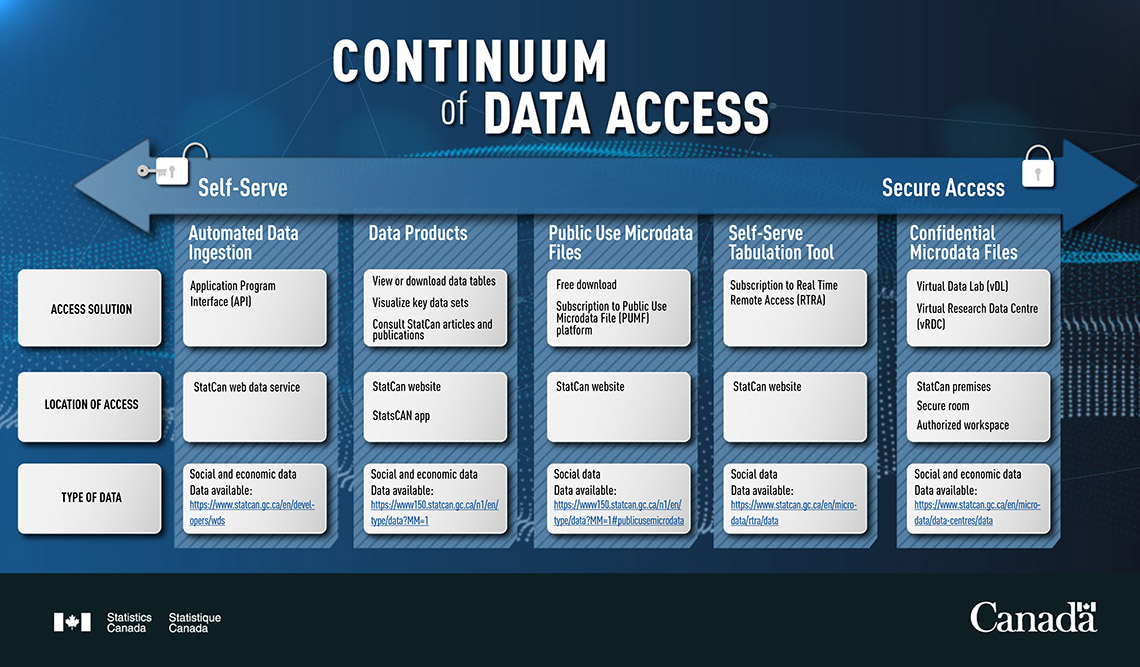
Self-serve access solutions, available with minimal restrictions, evolve into secure access solutions, available with security procedures.
Automated data ingestion
Automated data ingestion
A self-serve way to programmatically take away data and reuse it for applications, databases, and analyses.
Access solution
- Application program interface (API): Allows data users to access Statistics Canada aggregate data and metadata by connecting directly to our public facing databases. The Statistics Canada web services provide access to the time series made available on Statistics Canada's website in a structured form.
Location of access
- Statistics Canada's Web Data Service (WDS)
Type of data
- Social and economic data
- Web Data Service (WDS)
Ideal activities
- Training
- Policy research
- Academic research
- Evidence-based policy/decision-making
- Outcomes or products – data exploration, extractions and as an analytical tool for academic and policy research
Data products
Data products
Publications, data visualizations, and downloadable items such as multi-dimensional data tables storing standard socio-economic data sets.
Access solution
- View or download data tables: Data
- Visualize key data sets: Data
- Consult StatCan articles and publications: Analysis
Location of access
Type of data
- Social and economic data: Data
Ideal activities
- Training
- Policy research
- Academic research
- Evidence-based policy/decision-making – calculating frequencies, cross tabulations, means, percentiles, percent distribution, proportions, ratios, and shares
- Outcomes or products – data exploration, extractions and as an analytical tool for academic and policy research
Public use microdata files
Public use microdata files
Access solution
- Free download for select files
- Subscription to Public Use Microdata File (PUMF) Collection: Unlimited access to data and documentation is available through a database with an easy-to-use discoverability tool.
Location of access
- Free download: Data
- Subscription: Rich Data Service (IP-restricted access)
Type of data
- Social data: Data
Ideal activities
- Training – use as an analytical training tool.
- Policy research
- Academic research
- Evidence-based policy/decision-making – calculating frequencies, cross tabulations, means, percentiles, percent distribution, proportions, ratios, and shares
- Outcomes or products – data exploration, extractions, and as an analytical tool for academic and policy research
Self-serve tabulation tool
Self-serve tabulation tool
Access solution
Subscription to Real Time Remote Access (RTRA): Indirect access to Statistics Canada's microdata files, to produce non-confidential tabulations, via remotely submitted SAS programs. It is suitable for clients primarily looking for descriptive statistics.
Location of access
- Online submissions through the Electronic File Transfer Service (EFT)
Type of data
Ideal activities
- Training
- Policy research
- Academic research
- Evidence-based policy/decision-making – calculating frequencies, means, percentiles, proportions, ratios, and shares
- Outcomes or products – generating a full range of descriptive statistics that can be used for academic and policy research, training, and policy briefings
Confidential microdata files
Confidential microdata files
Data at the individual or institutional level accessed in a secured environment.
Access solution
- Virtual Data Lab (vDL): A secure cloud infrastructure used to store and facilitate access to microdata research projects. The vDL grants qualifying data users a more flexible approach to accessing Statistics Canada microdata. Data users can access their microdata projects from various locations, such as their home or office, depending on the sensitivity of the data.
- Virtual Research Data Centre (vRDC): A modern virtual infrastructure that will provide academic data users with secure access to Statistics Canada microdata through a partnership with the Canadian Research Data Centre Network (CRDCN). Qualifying data users will have access to data within secure RDC facilities, as well as from other authorized workspaces (e.g., a home or office). The vRDC is expected to start coming online in 2023.
Location of access
- Secure Access Points: Statistics Canada premises (e.g., Research Data Centres), secure rooms, authorized workspaces (e.g., personal residence)
Type of data
- Social and economic data available in Secure Access Points: Data available at the Research Data Centres
Ideal activities
- Training
- Policy research – answering policy and academic research questions that require the use of advanced analytical methods such as complex multivariate analysis, and modelling
- Academic research
- Evidence-based policy/decision-making
- Outcomes or products
Self-serve access to microdata
Statistics Canada offers Public Use Microdata Files (PUMFs) to institutions and individuals. The files contain non-aggregated data that are carefully modified and reviewed to ensure that no individual or business is directly or indirectly identified. They can be accessed directly through the Data Liberation Initiative (DLI) or the PUMF Collection with a paid subscription. Individual PUMFs can be downloaded from the Statistics Canada website at no cost. Statistics Canada also offers remote access solutions to data users.
Public Use Microdata Files Collection
The Public Use Microdata Files (PUMF) Collection is a subscription-based service for institutions that require unlimited access to all anonymized and non-aggregated data. This is available through an Electronic File Transfer (EFT) Service and the Rich Data Services (RDS) platform, an Internet Protocol (IP) restricted online database with an easy-to-use interface. Select files are also available free of charge from the Statistics Canada website.
The Data Liberation Initiative
The Data Liberation Initiative (DLI) is a partnership between postsecondary institutions and Statistics Canada that improves access to Canadian data resources, providing faculty and students with unlimited access to numerous public use datasets and geographical files.
Real Time Remote Access
Real Time Remote Access (RTRA) is an online tabulation tool that allows subscribers to run SAS programs in real time to extract results from confidential microdata in the form of tables.
Secure access to microdata
Statistics Canada provides secure access to confidential microdata for complex statistical analysis to support research, evidence-based decision making, policy development, program management and public understanding. Data users have direct access to a wide range of anonymized survey, administrative and integrated data.
Organizations can receive accreditation by entering into a memorandum of understanding, a section 10 agreement or an organization access agreement with Statistics Canada. Accredited data users are approved researchers and analysts from organizations that follow the protocols for accessing data in a secure environment.
To access microdata, data users must become deemed employees of Statistics Canada. This includes obtaining security clearance, completing mandatory training, and swearing or affirming the Oath of office and secrecy to Statistics Canada.
All data outputs are vetted for confidentiality by Statistics Canada employees before being released to data users.
Data access for academic data users
Research Data Centres (RDCs) are secure physical environments available to accredited academic researchers to access anonymized and non-aggregated microdata for research purposes. RDCs are on university campuses across Canada and staffed by Statistics Canada employees.
The Virtual Research Data Centre (vRDC) information technology platform is a modern virtual infrastructure that provides academic researchers with secure access to Statistics Canada microdata through a partnership with the Canadian RDC Network. Qualifying data users can access data within secure RDC facilities and from other “authorized workspaces” (e.g., a home or office location). The vRDC will be launching in 2025/2026.
Data access for federal government users
Federal government employees with an approved eligible access agreement can access confidential microdata remotely, in authorized workspaces, via the Virtual Data Lab (VDL) or onsite in the Secure Data Access Centre (SDAC), formerly known as the Federal RDC (FRDC), in Ottawa. Fees for access vary depending on access requirements.
Data access for provincial and territorial government users
Provincial and territorial government employees with an approved project can access confidential microdata remotely, in authorized workspaces, via the VDL. Access fees vary depending on the project.
Data access for non-profit organizations, non-governmental organizations and the private sector
Non-profit organizations, non-governmental organizations and the private sector can access confidential microdata, depending on the eligibility of their project, either remotely in authorized workspaces via the VDL, onsite at the SDAC (formerly the FRDC) in Ottawa, or at a local RDC. Access fees vary depending on the project.
Statistics Canada Biobank
Biospecimens like blood, urine and DNA (deoxyribonucleic acid) samples are collected from consenting participants of the Canadian Health Measures Survey and are accessible only for approved research initiatives that meet ethical standards. The resulting analyses are made available through RDCs. Under no circumstances will personal or identifiable information be published. Datasets of potential interest are available to approved academic and government data users.