

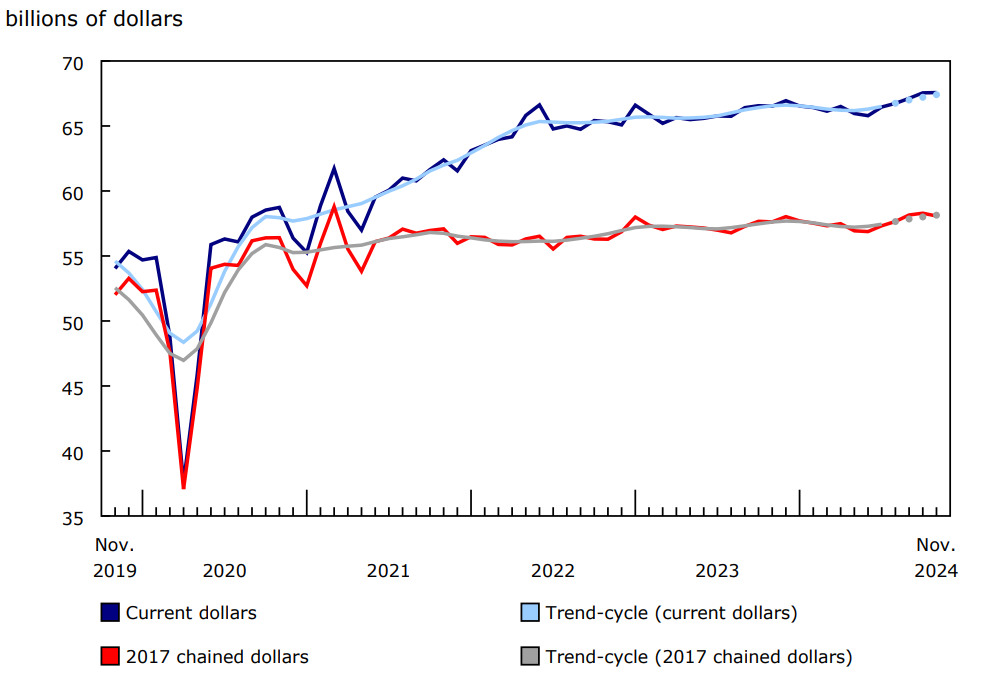
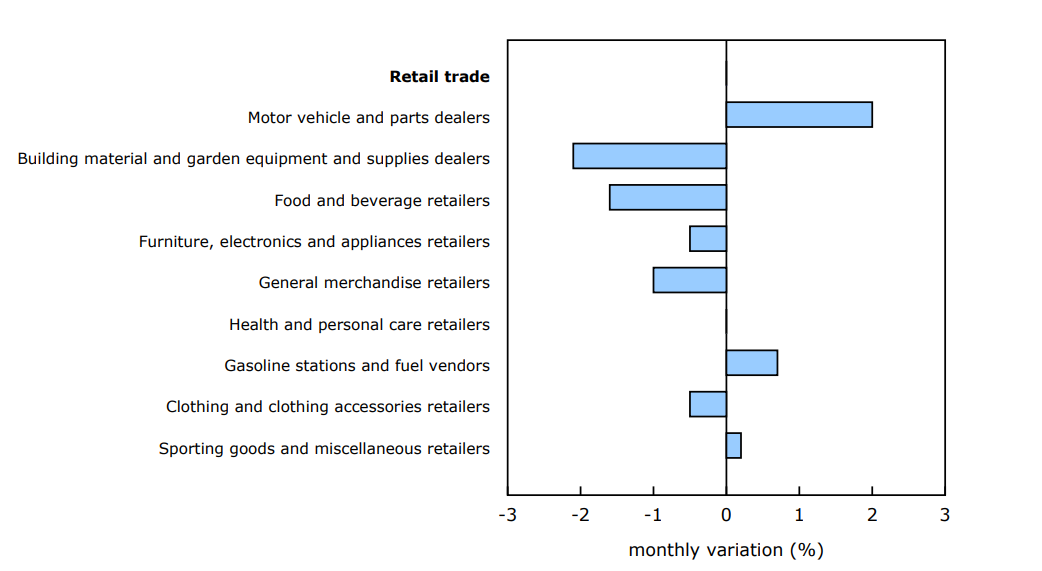
Retail sales were relatively unchanged in November. Sales were down in six out of nine subsectors, led by lower sales at food and beverage retailers (-1.6%). Higher sales at motor vehicle and parts dealers (+2.0%) and gasoline stations and fuel vendors (+0.7%) largely offset declines in the remaining subsectors.
Core retail sales—which exclude gasoline stations and fuel vendors and motor vehicle and parts dealers—were down 1.0% in November.
In volume terms, retail sales fell 0.4% in November.
Chart 1: Retail sales relatively unchanged in November
Description - Chart 1
Data table: Retail sales relatively unchanged in November
Note: The higher variability associated with the trend-cycle estimates is indicated with a dotted line on the chart for the current reference month and the previous three months. For more information, see the Note to readers.
Sources: Tables 20-10-0056-01 and 20-10-0067-01.
Core retail sales fall on lower sales at food and beverage retailers
Core retail sales decreased 1.0% in November, posting their largest decline in six months. The decrease was led by lower sales at food and beverage retailers (-1.6%), with supermarkets and other grocery retailers (except convenience retailers) (-1.5%) contributing the most to the decline. Lower receipts were also recorded at beer, wine, and liquor retailers (-2.9%), which fell for a second consecutive month.
Sales were also down at general merchandise retailers (-1.0%) and building material and garden equipment and supplies dealers (-2.1%) in November.
Sales at motor vehicle and parts dealers rise
The largest increase in retail sales in November was observed at motor vehicle and parts dealers (+2.0%), with all four store types within this subsector posting gains. New car dealers (+2.4%) led the increase, with sales rising for the fourth time in five months. Automotive parts, accessories and tire retailers (+0.9%) and other motor vehicle dealers (+0.8%) were also up in November.
Sales at gasoline stations and fuel vendors increased 0.7% in November following six consecutive monthly declines. In volume terms, sales at gasoline stations and fuel vendors decreased 0.8%.
Chart 2: Sales decrease in six of nine subsectors in November
Description - Chart 2
Data table: Sales decrease in six of nine subsectors in November
Source: Table 20-10-0056-01.
Sales down in seven provinces
Retail sales decreased in seven provinces in November. The largest provincial decrease in dollar terms was observed in Alberta (-1.1%), followed by New Brunswick (-2.0%).
The largest provincial increase in retail sales in November was observed in Ontario (+0.5%) on higher sales at motor vehicle and parts dealers. In the census metropolitan area of Toronto, retail sales were up 1.1% in the month.
Retail e-commerce sales in Canada
On a seasonally adjusted basis, retail e-commerce declined 1.2% to $4.1 billion in November, accounting for 6.1% of total retail trade compared with 6.2% in October.
Advance retail indicator
Statistics Canada is providing an advance estimate of retail sales, which suggests that sales increased 1.6% in December. Owing to its early nature, this figure will be revised. This unofficial estimate was calculated based on responses received from 48.3% of companies surveyed. The average final response rate for the survey over the previous 12 months was 88.4%.
Note to readers
All data in this release are seasonally adjusted and expressed in current dollars, unless otherwise noted.
Seasonally adjusted data are data that have been modified to eliminate the effect of seasonal and calendar influences to allow for more meaningful comparisons of economic conditions from period to period. For more information on seasonal adjustment, see Seasonally adjusted data – Frequently asked questions.
The percentage change for the advance estimate of retail sales is calculated using seasonally adjusted data and is expressed in current dollars.
This early indicator is a special unofficial estimate being provided to offer Canadians timely information on the retail sector. The data sources and methodology used are the same as those outlined on the Monthly Retail Trade Survey information page.
Trend-cycle estimates are included in selected charts as a complement to the seasonally adjusted series. These data represent a smoothed version of the seasonally adjusted time series and provide information on longer-term movements, including changes in direction underlying the series. For information on trend-cycle data, see Trend-cycle estimates – Frequently asked questions.
Both seasonally adjusted data and trend-cycle estimates are subject to revision as additional observations become available. These revisions could be extensive and could even lead to a reversal of movement, especially for the reference months near the end of the series or during periods of economic disruption.
Some common e-commerce transactions, such as travel and accommodation bookings, ticket purchases and financial transactions, are not included in Canadian retail sales figures.
Total retail sales expressed in volume terms are calculated by deflating current-dollar values using consumer price indexes.
Find more statistics on retail trade.
Reference
Data tables: 20-10-0056-01 and 20-10-0067-01.
- Note: some data tables may best be viewed on desktop.
Definitions, data sources and methods: survey number 2406 and 2408.
Previous release: Retail trade, October 2024.
Next release: February 21, 2025.
Contact information
For more information, or to enquire about the concepts, methods or data quality of this release, contact us (toll-free 1-800-263-1136; 514-283-8300; infostats@statcan.gc.ca) or Media Relations (statcan.mediahotline-ligneinfomedias.statcan@statcan.gc.ca).