

After reaching a 14-year high in 2022, the rate of firearm-related violent crime in Canada declined 1.7% in 2023. Firearm-related homicides also fell for the first time since 2018.
Consistent with previous years, firearm-related violent crime accounted for a small share (2.6%) of police-reported violent crime in Canada in 2023.
The Juristat article "Firearms and violent crime in Canada, 2023," published today, presents the most recent police-reported data on firearm-related violent crime, including incidents where a firearm was present, as well as the firearm-specific violations of discharging a firearm with intent, using a firearm in the commission of an offence and pointing a firearm. Based on data from the Uniform Crime Reporting Survey and the Homicide Survey, characteristics of incidents, victims and accused are discussed, as are trends over time.
After reaching a 14-year high in 2022, firearm-related violent crime declines in 2023
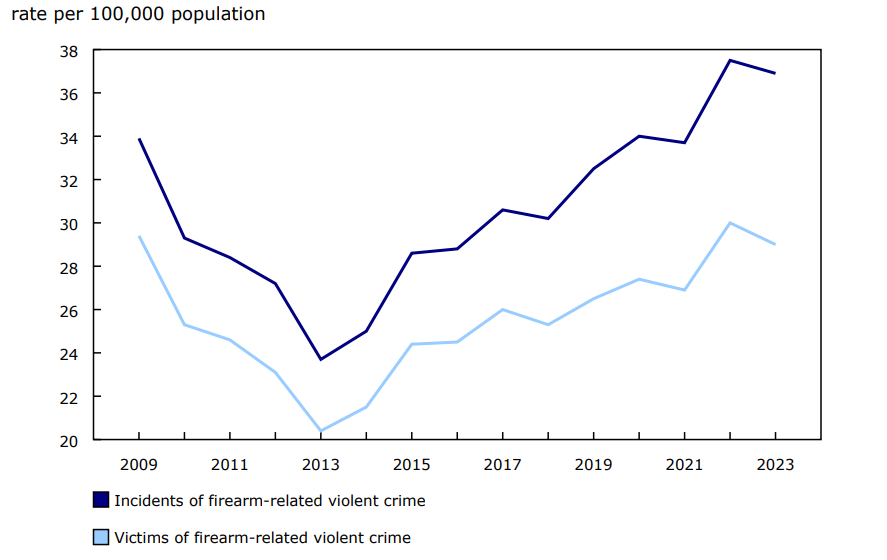
According to police data, there were 14,416 incidents of firearm-related violent crime in 2023. This represented 37 incidents of firearm-related violent crime per 100,000 population, down 1.7% from a year earlier. In contrast, the overall rate for incidents of violent crime increased 4.0%.
Chart 1: Incidents and victims of police-reported firearm-related violent crime, Canada, 2009 to 2023
Description - Chart 1
Data table: Incidents and victims of police-reported firearm-related violent crime, Canada, 2009 to 2023
Notes: Firearm-related violent crime includes incidents where the most serious violation was a firearm-specific violent offence (discharging a firearm with intent, use of a firearm in the commission of an offence, pointing a firearm) and other violent crimes where the most serious weapon present in the incident was a firearm. The number of incidents represents the number of victims, as well as incidents where the police did not provide victim records. Because of data quality concerns, the Service de police de la Ville de Québec is excluded. Rates are calculated based on 100,000 population, and populations are based on July 1 estimates from Statistics Canada's Centre for Demography.
Source: Uniform Crime Reporting Survey trend database (3302).
Trends in firearm-related violent crime have generally followed overall patterns in violent crime.
In the longer term, incidents of firearm-related violent crime have increased 55% since 2013, from 24 incidents per 100,000 population that year to 37 in 2023, while overall violent crime has grown 30% during this period (from 1,075 to 1,397).
Firearm-related violent crime declines in provincial urban south, but rises in all other regions
From 2022 to 2023, the rate of firearm-related violent crime fell 6.5% in the provincial urban south, driving the decrease in the overall rate. All other regions saw increases, with the largest in the provincial rural south (+19%) and the provincial urban north (+13%). Rates were also up in the territories (+9.4%) and the provincial rural north (+6.5%).
In 2023, the rate of firearm-related violent crime in the territories was 180 incidents per 100,000 population—the highest of any region in Canada. In comparison, the rate of firearm-related violent crime in the provinces was 165 incidents per 100,000 population in the rural north and 45 in the urban north. Rates were lowest in the rural south (41) and the urban south (32).
Firearm-related violent crime is often considered an urban phenomenon, where populations are large and dense. A large majority (84%) of the population lived in provincial urban areas in Canada in 2023. While the rate of firearm-related violent crime was lowest in the provincial urban south in 2023, just over 7 in 10 such incidents (71%) occurred in that region. A further 4.0% occurred in the provincial urban north.
Rates of firearm-related violent crime highest in the territories and the Prairies
Similar to previous years, firearm-related violent crime was highest in the territories and the Prairie provinces in 2023.
Nunavut (312 incidents per 100,000 population) and the Northwest Territories (171) had the highest rates in 2023, followed by Saskatchewan (127), Manitoba (81) and Yukon (71).
Meanwhile, the lowest rates were in Newfoundland and Labrador (22 incidents per 100,000 population) and Quebec (25).
The overall decline (-1.7%) in the national rate of firearm-related violent crime from 2022 to 2023 was largely attributed to decreases in the rate in Ontario (-6.6%, or -180 incidents), British Columbia (-6.6%, or -57 incidents), Quebec (-3.9%, or -35 incidents) and the Northwest Territories (-28%, or -29 incidents).
Meanwhile, there were notable increases in the rate of firearm-related violent crime in Saskatchewan (+11%, or +186 incidents), Manitoba (+14%, or +166 incidents), Nunavut (+73%, or +54 incidents), Prince Edward Island (+155%, or +28 incidents) and Nova Scotia (+5.1%, or +26 incidents).
Decline in firearm-related violent crime in the provincial urban south driven by decreases in Toronto, Calgary, Montréal and Vancouver
Among the census metropolitan areas (CMAs), Toronto had the largest number of incidents (2,449) of firearm-related violent crime—by a wide margin—in 2023. However, as Canada's most populous CMA, Toronto ranked 11th in terms of rate (40 incidents per 100,000 population).
The highest rates among the CMAs were in Red Deer (80), Regina (79), Chilliwack (55), Winnipeg (54) and Saskatoon (53) in 2023.
Meanwhile, the lowest rates were in Victoria (9), Guelph (11), Peterborough (12), Sherbrooke (14) and Belleville–Quinte West (16).
Among the regions, the rate of firearm-related violent crime decreased exclusively in the provincial urban south from 2022 to 2023. While several CMAs saw a decline in 2023, the decrease in the urban south was largely driven by rate decreases in Toronto (-9.2%, or -157 incidents), Calgary (-22%, or -130 incidents), Montréal (-12%, or -127 incidents) and Vancouver (-15%, or -75 incidents).
For Canada's other largest CMAs, the rate rose in Edmonton (+11%, or +100 incidents) and Ottawa (+5.7%, or +25 incidents) in 2023.
Rates for violent crimes involving handguns, rifles or shotguns, or fully automatic or sawed-off firearms decline
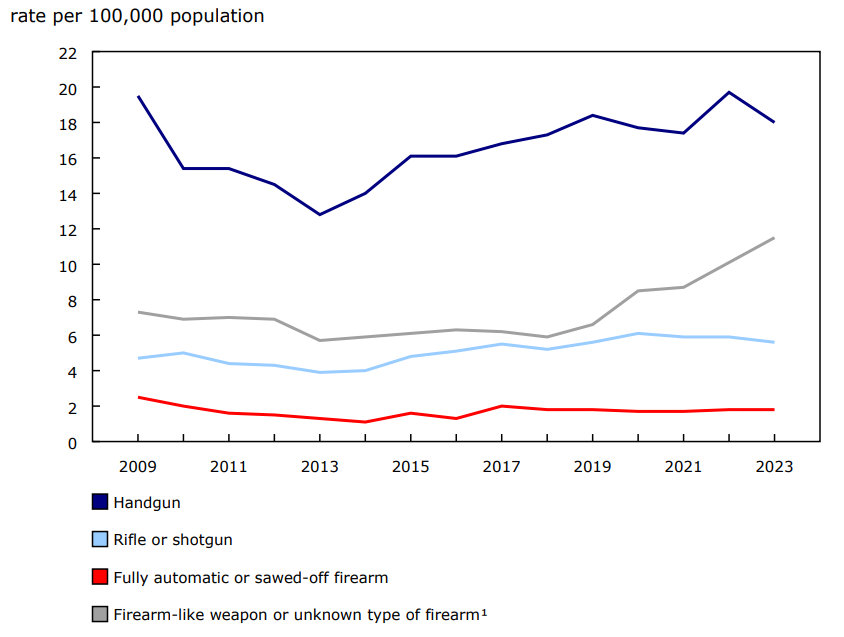
Around half (49%) of firearm-related violent crime involved the presence of a handgun in 2023, down from 53% in 2022. Nevertheless, handguns remained the most common type of firearm present in incidents of firearm-related violent crime in 2023, followed by firearm-like weapons or unknown types of firearms (31%), rifles or shotguns (15%), and fully automatic or sawed-off shotguns (4.7%).
The rate of handgun-related violent crime declined 8.6%, from 20 incidents per 100,000 population in 2022 to 18 in 2023. Firearm-related violent crime involving rifles and shotguns decreased by 4.0%, from 5.9 to 5.6.
Meanwhile, the rate for firearm-like weapons and unknown types of firearms increased 13% in 2023 (from 10 incidents per 100,000 population to 11).
While it is not possible to identify the exact reason behind this increase, the illicit manufacturing of firearms—that is, privately made firearms or "ghost guns"—is a growing safety concern in Canada. This includes a rise in the use of 3D printers, as well as the importation and distribution of parts, which are used to build unmarked and untraceable firearms that are untested and dangerous.
Chart 2: Incidents of police-reported firearm-related violent crime, by most serious type of firearm present, Canada, 2009 to 2023
Description - Chart 2
1. Includes, for example, starter pistols, flare guns, air guns, ghost guns and BB guns. Also includes violent crimes where the most serious violation was a firearm-specific violent offence (discharging a firearm with intent, use of a firearm in the commission of an offence, pointing a firearm) and the type of weapon was unknown.
Notes: Firearm-related violent crime includes incidents where the most serious violation was a firearm-specific violent offence (discharging a firearm with intent, use of a firearm in the commission of an offence, pointing a firearm) and other violent crimes where the most serious weapon present in the incident was a firearm. The number of incidents represents the number of victims, as well as incidents where the police did not provide victim records. Because of data quality concerns, the Service de police de la Ville de Québec is excluded. Rates are calculated on the basis of 100,000 population, and populations are based on July 1 estimates from Statistics Canada's Centre for Demography.
Source: Uniform Crime Reporting Survey trend database (3302)
In terms of counts, there were 436 fewer incidents of handgun-related violent crime in 2023 than a year earlier and 25 fewer incidents involving rifles or shotguns.
Meanwhile, there were 633 more incidents where firearm-like weapons or unknown types of firearms were present in 2023.
After increasing yearly since 2018, firearm-related homicides fall in 2023
The rate of firearm-related homicides rose yearly from 2018 to 2022 in Canada. However, in 2023, the rate fell 18% (from 0.88 incidents per 100,000 population to 0.72). There were 54 fewer firearm-related homicides in 2023 compared with the previous year (289 versus 343).
A decline was also noted in the homicide rate in general, which fell 14% (from 2.27 incidents per 100,000 population in 2022 to 1.94 in 2023). The rates for homicides caused by stabbing (-20%) and beating (-16%) also declined.
Despite these declines, the rate of firearm-related homicides in 2023 was 5.6% higher than in 2018 (0.68, or 253 homicides). The rates for stabbing homicides (+19%) and homicide in general (+8.3%) were also up during this period, while the rate for beating homicides declined 5.3%.
The rate of firearm-related homicides was 89% higher in 2023 than in 2013, when police reported 0.38 incidents per 100,000 population, or 134 homicides. In contrast, police reported much smaller increases since 2013 for homicides by stabbing (+5.0%) and beating (+7.2%) and for homicides in general (+33%).
In 2023, shooting homicides accounted for nearly 4 in 10 (38%) of all homicides where the primary method causing death was known. Shooting was the leading cause of death among homicide victims, followed by stabbing (31%), beating (17%) and other methods (14%).
Among homicides, shooting has been the leading primary method causing death every year since 2016.
Note to readers
In this release, firearm-related violent crime includes incidents where a firearm was present during the commission of an offence and where police determined that the firearm was relevant to the crime, regardless of whether it was used. Firearms include handguns; rifles or shotguns; fully automatic or sawed-off firearms; and firearm-like weapons, such as starter pistols, flare guns, air guns, ghost guns and BB guns. Firearm-specific offences—including discharging a firearm with intent, using a firearm in the commission of an offence and pointing a firearm—are also included in firearm-related violent crime. Percent changes are based on unrounded rates.
The Incident-based Uniform Crime Reporting (UCR) Survey trend database is a microdata survey that captures detailed information on crimes reported to police, including the characteristics of incidents, victims and accused persons. Trend coverage from 2009 to 2023 is estimated at 99% of the population of Canada. To allow for comparisons over time, the trend database includes only the police services that have consistently responded to the UCR Survey.
One incident can involve multiple offences. To ensure comparability, data presented in this release are based on the most serious violation in the incident. Police determine the most serious violation according to standardized classification rules in the UCR Survey that consider, for instance, whether the offence is violent, as well as the maximum penalty imposed by the Criminal Code. This release uses a hybrid approach—first adopted with the release of 2022 firearm data. Now, each victim is counted as a unique incident, as is each incident without an associated victim record. Every victim and every incident are counted the same way, regardless of whether a victim record was provided by police.
In Quebec, the information management system used by most police services produces a relatively high proportion of unknown values for the UCR Survey variable "most serious weapon present." Although incidents of firearm-related crime are likely correctly recorded in the vast majority of cases, undercounting remains possible. Therefore, caution should be used when comparing data from Quebec with data from other provinces and territories. This analysis excludes data from the Service de police de la Ville de Québec because of data quality concerns for the variable "most serious weapon present."
The Homicide Survey collects police-reported data on the characteristics of all homicide victims, accused persons and incidents in Canada. The Homicide Survey began collecting information on all homicides in 1961. Homicides that become known to police months or years after they occur are counted in the year in which they become known.
For the purposes of the UCR Survey and the Homicide Survey, a firearm is any barrelled weapon from which any shot, bullet or other missile can be discharged and can cause serious bodily injury or death to a person. Different types of firearms are distinguished as such by the two surveys (presented in descending order of seriousness according to the hierarchy for determining the most serious weapon):
Fully automatic firearm: Any firearm that allows continuous and rapid fire of bullets with one pull of the trigger.
Sawed-off rifle or shotgun: Any rifle or shotgun with a barrel length that has been altered to less than 457 millimetres, or with an overall weapon length of less than 660 millimetres.
Handgun: Any firearm designed to be held and fired by the action of one hand.
Rifle or shotgun: Any long-barrelled firearm with a barrel length of 660 millimetres or more.
Firearm-like weapon: Any firearm-like weapon capable of propelling any object through a barrel by means of gunpowder, compressed carbon dioxide, pumped air, etc., including, for example, starter pistols, flare guns, air guns, ghost guns and BB guns. This category also includes unknown types of firearms.
Reference
Definitions, data sources and methods: survey numbers 3302 and 3315.
Previous release: Firearms and violent crime in Canada, 2022.
Contact information
For more information, or to enquire about the concepts, methods or data quality of this release, contact us (toll-free 1-800-263-1136; 514-283-8300; infostats@statcan.gc.ca) or Media Relations (statcan.mediahotline-ligneinfomedias.statcan@statcan.gc.ca).