

The median employment income of certified journeypersons can reflect labour market demands and provide information on the economic well-being of these workers. In 2022, the median employment income of newly certified journeypersons one year after certification reached $56,580, up 1.0% (+$550) from the previous year. In comparison, their median employment income had grown by 12.2% in 2021, following a decline of 5.7% in 2020, during the first year of the COVID-19 pandemic.
Differences in median employment income can be attributed to many factors, such as the number of hours of work, the type of trade a journeyperson is employed in and the region of employment. In 2022, the unemployment rate returned to near pre-pandemic levels, signalling a labour market recovery from pandemic disruptions. The aforementioned factors may have led to an increase in the number of hours worked, contributing to the median employment income of journeypersons reaching its highest level since the series began in 2008.
Several trades have yet to recover to pre-pandemic median employment income levels
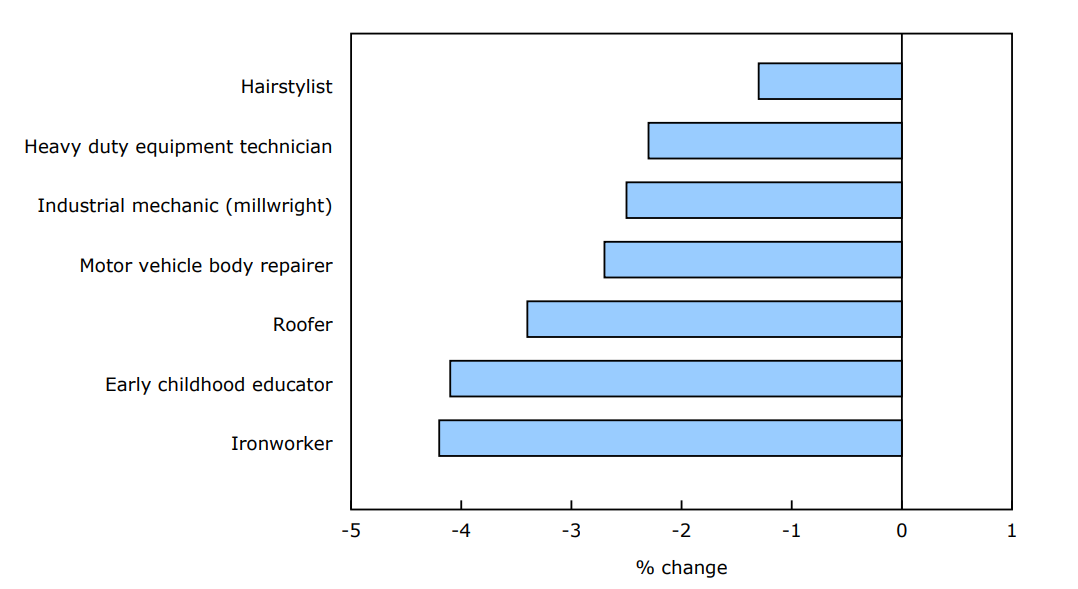
In 2022, median employment income increased for 17 of the 27 trades, compared with the previous year. Newly certified hairstylists (+$5,020; +27.0%) recorded the largest gains, though their median income remained below pre-pandemic levels observed in 2019. Cooks (+$3,040; +8.8%) and welders (+$4,750; +8.6%) also recorded large increases in median employment income in 2022, with welders surpassing their 2019 pre-pandemic levels for the first time.
While median employment income for most trades—such as powerline technicians, industrial instrumentation and control technicians, and agricultural equipment technicians—exceeded pre-pandemic levels, several trades have not yet recovered. In 2022, the median employment income of ironworkers and early childhood educators remained below pre-pandemic levels, lagging behind all the other trades studied.
Chart 1: Percent change in median employment income in trades where it has not recovered to pre-pandemic levels, 2019 to 2022
Description - Chart 1
Note: Mobility rates are measured one year after certification.
Source: Registered Apprenticeship Information System (3154).
Interprovincial mobility rates increase for the first time since 2013
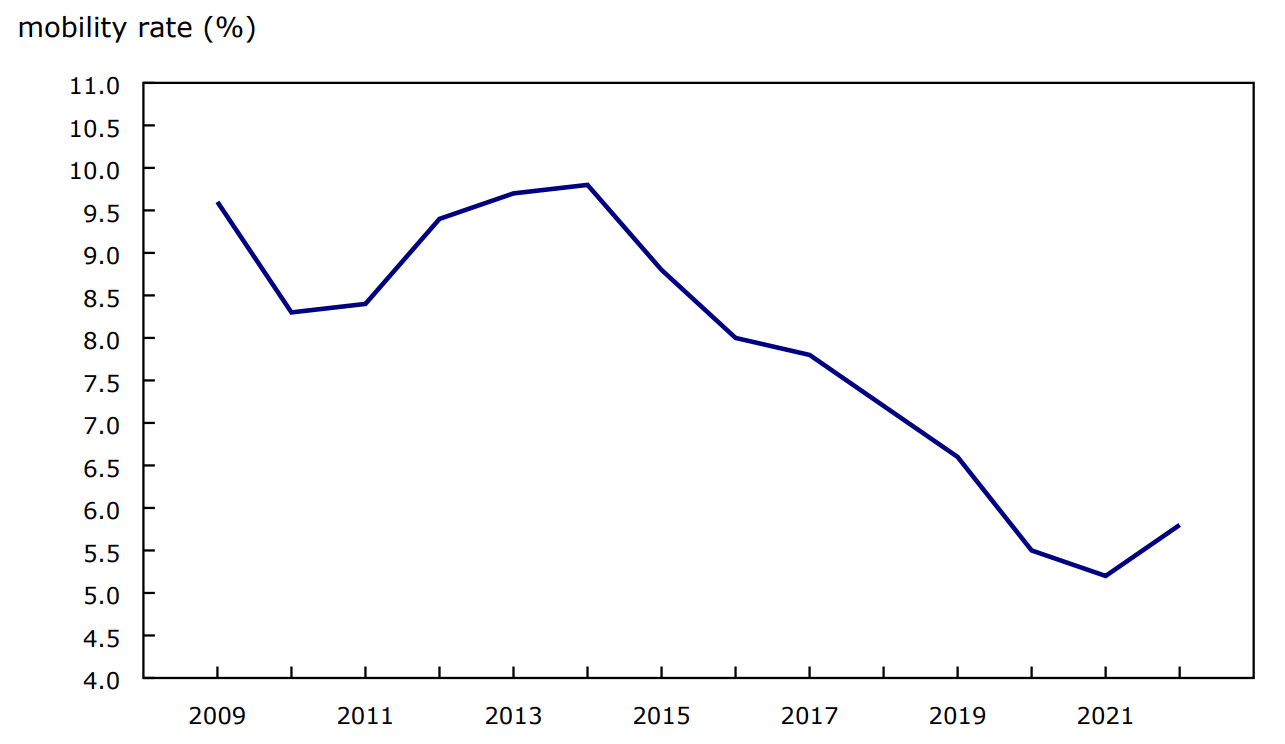
In 2022, 5.8% of journeypersons lived or worked in a province or territory other than their jurisdiction of certification one year after certification. This represents the first increase in the mobility rate since 2013, when it peaked at 9.8%.
The elimination of pandemic-related travel restrictions in 2022 facilitated interprovincial mobility, as journeypersons were able to move freely across the country and take on previously unavailable work opportunities.
Chart 2: Annual mobility rate of journeypersons in Canada
Description - Chart 2
Data table: Annual mobility rate of journeypersons in Canada
Note: Mobility rates are measured one year after certification.
Source: Registered Apprenticeship Information System (3154).
In 2022, British Columbia (22.2%) continued to be one of the top destinations for newly certified migrant journeypersons. The province's strong economic conditions, particularly growth in both services- and goods-producing industries—driven by ongoing large-scale construction projects—likely contributed to its appeal. This coincided with British Columbia experiencing the highest net migration of newly certified journeypersons (+135; +3.0%) among all provinces and territories in 2022. Alberta (22.2%) and Ontario (22.0%) were also popular destinations for migrant journeypersons. Despite this, Alberta (-185; -3.4%) continued its trend of negative net migration which began six years earlier, while Ontario (+125; +1.3%) saw modest gains.
Note to readers
Context
This release includes data from the Education and Labour Market Longitudinal Platform, from 2008 to 2022. For more information on the concepts and the methodology used in this study, consult "Earnings indicators for certified journeypersons in Canada, 2020," and "Indicators on the interprovincial and territorial mobility of certified journeypersons, 2020." Both articles are part of the publication Technical Reference Guides for the Education and Labour Market Longitudinal Platform (Catalogue number 37200001).
Data, definitions and concepts
Earnings indicators were derived at the aggregate level for all trades and at the disaggregate level for selected trades, including the 25 Red Seal trades with the largest number of certifications from 2008 to 2022 and 5 non-Red Seal trades. Four of the five non-Red Seal trades (child and youth worker, developmental services worker, early childhood educator, and educational assistant) are only considered designated trades in Ontario.
Mobility indicators were derived at the aggregate level for all trades and at the trade level for the 15 Red Seal trades with the largest number of certifications from 2008 to 2022.
Certification: The requirements for granting a certificate vary by jurisdiction in Canada. In most cases, apprentices are issued a certificate when they fulfill such requirements as supervised on-the-job training, technical training and passing one or more examinations. Trade qualifiers, meanwhile, become certified once they pass an examination.
Employment income: This income includes employment earnings (wages and salaries, commissions from employment, training allowances, tips and gratuities, and tax-exempted Indian employment income) and net self-employment income (net income from a business, a profession, farming, fishing and commissions). It is adjusted for inflation and presented in 2018 constant dollars.
Interprovincial mobility: Interprovincial mobility is calculated by comparing the jurisdiction of certification in a trade (in the Registered Apprenticeship Information System) with the province or territory of residence (recorded in the T1 Family File) and the province or territory of employment (obtained from T4 slips) one or three years after certification.
Journeypersons: Journeypersons are individuals who have completed an apprenticeship program or trade qualifiers who have earned a certificate of qualification.
Migrant population of journeypersons: This population consists of newly certified journeypersons who live in a different province or territory from the one where they certified.
Registered apprentices: These are individuals in a supervised work training program in a designated trade within their provincial or territorial jurisdiction. Apprentices must be registered with the appropriate governing body (usually a ministry of education or labour, or a trade-specific industry governing body).
Newly certified journeypersons who live and work in the same province or territory of certification show no interprovincial mobility.
Reference
Data tables: Access the latest tables.
- Note: some data tables may best be viewed on desktop.
Definitions, data sources and methods: survey number 3154.
Previous release: Earnings and mobility indicators for newly certified journeypersons in Canada, 2021.
Contact information
For more information, or to enquire about the concepts, methods or data quality of this release, contact us (toll-free 1-800-263-1136; 514-283-8300; infostats@statcan.gc.ca) or Media Relations (statcan.mediahotline-ligneinfomedias.statcan@statcan.gc.ca).