

About 2 million children, aged 14 or younger, immigrated to Canada during the period from 1980 to 2023, accounting for approximately 20% of those admitted to Canada during this period. Their long-term socioeconomic outcomes, such as education attainment and wages, are important aspects for understanding their integration in Canadian society and their contributions to Canada's economy and society over time.
This release finds that, in 2022, immigrant children admitted to Canada at younger ages and those admitted as dependents of economic immigrants were more likely to pursue postsecondary education and had higher median income as young adults. These findings are based on data from the Longitudinal Immigration Database (IMDB) Children Data Module. This module links immigrants admitted to Canada as children with their parents' socioeconomic information before and after immigration and provides tax filing data from the ages of 18 to 30 years. These consolidated data allow for analysis of their participation in postsecondary education and their labour market outcomes as young adults.
The IMDB is a collaborative effort between Statistics Canada, Immigration, Refugees and Citizenship Canada, and the provinces.
Immigrant children admitted to Canada at younger ages and those admitted through the economic category exhibited higher participation in postsecondary education
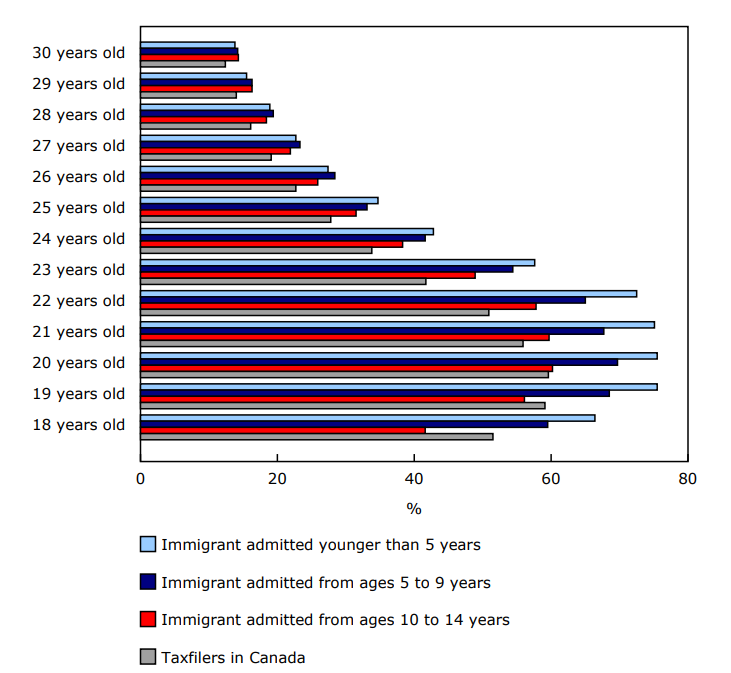
In 2022, immigrants admitted as children were more likely to participate in postsecondary education than Canadians. Notably, the younger the children were when they immigrated to Canada, the more likely they were to pursue postsecondary education. Among immigrants who were 20 years old in 2022, 75.5% of those who were under the age of 5 at the time of admission participated in postsecondary education, higher than those admitted from the ages of 5 to 9 (69.7%) and the ages of 10 to 14 (60.2%). In contrast, 59.6% of Canadians (all taxfilers, which includes both immigrants and non-immigrants) who were 20 years old in 2022 participated in postsecondary education.
Chart 1: Incidence of participation in postsecondary education for immigrant taxfilers admitted to Canada as children, by admission age, and for all tax filers, aged 18 to 30 years, tax year 2022
Source: Longitudinal Immigration Database 2023 (5057), table 43-10-0075-01.
Younger age at admission was associated with higher participation in postsecondary education across all four broad admission categories. Children admitted as dependents of economic immigrants posted the highest participation rate (73.1%), while refugees had the lowest (50.2%).
Immigrant children had higher median wages as young adults, especially those admitted at younger ages and those admitted as dependents of economic immigrants
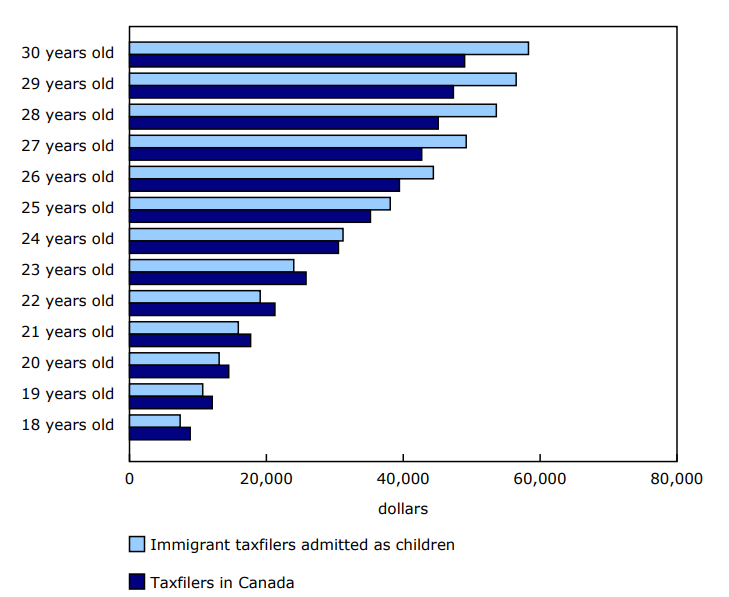
Immigrants admitted to Canada as children were also more likely to enjoy better long-term economic outcomes. While their median wages were lower than the Canadian median wages up to the age of 23, from ages 24 to 30, they had higher median wages than other Canadians of the same age. For example, by age 30, the median wage of immigrants admitted as children was $58,300, 19.1% higher than that of the overall population of 30-year-olds in Canada ($48,970). Those admitted under age 5 ($59,200) and from the ages of 5 to 9 ($60,600) had a higher median wage at age 30 than those admitted from the ages of 10 to 14 ($55,600).
Chart 2: Median wages, salaries and commissions for immigrant taxfilers admitted as children and for all Canadian taxfilers, aged 18 to 30 years, tax year 2022
Source: Longitudinal Immigration Database 2023 (5057), table 43-10-0075-01.
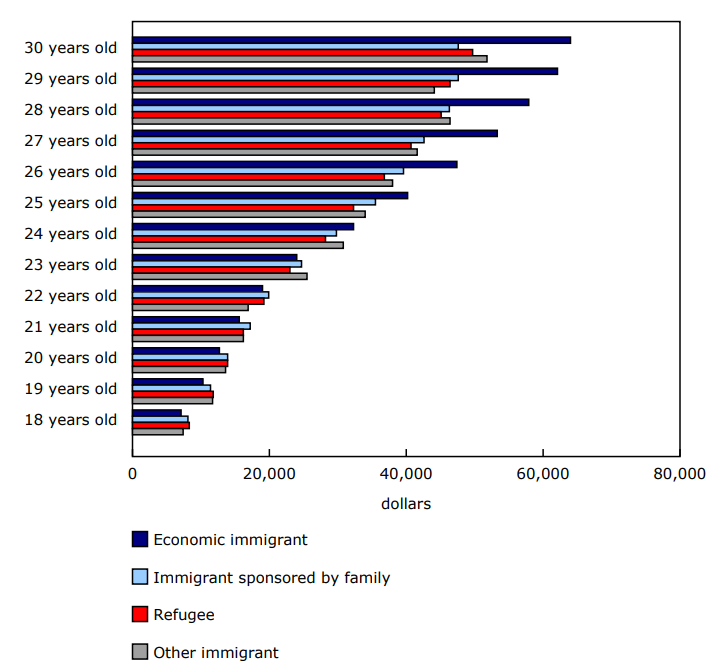
In 2022, median wages were similar across the four broad admission categories up to age 23, but from age 24 onward, those admitted under the economic category started outpacing the others. By age 30, their median wage was $64,000, 34.5% higher than family-sponsored immigrants ($47,600), 28.8% higher than refugees ($49,700), and 23.6% higher than other immigrants ($51,800). The economic category made up about 70% of immigrant taxfilers admitted as children and aged 18 to 30 in 2022.
Chart 3: Median wages, salaries and commissions for immigrant taxfilers admitted to Canada as children, by admission category, tax year 2022
Description - Chart 3
Source(s): Longitudinal Immigration Database 2023 (5057), table 43-10-0075-01.
Note to readers
The Longitudinal Immigration Database (IMDB) team is pleased to announce the release of the 2023 IMDB Children Data Module.
The release also includes a data table (43-10-0075-01) with information on immigrant taxfilers who arrived as children, including their admission cohorts, age at admission, broad admission categories, the number of years lived in a low-income household in their first four year after their admission, and their economic outcomes after reaching adulthood. The data table also includes information on all Canadian taxfilers at equivalent ages, to serve as comparative baselines.
The IMDB is a comprehensive data source that provides a better understanding of the economic behaviour of immigrants and non-permanent residents. It is the only annual Canadian dataset that allows users to study the characteristics of immigrants to Canada at time of admission and the economic outcomes and regional mobility of immigrants over a period of more than 40 years.
The IMDB is the result of a partnership between Statistics Canada, Immigration, Refugees and Citizenship Canada (IRCC) and the provinces. The IMDB combines administrative files on immigrant admissions and non-permanent resident permits from IRCC with tax files from the Canada Revenue Agency. IRCC's administrative records contain extensive information on immigrants admitted to Canada since 1952. They also include information on non-permanent residents who have been granted a temporary resident permit since 1980. Tax returns for immigrant taxfilers for 1982 and subsequent years are available.
The IMDB links short-term and long-term outcomes to characteristics at admission, such as immigrant admission category, country of origin and knowledge of official languages. The IMDB also provides information on pre-admission experience in Canada and citizenship acquisition since 2004.
Results from this release are based on Canadians (which includes both immigrants and non-immigrants) who have filed a tax return for a given tax year.
For additional information regarding the data coverage and quality of the IMDB, see the "Longitudinal Immigration Database (IMDB) Technical Report, 2023," which is a part of the series Analytical Studies: Methods and References (11-633-X).
This release analyzes income based on the median wages for the population who claimed wage, salary or commission income, excluding self-employment income. The median is the level of income at which half of the immigrant taxfilers have higher income and half have lower. Zero values are not included in the calculation of medians for individuals. All wage estimates are expressed in 2022 constant dollars to factor in inflation and enable comparisons across time in real terms.
Incidence of participation in postsecondary education is an estimate based on information on claiming tuition credits for oneself on the T1 tax return (Schedule 11) for the reference year. If the taxfiler was a student during the tax year, they may claim tuition fees (not books or expenses) paid to an educational institution of postsecondary level in Canada. Beginning in 1997, only the qualified total amount of the student is kept in the IMDB. However, any unused part of the tuition amount may be carried forward and claimed in a future year. Any amounts carried forward cannot be transferred to a spouse, parent or grandparent at a later date. In this analysis, the highest rate of participation in postsecondary education was observed at age 20 in 2022.
Immigrants admitted as children, also known as Generation 1.5, are immigrants who were admitted to Canada before the age of 15 years. This release analyzes the socioeconomic outcomes of members of this population aged 18 to 30 years.
Data on all taxfilers in Canada come from the T1 Family File, which uses data from filed tax returns to estimate income and demographic characteristics for the total Canadian population, including immigrants. For more information, users can access the Technical Reference Guide for the Annual Income Estimates for Census Families, Individuals and Seniors, T1 Family File.
Reference
Data table: 43-10-0075-01.
- Note: some data tables may best be viewed on desktop.
Definitions, data sources and methods: survey number 5057.
Previous release: Socioeconomic outcomes of immigrants admitted to Canada as children, 2022.
Contact information
For more information, or to enquire about the concepts, methods or data quality of this release, contact us (toll-free 1-800-263-1136; 514-283-8300; infostats@statcan.gc.ca) or Media Relations (statcan.mediahotline-ligneinfomedias.statcan@statcan.gc.ca).