

In January, 478,000 Canadians (-0.4%; -2,000) received regular Employment Insurance (EI) benefits, little changed from December and down slightly (-3.6%; -18,000) from the recent peak in August 2024.
Compared with January 2024, the number of regular EI beneficiaries was up by 7,500 (+1.6%) in January 2025. Ontario (+11,000; +7.4%) posted the largest year-over-year increase, which was partly offset by year-over-year declines in other provinces, most notably British Columbia (-2,500; -4.8%).
Data from the Labour Force Survey indicate that employment increased by 76,000 (+0.4%) in January, the third consecutive monthly increase. The unemployment rate declined 0.1 percentage points to 6.6% in January, marking the second consecutive monthly decline. On a year-over-year basis, the unemployment rate was up 0.9 percentage points and the number of unemployed people who had been laid off was up by 94,000 (+16.0%) to 685,000 (not seasonally adjusted).
In general, variations in the number of EI beneficiaries can reflect changes in the circumstances of different groups, including people becoming beneficiaries, those going back to work, those exhausting their regular benefits, and those no longer receiving benefits for other reasons.
To be eligible for regular EI benefits, one must have contributed to the EI program, have a valid job separation (for example, having been laid off or having quit for just cause) and have accumulated enough insurable hours.
Chart 1: Number of regular Employment Insurance beneficiaries little changed in January

Description - Chart 1
Data table: Number of regular Employment Insurance beneficiaries little changed in January
Sources: Employment Insurance Statistics (2604), table 14-10-0011-01.
The number of regular Employment Insurance recipients declines for men aged 55 years and older
In January, the number of EI recipients receiving regular benefits decreased by 1,100 (-1.3%) among men aged 55 years and older, while it edged up by 200 (+1.5%) among young women aged 15 to 24 years. There was little change for the other major demographic groups.
On a year-over-year basis, the number of people receiving regular EI benefits in January was up among women aged 25 to 54 years (+4,400; +3.9%), women aged 55 years and older (+2,000; +4.2%) and men aged 55 years and older (+1,600; +2.0%). At the same time, there were slightly fewer young men (-400; -1.2%) and young women (-300; -2.6%) who received regular EI benefits compared with January 2024.
The number of regular Employment Insurance recipients down in three provinces in January
The number of beneficiaries receiving regular EI benefits decreased in January in Newfoundland and Labrador (-900; -3.2%), Alberta (-600; -1.0%) and Saskatchewan (-200; -1.1%). For all three provinces, this was the second decline in three months.
The number of recipients receiving regular EI benefits in Manitoba edged up by 200 (+1.2%) in January, following a slight decline in November 2024 and little change in December. There was little change in January 2025 in all other provinces.
While the number of beneficiaries receiving regular EI benefits was little changed in January compared with the previous month in Ontario, it was up by 11,000 (+7.4%) on a year-over-year basis, the largest increase among all provinces. Men aged 25 to 54 years (+4,600; +7.6%) and women aged 25 to 54 years (+2,700; +6.8%) posted the largest increases, followed by men aged 55 years and older (+2,100; +10.6%) and women aged 55 years and older (+1,200; +6.9%).
Chart 2: Newfoundland and Labrador has the largest proportional decrease in regular Employment Insurance recipients in January, followed by Saskatchewan and Alberta

Sources: Employment Insurance Statistics (2604), table 14-10-0011-01.
The largest year-over-year increase in the number of regular Employment Insurance beneficiaries is among recipients who last worked in business, finance and administration occupations
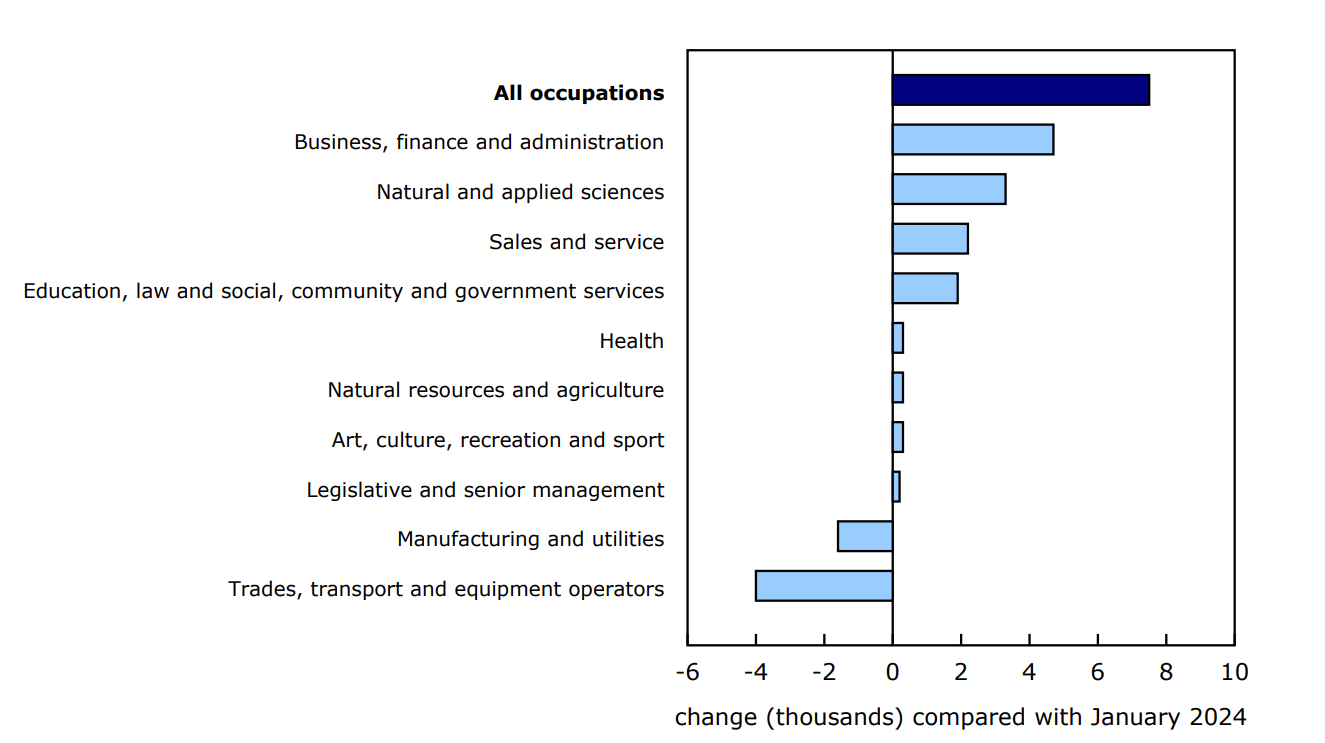
On a year-over-year basis, the number of regular EI beneficiaries in January increased the most among recipients who last worked in business, finance and administration occupations (+4,700; +8.3%) and natural and applied sciences and related occupations (+3,300; +10.2%). Increases in both of these major occupational groups were concentrated in Ontario.
At the same time, there was a decline in the number of beneficiaries who last worked in trades, transport and equipment operators and related occupations (-4,000; -2.4%) and in manufacturing and utilities occupations (-1,600; -4.3%).
Chart 3: Largest 12-month increase in regular Employment Insurance recipients among those who last worked in business, finance and administration occupations, followed by natural and applied sciences and related occupations
Sources: Employment Insurance Statistics (2604), table 14-10-0456-01.
In the spotlight: Workers receiving Employment Insurance benefits under the Work-Sharing Program
The Work-Sharing Program may introduce temporary special measures at any time to provide additional support for affected businesses during a period of economic downturn, natural disaster or national emergency. The special measures provide targeted support for impacted businesses to recover and avoid layoffs for a specific period.
Temporary flexibilities to the Employment Insurance (EI) Work-Sharing Program were announced on March 7, 2025, to support workers affected by US tariffs.
The agreement provides income support to employees eligible for EI benefits who work a temporarily reduced work week. This helps employers retain experienced workers and avoid layoffs and helps workers maintain their employment and skills while supplementing their reduced wages with EI benefits.
In January 2025, 7,600 workers received work-sharing EI benefits, little changed from 12 months earlier (6,800 workers) and representing 0.8% of all EI recipients.
The number of people receiving work-sharing EI benefits can increase significantly during economic downturns. For example, it rose to 36,000 in June 2020 during the COVID-19 pandemic and reached a peak of 68,000 in June 2009 during the 2008/2009 recession. As of January 2025, most workers receiving work-sharing EI benefits were men (5,400; 70.8%), with most of them being aged 25 to 54 years (3,600; 66.1%).
For more information about the Work-Sharing program, see Work-Sharing Program - Overview.
Table 2: Initial and renewal claims received, by province and territory – Seasonally adjusted
Table 3: Beneficiaries receiving regular income benefits, by census metropolitan area – Seasonally adjusted
Table 4: Beneficiaries receiving regular income benefits, by occupation, Canada – Seasonally adjusted
Sustainable Development Goals
On January 1, 2016, the world officially began implementing the 2030 Agenda for Sustainable Development—the United Nations' transformative plan of action that addresses urgent global challenges over the following 15 years. The plan is based on 17 specific sustainable development goals.
Employment Insurance statistics are an example of how Statistics Canada supports reporting on global sustainable development goals. This release will be used to help measure the following goal:
Note to readers
Concepts and methodology
Employment Insurance (EI) statistics are produced from administrative data sources provided by Service Canada and Employment and Social Development Canada. These statistics may, from time to time, be affected by changes to the Employment Insurance Act or administrative procedures.
EI statistics indicate the number of people who received EI benefits and should not be confused with Labour Force Survey (LFS) data, which provide estimates of the total number of unemployed people. There is always a certain proportion of unemployed people who do not qualify for benefits. Some unemployed people have not contributed to the program because they have not worked in the past 12 months or their employment was not insured. Other unemployed people have contributed to the program, but do not meet the eligibility criteria, such as workers who left their jobs voluntarily or those who did not accumulate enough hours of work to receive benefits.
All data in this release are seasonally adjusted, unless otherwise specified. To model the effects of the COVID-19 pandemic, values for all series from March 2020 to December 2022 have been treated with a combination of level shifts and outliers to determine a seasonal pattern for seasonal adjustment. For more information on seasonal adjustment, see Seasonally adjusted data – Frequently asked questions.
The number of regular EI beneficiaries for the current month and the previous month is subject to revision.
The number of beneficiaries is all people who received regular EI benefits from January 12 to 18, 2025. This period coincides with the reference week of the LFS.
A census metropolitan area (CMA) and a census agglomeration (CA) are formed by one or more adjacent municipalities centred on a population centre. A CMA must have a total population of at least 100,000. A CA must have a population of at least 10,000. See Standard Geographical Classification (SGC) 2021 for more information.
Reference
Data tables: Access the latest tables.
- Note: some data tables may best be viewed on desktop.
Definitions, data sources and methods: survey number 2604.
Previous release: Employment Insurance, December 2024.
Next release: April 17, 2025.
Contact information
For more information, or to enquire about the concepts, methods or data quality of this release, contact us (toll-free 1-800-263-1136; 514-283-8300; infostats@statcan.gc.ca) or Media Relations (statcan.mediahotline-ligneinfomedias.statcan@statcan.gc.ca).