
The 2021 Census of Population revealed that 243,155 people reported the ability to speak an Indigenous language well enough to conduct a conversation. There were more than 70 distinct Indigenous languages reported on the census questionnaire. Within this rich diversity of Indigenous languages, the data reveal varying levels of vitality and patterns of acquisition and use.
The history of colonial practices in Canada has had a profoundly negative impact on the use of Indigenous languages. Perhaps most notably, the Truth and Reconciliation Commission report detailed many of the harms done to the languages of First Nations, Métis and Inuit children through the residential school system, in an effort to assimilate Indigenous people and break their ties to their culture.
In response to the Calls to Action by the Truth and Reconciliation Commission, the Indigenous Languages Act was passed in 2019. With its passage, the Office of the Commissioner of Indigenous Languages was created to "help promote Indigenous languages and support the efforts of Indigenous peoples to reclaim, revitalize, maintain and strengthen their languages."
Today, the Centre for Indigenous Statistics and Partnerships at Statistics Canada, in collaboration with the Office of the Commissioner of Indigenous Languages, is releasing nine new reports on Indigenous languages in Canada, providing relevant data on the vitality and patterns of language acquisition and use. Among these reports, eight are framed around one of the major Indigenous language families in Canada—Algonquian, Athabaskan, Inuktut (Inuit), Iroquoian, Salish, Siouan, Tsimshian and Wakashan—and one report focuses on languages that are not part of any specific family (Haida, Ktunaxa [Kutenai] and Michif).
Algonquian, Inuktut (Inuit) and Athabaskan language families are those spoken most often
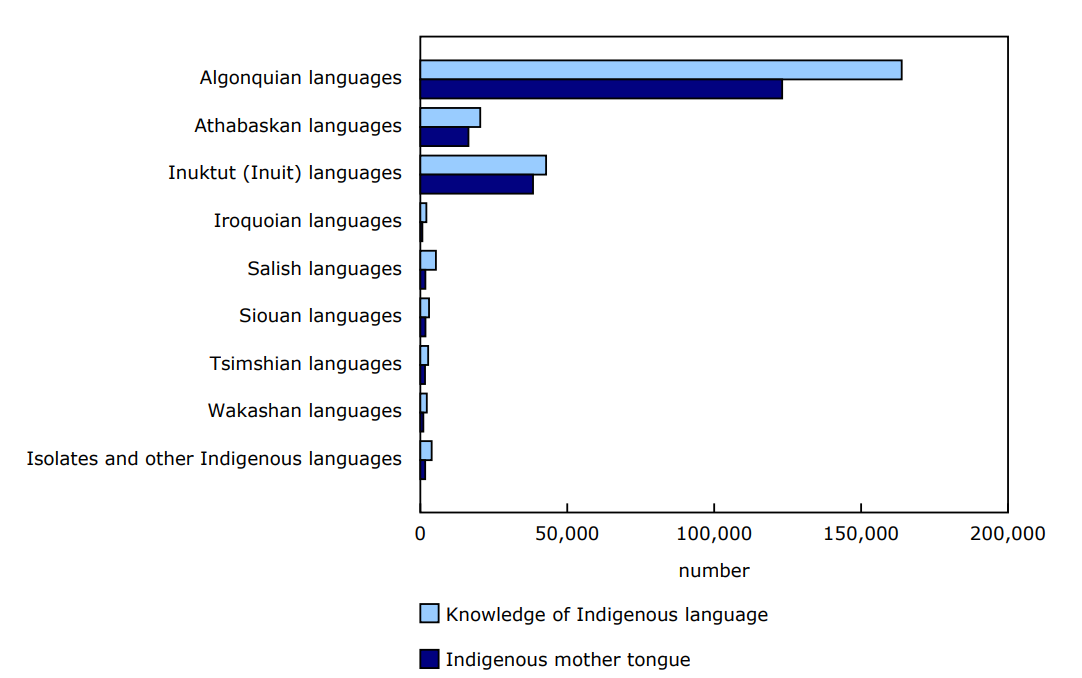
Indigenous languages are generally classified into one of eight major language families, such as Athabaskan languages or Inuktut (Inuit) languages. In terms of language knowledge, the largest Indigenous language family in 2021 was Algonquian languages, with 163,815 speakers. The most commonly spoken Algonquian languages were Cree languages (87,875 speakers), Ojibway languages (26,165) and Oji-Cree (15,305).
The language family with the second-highest number of speakers was Inuktut (Inuit) languages (42,800 speakers). Inuktitut (41,675) was the largest Inuktut (Inuit) language, followed by Inuinnaqtun (790) and Inuvialuktun (355).
Athabaskan languages (20,390) was the language family with the third-highest number of speakers. The most commonly spoken Athabaskan languages were Dene, not otherwise specified (11,560 speakers), Slavey-Hare languages (2,325) and Tlicho (Dogrib) (2,135).
Mother tongue refers to the first language a person learned in childhood and still understands. As with knowledge, the Indigenous language families with the largest mother tongue populations were Algonquian languages, Inuktut (Inuit) languages and Athabaskan languages.
Chart 1: Knowledge of an Indigenous language and Indigenous mother tongue by Indigenous language family, Canada, 2021
Description - Chart 1
Data table: Knowledge of an Indigenous language and Indigenous mother tongue by Indigenous language family, Canada, 2021
Notes: Isolates and other Indigenous languages include Haida; Ktunaxa (Kutenai); Michif; Indigenous languages, not included elsewhere; and Indigenous languages, not otherwise specified.
Source: Census of Population, 2021 (3901).
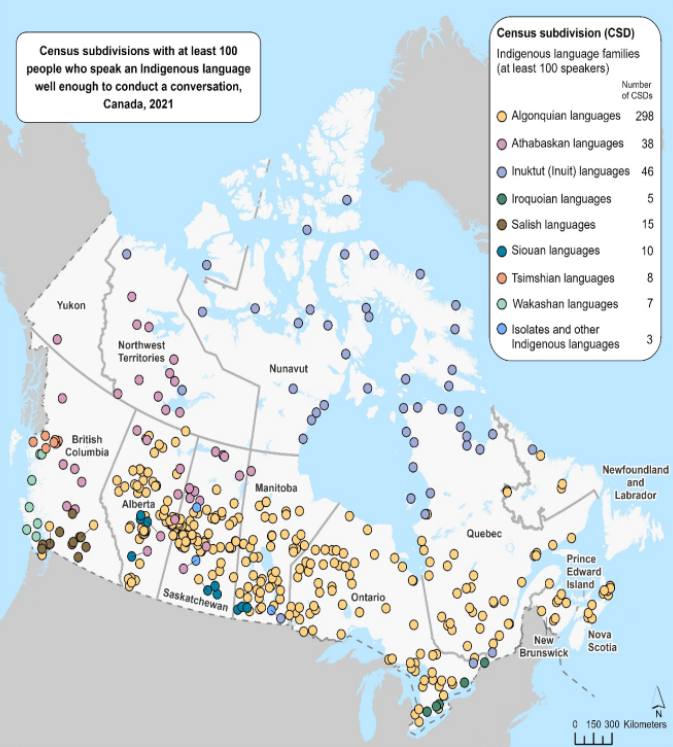
Indigenous languages are intrinsically tied to geography, as the traditional territories of many First Nations people, Métis and Inuit continue to be the same places where these languages are most likely to be spoken. Speakers of Indigenous languages belonging to the Algonquian language family are spread throughout the country, from as far east as Atlantic Canada to as far west as the Peace River region in British Columbia.
Conversely, nearly all speakers of many other Indigenous language families in Canada are concentrated in smaller areas. For example, almost all speakers of Salish languages lived in southern British Columbia. In the North, speakers of Inuktut (Inuit) languages were most likely to live throughout Inuit Nunangat—the homeland of Inuit in Canada—which comprises four regions: Nunatsiavut (Northern coastal Labrador), Nunavik (Northern Quebec), the territory of Nunavut and the Inuvialuit region of the Northwest Territories.
Map 1: Census subdivisions with at least 100 people who speak an Indigenous language well enough to conduct a conversation, Canada, 2021
Description - Map 1
The title of the map is "Census subdivisions with at least 100 people who speak an Indigenous language well enough to conduct a conversation, Canada, 2021"
This is a map of Canada showing census subdivisions (CSDs) with at least 100 people who speak an Indigenous language well enough to conduct a conversation. Each CSD with at least 100 speakers is marked with a coloured dot, which corresponds to the Indigenous language family that is spoken there.
In 2021, there were 298 CSDs with at least 100 speakers of Algonquian languages, 38 CSDs with at least 100 speakers of Athabaskan languages, 46 CSDs with at least 100 speakers of Inuktut (Inuit) languages, 5 CSDs with at least 100 speakers of Iroquoian languages, 15 CSDs with at least 100 speakers of Salish languages, 10 CSDs with at least 100 speakers of Siouan languages, 8 CSDs with at least 100 speakers of Tsimshian languages, 7 CSDs with at least 100 speakers of Wakashan languages and 3 CSDs with at least 100 speakers of isolates and other Indigenous languages.
Source: Census of Population, 2021 (3901).
Indigenous languages with younger age profiles tend to be spoken more often at home
The average age of the mother tongue population of an Indigenous language is an indicator of the intergenerational transmission of the language. A young average age for an Indigenous language implies that children are continuing to acquire it as their first language.
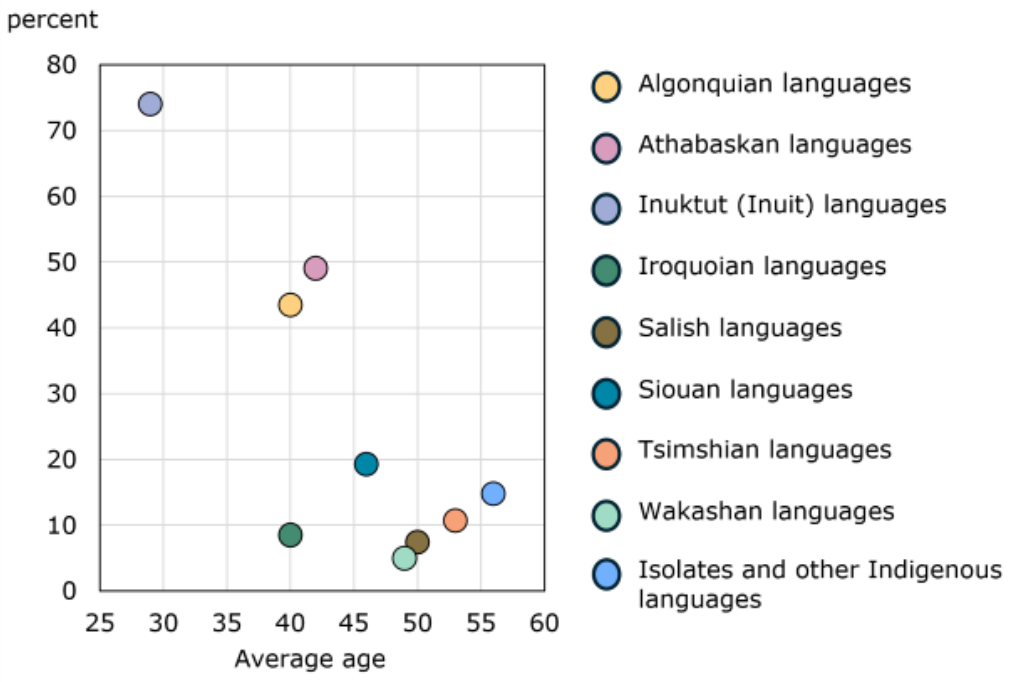
In 2021, language families with younger age profiles tended to be spoken more often at home than those with older age profiles (chart 2). For example, Inuktut (Inuit) languages were the language family with the youngest average age (29 years) among people with an Indigenous mother tongue. It was also the language family where speakers were most likely to speak the language most often at home (74%).
Chart 2: Proportion of Indigenous language speakers who speak their language most often at home by average age of mother tongue population, for Indigenous language families, Canada, 2021
Description - Chart 2
The title of the chart is "Proportion of Indigenous language speakers who speak their language most often at home by average age of mother tongue population, for Indigenous language families, Canada, 2021"
This chart is a scatterplot with a dot for every Indigenous language family. It compares the proportion of Indigenous language speakers who speak their language most often at home on the y-axis with the average age of the mother tongue population of that same language family on the x-axis.
The average age of the mother tongue population of Algonquian languages was 40 years and the proportion of speakers who used their language most often at home was 43%.
The average age of the mother tongue population of Athabaskan languages was 42 years and the proportion of speakers who used their language most often at home was 49%.
The average age of the mother tongue population of Inuktut (Inuit) languages was 29 years and the proportion of speakers who used their language most often at home was 74%.
The average age of the mother tongue population of Iroquoian languages was 40 years and the proportion of speakers who used their language most often at home was 9%.
The average age of the mother tongue population of Salish languages was 50 years and the proportion of speakers who used their language most often at home was 7%.
The average age of the mother tongue population of Siouan languages was 46 years and the proportion of speakers who used their language most often at home was 19%.
The average age of the mother tongue population of Tsimshian languages was 53 years and the proportion of speakers who used their language most often at home was 11%.
The average age of the mother tongue population of Wakashan languages was 49 years and the proportion of speakers who used their language most often at home was 5%.
The average age of the mother tongue population of Isolates and other Indigenous languages was 56 years and the proportion of speakers who used their language most often at home was 15%.
Source: Census of Population, 2021 (3901).
Almost one-third of Indigenous language speakers learn their language as a second language
Data from the Census of Population revealed that the share of Indigenous language speakers who learned their language as a second language rose from 25.7% in 2016 to 29.5% in 2021. The remaining share (70.5%) learned it as their mother tongue.
Those who learned an Indigenous language as their mother tongue were more likely to speak it at home, at least on a regular basis. Among Indigenous language speakers who learned the language as their mother tongue, 82.1% spoke it at home (61.4% most often and 20.7% on a regular basis). Among those who learned an Indigenous language as a second language, 55.8% spoke it at home (12.5% most often and 43.3% on a regular basis).
Finally, researchers and advocates for Indigenous languages have pointed to another group, often called "silent speakers." This term refers to those who have an Indigenous mother tongue that they still understand but can no longer speak well enough to conduct a conversation. In some circumstances, this may reflect those who have not continued to use their mother tongue over time or those who do not have a community of other speakers of the same language with whom to converse. In 2021, among the 185,510 people in Canada with an Indigenous mother tongue, 7.6% were silent speakers of an Indigenous language.
Note to readers
This release provides an overview of the vitality, acquisition and use of the different Indigenous languages spoken across Canada, using data from the 2021 Census of Population.
The nine reports present relevant data on the vitality of Indigenous languages, along with patterns of language acquisition and use. Languages are grouped in their respective language families, comprising eight families and a group of three languages not affiliated with any specific family. Furthermore, maps within each report show selected communities with speakers of various Indigenous languages, providing a regional perspective on the extent to which Indigenous languages are spoken across Canada.
Mother tongue refers to the first language learned in childhood that is still understood.
Knowledge of a language refers to whether a person reported they could conduct a conversation in the language.
Average age is presented as an indicator because the age of language speakers provides an indication of the general health of a language.
Second language refers to those who could speak an Indigenous language, but who did not report that same language as their mother tongue.
Silent speakers are people who have an Indigenous mother tongue that they still understand but can no longer speak well enough to conduct a conversation.
Language spoken at home refers to a language a person spoke at home on a regular basis at the time of data collection. People who report speaking a given language speak it at least on a regular basis, alone or with other languages. People who only speak a given language most often at home speak the language predominantly.
Reference
Definitions, data sources and methods: survey number 3901.
Contact information
For more information, or to enquire about the concepts, methods or data quality of this release, contact us (toll-free 1-800-263-1136; 514-283-8300; infostats@statcan.gc.ca) or Media Relations (statcan.mediahotline-ligneinfomedias.statcan@statcan.gc.ca).