

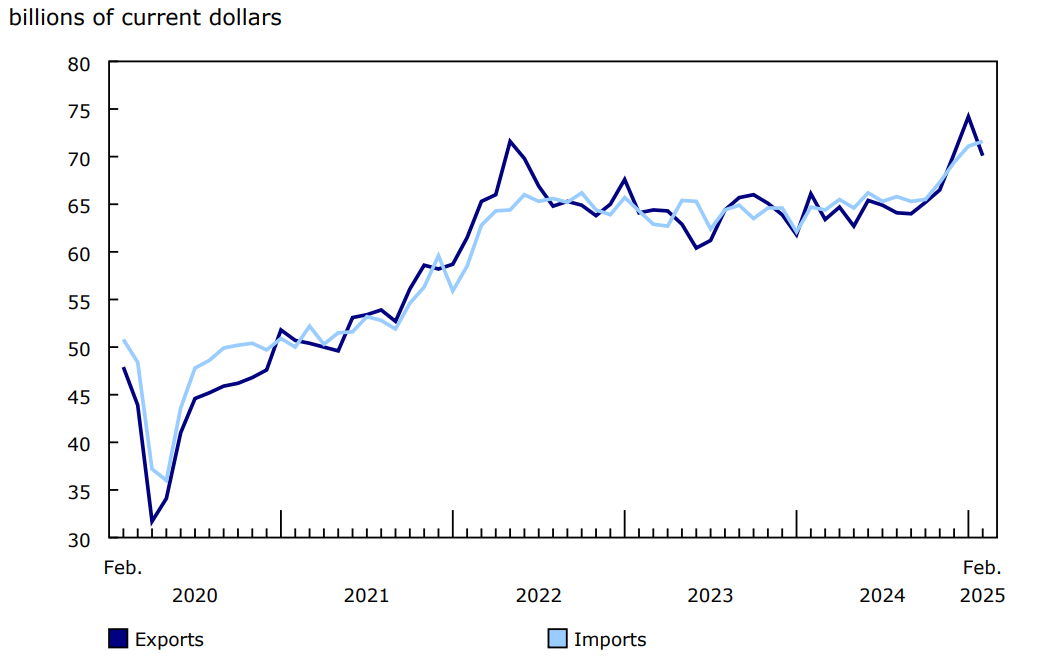
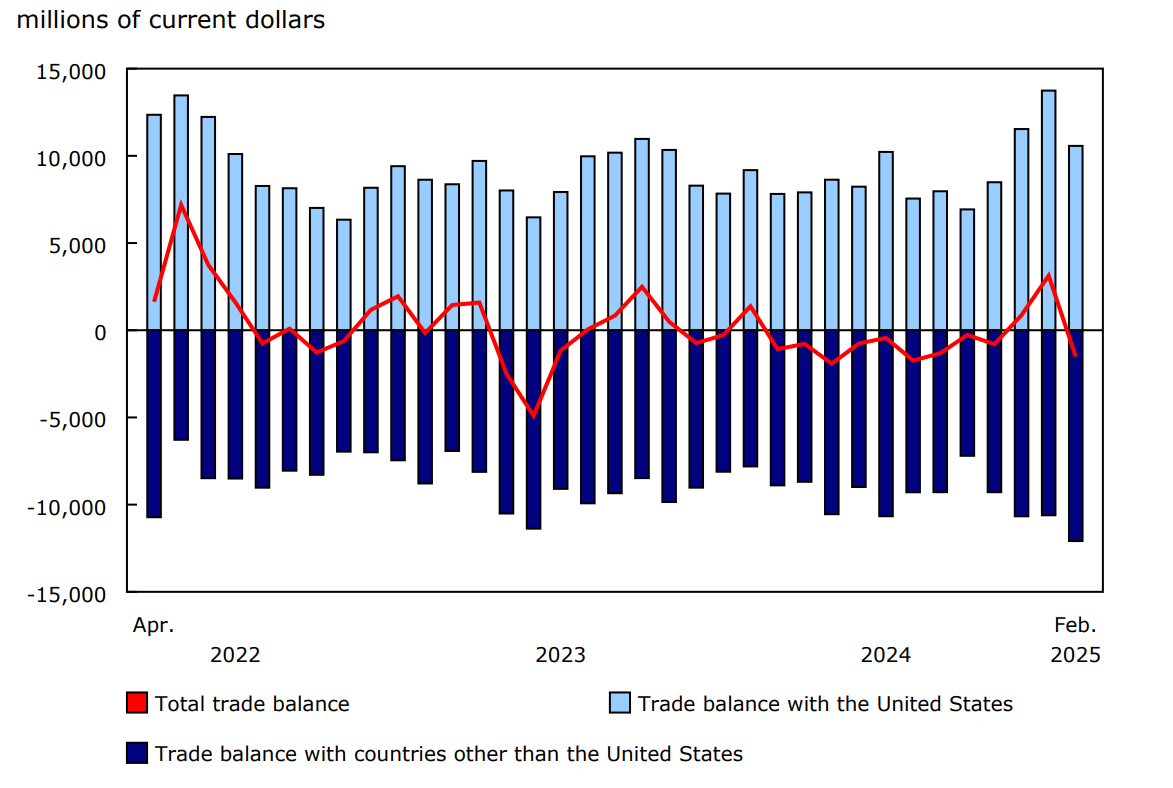
In February, Canada's merchandise exports decreased 5.5%, while imports were up 0.8%. As a result, Canada's merchandise trade balance with the world went from a surplus of $3.1 billion in January to a deficit of $1.5 billion in February.
Due to the implementation of the Canada Border Services Agency (CBSA) Assessment and Revenue Management (CARM) digital initiative and delays in the receipt of merchandise import data at Statistics Canada, estimates were added to the collected values in order to produce a more complete picture of Canada's import activity from November 2024 to February 2025. Please see the Note to readers below for more information.
Consult the "International trade monthly interactive dashboard" to explore the most recent results of Canada's international trade in an interactive format.
Chart 1: Merchandise exports and imports
Description - Chart 1
Data table: Merchandise exports and imports
Notes: Data are on a balance-of-payments basis and are seasonally adjusted.
Source: Table 12-10-0163-01.
Exports down in February following four consecutive monthly increases
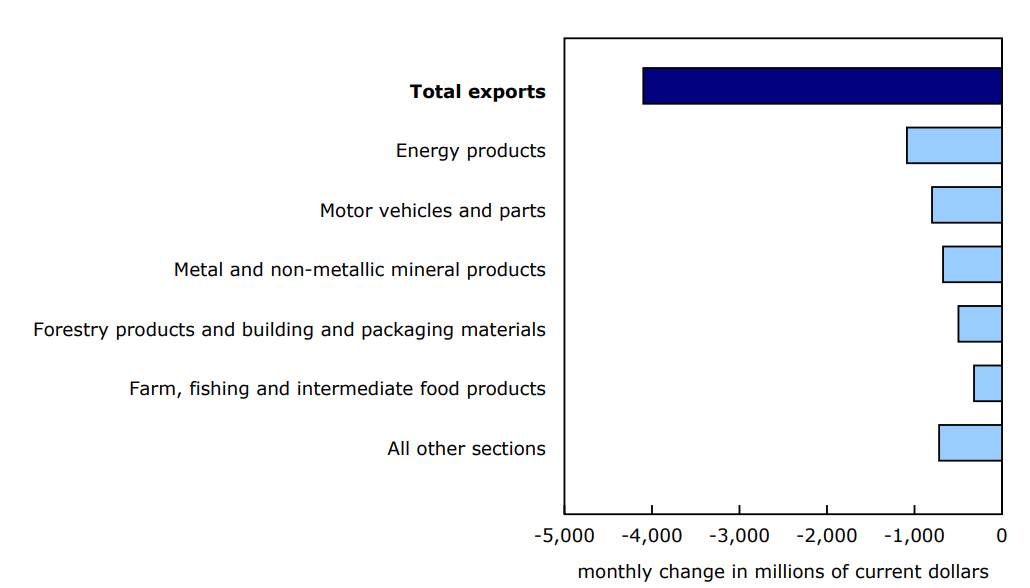
After increasing 15.9% from September 2024 to January 2025, total exports decreased 5.5% in February. The strong volatility in recent months occurred amid threats by the United States to impose tariffs on Canadian goods. Overall, declines were observed in 10 of the 11 product sections. In real (or volume) terms, total exports declined 5.0% in February, following a real increase of 4.8% in January.
Chart 2: Contribution to the monthly change in exports, by product, February 2025
Description - Chart 2
Data table: Contribution to the monthly change in exports, by product, February 2025
Notes: Data are on a balance-of-payments basis and are seasonally adjusted.
Source: Table 12-10-0163-01.
Exports of energy products (-6.3%) posted the largest decline in February, the first decrease since September 2024. Several product subcategories contributed to the decline in February 2025. Exports of crude oil (-4.2%) fell on lower prices; refined petroleum product exports (-15.3%) were down due to lower shipments of diesel, mainly to the United States and Panama; coal exports (-26.9%) decreased primarily on lower shipments to Asian countries; and exports of natural gas (-8.9%) fell mostly on lower prices. Excluding energy products, total exports were down 5.3% in February.
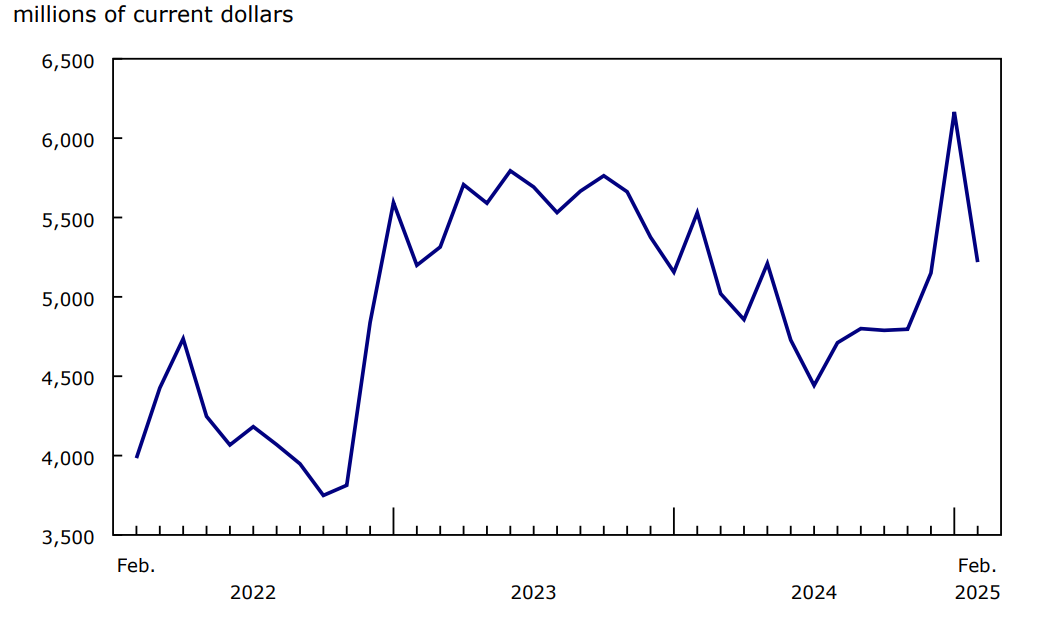
After reaching their highest level since 2000 in January, exports of motor vehicles and parts (-8.8%) decreased in February, mainly because of lower exports of passenger cars and light trucks (-15.3%). This decline came after these exports—in the context of tariff threats—reached a peak in January 2025. The Canadian auto manufacturing industry is deeply integrated with the US industry, as 93.4% of exports of passenger cars and light trucks were destined to the United States in 2024 on a customs basis.
Chart 3: Exports of passenger cars and light trucks
Description - Chart 3
Data table: Exports of passenger cars and light trucks
Notes: Data are on a balance-of-payments basis and are seasonally adjusted.
Source: Table 12-10-0163-01.
After posting four consecutive monthly increases, exports of metal and non-metallic mineral products fell 6.6% in February. Exports of unwrought gold, silver and platinum group metals and their alloys—a category largely composed of unwrought gold—posted the largest decline (-5.9%). In February, exports of unwrought gold to the United Kingdom and the United States were down. After posting a strong increase in January, exports of basic and semi-finished iron and steel products (-11.2%) also contributed to the decrease in February, mostly on lower shipments to the United States.
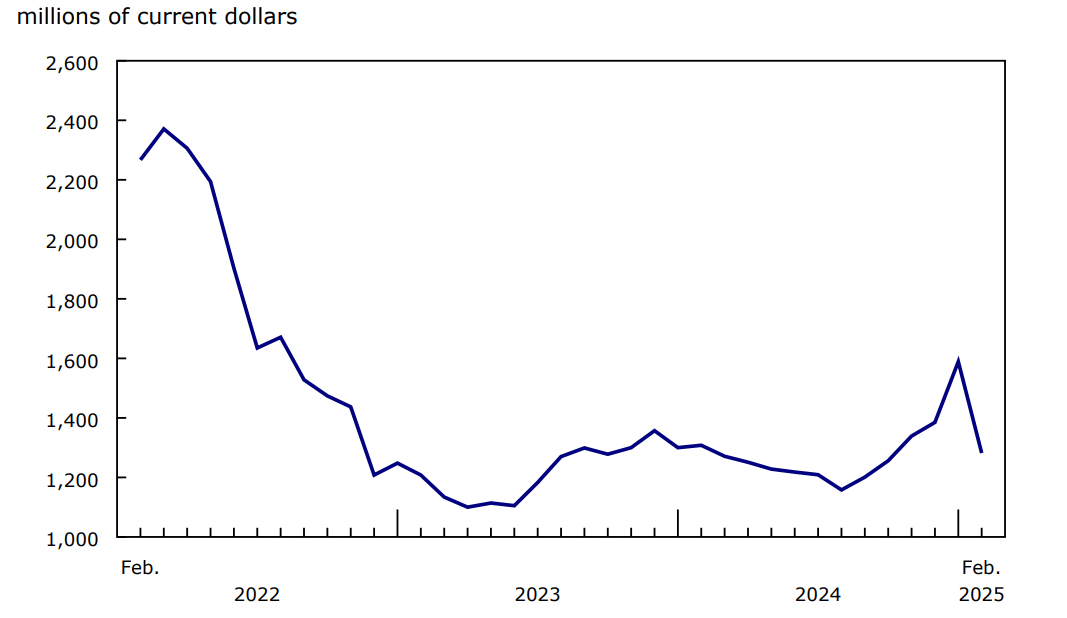
Following three consecutive monthly increases, exports of forestry products and building and packaging materials declined 10.8% in February. Exports of lumber and other sawmill products (-19.3%) saw the largest decrease. Most Canadian lumber exports are destined to the United States, which has been imposing countervailing and anti-dumping duties on Canadian lumber imports since 2017. Pulp and paper exports (-13.0%) also fell in February, mainly because of lower exports to the United States. This decrease follows two consecutive monthly increases.
Chart 4: Exports of lumber and other sawmill products
Description - Chart 1
Data table: Exports of lumber and other sawmill products
Notes: Data are on a balance-of-payments basis and are seasonally adjusted.
Source: Table 12-10-0163-01.
Exports of aircraft and other transportation equipment and parts (+9.7%) partially offset the overall decrease in February, mainly on an increase in exports of aircraft (+29.6%). Higher shipments of business jets to the United States contributed the most to the monthly increase.
Imports rise in February for a fifth consecutive month
After increasing 2.4% in January, total imports rose 0.8% in February, a fifth consecutive monthly gain. The largest contributors to the increase in February were imports of motor vehicles and parts (+5.8%), industrial machinery, equipment and parts (+3.1%), energy products (+5.2%) and metal and non-metallic mineral products (+3.5%). In real (or volume) terms, total imports (+0.0%) were essentially unchanged in February.
Statistics on imports are primarily based on administrative data from the CBSA and are generally not subject to significant estimation. However, given delays in the receipt of import data for November 2024 through February 2025 due to the CARM digital initiative, estimated values were added to a majority of the product categories to compensate for the outstanding transactions. Users of merchandise import statistics should exercise caution when analyzing and interpreting the data and should expect significant revisions to the results for these months in future publications. Please see the Note to readers below for more information.
Similar decreases in exports to the United States and to countries other than the United States
After rising for three consecutive months and reaching a record high in January, exports to the United States were down 3.6% in February, representing a decrease of $2.1 billion. Meanwhile, imports rose 2.5% in February. As a result, Canada's merchandise trade surplus with the United States went from a record of $13.7 billion in January to $10.6 billion in February.
Exports to countries other than the United States fell 12.4% in February, representing a decline of $2.0 billion. Lower exports to the United Kingdom (unwrought gold) and Germany (various products) were partially offset by higher exports to South Korea (various products). Imports from countries other than the United States were down 2.0% in February. Canada's trade deficit with countries other than the United States widened from $10.6 billion in January to a record $12.1 billion in February.
Focus on Canada and the United States
Recent announcements by the US government of broad new tariffs on imports of Canadian-origin goods, and Canadian retaliatory tariffs on imports of US-origin goods may shape future trends in Canadian international merchandise trade statistics. By examining Canada's domestic exports to the United States and Canada's imports of US-origin goods within customs basis statistics, the relevant measure for the issue of tariffs, the potential impact of these tariffs can be brought into focus.
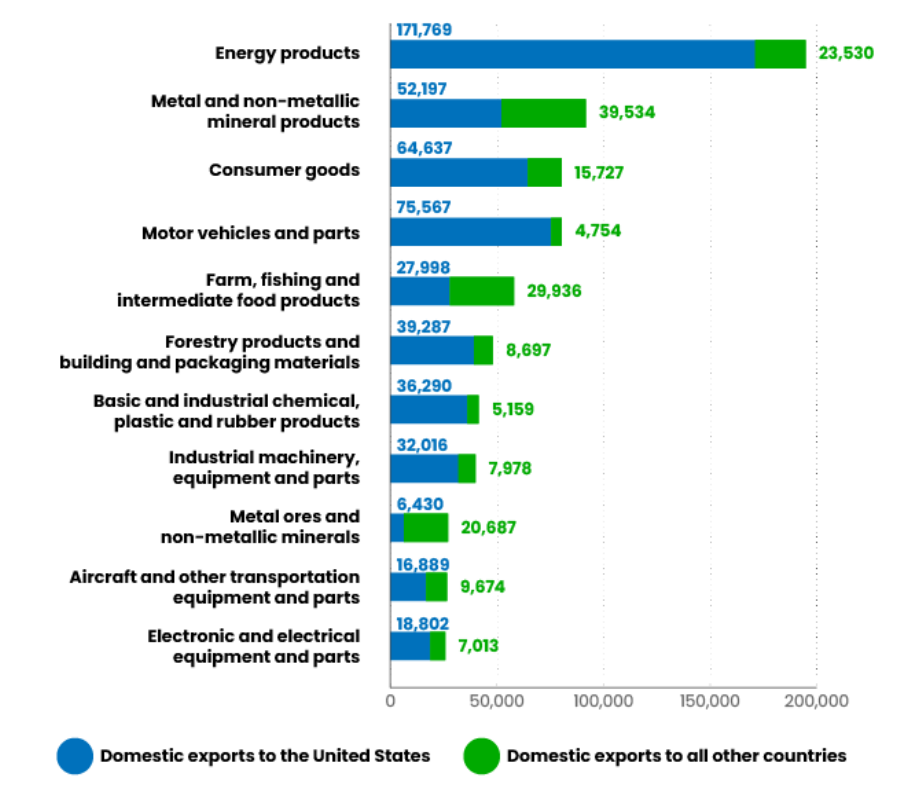
In 2024, Canada's domestic exports totalled $721.1 billion, with 75.9% of these exports destined to the United States. Energy products was the top export product category by far at $195.3 billion, with the vast majority (88.0%) of these exports being sent to the US market. Canada's next largest export category in 2024 was metal and non-metallic mineral products, with domestic exports of $91.7 billion, 56.9% of which were shipped to the United States.
The product category with the largest percentage of domestic exports sent to the United States in 2024 was motor vehicles and parts, at 94.1% of the $80.3 billion recorded. The category with the lowest percentage of domestic exports destined to the United States was metal ores and non-metallic minerals, at 23.7% of the $27.1 billion exported.
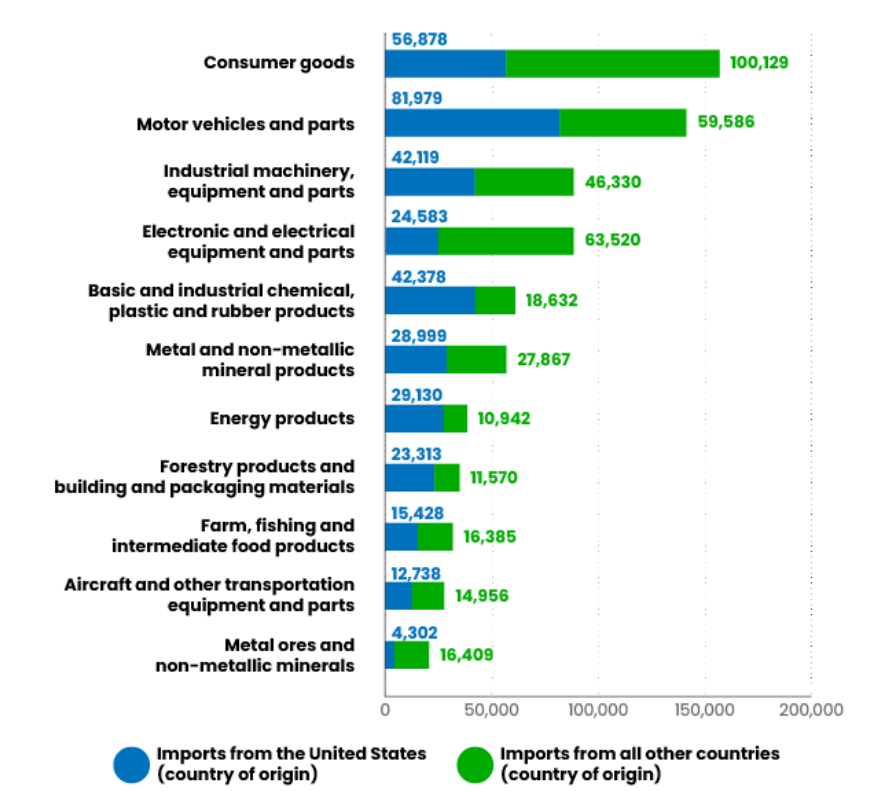
Canada's imports totalled $764.9 billion in 2024, with 49.2% of these imports being goods from the United States on a country-of-origin basis (which exclude US re-exports of goods originally produced in other countries). Consumer goods was the top import product category at $157.0 billion, with 36.2% of these imports being of US origin. This was followed by motor vehicles and parts at $141.6 billion, with US origin goods representing 57.9% of these imports.
For imports in 2024, the product category with the largest US-origin share was energy products, at 72.7% of the $40.1 billion imported. Metal ores and non-metallic minerals had the lowest share of US-origin products, at 20.8% of the $20.7 billion imported.
These results are summarized in charts 5 and 6, and additional details, including more specific product groupings and trade with other specific partner countries, are available in tables 12-10-0178-01 and 12-10-0179-01.
For more data and insights on areas touched by the socio-economic relationship between Canada and the United States, see the Focus on Canada and the United States webpage.
Chart 5: Canadian domestic exports in millions of current dollars, annual 2024
Description - Chart 5
The title of the chart is "Canadian domestic exports in millions of current dollars, annual 2024"
This is a bar chart.
The vertical axis shows the 11 product categories while the horizontal axis shows their annual export values in millions of current dollars for the year 2024.
The value of each bar is derived from two sub-categories: "Domestic exports to all other countries" and "Domestic exports to the United States".
The bars are sorted in descending order by total value and display the following in millions of current dollars:
The energy products category had domestic exports to all other countries of 23,530 while domestic exports to the United States were 171,769.
The metal and non-metallic mineral products category had domestic exports to all other countries of 39,534 while domestic exports to the United States were 52,197.
The consumer goods category had domestic exports to all other countries of 15,727 while domestic exports to the United States were 64,637.
The motor vehicles and parts category had domestic exports to all other countries of 4,754 while domestic exports to the United States were 75,567.
The farm, fishing and intermediate food products category had domestic exports to all other countries of 29,936 while domestic exports to the United States were 27,998.
The forestry products and building and packaging materials category had domestic exports to all other countries of 8,697 while domestic exports to the United States were 39,287.
The basic and industrial chemical, plastic and rubber products category had domestic exports to all other countries of 5,159 while domestic exports to the United States were 36,290.
The industrial machinery, equipment and parts category had domestic exports to all other countries of 7,978 while domestic exports to the United States were 32,016.
The metal ores and non-metallic minerals category had domestic exports to all other countries of 20,687 while domestic exports to the United States were 6,430.
The aircraft and other transportation equipment and parts category had domestic exports to all other countries of 9,674 while domestic exports to the United States were 16,889.
The electronic and electrical equipment and parts category had domestic exports to all other countries of 7,013 while domestic exports to the United States were 18,802.
Source: Table 12-10-0179-01.
Chart 6: Canadian imports in millions of current dollars, annual 2024
Description - Chart 6
The title of the chart is "Canadian imports in millions of current dollars, annual 2024"
This is a bar chart.
The vertical axis shows the 11 product categories while the horizontal axis shows their annual import values in millions of current dollars for the year 2024.
The value of each bar is derived from two sub-categories: "Imports from all other countries (country of origin)" and "Imports from the United States (country of origin)".
The bars are sorted in descending order by total value and display the following in millions of current dollars:
The consumer goods category had imports from all other countries (country of origin) of 100,129 while imports from the United States (country of origin) were 56,878.
The motor vehicles and parts category had imports from all other countries (country of origin) of 59,586 while imports from the United States (country of origin) were 81,979.
The industrial machinery, equipment and parts category had imports from all other countries (country of origin) of 46,330 while imports from the United States (country of origin) were 42,119.
The electronic and electrical equipment and parts category had imports from all other countries (country of origin) of 63,520 while imports from the United States (country of origin) were 24,583.
The basic and industrial chemical, plastic and rubber products category had imports from all other countries (country of origin) of 18,632 while imports from the United States (country of origin) were 42,378.
The metal and non-metallic mineral products category had imports from all other countries (country of origin) of 27,867 while imports from the United States (country of origin) were 28,999.
The energy products category had imports from all other countries (country of origin) of 10,942 while imports from the United States (country of origin) were 29,130.
The forestry products and building and packaging materials category had imports from all other countries (country of origin) of 11,570 while imports from the United States (country of origin) were 23,313.
The farm, fishing and intermediate food products category had imports from all other countries (country of origin) of 16,385 while imports from the United States (country of origin) were 15,428.
The aircraft and other transportation equipment and parts category had imports from all other countries (country of origin) of 14,956 while imports from the United States (country of origin) were 12,738.
The metal ores and non-metallic minerals category had imports from all other countries (country of origin) of 16,409 while imports from the United States (country of origin) were 4,302.
Source: Table 12-10-0178-01.
Chart 7: International merchandise trade balance
Description - Chart 7
Notes: Data are on a balance-of-payments basis and are seasonally adjusted.
Source: Table 12-10-0011-01.
Note to readers
Information on concepts and methods used for the monthly release of Canada's international merchandise trade is now available online. Please see "Notes on the monthly release of Canadian international merchandise trade" for more details.
For a detailed overview of the Canadian International Merchandise Trade program, please see "Guide to Canadian International Merchandise Trade Statistics."
Important notice to users of import statistics following the implementation of CBSA Assessment and Revenue Management (CARM)
Statistics Canada's primary data source used in the compilation of import statistics is undergoing a major transition as a result of the Canada Border Services Agency (CBSA) Assessment and Revenue Management (CARM) digital initiative, implemented on October 21, 2024. Despite improved coverage since the last publication of Canadian International Merchandise Trade statistics, delays in the receipt of import data at Statistics Canada continue to impact the completeness and quality of import statistics.
Analysis indicates that additional data volumes will be received after Statistics Canada's deadline for monthly collection for the reference months of November 2024 through February 2025. While strategies for producing estimates to account for the late receipt of data have been enhanced to maximize the comprehensiveness of merchandise trade indicators for these months, Statistics Canada's ability to respond to these issues is limited.
Canadian International Merchandise Trade statistics are produced on both a customs basis and a balance-of-payments basis. Customs basis statistics are highly detailed and multidimensional, while more aggregated balance-of-payments basis statistics are aligned with Canada's macroeconomic accounting framework and are the source for key indicators related to merchandise trade. Within the customs basis statistics, the use of estimates is limited compared with the balance-of-payments basis statistics, relying on placeholder estimates within the special transactions category to partially account for data expected to be received at a later date. Within balance-of-payments basis statistics, estimation is more comprehensive in order to produce a more complete picture of Canada's import activity throughout the various categories for the affected months.
In light of the issues that are temporarily impacting the completeness and quality of international merchandise trade statistics, users should exercise caution and expect material revisions until the situation stabilizes. This is particularly true for import statistics on a customs basis, where estimation is more limited. While revisions to balance-of-payments basis statistics may be less apparent at the total import level, values by category will still be subject to material revisions as actual data replace estimates. Statistics Canada will provide further updates as new information becomes available.
Real-time data table
The real-time data table 12-10-0165-01 will be updated on April 14.
Reference
Data tables: Access the latest tables.
- Note: some data tables may best be viewed on desktop.
Definitions, data sources and methods: See the associated survey numbers.
Previous release: Canadian international merchandise trade, January 2025.
Next release: May 6, 2025.
Contact information
For more information, or to enquire about the concepts, methods or data quality of this release, contact us (toll-free 1-800-263-1136; 514-283-8300; infostats@statcan.gc.ca) or Media Relations (statcan.mediahotline-ligneinfomedias.statcan@statcan.gc.ca).