

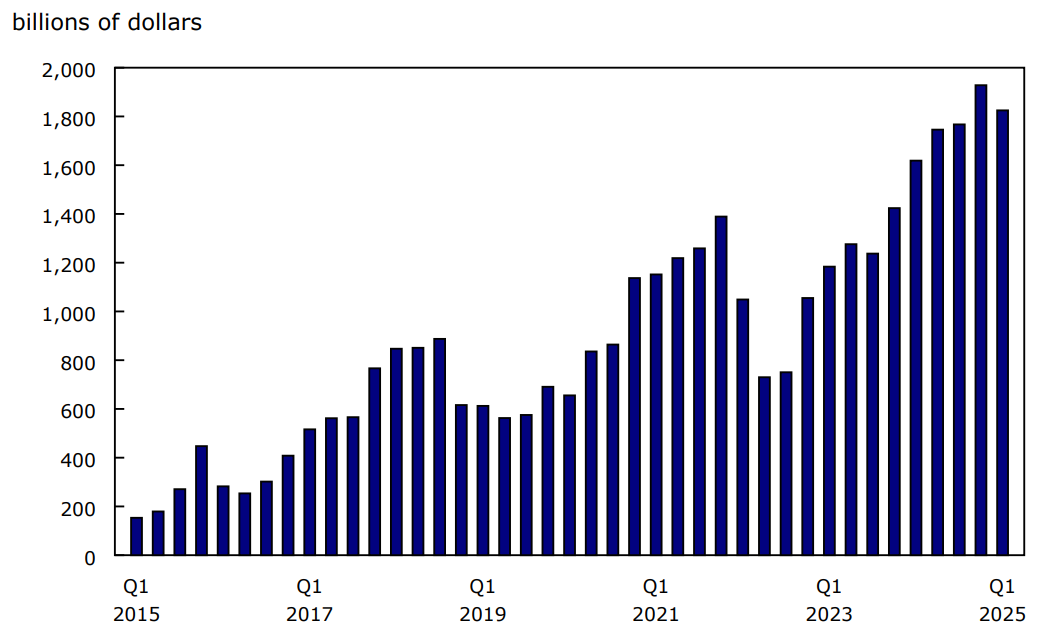
Canada's net foreign asset position—the difference between Canada's international financial assets and international liabilities—was down by $103.2 billion to $1,824.8 billion at the end of the first quarter of 2025, the first decrease since the third quarter of 2023.
Chart 1: Canada's net international investment position
Description - Chart 1
Data table: Canada's net international investment position
Note: Q = quarter.
Source: Table 36-10-0485-01.
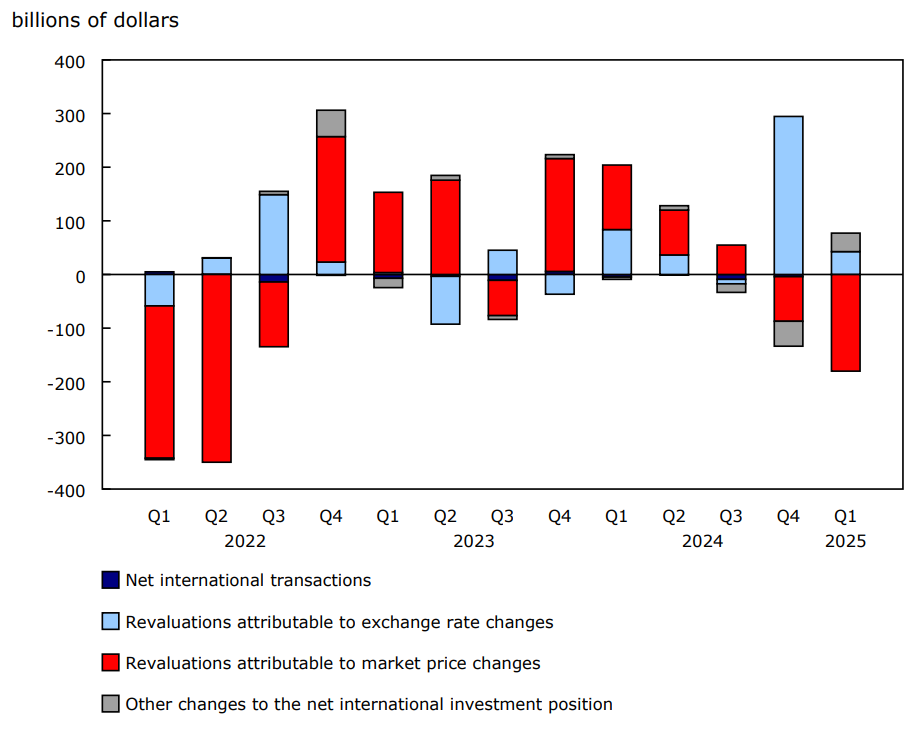
The revaluation effect resulting from market price changes (-$180.1 billion) contributed the most to the decrease in Canada's net foreign asset position in the first quarter, which is strongly influenced by the performance of global stock markets. While the Canadian (+0.8%) and European (+7.2%) stock markets grew, the US stock market fell by 4.6%, resulting in an overall decline in the value of Canada's international assets in the form of equity instruments which are predominantly held in the United States.
The revaluation effect from fluctuations in exchange rates (+$42.6 billion), which increased the value of assets more than the value of liabilities in the first quarter, moderated the overall decline in Canada's net foreign asset position. Over the quarter, the Canadian dollar edged up 0.09% against the US dollar, but depreciated against the euro (-3.9%), the British pound (-2.9%), and the Japanese yen (-4.4%).
At the end of the first quarter, 96.7% of Canada's international assets were denominated in foreign currencies (67.2% in US dollars and 8.3% in euros) compared with 40.8% of its international liabilities (29.4% in US dollars and 4.4% in euros).
Chart 2: Contributors to the change in the net international investment position
Description - Chart 2
Data table: Contributors to the change in the net international investment position
Note: Q = quarter.
Source: Table 36-10-0454-01.
Canada's international assets decrease
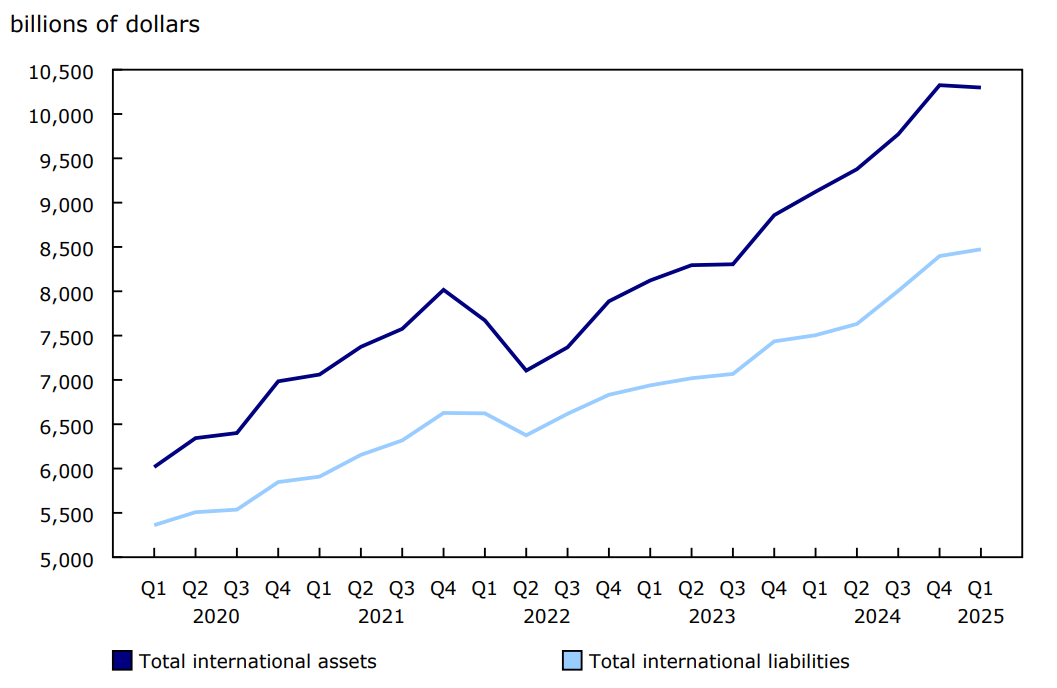
Canada's international assets were down by $26.9 billion to $10,298.3 billion at the end of the first quarter, the first decrease since the second quarter of 2022. The decrease was largely attributable to the decline in US equity prices. The revaluation due to exchange rate movements (+$55.1 billion), mainly the euro, and new investments abroad (+$51.2 billion), mostly acquisitions of foreign securities, moderated the decrease.
On the other side of the ledger, Canada's international liabilities increased by $76.3 billion to $8,473.4 billion. This increase was primarily the result of an upward revaluation due to fluctuations in market prices (+$74.8 billion). Foreign borrowing activity, mainly in the form of debt securities, also contributed to the increase. Foreign divestments in Canadian equity securities (-$40.6 billion) moderated the overall increase.
Chart 3: Canada's international assets and liabilities
Description - Chart 3
Data table: Canada's international assets and liabilities
Note: Q = quarter.
Source: Table 36-10-0485-01.
Canada's gross external debt increases
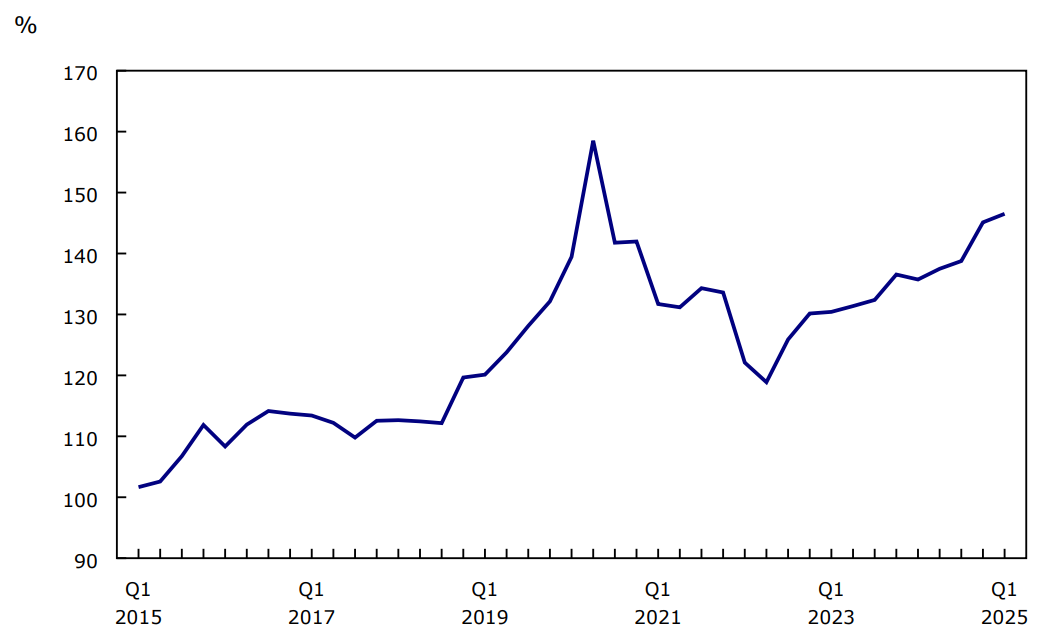
Canada's gross external debt, or the value of Canadian debt instruments held by foreign investors, was up by $99.1 billion to $4,650.8 billion at the end of the first quarter of 2025. It amounted to 146.5% of the gross domestic product; in contrast, it was 135.7% at the end of the first quarter of 2024.
On a sector basis, the financial sector's gross external debt increased by $65.8 billion to reach $2,746.8 billion at the end of the first quarter of 2025. At the end of March, the financial sector accounted for the highest proportion of Canada's gross external debt at 59.1%, followed by the government sector at 18.3%. The government sector's gross external debt grew by $14.5 billion to reach $849.2 billion at the end of the first quarter, a sixth consecutive quarterly increase.
Chart 4: Canada's gross external debt as a percentage of gross domestic product
Description - Chart 4
Data table: Canada's gross external debt as a percentage of gross domestic product
Note: Q = quarter.
Sources: Tables 36-10-0104-01 and 36-10-0469-01.
Chart 5: Canada's net international investment position, by region
Description - Chart 5
Data table: Canada's net international investment position, by region
Note: Q = quarter.
Source: Table 36-10-0485-01.
Chart 6: Canada's net portfolio investment position with the United States
Description - Canada's net portfolio investment position with the United States
Data table: Canada's net portfolio investment position with the United States
Note: Q = quarter.
Source: Table 36-10-0485-01.
Focus on Canada and the United States
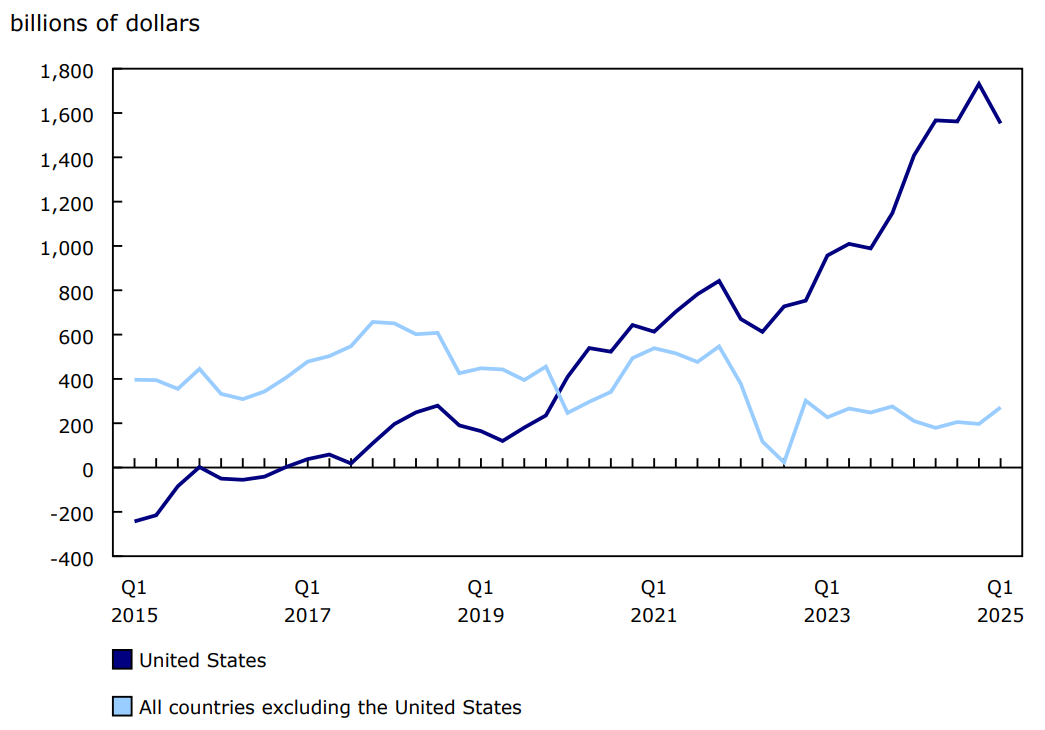
Canada's net foreign asset position with the United States was down by $177.8 billion to $1,553.3 billion at the end of the first quarter of 2025, an unprecedented quarterly decrease. Significant declines in the value of both portfolio (-$82.2 billion) and direct (-$64.7 billion) investment assets in the United States, largely resulting from lower US equity prices, contributed to the decline.
In comparison, Canada's net foreign asset position with the rest of the world was up by $74.7 billion to $271.5 billion at the end of the first quarter. This change was mainly the result of upward revaluations coming from fluctuations in exchange rates and market prices.
Despite the decline in the first quarter of 2025, the value of Canadian direct investment in the United States has, since the first quarter of 2015, consistently been greater than the value of US direct investment in Canada.
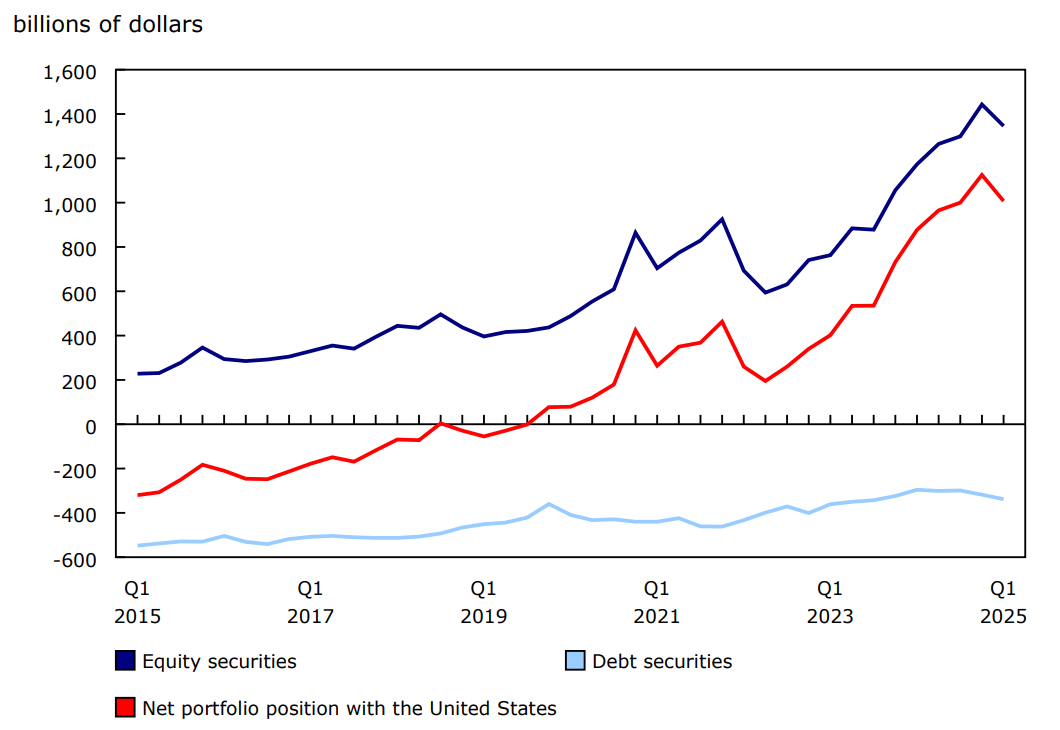
In parallel, since the fourth quarter of 2019, the value of Canadian portfolio investment in the United States has been greater than the value of US portfolio investment in Canada. On an instrument basis, the net portfolio investment position with the United States reflects a net asset position in equity securities partially offset by a net liability position for debt securities. Over the years, Canada has always maintained a consistent net liability position vis-à-vis the United States in terms of debt securities. However, the increase in the net portfolio investment position with the United States since the end of 2019 has been driven by equities. Especially in recent years, Canadian holdings of US equities have grown substantially, surpassing US holdings of Canadian equities.
For more data and insights on areas touched by the socio-economic relationship between Canada and the United States, see the Focus on Canada and the United States webpage.
Note to readers
Definitions
The international investment position is the value and composition of Canada's assets and liabilities to the rest of the world.
Canada's net international investment position is the difference between Canada's assets and liabilities to the rest of the world. An excess of international liabilities over international assets can be referred to as Canada's net foreign debt. An excess of international assets over international liabilities can be referred to as Canada's net foreign assets.
Foreign direct investment is presented on an asset-liability principle basis (that is, a gross basis) in the international investment position. Foreign direct investment can also be presented on a directional principle basis (that is, a net basis), as shown in supplementary foreign direct investment tables 36-10-0008-01, 36-10-0009-01 and 36-10-0659-01. The difference between the two foreign direct investment conceptual presentations resides in the classification of reverse investment, such as (1) Canadian affiliates' claims on foreign parents and (2) Canadian parents' liabilities to foreign affiliates. Under the asset-liability presentation, (1) is classified as an asset and included in direct investment assets, and (2) is classified as a liability and included in direct investment liabilities.
Reference
Data tables: Access the latest tables.
- Note: some data tables may best be viewed on desktop.
Definitions, data sources and methods: survey numbers 1534 and 1537.
Previous release: Canada's international investment position, fourth quarter 2024.
Next release: September 10, 2025.
Contact information
For more information, or to enquire about the concepts, methods or data quality of this release, contact us (toll-free 1-800-263-1136; 514-283-8300; infostats@statcan.gc.ca) or Media Relations (statcan.mediahotline-ligneinfomedias.statcan@statcan.gc.ca).