

Avoidable hospitalization rates continue to be highest among males and the Black population in recent years
Avoidable hospitalizations—that is, instances where timely and appropriate ambulatory health care could have prevented the need for hospitalization—are a key indicator of access to primary health care. They include hospitalizations related to health conditions such as asthma, diabetes and hypertension that could have been treated by a primary health care team. A new table on annual age-standardized avoidable hospitalization rates among racialized populations in Canada from 2016 to 2024 (including hospitalizations from April 1, 2016, to March 31, 2024) is now available using updated 2016 Canadian Census Health and Environment Cohort (CanCHEC) data and rates standardized to the 2021 Canadian standard population.
After declines in overall avoidable hospitalization rates during the initial COVID-19 pandemic years (2020/2021), rates have stabilized from fiscal year 2022/2023 to fiscal year 2023/2024. However, the change over time varied by sex and racialized group.
From 2016 to 2024, all racialized groups, except for the Black population, had lower avoidable hospitalization rates compared with non-racialized people; the Chinese population had the lowest rates. Males had higher avoidable hospitalization rates compared with females in all groups.
Chart 1: Age-standardized avoidable hospitalization rates (per 100,000 population) by racialized group, ages 10 to 74 years, Canada (excluding Quebec), 2016/2017 to 2023/2024
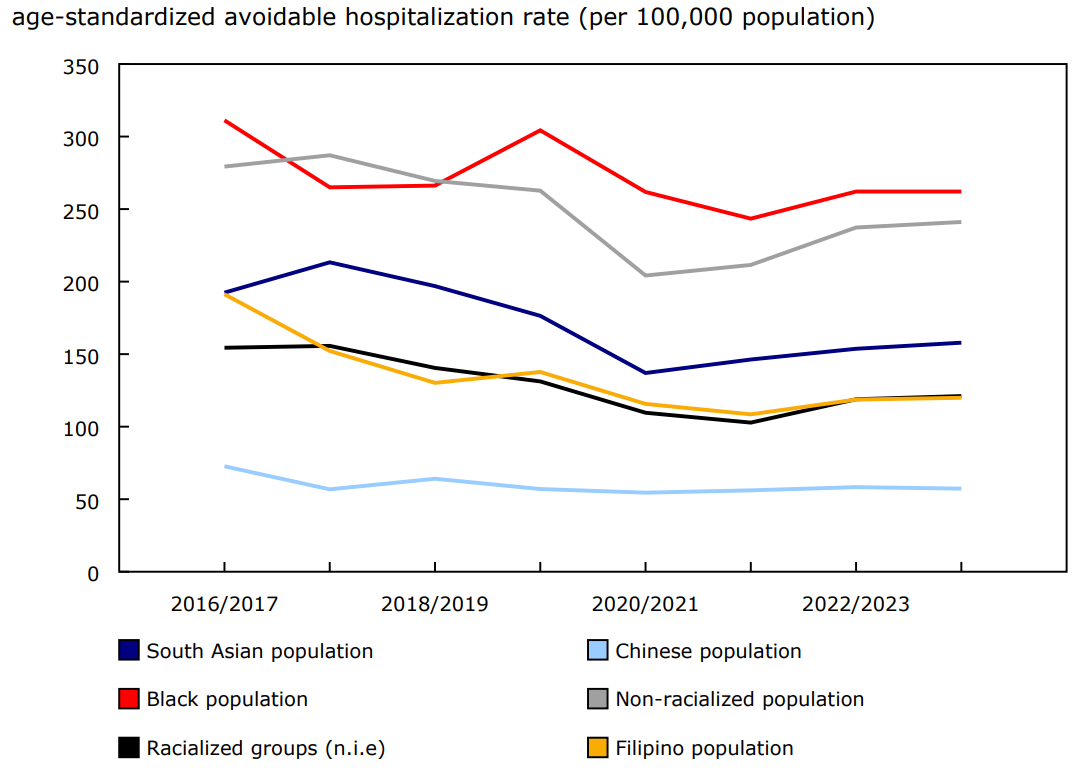
Description - Chart 1
Note: n.i.e. = not included elsewhere.
Source: Canadian Census Health and Environment Cohort 2016 (version 1d), linked to Discharge Abstract Database, 2016/2017 to 2023/2024 (5422).
Inequalities in avoidable hospitalizations decreased for Black males from 2020 to 2024
From 2018/2019 to 2023/2024, Black and non-racialized males had the highest avoidable hospitalization rates of all groups studied. In 2020/2021, following the start of the pandemic, the avoidable hospitalization rate among Black males was 358.9 per 100,000 population. This rate was significantly higher than that of non-racialized males (232.8 per 100,000 population) and of racialized males in other groups. In 2023/2024, the gap in avoidable hospitalization rates narrowed between Black males (271.9 hospitalizations per 100,000 population) and non-racialized males (257.2 hospitalizations per 100,000 population), as rates among non-racialized males increased compared with 2020/2021.
Furthermore, in 2023/2024, avoidable hospitalization rates among Black females (253.3 per 100,000 population) and non-racialized females (225.7 per 100,000 population) were higher than those of females in all other racialized groups.
These insights were made possible with the updated cycles of the 2011, 2016 and 2021 CanCHEC data, available now in the Research Data Centres. The CanCHECs combine census long-form respondents (or National Household Survey respondents) with various administrative health data—including mortality, cancer, hospitalizations, ambulatory care and mental health services—and the annual postal codes for mailing addresses. These data can be used to examine health outcomes over time by demographic, social and economic characteristics (e.g., age, education, income, Indigenous identity, racialized population, immigration status) to provide information on health trends and emerging health care issues. These updates extend the follow-up time for the 2011, 2016 and 2021 CanCHECs.
Note to readers
The insights from the data table, including weighted counts, age-standardized hospitalization rates, rate ratios and 95% confidence intervals, were made possible using the 2016 Canadian Census Health and Environment Cohort, which is a de-identified microdata linkage of the Census of Population long-form sample with the Canadian Vital Statistics – Death database (2016 to 2023) and Discharge Abstract Database (fiscal years 2016/2017 to 2023/2024). Discharge Abstract Database data are collected for each fiscal year from April 1 to March 31 of a given calendar year. The use of linked administrative health data allowed for disaggregation by racialized groups in Canada.
Avoidable hospitalizations (otherwise known as ambulatory care sensitive conditions) include hospitalizations among people aged less than 75 years, in which access to appropriate and timely primary or ambulatory care could have prevented hospitalization. Potentially avoidable conditions include diabetes, chronic lower respiratory diseases, asthma and hypertension, which are considered measures of access to appropriate primary health care. According to the Canadian Institute for Health Information, while not all admissions could have been avoided, it is assumed that appropriate ambulatory care treatment could have prevented the onset of this type of illness or condition, controlled an acute episodic illness or condition or managed a chronic disease or condition.
Age-standardized avoidable hospitalization rates, a method for comparing outcomes across different populations accounting for differences in age structure, were calculated for individuals who were hospitalized at least once for an ambulatory care sensitive condition for each fiscal year from 2016/2017 to 2023/2024 per 100,000 population, using the 2021 standard Canadian population estimates with five-year intervals.
Data on racialized groups are measured using the "visible minority" variable from the 2016 Census. "Visible minority" refers to whether a person is a visible minority or not, as defined by the Employment Equity Act. The Employment Equity Act defines visible minorities as "persons, other than Aboriginal peoples, who are non-Caucasian in race or non-white in colour." The visible minority population consists mainly of the following groups: South Asian, Chinese, Black, Filipino, Latin American, Arab, Southeast Asian, West Asian, Korean and Japanese. The non-racialized population excludes Indigenous Peoples (First Nations people, Inuit and Métis).
Reference
Definitions, data sources and methods: See the associated survey numbers.
Previous release: Canadian Census Health and Environment Cohort, 2021
Contact information
For more information, or to enquire about the concepts, methods or data quality of this release, contact us (toll-free 1-800-263-1136; 514-283-8300; infostats@statcan.gc.ca) or Media Relations (statcan.mediahotline-ligneinfomedias.statcan@statcan.gc.ca).