
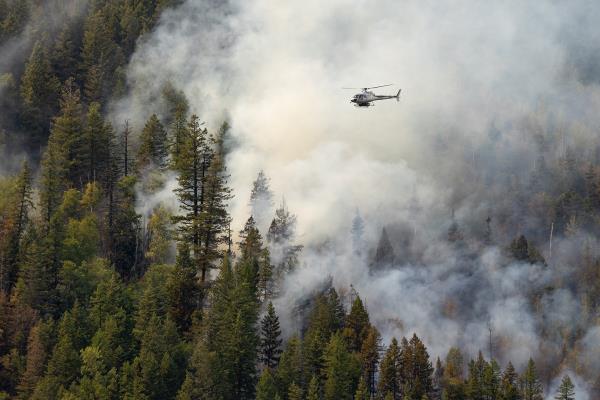
In recent years, the summer months have unfortunately become synonymous with wildfire season in Canada. As of June 18, 2025, there have been 2,061 wildfires since the beginning of the year, covering an area of 3.88 million hectares, which is more than quadruple the 10-year average of 930,000 hectares.
Given the changing climate, wildfire risk will likely continue to increase into the future; therefore, it is critical to understand the potential economic effects of wildfires. To that end, Statistics Canada researchers have developed new experimental estimates of gross domestic product (GDP) by square kilometre in Canada to measure economic activity at risk of being affected, but not necessarily being impacted, in communities that face mass evacuations.
These new methods were applied to recent wildfires (as of June 10, 2025) and findings show that these wildfires have either spread to or caused evacuations in regions representing approximately 0.125% of Canada's GDP.
As of mid-June, Manitoba had the largest percentage of GDP at risk among the provinces; the wildfire-affected areas, where 21,000 residents were ordered to evacuate, accounted for 2.4% of total provincial GDP.
Saskatchewan (0.4%) is estimated to have the second-largest percentage of GDP at risk, followed by Alberta (0.2%). Sites of economic activity in British Columbia, New Brunswick, Ontario, Newfoundland and Labrador and Quebec were also located in areas identified as having been affected by wildfires. However, less than 0.1% of the total provincial GDP was at risk in these provinces.
While the current wildfires amount to limited economic risk at the provincial level, they pose significant disruption to the affected economic regions and local communities. In north Manitoba, where some of the largest fires are concentrated, economic activity in wildfire-affected areas amounts to over one-quarter (26.3%) of the region's GDP. Similarly, almost one-quarter (24.4%) of economic activity within northern Saskatchewan is also at risk due to the wildfires within the area.
Recent research (see Note to readers) shows that the wildfire 2023 season was the largest ever recorded by land area affected, and the 2024 wildfire season was the second largest in two decades. The article, "Estimates of gross domestic product in wildfire-affected areas during the 2023 and 2024 wildfire seasons," also released today, provides more information about how these innovative economic estimates were developed.
Although past wildfires have affected large areas of land across the country, their potential effects on overall GDP are relatively limited at the national or provincial level. However, for the economic regions and communities affected, these impacts are potentially devastating locally, particularly for those that experience extended evacuation periods.
Note to readers
For more information on the 2023 and 2024 wildfire seasons, please see the articles, "Drivers and Impacts of the Record-Breaking 2023 Wildfire Season in Canada," from Nature Communications, and "Wildfires in 2024," from Nature Reviews Earth & Environment.
Contact information
For more information, or to enquire about the concepts, methods or data quality of this release, contact us (toll-free 1-800-263-1136; 514-283-8300; infostats@statcan.gc.ca) or Media Relations (statcan.mediahotline-ligneinfomedias.statcan@statcan.gc.ca).