

Productivity declines in the second quarter, after little change in the first quarter
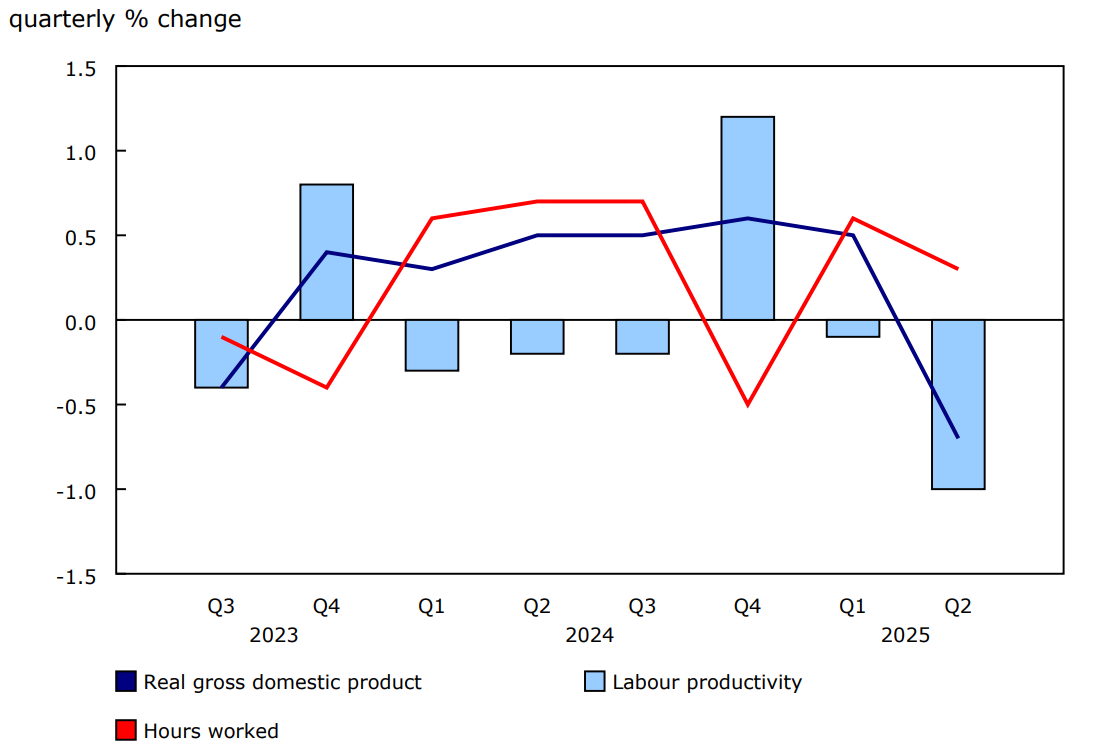
Labour productivity of Canadian businesses declined 1.0% in the second quarter. This decline followed a nearly flat variation in the first quarter, which had followed a strong increase of 1.2% in the fourth quarter of 2024. The last time productivity declined so sharply was in the fourth quarter of 2022 (-1.1%).
Chart 1: Business output declines for the first time in seven quarters, while growth in hours worked slows
Description - Chart 1
Data table: Business output declines for the first time in seven quarters, while growth in hours worked slows
Source: Table 36-10-0206-01.
With uncertainty surrounding international trade, businesses reduced their output for the first time in seven quarters in the second quarter of 2025. At the same time, hours worked continued to increase but at half the pace of the previous quarter.
Real gross domestic product of businesses contracted 0.7% in the second quarter, after growing 0.5% in the previous quarter. This was the first contraction since the third quarter of 2023 (-0.4%).
Manufacturing and wholesale trade are the main contributors to the decline in productivity in the business sector
Productivity in the business sector declined in the second quarter, due to decreases in 9 of the 16 industry sectors.
In the second quarter, productivity recorded significant declines in utilities (-4.0%) and wholesale trade (-2.6%). Manufacturing (-2.1%) also posted a significant decline, following a quarter of zero growth, while construction (-0.1%) posted a slight decline.
Overall, manufacturing and wholesale trade were the main contributors to the decrease in business sector productivity in the second quarter. These two sectors—which are heavily dependent on merchandise trade—were particularly affected by the uncertainty surrounding Canada's trade activities with the United States during the quarter.
Hours worked continue to grow but at a slower pace
Hours worked in the business sector grew at a slower pace in the second quarter (+0.3%) than in the first quarter (+0.6%), due to a slowdown in services-producing businesses.
In the second quarter, hours worked in services-producing businesses rose 0.3%, after increasing 0.8% in the previous quarter, while hours worked in goods-producing businesses were little changed for a second consecutive quarter.
Overall, hours worked were up in 10 of the 16 industry sectors in the second quarter, and they were virtually unchanged in three sectors: manufacturing, professional services and other business services.
As a result of the wildfires that affected certain economic regions in Western Canada as well as the west of Ontario in May, some workers lost hours of work, while others worked overtime. The net effect of the wildfires on hours worked was virtually nil in the second quarter, as overtime in a few industry sectors nearly offset the hours lost in most sectors.
Wildfires in certain economic regions of the country: Impact on hours worked, May 2025
Data on lost work hours and overtime due to the wildfires, which affected certain economic regions of the country in May 2025, are taken from questions added to the Labour Force Survey (LFS) questionnaire for the provinces of Western Canada and Ontario.
For the reference month of May, the additional questions were included in the June LFS. Data from the answers to these questions allowed Statistics Canada to adjust the estimates of hours worked that are used to calculate labour productivity.
In May, 809,000 hours of work were lost in the business sector, while 802,000 overtime hours were worked. As a result, for the second quarter, the net effect was a slight loss of 7,000 hours of work.
Unit labour costs rebound slightly
In the second quarter, hourly compensation (-0.5%) decreased for the first time since the first quarter of 2021 (-0.5%). As productivity declined 1.0% in the second quarter of 2025, this led to a slight rebound (+0.5%) in unit labour costs of businesses. Along with productivity, hourly compensation and unit labour costs changed little in the first quarter.
Unit labour costs represent the labour costs required to produce one unit of output.
Learn more about labour productivity
To learn more about productivity, the factors that influence it and why it matters for Canadians, listen to the Eh Sayers podcast episode, "Why economists are sounding the alarm on productivity."
Table 1: Business sector: Labour productivity and related variables for Canada – Seasonally adjusted
Note to readers
Revisions
With this release, data were revised back to the first quarter of 2025 at the aggregate level and to the first quarter of 2024 at the industry level.
These data updates are consistent with those incorporated in the release on quarterly gross domestic product (GDP) by income and expenditure and the release on monthly GDP by industry, released on August 29, 2025.
Productivity measures
The term productivity in this release refers to labour productivity. For the purposes of this analysis, labour productivity and related variables cover the business sector only.
Labour productivity is a measure of real GDP per hour worked.
Unit labour cost is defined as the cost of workers' wages and benefits per unit of real GDP.
The approach to measuring real output in the business sector differs from the one that is used in the estimates by industry. For the business sector, output is measured using the expenditure-based GDP approach at market prices, while the measure of output by industry is based on the value-added approach at basic prices.
All the growth rates reported in this release are rounded to one decimal place. They are calculated with index numbers rounded to three decimal places, which are now available in data tables.
All necessary basic variables for productivity analyses (such as hours worked, employment, output and compensation) are seasonally adjusted. For information on seasonal adjustment, see Seasonally adjusted data – Frequently asked questions.
Next release
Labour productivity, hourly compensation and unit labour cost data for the third quarter of 2025 will be released on December 3, 2025.
Contact information
For more information, or to enquire about the concepts, methods or data quality of this release, contact us (toll-free 1-800-263-1136; 514-283-8300; infostats@statcan.gc.ca) or Media Relations (statcan.mediahotline-ligneinfomedias.statcan@statcan.gc.ca).