
Highlights
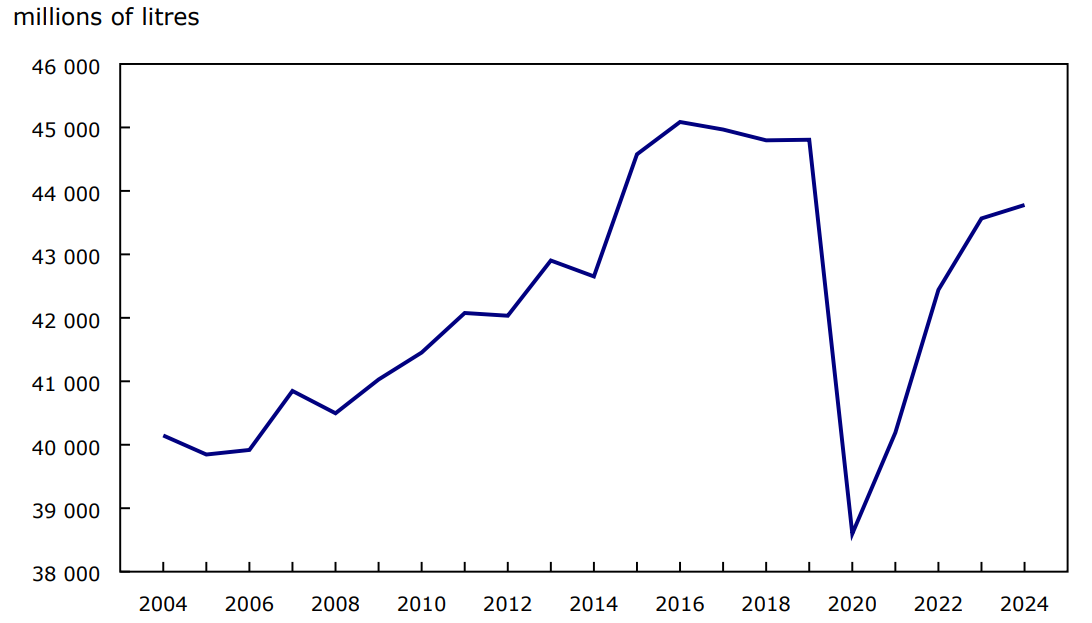
The demand for motor vehicle fuels levelled off in 2024, with gross sales of gasoline in Canada edging up 0.5% year over year to 43.8 billion litres. Despite this gain, gross sales of gasoline remained below the pre-COVID-19 pandemic 2019 level.
Gasoline sales edge up
After falling to a low in 2020, gross sales of gasoline in Canada have been increasing; however, the pace of growth is slowing. Gross sales of gasoline edged up 0.5% from 2023 to 43.8 billion litres in 2024, after rising 2.7% in 2023.
Chart 1: Gross sales of gasoline in Canada, 2004 to 2024
Description - Chart 1
Data table: Gross sales of gasoline in Canada, 2004 to 2024
Source: Table 23-10-0066-01.
More Canadians were on the move in 2024. The National Travel Survey reported that Canadian residents took 292.1 million domestic trips in 2024, a 2.5% increase from 2023. Furthermore, as noted in the Labour Force Survey, the number of commuters reached 16.5 million in May 2024, a 3.7% increase from May 2023. This continues an upward trend in the number of commuters, following notable declines during the pandemic in 2020 and 2021.
However, gross sales of gasoline have yet to reach their pre-pandemic 2019 level. While the number of new motor vehicle registrations—passenger cars, pickup trucks, multi-purpose vehicles and vans—increased by 8.0% in 2024, 14.6% of new registrations in Canada were zero-emission vehicles (ZEVs). Registrations of ZEVs in the first two quarters of 2025, however, have retreated to roughly 8%, similar to 2022 levels.
Net sales of gasoline in 2024 rose 1.0% to 41.9 billion litres, marking a five-year high, albeit 3.3% lower than 2019 levels.
Fuel sales across Canada
In 2024, year-over-year gross sales of gasoline increased the most in Ontario (+438.3 million litres; +2.7%) and Alberta (+222.5 million litres; +3.6%) while the largest decreases were posted in Quebec (-320.7 million litres; -3.5%) and British Columbia (-76.1 million litres; -1.6%). Quebec and British Columbia have provided the strongest incentives to encourage ZEV adoption. Together, the four largest provinces accounted for over four-fifths (84.0%) of gross sales of gasoline in Canada.
Sales of diesel and liquefied petroleum gas both down from a year earlier
Net sales of diesel declined 5.1% from 2023 to 17.1 billion litres in 2024, the lowest volume since 2020.
Net sales of liquefied petroleum gas fell 5.9% year over year to 517.0 million litres in 2024.
Note to readers
The Gasoline and Other Petroleum Fuels Sold survey collects data used by the Department of Finance for the calculation of fiscal equalization payments to the provinces pursuant to the Federal-Provincial Fiscal Arrangements Act and territorial financing for the territories.
Motor vehicle fuel sales data are available starting in 1987 for Canada as well as provinces and territories.
Gross sales of gasoline represent total sales of all road grades of gasoline, including off-road activities such as farming, forestry, construction, and mining.
Net sales of gasoline (road grade), net sales of diesel oil (road), and net sales of liquefied petroleum gas represent sales on which taxes were remitted at road-use rates minus sales previously reported at road-use tax rates on which taxes were totally or partially refunded.
The Transportation Data and Information Hub, featuring data from Statistics Canada, Transport Canada and partners, provides Canadians with online access to comprehensive statistics and indicators for the country's transportation sector.
Contact information
For more information, or to enquire about the concepts, methods or data quality of this release, contact us (toll-free 1-800-263-1136; 514-283-8300; infostats@statcan.gc.ca) or Media Relations (statcan.mediahotline-ligneinfomedias.statcan@statcan.gc.ca).