
During the period from 2022 to 2024, more than two-thirds (68%) of Canadian adults aged 18 to 79 had a body mass index (BMI) classified as overweight or having obesity, an increase from 60% before the COVID-19 pandemic (the period from 2016 to 2019). Abdominal obesity, which refers specifically to excessive fat stored around the waist and stomach area, was also widespread, with about half (49%) of adults having a waist circumference above the Canadian thresholds associated with increased health risks.
Among children and youth aged 5 to 17, nearly one in three (31%) was classified in the overweight or obesity range. While this proportion has not changed significantly over time, it remains a concern due to long-term health risks associated with excess weight in childhood.
Results are based on new data released today from the Canadian Health Measures Survey (CHMS), Cycle 7 (2022 to 2024), which includes direct measures of height, weight, and waist circumference. Height and weight are used to calculate BMI, the most widely used indicator of overweight and obesity, while waist circumference provides additional information on abdominal fat distribution.
Overweight, obesity, and abdominal obesity are all linked to a higher likelihood of developing serious conditions such as type 2 diabetes, cardiovascular disease, hypertension, and certain cancers. Tracking these measures over time helps public health officials monitor population health and plan prevention and treatment strategies.
Obesity has increased among adults, especially young adults
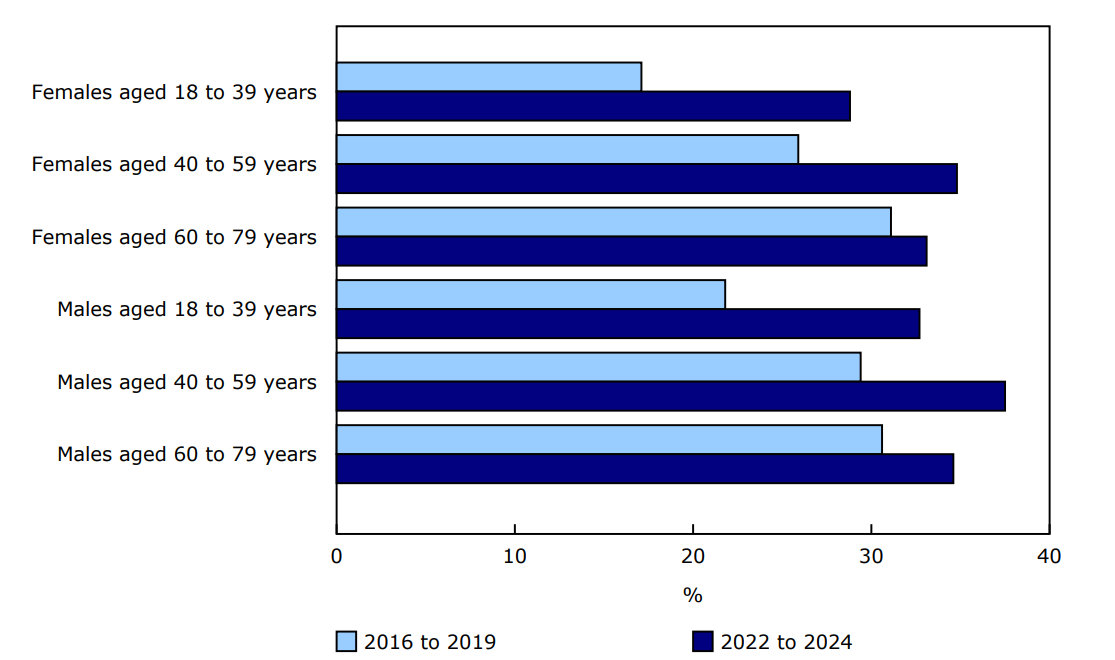
Among adults aged 18 to 79, the prevalence of obesity increased from 25% before the pandemic (the period from 2016 to 2019) to 33% (the period from 2022 to 2024). This is in line with research suggesting that pandemic-related changes in lifestyle, including reduced physical activity and increased sedentary behaviour, may have contributed to higher obesity levels in adults.
The percentage of males in the obesity range rose from 27% to 35%, while among females it increased from 24% to 32%. These increases were accompanied by a decline in the proportion of adults in the "normal BMI" category, falling from 34% to 26% for males and from 46% to 38% for females.
By age group, obesity prevalence was highest among adults aged 40 to 59, affecting 38% of males and 35% of females. Among adults aged 60 to 79, the prevalence was slightly lower, at 35% for males and 33% for females. The largest increase was observed among young adults aged 18 to 39, where obesity rose from 22% during the period from 2016 to 2019 to 33% during the period from 2022 to 2024 for males, and from 17% to 29% for females.
While obesity increased across all adult age groups, the changes are statistically significant only among young adult males and females. For the other age groups, the small number of survey participants makes it harder to confirm whether the changes are statistically significant. However, the pattern is consistent with recent self-reported data from the 2024 Canadian Community Health Survey (CCHS), which also showed the greatest increases in obesity since the pandemic were among young adults.
The prevalence of overweight among adults remains widespread and contributes substantially to the total population at risk. During the period from 2022 to 2024, 40% of males and 30% of females were classified in the overweight range. Combined with those classified as having obesity, nearly three in four males (74%) and almost two in three females (62%) had a BMI associated with increased health risks. These proportions are slightly higher than those from the CCHS, which found 69% of males and 61% of females in the overweight or obesity categories. This difference is expected since self-reported BMI tends to be underestimated compared with direct measures.
Chart 1: Prevalence of obesity among adults, by sex and age group, 2016 to 2019 and 2022 to 2024
Description - Chart 1
Data table: Prevalence of obesity among adults, by sex and age group, 2016 to 2019 and 2022 to 2024
Notes: Body Mass Index (BMI) classifications are based on guidelines from the World Health Organization. For adults, overweight is defined as a BMI of 25.0 to 29.9 kg/m², and obesity as a BMI of 30.0 kg/m² or greater. For the "Females aged 18 to 39 years" and "Males aged 18 to 39 years" categories, p < 0.05 indicates a statistically significant difference between 2022 to 2024 and 2016 to 2019.
Source: Canadian Health Measures Survey, Cycle 7 (2022 to 2024).
Waist circumference data reveal high and growing levels of abdominal obesity
In addition to BMI, the CHMS measures waist circumference, which provides an indication of excess fat located around the midsection (or abdominal obesity). Abdominal obesity and BMI together provide greater insight into cardiometabolic health risks than BMI alone.
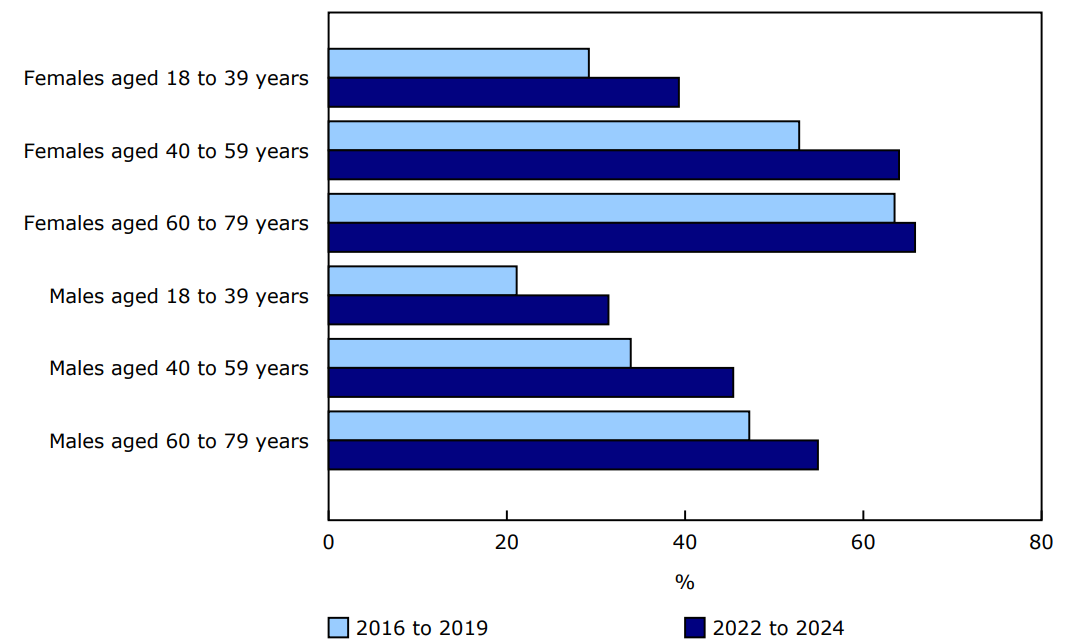
During the period from 2022 to 2024, nearly half of adults aged 18 to 79 (49%) had a waist circumference above the threshold for abdominal obesity (greater than 102 cm for males and greater than 88 cm for females). This was more common among females (55%) than males (42%). Abdominal obesity increased steadily with age: among males, the proportion ranged from 31% of those aged 18 to 39 to 55% of those aged 60 to 79. Among females, it rose from 39% in the youngest group to 66% of those aged 60 to 79.
The prevalence of abdominal obesity has risen compared with the period from 2016 to 2019, when 47% of females and 32% of males measured above the thresholds. The increase was particularly marked among men, with the proportion at risk growing by 10 percentage points between time periods.
While a high BMI already indicates elevated health risks, a large waist circumference can add further risk information. For example, among adults classified in the "normal weight" range, almost no males (less than 1%) and about 11% of females had a high waist circumference. Among those in the overweight category, the proportion rose to 26% of males and 64% of females. At the highest BMI category, abdominal obesity was nearly universal: 92% of males and 99% of females classified as having obesity by BMI also exceeded the waist circumference thresholds. These results show that waist circumference can reveal weight-related health risks that are not always reflected by BMI.
Chart 2: Prevalence of abdominal obesity among adults, by sex and age group, 2016 to 2019 and 2022 to 2024
Description - Chart 2
Data table: Prevalence of abdominal obesity among adults, by sex and age group, 2016 to 2019 and 2022 to 2024
Notes: Waist circumference thresholds are based on Health Canada's guidelines for abdominal obesity risk. Individuals with waist measurements above 102 cm for men and above 88 cm for women are considered at increased risk of obesity-related health problems. For the "Males aged 40 to 59 years" category, p < 0.05 indicates a statistically significant difference between 2022 to 2024 and 2016 to 2019.
Source: Canadian Health Measures Survey, Cycle 7 (2022 to 2024).
Excess weight in children and youth remains stable but is still a concern
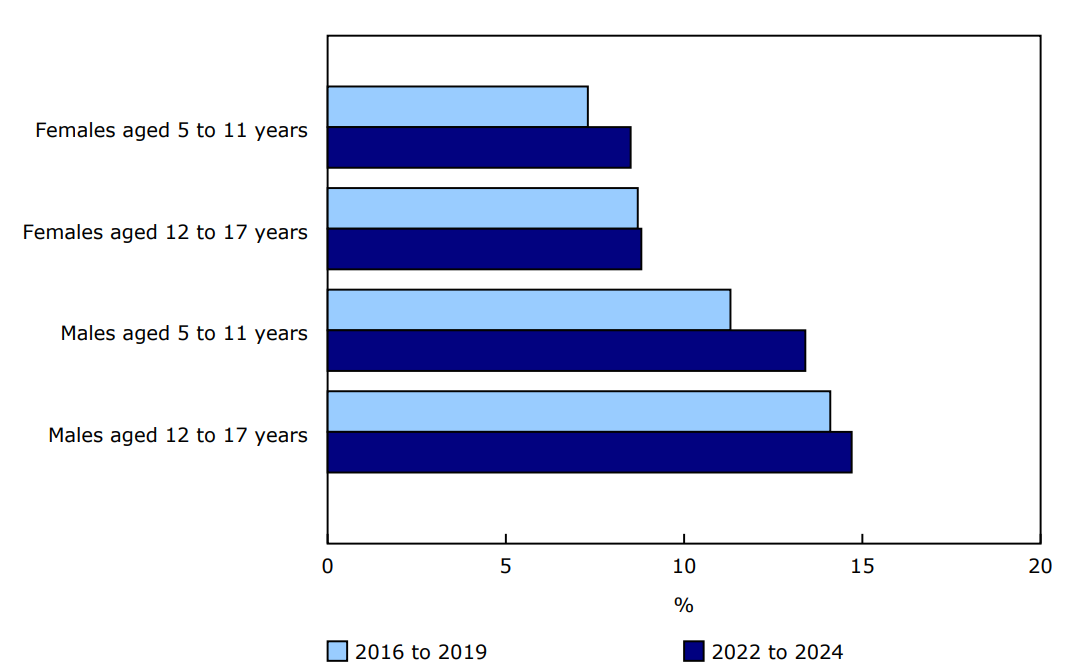
Although overweight and obesity rates are lower among children and youth than adults, they remain important public health concerns. During the period from 2022 to 2024, across ages 5 to 17, 19% were classified in the overweight category and 11% in the obesity category, meaning almost one in three were at an increased risk of developing weight-related health problems later in life.
Prevalence increased among male children and youth with age: among children aged 5 to 11, 19% of males and 19% of females were classified as overweight, while 13% of males and 9% of females were classified as having obesity. Among youth aged 12 to 17, 22% of males and 17% of females were classified as overweight, while 15% of males and 9% of females were classified as having obesity.
Monitoring overweight and obesity from early childhood is important because excess weight is linked to physical and mental health challenges during childhood and often persists into adulthood. Trends since earlier CHMS cycles show a modest increase in overweight and obesity among older children and youth. As in adults, there is evidence that the pandemic led to increases in screen time and snack food intake, which may have resulted in an increase in excess weight among children and youth.
Chart 3: Prevalence of obesity among children and youth, by sex and age group, 2016 to 2019 and 2022 to 2024
Description - Chart 3
Data table: Prevalence of obesity among children and youth, by sex and age group, 2016 to 2019 and 2022 to 2024
Notes: Body Mass Index classifications for children and youth are based on World Health Organization growth charts, which use age- and sex-specific cut-offs to define healthy weight, overweight, and obesity.
Source: Canadian Health Measures Survey, Cycle 7 (2022 to 2024).
Note to readers
The Canadian Health Measures Survey (CHMS) is the only ongoing nationally representative source of direct health measures in Canada. It provides detailed insight into the health conditions and behaviours of the Canadian population and is designed to inform the prevention, diagnosis, and treatment of illnesses, as well as to promote health and wellness.
Data for Cycle 7 of the CHMS were collected from November 2022 to December 2024. The target population included persons aged 1 to 79 years living in the Canadian provinces. The observed population excludes persons living in the three territories; persons living on reserves and other Indigenous settlements in the provinces; full-time members of the Canadian Forces; the institutionalized population; and residents of certain remote regions. Altogether, these exclusions represent approximately 3% of the target population.
Today's release includes data from the household questionnaire and from the Temporary Examination Centre, which collected additional questionnaires and direct measures of anthropometry and blood pressure. Data on direct measures of physical activity, oral health, bone health, and laboratory tests on blood and urine samples will be released at a later date. Also available today are data regarding blood, urine, and saliva samples that were collected and stored for future research as part of the Statistics Canada Biobank.
Body mass index (BMI) is calculated by dividing a person's weight in kilograms by the square of their height in metres. For adults, a BMI of 25.0 to 29.9 is considered overweight and 30.0 or higher is considered obese. For youth, age- and sex-specific BMI thresholds are used to classify overweight and obesity, reflecting normal growth and development patterns.
Waist circumference provides complementary information on abdominal fat distribution, which is strongly linked to cardiometabolic health risks such as type 2 diabetes and cardiovascular disease. Waist circumference is not used in children and youth because growth patterns and body composition change significantly during development.
For comparison over time, Cycles 5 (covering the period from 2016 to 2017) and 6 (covering the period from 2018 to 2019) were combined to provide more stable estimates and reduce the impact of sampling variability. Differences between survey cycles may reflect real changes in the population, but smaller sample sizes in some subgroups can limit statistical significance.
BMI and waist circumference provide different but complementary information. While BMI indicates overall excess weight, waist circumference helps identify individuals at increased health risks due to abdominal fat. Even among adults with a "normal" BMI, some may have elevated waist circumference, highlighting the importance of using both measures to understand health risks.
Finally, trends in children and youth should be interpreted in the context of growth and development. While prevalence of overweight and obesity in children has remained relatively stable, lifestyle factors such as diet quality, physical activity, and sedentary behaviour can influence long-term weight trajectories.
Contact information
For more information, or to enquire about the concepts, methods or data quality of this release, contact us (toll-free 1-800-263-1136; 514-283-8300; infostats@statcan.gc.ca) or Media Relations (statcan.mediahotline-ligneinfomedias.statcan@statcan.gc.ca).