

In 2025, 58% of children aged 0 to 5 years were in child care in Canada. Participation was similar to 2023 (56%).
In Canada, there are numerous types of child care arrangements for parents to choose from. Centre-based child care remained the most common type of arrangement in 2025, with 32% of all children aged 0 to 5 using this type of child care, followed by care by a relative (12%) and home-based child care (10%).
Today's release of the 2025 Survey on Early Learning and Child Care Arrangements (SELCCA) focuses on trends in parental expenses and difficulties finding child care.
Parental expenses for centre-based child care decrease from 2023 to 2025
Among its key objectives, the ongoing implementation of the Canada-wide Early Learning and Child Care system (CWELCC) aims to reduce child care fees for children aged 0 to 5 in participating licensed child care arrangements. The SELCCA collects information on parental expenses for all types of licensed and unlicensed arrangements used by children, and not just child care that is part of the CWELCC.
Similar to findings from 2023, expenses for full-time home-based child care were stable in 2025 at $534 per month. Home-based child care is comprised of both licensed providers, which may participate in the CWELCC, and unlicensed providers (around 45% of home-based child care providers in 2024), which are ineligible.
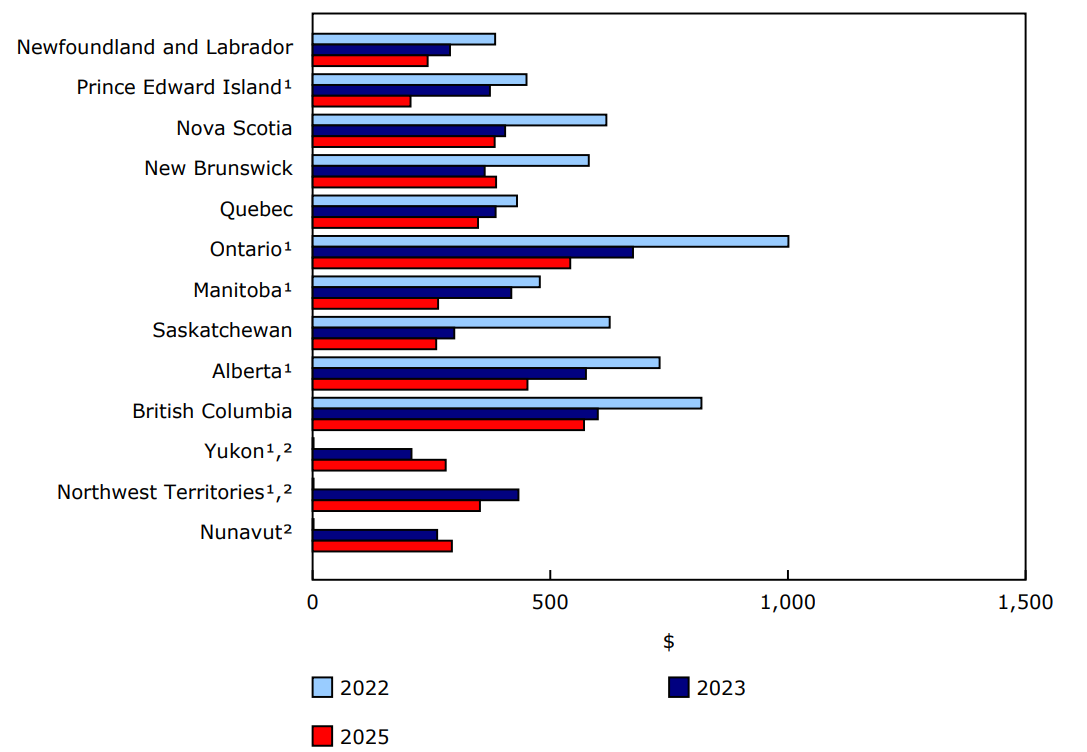
Nationally, expenses for children aged 0 to 5 attending centre-based child care full-time have continued to decrease from an average of $663 per month in 2022, to $508 in 2023 and to $435 in 2025, coinciding with the implementation of the CWELCC for participating centres.
Overall, five jurisdictions—Prince Edward Island, Ontario, Manitoba, Alberta, and the Northwest Territories—saw decreases in average parental expenses for full-time centre-based child care, each decreasing over $100 per month in 2025 compared to 2023.
While parental expenses in 2025 in Newfoundland and Labrador, Saskatchewan and Nunavut were similar to 2023, these jurisdictions already had expenses that were lower than the average for Canada.
Chart 1: Monthly mean expenses for full-time centre-based child care, by province or territory, children aged 0 to 5 years, Canada², 2022, 2023, 202
Description - Chart 1
1. Significant change from 2023 to 2025.
2. Data were not collected in the three territories in 2022.
Source: Table 42-10-0053-01.
A higher proportion of parents report difficulty finding child care
The proportion of parents who used child care and who reported having difficulty finding it increased from 46% in 2023 to 50% in 2025.
Among parents using child care who experienced difficulties finding child care, finding available care in their community remained the top challenge (reported by 65% of parents) in 2025, followed by finding affordable child care (42%) and finding subsidized child care (35%).
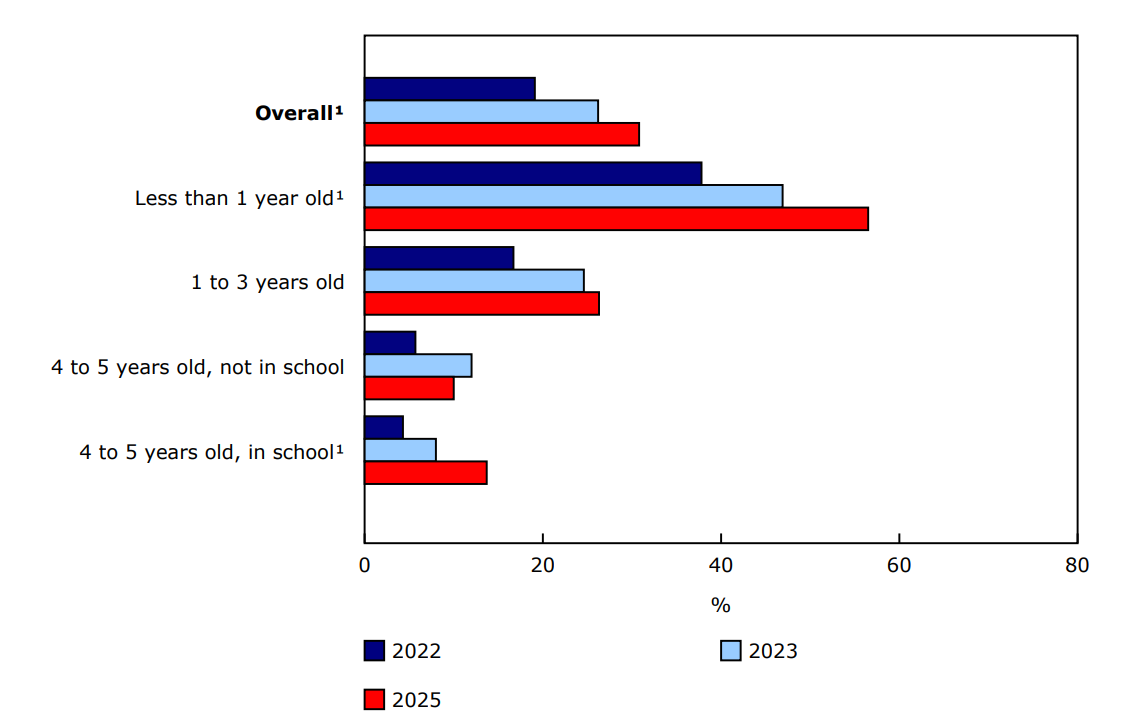
For parents who were not using child care, 31% of parents of children aged 0 to 5 years reported that their child was on a waitlist in 2025, up from 26% in 2023.
Waitlist rates for those not using care were highest among children less than 1 year old, increasing from 47% in 2023 to 56% in 2025. Many children less than 1 year old are likely on a waitlist in anticipation of needing a spot when they are old enough to attend. Waitlist rates for children aged 4 to 5 years old in school but not in care also increased during this period, from 8% to 14%.
Chart 2: Percentage of children on a waitlist, children aged 0 to 5 years not in child care, by age, Canada², 2022, 2023, 2025
Description - Chart 2
1. Significant change from 2023 to 2025.
2. Data were not collected in the three territories in 2022.
Source: Table 42-10-0106-01.
Under the CWELCC extended agreements, provinces and territories have committed to creating more child care spaces across the country by March 2026.
Note to readers
The Survey on Early Learning and Child Care Arrangements (SELCCA) provides a snapshot of early child care use in Canada.
The SELCCA was collected in the three territories from January to April 2025. The response rate for SELCCA's 0- to 5-year-old cohort was 47.6%, yielding a sample size of 7,509 children, which represents about 2.11 million children in Canada.
In 2025, the target population of the SELCCA was children aged 0 to 12 years in the provinces and aged 0 to 5 years in the territories. The information was obtained from a parent or guardian who was knowledgeable about the child's care arrangements.
The majority of respondents were women (9 in 10). Children living in institutions or on reserve were excluded from the target population.
Comparisons to 2023 include data from both the Canadian Survey on Early Learning and Child Care (conducted in the provinces) and the SELCCA (conducted in the territories).
Comparisons to 2022 exclude the territories since data were not collected in the territories in 2022.
Notes on terminology and definitions:
• The term "parents," refers to the parent, guardian or person who was knowledgeable about the child's care arrangements.
• The term "centre-based care" includes daycares, preschools and centres de la petite enfance.
• Parental expenses are reported for full-time care (30 hours or more per week) and in current dollars for the year the data were collected.
Survey sampling weights were applied to render the analyses representative of Canadian children aged 0 to 5 years. Bootstrap weights were also applied when testing for significant differences (p <0.05) to account for the complex survey design.
Contact information
For more information, or to enquire about the concepts, methods or data quality of this release, contact us (toll-free 1-800-263-1136; 514-283-8300; infostats@statcan.gc.ca) or Media Relations (statcan.mediahotline-ligneinfomedias.statcan@statcan.gc.ca).