

Energy consumption by the Canadian manufacturing sector decreased by 2.3% from 2023 to 2 090.1 petajoules in 2024, continuing the downward trend observed since 2022.
For context, approximately 88.3 petajoules of energy were required to operate Canadian railways in 2023.
The primary metal manufacturing subsector is now the top energy consumer
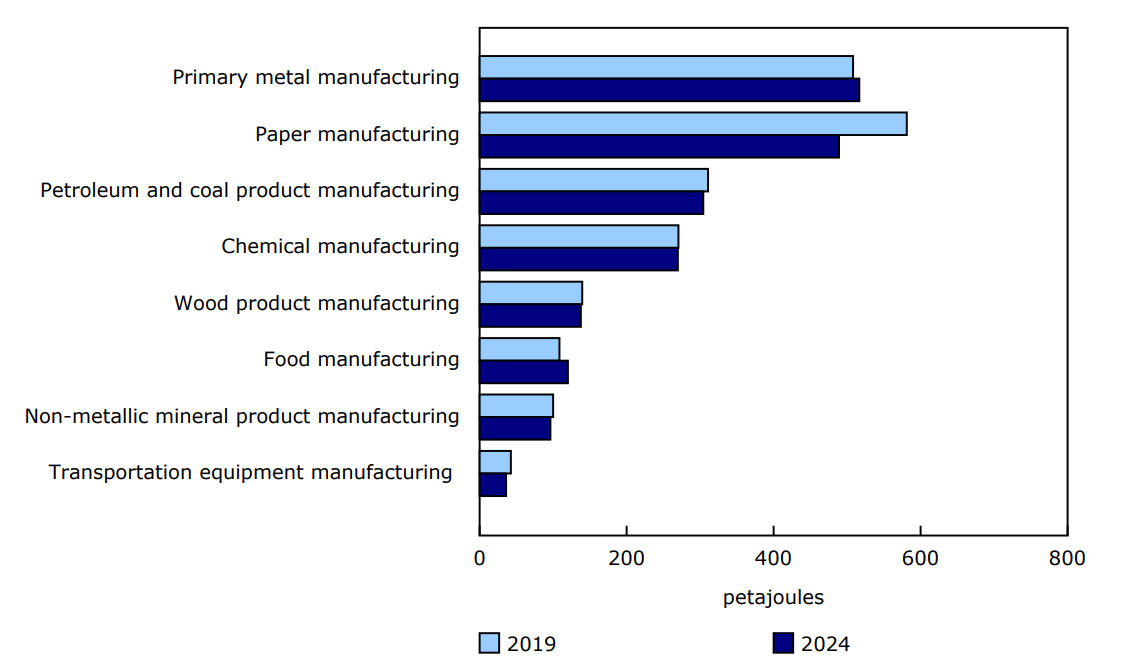
In 2024, the primary metal manufacturing subsector (516.6 petajoules) was the largest energy consumer, followed by the paper manufacturing subsector (489.0 petajoules). Together, these subsectors accounted for almost half (48.1%) of all energy consumed by the manufacturing sector. Petroleum and coal product manufacturing (304.3 petajoules) and chemical manufacturing (269.7 petajoules)—their combined share of energy consumption being 27.5%—rounded out the top four subsectors for energy consumption.
Historically, paper manufacturing has usually been the largest energy consumer in Canada. However, this subsector's energy consumption decreased by 15.9% from 2019, prior to the COVID-19 pandemic, to 2024. The largest declines from 2019 to 2024 were in newsprint and paper mills, where energy consumption dropped by 77.3 petajoules (-42.3%) because of lower demand, instability in the fibre supply and greater competition from developing nations.
Chart 1: Top eight energy consumers in manufacturing sector, 2019 and 2024
Description - Chart 1
Data table: Top eight energy consumers in manufacturing sector, 2019 and 2024
Source: Table 25-10-0025-01.
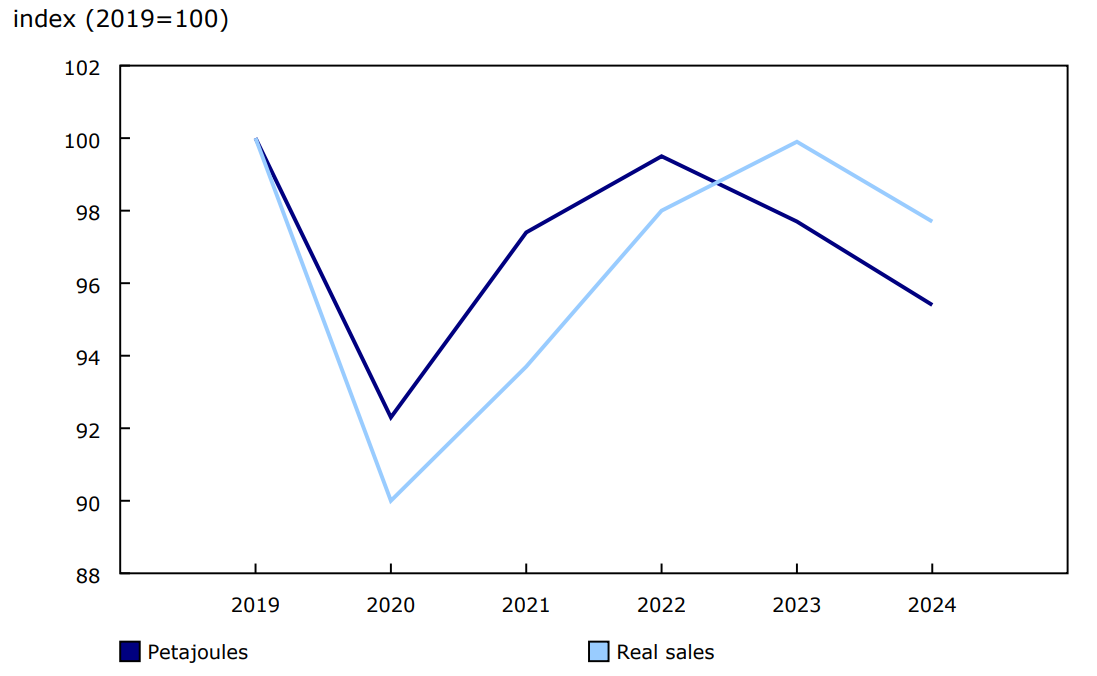
Overall, real sales for the manufacturing sector decreased by 2.3% from 2019 to 2024, while energy consumption declined by 4.6%.
Energy consumption by the manufacturing sector is not necessarily indicative of sales volumes. Despite representing close to half of energy consumption, primary metal manufacturing and paper manufacturing accounted for 10.3% of total real sales of manufactured goods in 2024. Meanwhile, transportation equipment manufacturing accounted for 1.7% of energy consumption and 17.7% of total real sales of manufactured goods.
Chart 2: Energy consumption and real sales of goods, all manufacturing subsectors
Description - Chart 2
Data table: Energy consumption and real sales of goods, all manufacturing subsectors
Sources: Tables 25-10-0025-01 and 16-10-0013-01.
Natural gas and electricity are the largest sources of energy consumed
Natural gas and electricity, the most common sources of energy, were used in all manufacturing subsectors.
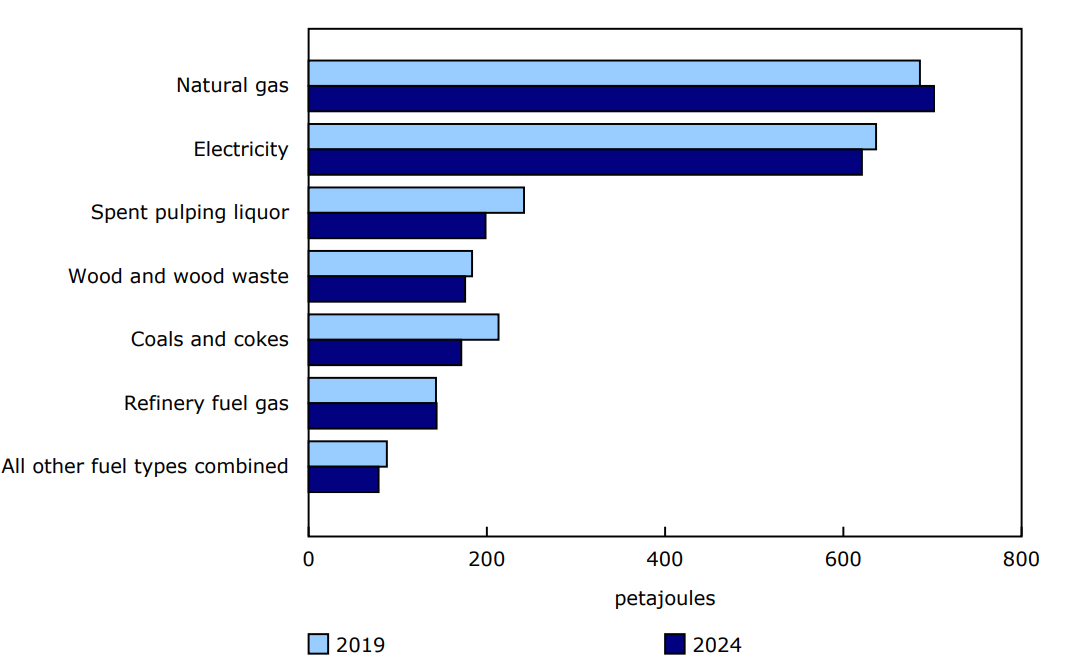
In 2024, 701.7 petajoules of natural gas were consumed, accounting for slightly over one-third (33.6%) of the total energy used by the manufacturing sector. Chemical manufacturing (172.3 petajoules) and primary metal manufacturing (134.1 petajoules) were the largest consumers. Together, they accounted for 43.7% of total natural gas consumed. Meanwhile, 620.8 petajoules of electricity were consumed, representing 29.7% of total energy used by the manufacturing sector. Primary metal manufacturing (269.5 petajoules) and paper manufacturing (110.3 petajoules) were the largest electricity consumers, representing 61.2% of total electricity consumed.
Other energy sources were also used by the manufacturing sector in 2024. Spent pulping liquor, consumed solely by the paper manufacturing subsector, accounted for 9.5% (198.5 petajoules) of total energy consumed. Wood and wood waste, primarily used by wood product and paper manufacturing, accounted for 8.4% (175.6 petajoules) of total energy consumed. Coals and cokes accounted for 8.2% (171.3 petajoules) of total energy consumed. They were mainly used by primary metal manufacturing, petroleum and coal product manufacturing and non-metallic mineral product manufacturing. Refinery fuel gas, which is mainly consumed by petroleum and coal product manufacturing, made up 6.9% (143.6 petajoules) of total energy consumed. All other energy sources combined accounted for the remaining 3.8% of total energy consumed.
From 2019 to 2024, consumption of all fuels decreased, except for natural gas (+2.3%) and refinery fuel gas (+0.5%).
Chart 3: Type of energy consumed by manufacturing sector, 2019 and 2024
Description - Chart 3
Data table: Type of energy consumed by manufacturing sector, 2019 and 2024
Source: Table 25-10-0025-01.
Note to readers
The Annual Industrial Consumption of Energy Survey, sponsored by Natural Resources Canada and Environment and Climate Change Canada, estimates the energy consumed by type of fuel in Canadian manufacturing.
The 2024 survey estimates are based on a sample of 5,033 manufacturing establishments, which represent a weighted response rate of 84.2%.
A joule is a derived measure of energy or work. One gigajoule is equal to 1 billion (109) joules. The energy content of a 30-litre tank of gasoline is about one gigajoule, and six gigajoules are roughly equivalent to the amount of potential energy from burning one US standard barrel of oil. One petajoule is equal to 1015 joules, or 1 million gigajoules.
Energy includes the energy used as fuel to power the production process, for heating, for transportation at the establishment and for generating steam consumed on site.
Other energy sources include butane, heavy fuel oil, middle distillates, propane and purchased steam.
Electricity consists of both purchased and self-generated electricity.
The coals and cokes grouping includes coal, coal coke, coke oven gas, petroleum coke and coke from catalytic cracking.
Totals and percentages may not add up because of rounding.
Manufacturing sales are from table 16-10-0013-01.
Data for 2023 have been finalized. Data for 2024 are subject to revision.
Contact information
For more information, or to enquire about the concepts, methods or data quality of this release, contact us (toll-free 1-800-263-1136; 514-283-8300; infostats@statcan.gc.ca) or Media Relations (statcan.mediahotline-ligneinfomedias.statcan@statcan.gc.ca).