
Net capital stock totalled $7.8 trillion in 2024, consisting of $4.2 trillion in residential structures and $3.6 trillion in non-residential assets, including machinery and equipment, engineering construction and non-residential structures.
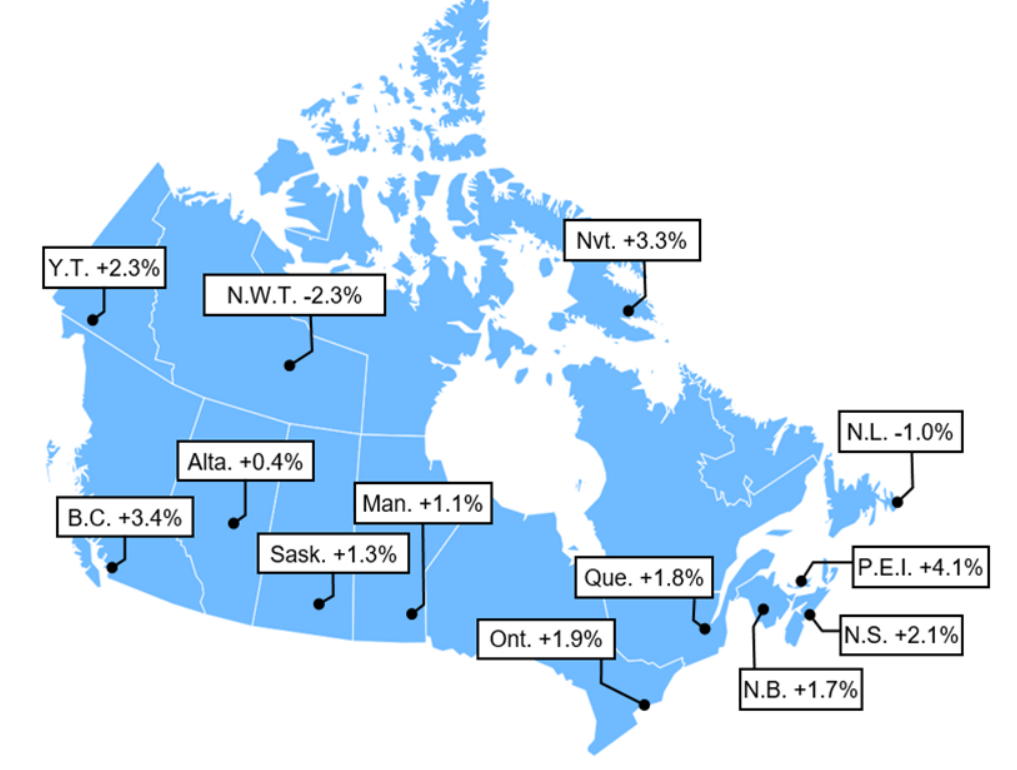
Expressed in volume, Canada's capital stock increased 1.7% in 2024, a slight deceleration from the growth in 2023 (+1.8%), mainly due to a slowdown in non-residential investment. Most provinces and territories recorded increases in capital stocks in 2024, ranging from a growth of 0.4% in Alberta to a gain of 4.1% in Prince Edward Island. Newfoundland and Labrador (-1.0%) and the Northwest Territories (-2.3%) were the only two provinces or territories to record declines. Newfoundland and Labrador posted a larger decrease in non-residential capital assets in 2024 because of slower investment in recent years, while the drop in the Northwest Territories was mostly related to a significant decline in intellectual property products.
Map 1: Total capital stock in 2024 (growth in percentage)
Description - Map 1
The title of the map is "Total capital stock in 2024 (growth in percentage)"
This is a map of Canada.
The map shows the growth in percentage of total capital stock in 2024, by province and territory. Newfoundland and Labrador was down 1.0%, Prince Edward Island was up 4.1%, Nova Scotia was up 2.1%, New Brunswick was up 1.7%, Quebec was up 1.8%, Ontario was up 1.9%, Manitoba was up 1.1%, Saskatchewan was up 1.3%, Alberta was up 0.4%, British Columbia was up 3.4%, Yukon was up 2.3%, the Northwest Territories was down 2.3% and Nunavut was up 3.3%.
Sources: Tables 36-10-0098-01 and 36-10-0099-01.
Residential capital stock up in 2024 on increased activity in new housing construction
Residential capital stock increased 2.0% nationally in volume terms in 2024, similar to the increase in 2023 (+2.1%). Growth in 2024 was mainly attributable to a rebound in investment in new housing construction, despite a decrease in investment in residential renovations to existing structures. This rebound coincided with greater variability associated with the values of residential building permits, along with higher material and labour costs.
In 2024, growth in residential capital stock was lower than population growth in all the provinces and territories except Prince Edward Island, Nova Scotia, New Brunswick, British Columbia and Nunavut.
Non-residential capital stock up in 2024 on increased intellectual property products and non-residential structures
Non-residential capital stock rose 1.4% nationally in 2024, a slight deceleration from 2023 (+1.5%). Growth in 2024 was driven by an increase in intellectual property products and non-residential structures. Among sectors, utilities, transportation and warehousing, and construction contributed the most to growth.
Note to readers
This release reflects revised estimates of investment flows and prices in accordance with the latest revision of the Canadian System of Macroeconomic Accounts.
The classification of non-residential capital stock is based on the final demand classification used in the Supply and Use Tables.
Estimates of non-residential and residential investment, depreciation and the associated net stocks are available by geographical breakdown on a current price basis, 2017 constant price basis (2017 asset price = 100) and chained (2017) dollar basis. Non-residential estimates of depreciation and stock are available by industry and by asset, using linear, geometric, and hyperbolic methods. Residential estimates are available by type of investment using geometric methods.
Percentage changes are calculated from volume measures that are adjusted for price variations (constant dollar).
Contact information
For more information, or to enquire about the concepts, methods or data quality of this release, contact us (toll-free 1-800-263-1136; 514-283-8300; infostats@statcan.gc.ca) or Media Relations (statcan.mediahotline-ligneinfomedias.statcan@statcan.gc.ca).