

In the 2023/2024 academic year, enrolments in public colleges and universities increased to 2.3 million students, up 5.8% from 2.2 million the previous year. After a slight decline in 2020/2021 (-0.6%) due to COVID-19 pandemic-related restrictions, followed by modest growth in 2021/2022 (+1.1%) and 2022/2023 (+0.7%), the growth in 2023/2024 was the first notable increase.
Much of the growth in 2023/2024 was due to international students, whose enrolments rose by 103,953 (+22.2%), with increases being observed in both colleges (+82,608; +40.1%) and universities (+21,345; +8.1%). The 2023/2024 data in this release were collected prior to the implementation of recent federal policy changes aimed at stabilizing growth and reducing the number of new international student permits. These data therefore provide an important benchmark for assessing the impact of these policies on international student enrolments in subsequent years.
International students: College enrolments surpass university enrolments
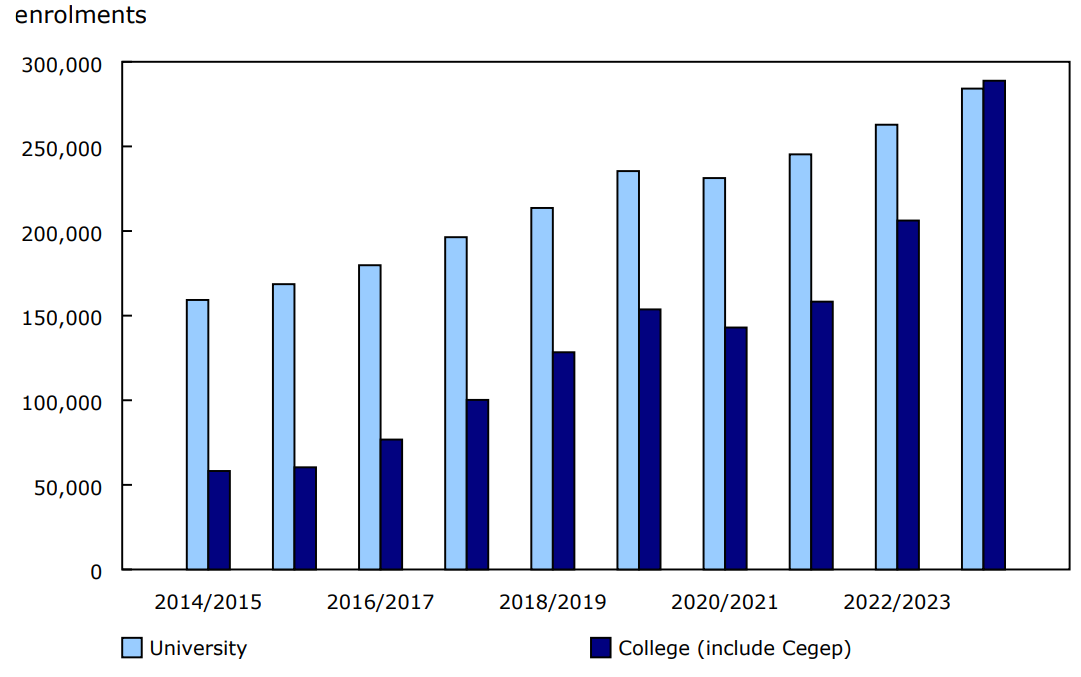
In 2023/2024, international student enrolments in public colleges (288,801, or 50.4% of total enrolments) surpassed those in universities (284,160, or 49.6%) for the first time in a decade. In 2014/2015, the distribution was notably different, with international students being more concentrated in universities (159,261, or 73.2% of total enrolments) than in colleges (58,188 or 26.8%).
From 2014/2015 to 2023/2024, international student enrolments in universities nearly doubled, while those in colleges increased by about fivefold. For additional information on changes in international student college enrolments during this period, see the infographic "International student enrolments at Canadian public colleges, 2014/2015 and 2023/2024."
Chart 1: International student enrolments by institution type, 2014/2015 to 2023/2024
Description - Chart 1
Data table: International student enrolments by institution type, 2014/2015 to 2023/2024
Source: Table 37-10-0163-01.
Field-specific enrolment growth for international and Canadian students
College and university enrolments among international students increased across all fields of study for the 2023/2024 academic year. Increases continued to be concentrated in business and administration, where enrolments rose in both colleges (+39.4%; +35,928) and universities (+12.1%; +6,939). The next largest increases were observed in mathematics and computer and information sciences, where enrolments were up 48.9% (+12,204) at colleges and 11.6% (+4,305) at universities.
In contrast, among Canadian students, the strongest growth in college enrolments occurred in science and science technology (+6.7%, +2,508), followed by arts and humanities (+3.2%; +3,465). At the university level, the largest increases were recorded in mathematics and computer and information sciences (+6.4%; +3,981) and in engineering and engineering technology (+1.8%; +1,731).
India continues to contribute the largest number of international student enrolments
International student enrolments in 2023/2024 continued to be led by students from India, whose numbers increased by 57,705 (+34.8%) and accounted for just over half (55.5%) of the total growth in international student enrolments. Beyond India, there were also increased enrolments from several other countries from 2014/2015 to 2023/2024. For example, international student enrolments from the Philippines rose from 681 in 2014/2015 to 19,608 in 2023/2024, while those from Nigeria increased from 5,742 to 24,159 over the same period.
Increase in number of graduates across all provinces except for Quebec
Table 1: Graduates from Canadian public universities and colleges, 2022 and 2023
In 2023, 662,751 students graduated with a certificate, diploma or degree from a Canadian public postsecondary institution, an increase of 7.4% (+45,468) from 2022. The number of college graduates in 2023 rose by 14.8% (+40,782), increasing at around nine times the pace of university graduates (+4,689; +1.4%). Across Canada, Ontario recorded the largest increases in both university (+3,822; +2.8%) and college (+35,514; +23.7%) graduates, while Quebec recorded the largest decreases in university (-2,700; -2.8%) and college (-204; -0.4%) graduates.
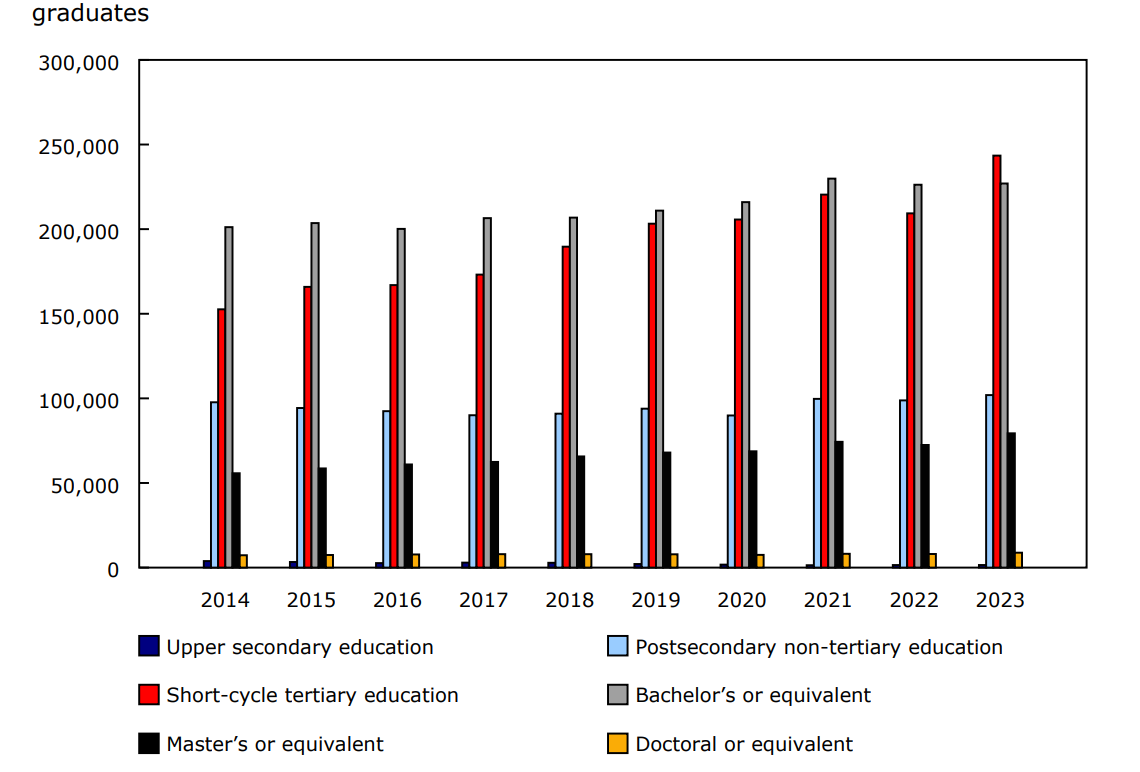
By level of education, in 2023, graduates from short-cycle tertiary programs (243,453) outnumbered those from bachelor's or equivalent programs (226,971) for the first time since 2014. In 2023, college students accounted for 84.0% (204,576) of short-cycle-tertiary graduates, compared with 16.0% (38,877) for university students.
Chart 2: Graduates from postsecondary institutions by level of education, 2014 to 2023
Description - Chart 2
Data table: Graduates from postsecondary institutions by level of education, 2014 to 2023
Note: Level of education by the International Standard Classification of Education.
Source: Table 37-10-0070-01.
Note to readers
Administrative data on Canadian postsecondary institution enrolments and graduates are obtained from public colleges and universities using the Postsecondary Student Information System. The counts exclude students enrolled in apprenticeship programs. Enrolment and graduate counts for certain institutions are preliminary or based on estimates.
The number of enrolments presented is not meant to represent a complete enumeration of all students at postsecondary institutions during the 2023/2024 academic year. Instead, they are based on students enrolled in postsecondary institutions at the time of the fall snapshot date, that is, a single date chosen by the institution that falls between September 30 and December 1. Therefore, students who are not enrolled during this period are excluded. This has a greater impact on colleges as they have a continuous intake of students and offer shorter programs.
Enrolments are based on program counts and not on student counts. If a student is enrolled in more than one program as of the snapshot date, all their programs are included in the count.
Graduate data are published based on the calendar year.
Colleges can offer some programs at the bachelor level and above.
All numbers, including the totals, have been rounded; therefore, sums of the values may not match the total counts. Percentage changes were calculated using rounded values. The data are subject to annual revisions. These revisions are applied to include new data submissions from 2004, any updates to classification standards and changes in concepts.
The International Standard Classification of Education is the reference classification for organizing education programs and related qualifications by education levels and fields.
Postsecondary non-tertiary education refers to college-level programs that lead to trade certificates and career, technical or professional training programs which typically require six months to two years of study. This category also includes certificates of apprenticeships.
Short-cycle tertiary education includes college diploma programs that typically lead to specific career paths, as well as academically focused programs that prepare students for entry into bachelor's degree programs. These programs are mostly offered by colleges and occasionally by universities. They usually have a duration of two to three years.
Contact information
For more information, or to enquire about the concepts, methods or data quality of this release, contact us (toll-free 1-800-263-1136; 514-283-8300; infostats@statcan.gc.ca) or Media Relations (statcan.mediahotline-ligneinfomedias.statcan@statcan.gc.ca).