
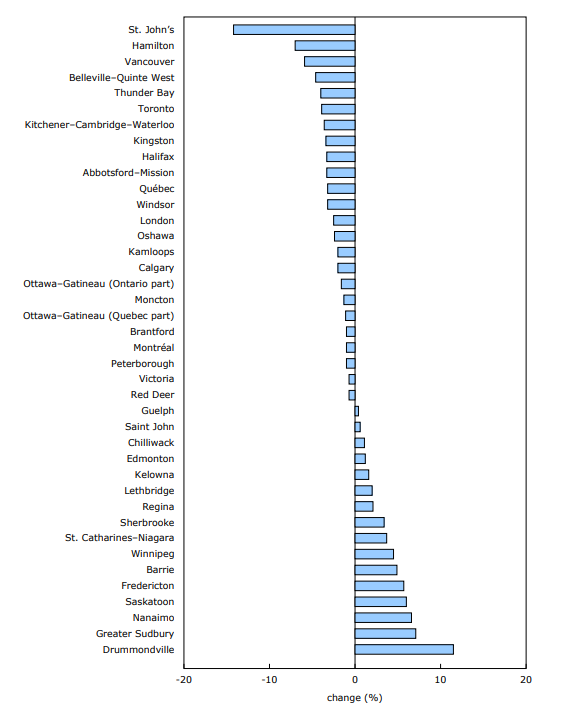
In the third quarter of 2025, the average asking rent for a two-bedroom apartment fell year over year in 24 of the 40 census metropolitan areas in the country with available data, including Montréal (-1.0%), Toronto (-3.9%) and Vancouver (-5.9%).
However, the average asking rent for a two-bedroom apartment rose year over year in the third quarter of 2025 in the three metropolitan areas in Saskatchewan and Manitoba: Saskatoon (+6.0%), Winnipeg (+4.5%) and Regina (+2.1%). Increases were also observed in other parts of the country, such as in Drummondville (+11.5%), Quebec, Greater Sudbury (+7.1%), Ontario, and Nanaimo (+6.6%), British Columbia.
For a second time, Statistics Canada, in collaboration with the Canada Mortgage and Housing Corporation, is publishing estimates from the Quarterly Rent Statistics program. This program provides experimental estimates on the asking rent of available rental units listed on major rental platforms in Canada. Today, new data are being released for the second and third quarters of 2025.
Chart 1: Year-over-year change in the average asking rent for a two-bedroom apartment, by census metropolitan area, third quarter of 2025
Description - Chart 1
Source: Table 46-10-0092-01.
The decreases observed in a number of markets occurred amid slower population growth in Canada, which stood at 0.1% in each of the first two quarters of 2025, representing the lowest growth rates since 2020. At the same time, more dwellings were added to the market. In the first three quarters of 2025, more than 148,000 dwellings were completed in Canada's metropolitan areas, according to data from the Canada Mortgage and Housing Corporation. Of these dwellings, more than 64,000 were destined for the rental market, while close to 44,000 were condominiums, some of which were potentially destined for rental.
Average asking rent falls in Toronto and Vancouver, the two least affordable markets
In the third quarter of 2025, the average asking rent for a two-bedroom apartment in the Toronto metropolitan area continued to trend downward since reaching the high of $2,920 in the last two quarters of 2023. In the third quarter of 2025, the average asking rent for a two-bedroom apartment was $2,720, down 3.9% from the same quarter one year earlier.
This trend occurred amid a weak home resale market since 2022 in the Toronto metropolitan area. Fewer sales, combined with a lower average selling price, could have pushed owners to rent their property rather than sell it. A higher number of rental units on the market may have contributed to lower average asking rent. In addition, demand for housing in the Toronto metropolitan area may have waned due to a decline in the number of non-permanent residents in Ontario in the first two quarters of 2025.
There was a similar trend in the Vancouver metropolitan area, where the average asking rent for a two-bedroom apartment decreased 5.9% from the third quarter of 2024 to $3,190 in the third quarter of 2025. This downturn occurred as the number of sales in Vancouver was below the 20-year historical average and the number of non-permanent residents in British Columbia fell in the first two quarters of 2025.
In the Montréal metropolitan area, even though sales fared better in the real estate market, the average asking rent also fell in the third quarter of 2025 (-1.0%), but to a lesser extent. In Montréal, the average asking rent for a two-bedroom apartment was $1,930 in the third quarter of 2025.
Prices for individual rooms decrease in British Columbia's metropolitan areas
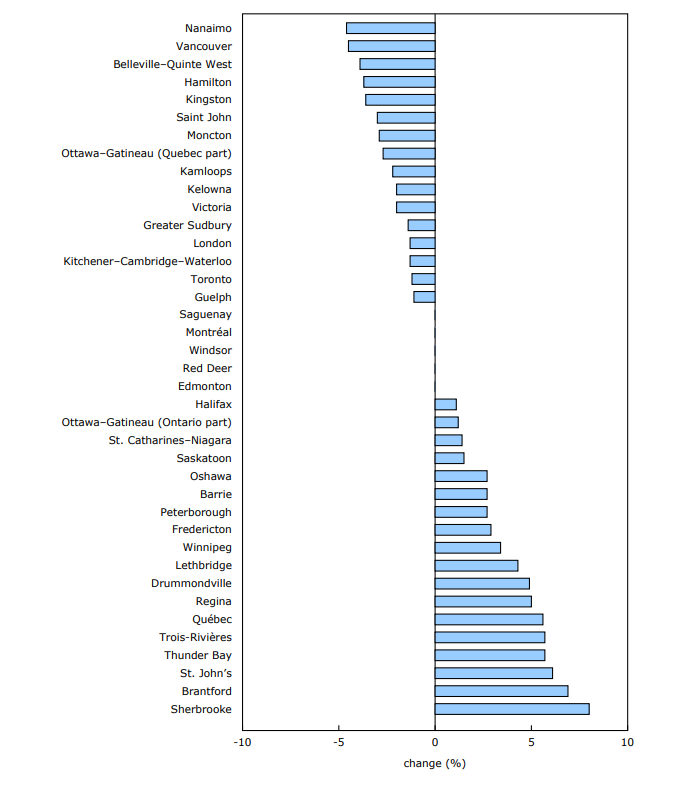
In the third quarter of 2025, the average asking rent for an individual room fell year over year in 16 of the 39 metropolitan areas with available data. Many of these decreases were observed in British Columbia, notably in Nanaimo (-4.6%) and Vancouver (-4.5%).
Sherbrooke (+8.0%), Quebec, and Brantford (+6.9%), Ontario, posted the biggest increases in the average asking rent for an individual room in the third quarter.
Chart 2: Year-over-year change in the average asking rent for a room, by census metropolitan area, third quarter of 2025
Description - Chart 2
Source: Table 46-10-0092-01.
Note to readers
Today, Statistics Canada, in collaboration with the Canada Mortgage and Housing Corporation, is publishing new quarterly rent statistics. For more information about the methodology, please consult the document ''Quarterly Rent Statistics: Technical Report on Methodology and Assumptions.''
In this release, the average asking rent is derived from listings posted on major rental listing platforms in Canada. The average asking rent offers a picture of what prospective tenants can expect to pay based on the type of housing they are searching for (rental unit type, number of rooms and location).
Estimates for all census metropolitan areas (CMAs) for the second quarter of 2025 should be used with caution because data from one platform were not available. The average asking rent for apartments was estimated with a regression model, using listings from other platforms when possible, as well as interpolation techniques. Meanwhile, the average asking rent for rooms was estimated using only linear interpolation.
Some estimates for the second and third quarters for the Calgary CMA are not available. The data published for this CMA should be used with caution, as they were modelled using a smaller sample of listings.
Estimates include purpose-built (primary) rentals and units available in the secondary rental market. Collective dwellings, vacation homes, mobile homes and subsidized housing are not included in these estimates.
Although estimates of average asking rent are adjusted to represent the different types of rental units, they do not account for variations in their quality. This means that variations in average asking rent levels can be influenced by changes in the quality attributes of rental units, such as the inclusion of utilities, upgraded finishes or parking.
Data are experimental and subject to revision.
All data are expressed in current dollars and are based on the 2021 Standard Geographical Classification.
Definitions
A metropolitan area, also called a census metropolitan area, is formed by one or more adjacent municipalities centred on a population centre (known as the core). A CMA must have a total population of at least 100,000, of which 50,000 or more must live in the core. To be included in the CMA, other adjacent municipalities must have a high degree of integration with the core, as measured by commuting flows derived from data on place of work from the previous Census program.
Asking rent refers to the monthly amount for which a rental unit is advertised, regardless of what is included in the rent.
Rental unit refers to a private dwelling or a set of living quarters in a private dwelling that is rented or for rent.
Contact information
For more information, or to enquire about the concepts, methods or data quality of this release, contact us (toll-free 1-800-263-1136; 514-283-8300; infostats@statcan.gc.ca) or Media Relations (statcan.mediahotline-ligneinfomedias.statcan@statcan.gc.ca).