

From 2014 to 2024, just over 5,000 human trafficking incidents were reported by police services in Canada, and the vast majority of identified victims were women and girls.
Trafficking in persons, also known as human trafficking, involves recruiting, transporting, sheltering or controlling the movements of a person for the purposes of exploitation, usually for sexual reasons or forced labour. Human trafficking does not require the crossing of international borders and can occur entirely within a single country.
The Juristat article "Trafficking in persons in Canada, 2024" released today, examines trends and characteristics in human trafficking incidents reported by police from 2014 to 2024, along with the decisions and outcomes of cases completed in the adult criminal courts.
Police-reported human trafficking has generally increased year over year since 2014
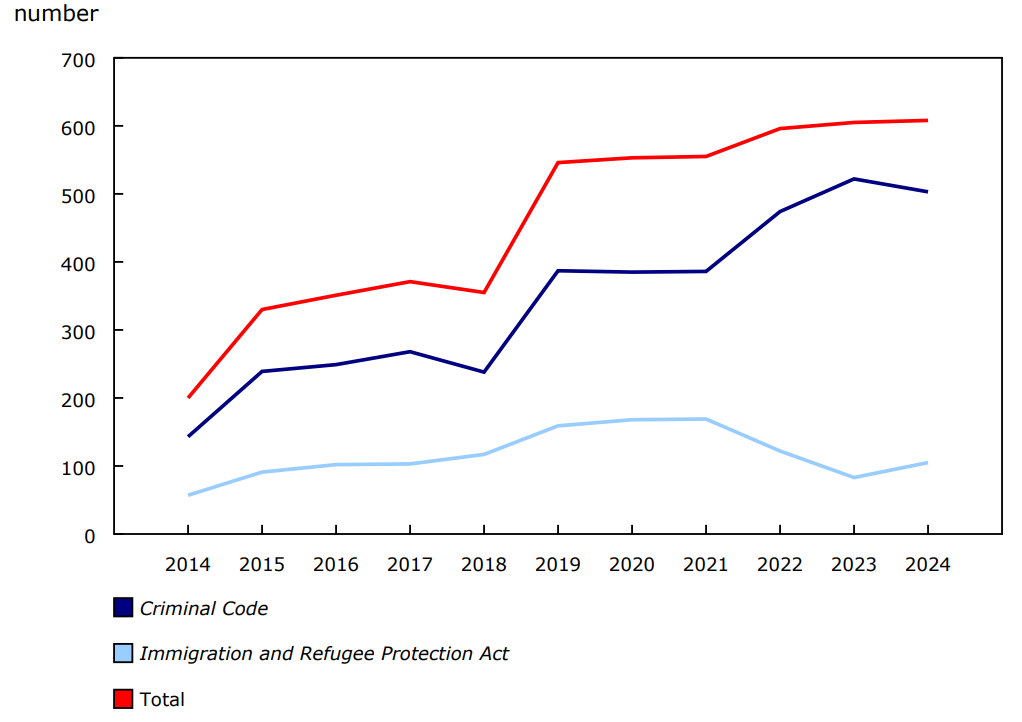
From 2014 to 2024, there were 5,070 human trafficking incidents reported by police services in Canada, representing an average annual rate of 1.2 incidents per 100,000 population. On a year-over-year basis, there were about three times as many human trafficking incidents in 2024 compared with 2014, with numbers increasing in each year since 2014, except for 2018.
Chart 1: Police-reported human trafficking, by statute, Canada, 2014 to 2024
Description - Chart 1
Data table: Police-reported human trafficking, by statute, Canada, 2014 to 2024
Notes: This chart is based on aggregate data. Counts are based on the most serious violation against the victim for Criminal Code offences and the most serious violation in the incident for Immigration and Refugee Protection Act offences. Data reported by the Canadian Forces Military Police are excluded.
Source: Uniform Crime Reporting Survey (3302).
In 2024 alone, 608 human trafficking incidents were reported by police services across the country, representing a rate of 1.5 incidents per 100,000 population (see Note to readers). Similar to what was observed in previous years, the highest rate in the provinces was reported by police in Nova Scotia (4.5). In 2024, four other provinces also exceeded the national rate: Prince Edward Island (2.8), Ontario (2.3), New Brunswick (2.0) and Saskatchewan (1.9).
Aligned with prior annual trends, more than 8 in 10 human trafficking incidents (83%) reported by police in 2024 were in Canada's largest urban centres.
Most identified victims of human trafficking are women and girls, while men and boys make up majority of accused persons
Human trafficking is highly gendered. From 2014 to 2024, the vast majority (93%) of victims identified by police were women and girls, and most persons (82%) accused of the crime were men and boys. These trends have generally remained consistent over time. Additionally, compared with men and boy victims, women and girl victims tended to be younger, to be involved in single-victim incidents and to share an intimate relationship with their trafficker.
From 2014 to 2024, about three in five police-reported incidents of human trafficking (59%) were not cleared (see Note to readers), but of those that were, most (90%) were cleared by the laying or recommendation of charges.
Charges and cases of human trafficking completed in court have generally increased from 2013/2014 to 2023/2024
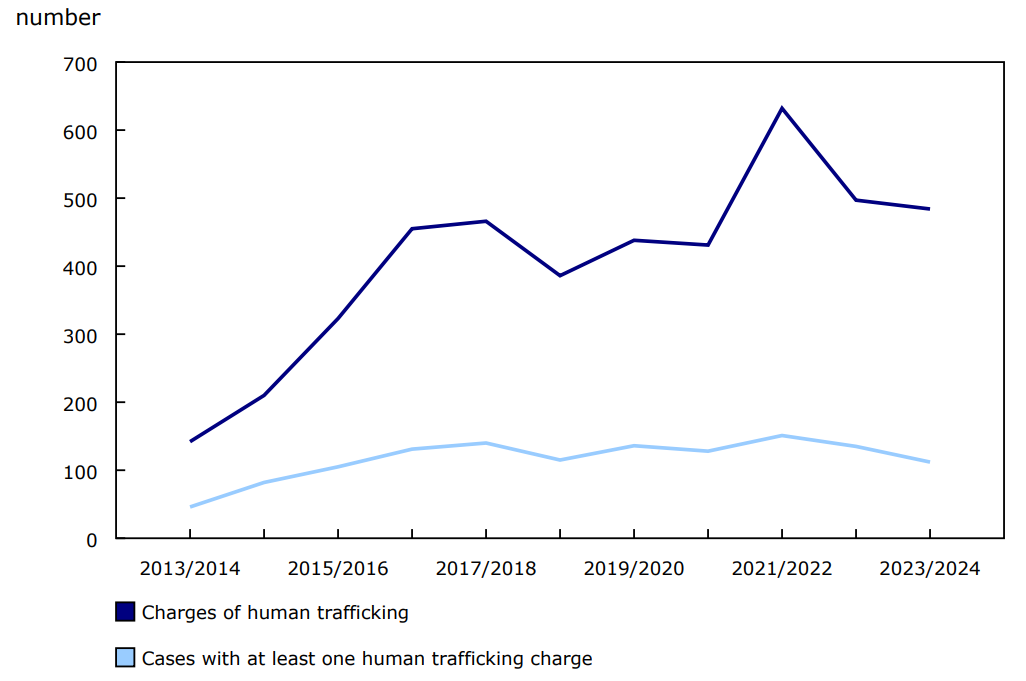
Cumulatively, from 2013/2014 to 2023/2024 (the reference period of criminal court statistics is April 1 to March 31), there were 1,281 cases involving 4,464 human trafficking charges processed in adult criminal courts that received a final decision. In general, the annual number of human trafficking cases with a final decision has more than doubled over this period, from 46 in 2013/2014 to 112 in 2023/2024.
Chart 2: Completed charges and cases related to human trafficking in adult criminal courts, Canada, 2013/2014 to 2023/2024
Description - Chart 2
Notes: Data are based on the adult criminal court portion of the survey, where accused persons were aged 18 and older at the time of the offence. This chart includes Criminal Code charges and cases only, excluding Immigration and Refugee Protection Act offences. A case involves one or more charges against an accused person or company that were processed by the courts at the same time and received a final decision. Data exclude information from superior courts in Ontario, Manitoba and Saskatchewan, as well as municipal courts in Quebec, because of data availability. Data for Quebec were not available for 2021/2022, 2022/2023 and 2023/2024. Superior court data for Prince Edward Island were included as of 2018/2019.
Source: Integrated Criminal Court Survey (3312).
Human trafficking cases are often highly complex, with an average of 18 charges per case from 2013/2014 to 2023/2024, and take about twice as long to complete in court as other violent offence cases. However, most cases completed (84%) were stayed, withdrawn, dismissed or discharged, while 10% resulted in a guilty finding. More than three in four (78%) of those convicted were sentenced to incarceration.
Note to readers
Police-reported data come from the Uniform Crime Reporting (UCR) Survey, and the category of human trafficking offences includes six offences under the Criminal Code and one offence under the Immigration and Refugee Protection Act that targets international cross-border trafficking. Police services can report up to four violations for each criminal incident.
- Criminal Code offences: trafficking in persons, trafficking in persons under 18 years, material benefit from trafficking in persons, material benefit from trafficking of persons under 18 years, withholding or destroying documents, and withholding or destroying documents to facilitate trafficking of persons under 18 years.
- Immigrant and Refugee Protection Act: trafficking in persons into Canada.
Human trafficking incidents may be cleared by the laying or recommendation of charges, or cleared otherwise. Those that are not cleared include incidents that were open and still under investigation, incidents with insufficient evidence to proceed, and incidents where the victim or complainant declined to proceed (no accused person identified).
In the UCR Survey, victim information is reported by police for Criminal Code incidents of human trafficking, but not for Immigration and Refugee Protection Act violations. As a result, there are fewer victims of police-reported human trafficking than there are incidents, and analyses of victim characteristics include all victims involved in a human trafficking incident where a Criminal Code offence was the most serious violation. Human trafficking is an especially complex crime, and incident counts may shift following additional police investigation. Revisions are accepted up to one year after UCR Survey data are initially released. For instance, 570 incidents of human trafficking were initially reported in 2023 but, following annual revision, there were 605 incidents. Therefore, comparisons using the latest year of data should be avoided until the revised data are released in May 2026.
Given that there may be small counts of victims and accused persons identified as "non-binary", the UCR Survey data available to the public have been recoded to assign these counts to either "women and girls" or "men and boys" to ensure the protection of confidentiality and privacy. Percentage calculation excludes victims and accused persons whose gender was unknown.
Data on human trafficking in courts come from the Integrated Criminal Court Survey (ICCS), which collects statistical information on adult criminal and youth court cases involving Criminal Code and other federal statute offences. For this analysis, a human trafficking case requires at least one human trafficking charge and can include one or more charges (related or unrelated) against an accused person or company that were processed by the courts at the same time and received a final decision. Like UCR Survey data, ICCS data are revised one year after initially released. For example, 122 human trafficking cases were originally reported completed in the 2022/2023 fiscal year but, following annual revision, there were 135 cases. Comparisons using the latest year of data should therefore be made with caution.
Guilty findings include guilty of the charged offence, of an included offence, of an attempt of the charged offence, or of an attempt of an included offence. This category also includes guilty pleas and cases where an absolute or conditional discharge has been imposed. Data reflect the most serious sentence in relation to a guilty charge in a case. Sentences are ranked from most to least serious as follows: custody, conditional sentence, probation, fine and other (restitution, absolute or conditional discharge, suspended sentence, other).
Contact information
For more information, or to enquire about the concepts, methods or data quality of this release, contact us (toll-free 1-800-263-1136; 514-283-8300; infostats@statcan.gc.ca) or Media Relations (statcan.mediahotline-ligneinfomedias.statcan@statcan.gc.ca).