

Canadian colleges recorded their largest increase in total revenue (+11.5%) and expenditure (+12.3%) in more than two decades in 2023/2024. Total revenues reached $18.5 billion, while expenditures totalled $17.9 billion.
Nearly four-fifths (77.0%) of the annual increase in college revenues came from student fees ($1.5 billion), followed by investment income (9.7%), provincial funding (7.0%) and other revenue sources (6.3%).
The $2.0 billion increase in college expenditures was largely driven by higher salaries and benefits (45.5%), followed by spending on fees and contracted services (31.4%), operational supplies (5.1%), and expenditure items (18.0%) such as utilities and furniture and equipment.
All figures are expressed in 2024 constant dollars to remove the effects of inflation and allow for consistent comparisons over time.
Student enrolment and college fees contribute most to revenue
A record increase of nearly 100,000 new students contributed to the 23.2% increase in total college fees collected in 2023/2024. Most of this growth came from international students studying in Ontario, who often pay up to four times more in fees than Canadian students.
Over the last two decades—particularly since the COVID-19 pandemic—colleges have become increasingly reliant on student fees as opposed to public funding. In 2020/2021, fees accounted for less than one-third (32.9%) of total revenues; by 2023/2024, this share had risen to 42.1%.
Chart 1: Total fees and total provincial funding as a percent of total revenues, 2009/2010 to 2023/2024
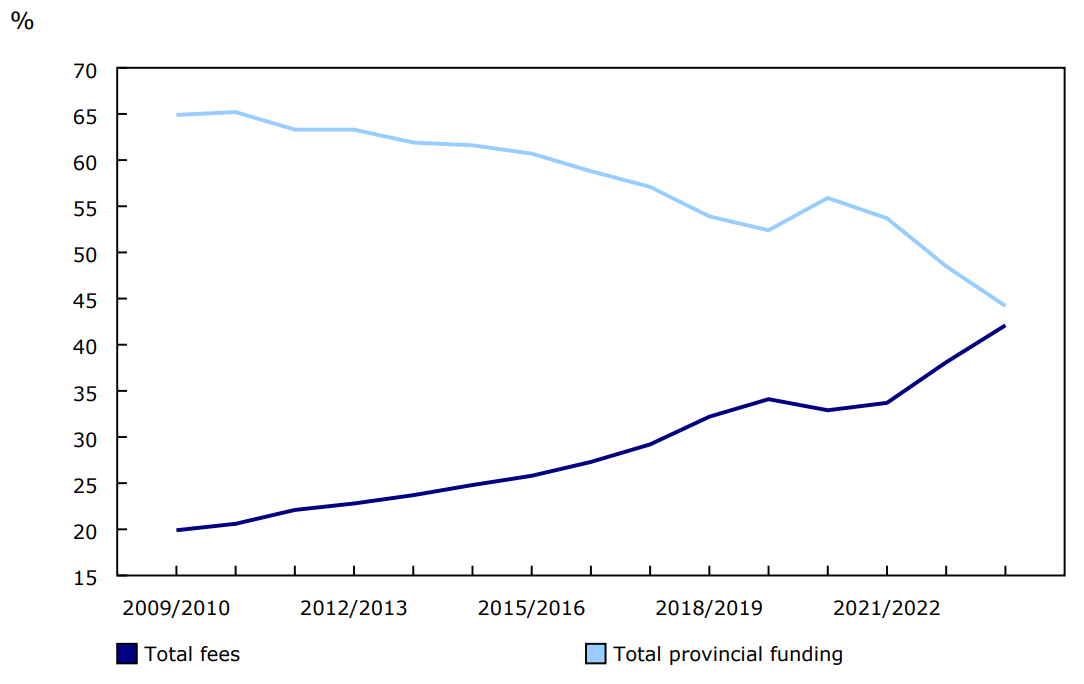
Description - Chart 1
Data table: Total fees and total provincial funding as a percent of total revenues, 2009/2010 to 2023/2024
Source: Financial Information of Colleges (FINCOL) (3146).
Some variations in dependence on college fees were noted across the country. In 2023/2024, Ontario was the only province where the majority of college revenue (64.5%) came from fees, while all other provinces and territories relied more on provincial funding.
In 2023/2024, college fees accounted for the smallest share of total revenue in Nunavut (2.5%), the Northwest Territories (3.7%) and Quebec (7.5%).
Despite the large increase in total fees in 2023/2024, revenue from future fees could be impacted by federal and provincial policy changes. These policy changes include capping international student study permit applications and changing the eligibility criteria for the Post-Graduation Work Permit Program.
Public funding rises at fastest pace in a decade
Colleges received their largest year-over-year increase in public funding in a decade in 2023/2024. However, public funding continues to decline as a share of total revenue.
Public funding—from federal, provincial, and municipal sources—increased by 2.1% to $8.5 billion in 2023/2024. Despite this rise, its share of total college revenue fell from 58.5% in 2020/2021 to 46.0% in 2023/2024.
Investment income increases for a second straight year
Investment income is influenced by broader economic conditions and is not a guaranteed source of revenue.
In 2023/2024, colleges reported a second consecutive increase in investment income with all provinces and territories reporting positive returns on investment.
Total investment returns increased by nearly two-thirds (+65.8%) to $466.5 million in 2023/2024, following a record 110.0% increase the previous year.
Salaries and benefits rise at a record rate
The renewal of collective agreements, retroactive payments and the hiring of new staff to support increased student enrolment contributed to a record year-over-year rise in college salary and benefit expenses in 2023/2024.
These expenses increased by 9.4% to $10.5 billion in 2023/2024. However, they continue to represent a smaller share of total spending, falling from a high of 66.5% in 2020/2021 to 58.3% in 2023/2024.
Note to readers
In the Financial Information of Colleges (FINCOL) survey, "colleges" refers to public and private – not for profit colleges, CEGEPs and polytechnics.
Revenue data are collected from each public college and are distributed by type of fund, including general operating funds (an unrestricted fund that accounts for the institution's primary activities of instruction and operations), sponsored research and capital.
Additional information for the 2023/2024 FINCOL survey is also available.
Yukon is no longer in the survey because Yukon College became Yukon University in 2020.
Contact information
For more information, or to enquire about the concepts, methods or data quality of this release, contact us (toll-free 1-800-263-1136; 514-283-8300; infostats@statcan.gc.ca) or Media Relations (statcan.mediahotline-ligneinfomedias.statcan@statcan.gc.ca).