
Logging revenue rises again after decline in 2023
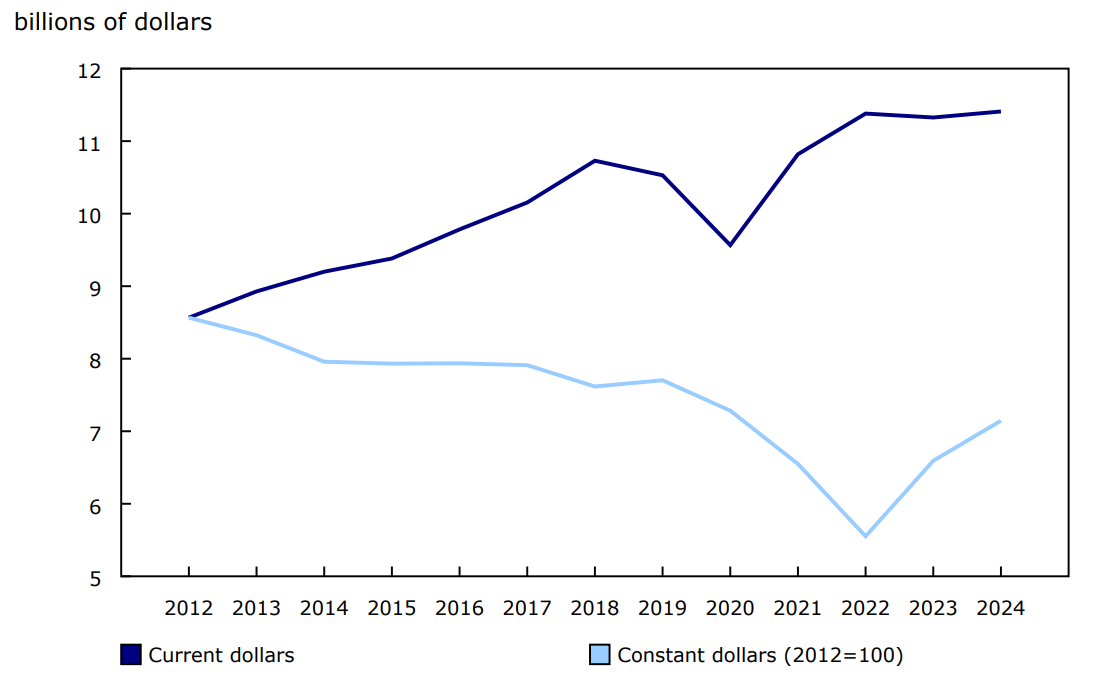
Total revenue in the logging industry increased by $49.2 million (+0.4%) to $12.4 billion in 2024 after falling 0.3% in 2023. Revenue in 2024 was split almost equally between the logging (except contract) industry (50.6%) and the contract logging industry (49.4%). Revenue from logging activities—which excludes revenue from other sources, such as secondary business activities—was up 0.7% to $11.4 billion in 2024.
Chart 1: Revenue from logging activities, 2012 to 2024
Description - Chart 1
Data table: Revenue from logging activities, 2012 to 2024
Note: Constant dollars were calculated using the yearly averages of the Raw Materials Price Index for logs, pulpwood and other forestry products and rebased to 2012=100.
Sources: Tables 18-10-0268-01 and 16-10-0114-01.
Expenses decrease despite increase in salaries and wages
Expenses from logging activities declined by $60.6 million to $11.7 billion in 2024, the second consecutive annual decrease. However, total expenses still represented 95 cents for every dollar of total revenue, a ratio that has remained unchanged since 2022.
The cost of materials and supplies for all logging activities decreased 1.3% to $6.0 billion in 2024, accounting for 62.5% of total expenses for loggers (except contract) and 39.1% for contract loggers. The cost of energy, water utility and vehicle fuel for logging activities edged down 3.3% (-$33.6 million).
Salaries and wages for the logging industry increased 1.7% to $1.8 billion in 2024. Contract loggers' share of total salaries and wages was 68.5%, compared with 31.5% for loggers (except contract). This difference reflects the fact that loggers (except contract) operate on an own-account basis and hire subcontractors, resulting in part of their labour costs being recorded as subcontract fees. For every dollar of total expenses, contract loggers spent 21 cents on salaries and wages, while loggers (except contract) spent 9 cents.
Lower revenues in four of the top five logging provinces
In 2024, the top five logging provinces accounted for 96.7% of Canada's revenue from logging activities. British Columbia recorded a notable increase in revenue (+$293.5 million to $5.4 billion). Conversely, revenues were down in Quebec (-$80.2 million to $ 2.6 billion), New Brunswick (-$52.5 million to $677.7 million), Ontario (-$44.2 million to $1.1 billion) and Alberta (-$15.8 million to $1.2 billion).
Note to readers
The logging industry is composed of two Canadian industries: logging (except contract) and contract logging. One of the main features of businesses specialized in logging (except contract) is that they own the rights to harvest timber. The largest proportion of revenues for contract loggers comes from logging services provided on a fee or contract basis, while the largest share of revenues for the logging (except contract) industry is from logging operations on an own-account basis.
The cost of materials and supplies is made up of purchases of raw materials and components, repairs and maintenance, payments to subcontractors, and stumpage fees.
Data for 2023 have been revised.
Data were collected for the 12-month fiscal period ending on April 1, 2024, or between this date and March 31, 2025. For more information on data quality and revisions, please refer to the page Annual Survey of Manufacturing and Logging Industries.
Contact information
For more information, or to enquire about the concepts, methods or data quality of this release, contact us (toll-free 1-800-263-1136; 514-283-8300; infostats@statcan.gc.ca) or Media Relations (statcan.mediahotline-ligneinfomedias.statcan@statcan.gc.ca).