

This infographic shows core housing need rates in Canada from the 2021 Census of Population.
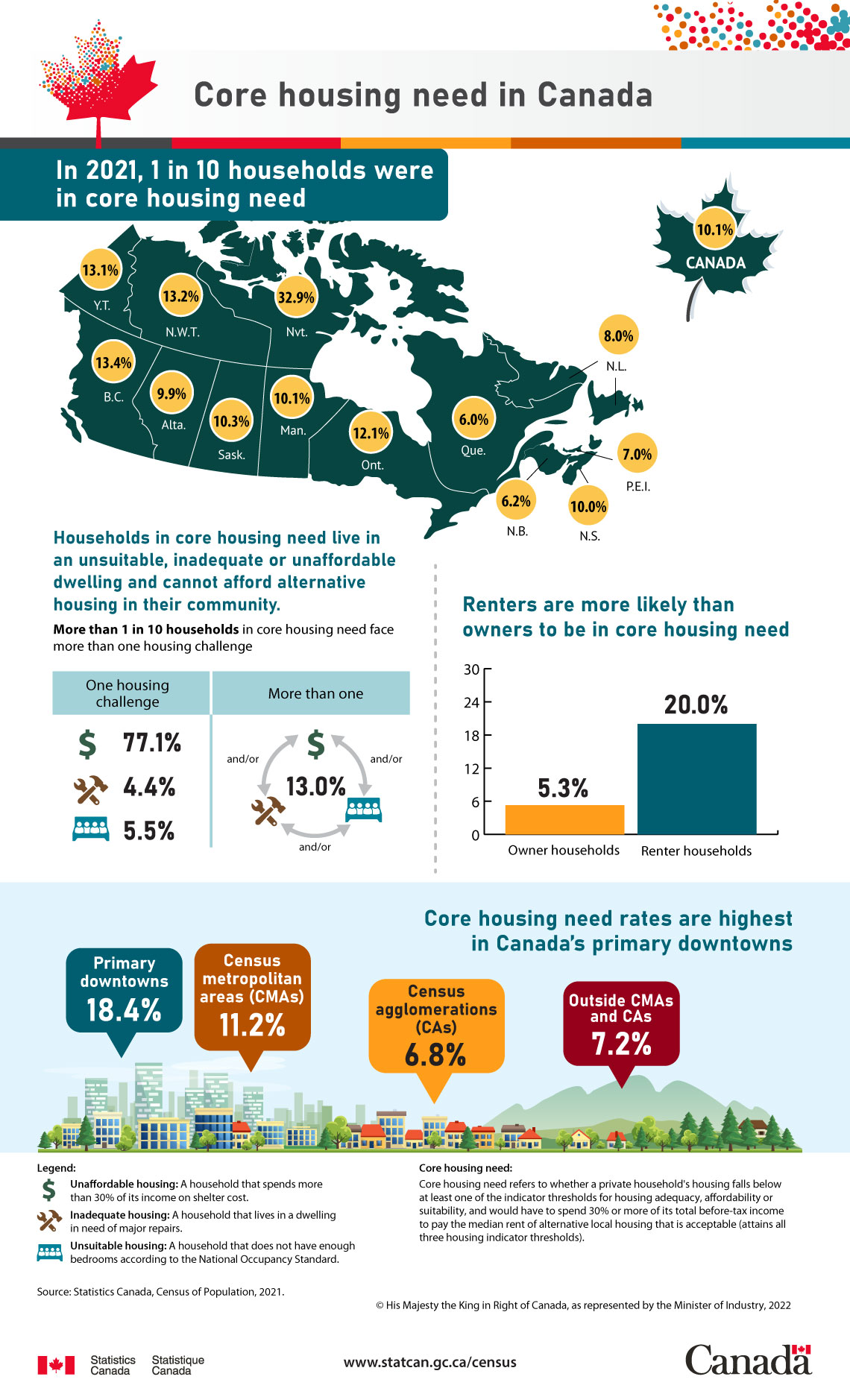
Description - Core housing need in Canada
In 2021, 1 in 10 households were in core housing need
| Geography | 2021 |
|---|---|
| Canada | 10.1% |
| Newfoundland and Labrador | 8.0% |
| Prince Edward Island | 7.0% |
| Nova Scotia | 10.0% |
| New Brunswick | 6.2% |
| Quebec | 6.0% |
| Ontario | 12.1% |
| Manitoba | 10.1% |
| Saskatchewan | 10.3% |
| Alberta | 9.9% |
| British Columbia | 13.4% |
| Yukon | 13.1% |
| Northwest Territories | 13.2% |
| Nunavut | 32.9% |
Households in core housing need live in an unsuitable, inadequate or unaffordable dwelling and cannot afford alternative housing in their community.
More than one in ten households in core housing need face more than one housing challenge
| One housing challenge | Rate |
|---|---|
| Unaffordable housing | 77.1% |
| Inadequate housing | 4.4% |
| Unsuitable housing | 5.5% |
| More than one | 13.0% |
Renters are more likely than owners to be in core housing need
| Owner households | Renter households |
|---|---|
| 5.3% | 20.0% |
Core housing need rates are highest in Canada’s primary downtowns
| Geography | Rate |
|---|---|
| Primary downtowns | 18.4% |
| Census metropolitan areas (CMAs) | 11.2% |
| Census agglomerations (CAs) | 6.8% |
| Outside CMAs and CAs | 7.2% |
Legend:
Unaffordable housing: A household that spends more than 30% of its income on shelter cost.
Inadequate housing: A household that lives in a dwelling in need of major repairs.
Unsuitable housing: A household that does not have enough bedrooms according to the National Occupancy Standard.
Core housing need: Core housing need refers to whether a private household's housing falls below at least one of the indicator thresholds for housing adequacy, affordability or suitability, and would have to spend 30% or more of its total before-tax income to pay the median rent of alternative local housing that is acceptable (attains all three housing indicator thresholds).
Source: Statistics Canada, Census of Population, 2021.
Contact information
For more information, or to enquire about the concepts, methods or data quality of this release, contact us (toll-free 1-800-263-1136; 514-283-8300; infostats@statcan.gc.ca) or Media Relations (statcan.mediahotline-ligneinfomedias.statcan@statcan.gc.ca).