
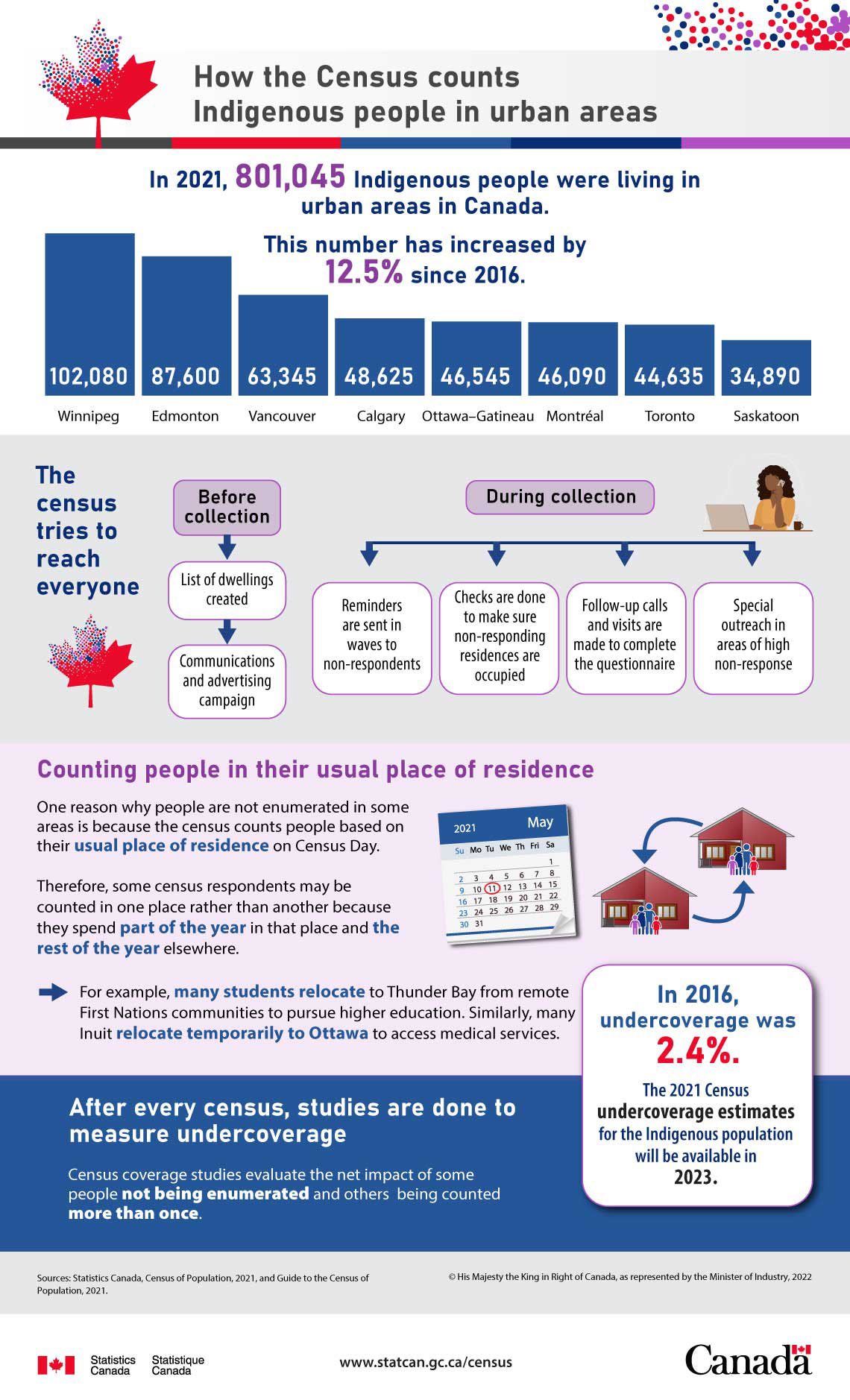
The infographic provides a high-level description of how the Census counts people, including Indigenous people, particularly those in urban areas. This includes efforts before and during data collection including communications and advertising, reminders, follow up calls and visits, and special outreach. It also outlines the practice of counting people based on usual place of residence on Census day. Finally, the infographic discusses studies that Statistics Canada undertakes to estimate undercoverage, that is, the net impact of some people being missed and others that are being counted more than once by the Census.
Description - How the Census counts Indigenous people in urban areas
In 2021, 801,045 Indigenous people were living in urban areas in Canada.
This number has increased by 12.5% since 2016.
| Census Metropolitan Area (CMA) | Indigenous population |
|---|---|
| Winnipeg | 102,080 |
| Edmonton | 87,600 |
| Vancouver | 63,345 |
| Calgary | 48,625 |
| Ottawa–Gatineau | 46,545 |
| Montréal | 46,090 |
| Toronto | 44,635 |
| Saskatoon | 34,890 |
The Census tries to reach everyone
Before collection
List of dwellings created
Communications and advertising campaign
During collection
Reminders are sent in waves to non-respondents
Checks are done to make sure non-responding residences are occupied
Follow-up calls and visits are made to complete the questionnaire
Special outreach in areas of high non-response
Counting people in their usual place of residence
One reason why people are not enumerated in some areas is because the census counts people based on their usual place of residence on Census Day.
Therefore, some census respondents may be counted in one place rather than another because they spend part of the year in that place and the rest of the year elsewhere.
For example, many students relocate to Thunder Bay from remote First Nations communities to pursue higher education. Similarly, many Inuit relocate temporarily to Ottawa to access medical services.
After every census, studies are done to measure undercoverage
Census coverage studies evaluate the net impact of some people not being enumerated and others being counted more than once.
In 2016, undercoverage was 2.4%.
The 2021 Census undercoverage estimates for the Indigenous population will be available in 2023.
Sources: Statistics Canada, Census of Population, 2021, and Guide to the Census of Population, 2021.
Contact information
For more information, or to enquire about the concepts, methods or data quality of this release, contact us (toll-free 1-800-263-1136; 514-283-8300; infostats@statcan.gc.ca) or Media Relations (statcan.mediahotline-ligneinfomedias.statcan@statcan.gc.ca).