
On this page
Statistics Canada: a long-standing Canadian institution

Canada's central statistical agency, which we know today as Statistics Canada, has been mandated since 1918 to provide statistical information to the people of Canada and to the world. From its humble beginnings with one office of 123 employees, using punch cards and electric tabulating machinery, the agency has grown into an institution with over 7,000 employees spread across three major regional offices—the Eastern Region, the Central Region, and the Western and Northern Territories Region—all proudly representing Statistics Canada across the nation.
Today, Statistics Canada conducts more than 450 active surveys, covering 32 different subject matter fields, as well as censuses of population and agriculture every five years. As the demand for high-quality, relevant information continues to grow, Statistics Canada continues to deliver.
Canada's first statistician

Jean Talon was Canada's first official statistician. He was born in 1625 in Champagne, France and arrived in North America in 1665 on a mission for King Louis XIV and his finance minister, Jean-Baptiste Colbert.
Jean Talon initiated Canada's first census in 1666 as the Intendant, or chief civil servant, of New France (a large territory that once encompassed parts of eastern Canada and parts of the United States). The census counted the colony's 3,215 inhabitants, recording their age, sex, marital status and occupation. The information was needed for planning the colony's development. Talon did much of the data collection personally by visiting settlers on horseback during the winter of 1665-1666. Some have claimed that this was the first modern census since it was conducted purely for statistical purposes.
Talon was a man of enthusiasm and vision, and although he ranked below the Governor, he soon became the real manager of the colony. He served for two terms, from 1665 to 1668 and from 1670 to 1672.
He died in France in 1694.
The foundation of Canada's statistical system

When Canada was created in 1867, the British North America Act assigned responsibility for "the Census and Statistics" to the federal government. This laid the foundation for Canada's statistical system. It also created a constitutional requirement for a decennial census. The first national census was conducted in 1871.
General statistics were assembled by provincial and federal government departments from operating documents as by-products. These documents produced postal, merchant shipping, trade, inland revenue and immigration statistics.
The 1880s and 1890s brought substantive progress with general statistics, which, starting in 1889, were compiled in editions of what would become the Canada Year Book. These early editions were impressive achievements of statistical coordination.
In 1918, the Statistics Act created the Dominion Bureau of Statistics, a national statistics office with broad powers to collect administrative and survey data for statistical purposes. The Act established a central statistical system that made better use of the scarce skilled employees available at the time and established better ways of collecting and analyzing data.
In 1960, the Glassco Royal Commission, in one of its special studies, gave a strong endorsement to strengthening the centralized statistical system and ensuring the Bureau's independence. One recommendation was that the Bureau become a federal department and that the Dominion Statistician have the status of a deputy minister. By an Order-in-Council of January 6, 1965, the government accepted this recommendation. Statistics Canada emerged six years later, in 1971, when a new Statistics Act was passed by Parliament.
Over the years, Statistics Canada has continued to fulfill its mandate to produce statistics that help Canadians better understand their country—the land, the people, the economy and the society.
Statistics and evolving technology
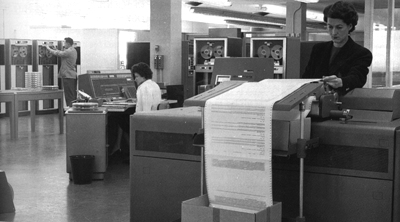
In 1911, card-punching and electric tabulating machinery revolutionised statistical compilation. The machines required expert supervision and were expensive, but they added a range of analysis and great savings in time and costs. The Dominion Statistician, Herbert Marshall, wrote in his annual report for 1955/1956, "Much study is being given to the question of adding an electronic computing machine to the Bureau's mechanical equipment." The 1960/1961 Annual Report noted that for the first time an electronic computer would be used to compile data for the Census. This eliminated the need for intermediary punched cards.
The Bureau's first in-house computer was the IBM 705. In its day, it was one of the biggest computers in Canada. It began arriving in July 1960: the 705 was not one piece of equipment, but rather a number of machines working together. The 705 occupied an entire wing of the Bureau's Main Building, and the ceiling had to be rebuilt to house the cables. The heat generated by the computer's 10,000 vacuum tubes had to be offset by two large air-conditioning units. A staff of 30 worked directly on the computer.
By 1966, the Dominion Statistician reported that "the computer resources continue to be used virtually at capacity—24 hours a day during a five-day week, with considerable overtime on weekends." He noted that "a systematic study is under way to establish long-term computer requirements in the Dominion Bureau of Statistics as the basis for plans to replace some of the existing equipment which is becoming obsolete."
By 1968, the Canadian Socio-Economic Information Management System (CANSIM)—originally a data storage, retrieval and manipulation computer program—contained a meagre 2,500 time series. Twenty-five years later, it had grown to over 400,000, still only a fraction of the agency's total time series it contains today. Online service to CANSIM was introduced in 1972, first to federal government users and a year later to the general public. In 2008, CANSIM celebrated its fortieth anniversary as the agency's primary database for Canada's socio-economic information.
In the 1990s, the Internet revolution and the growing popularity of this new technology, combined with the increasing demand for micro data, paved the way for Statistics Canada to respond to data users' needs with an extensive Internet site, public-use micro data files and a network of research data centres. The Statistics Canada website was launched in 1995, marking the beginning of a new era.
Since then, the website has become the main communication and dissemination channel for Statistics Canada. With its seven million pages of news releases, in-depth analytical studies, articles, technical papers, data tables, etc., it is one of the largest websites in the federal government.
The Daily lives up to its name

At almost 100 years of age, Statistics Canada’s venerable official release bulletin lives up to its name. The Daily has never missed an issue—despite strikes, computer viruses, ice storms and a blackout in 2003 that plunged eastern North America into darkness.
Throughout the decades, The Daily has kept pace with the need for consistent, accurate information and the technological changes for its delivery.
In 1996, The Daily made the transition from a paper product to an Internet product. Statistics Canada continued to distribute a paper version as well until 2003 when diminishing demand for the print version no longer justified its production. This decision coincided with the 2003 blackout, which closed the Agency for six days. Despite this challenge, the publication did not skip a beat.
The Daily experienced another milestone in 2009 when it received a new online image. In addition to the day’s new releases, The Daily website now also provides the most recently published analytical releases.
From its humble beginnings in 1932 as a typewritten fact sheet, The Daily has evolved into a smart, fully electronic product that is delivered every workday morning at 8:30 (E.T.)—without fail—in English and French.
A positive and forward-looking workplace

From its early days, the agency has been a family-oriented "people place." Picnics, sports and social events are among the agency's traditions. Today, Statistics Canada continues to value its employees and to support diversity among its workforce.
In 1945, Sedley A. Cudmore, the Dominion Statistician, asked his senior managers to develop a constitution for a staff organization that would deal with recreation facilities, working conditions and morale in general. The request led to the establishment of an Advisory Council.
In 1956, the Council was split into a working conditions committee and a staff association responsible for sports, social and recreational matters.
Since 1988, the Garderie Tunney's Daycare has operated in the Main Building serving families and caring for children with programs offered in both English and French.
Statistics Canada has been recognized with awards throughout the years and continues to receive honours today.