

Table of Contents
- Introduction
- Organizational Structure of Statistics Canada
- Delegation Order
- Performance 2024-2025
- Complaints and Investigations
- Embedding Privacy in Operations
- Training and Awareness
- Policies, Guidelines and Procedures
- Initiatives and Projects to Improve Privacy
- Summary of Key Issues and Actions Taken on Complaints
- Material Privacy Breaches
- Privacy Impact Assessments
- Safety and Security for the Centre for Direct Health Measures Mobile Examination Centre – Security Camera System
- StatsCAN app
- Canadian Housing Survey
- Canadian Survey on Working Conditions
- Parental Experiences Survey
- Survey of Safety in Public and Private Spaces
- Survey on Family Transitions
- Survey Series on First Nations People, Métis and Inuit
- Engaging DisAbility Innovation Study
- Public Service Employee Survey
- 2024 Census Test
- Canadian Correctional Services Survey
- Canadian Health Measures Survey
- Canadian Health Survey on Children and Youth
- Microdata Linkage
- Public Interest Disclosures
- Monitoring Compliance
- Appendix A: Delegation Order
- Appendix B: Statistical Report on the Privacy Act
- Appendix C: Microdata linkages 2024-2025
Copyright information
© His Majesty the King in Right of Canada, as represented by the Minister of Innovation, Science and Industry, 2026
Catalogue no. 892600082025001
ISSN 2818-5056
Introduction
The Privacy Act grants Canadian citizens and residents the right to access personal information held by federal institutions. It also imposes strict obligations on these institutions regarding the collection, use, disclosure, retention, and disposal of such information, ensuring it is protected against unauthorized access or misuse.
The Annual Report on the Administration of the Privacy Act is prepared and submitted, in accordance with section 72 of the Act, and it covers the period from April 1, 2024, to March 31, 2025. The report is tabled in Parliament.
Statistics Canada’s Mandate
Statistics Canada is mandated to produce high-quality statistical information that enables Canadians to better understand their country—its population, resources, economy, environment, society, and culture. As a national statistical agency, it serves both the federal government and each province and territory. In accordance with its legislative obligations, Statistics Canada also conducts the Census of Population and the Census of Agriculture every five years, providing a comprehensive and detailed portrait of Canadian society.
Non-Operational Subsidiaries
Statistics Canada did not have any non-operational subsidiaries during the reporting period.
Administration of the Privacy Act
Under the Privacy Act, federal institutions may collect personal information only when it directly relates to their programs or activities. For Statistics Canada, this authority is provided by the Statistics Act, which mandates the collection of personal information for statistical purposes. Both Acts impose strict obligations to safeguard this information, including protecting it from unauthorized disclosure.
Within Statistics Canada, the Director of the Office of Privacy Management and Information Coordination serves as the Access to Information and Privacy (ATIP) Coordinator and Chief Privacy Officer. This role oversees the administration of the Access to Information and Privacy Acts, ensuring compliance with legislative requirements and the protection of personal information across the agency.
Organizational Structure of Statistics Canada
Statistics Canada operates under the authority of the Statistics Act, which mandates the Agency to collect, compile, analyze, and publish statistical information on Canada’s economic, social, and general conditions. The Act also tasks the Agency with coordinating the national statistical system to minimize duplication across government. To fulfill this role, the Chief Statistician may enter into data-sharing agreements with federal, provincial, and territorial partners.
The Statistics Act specifically requires Statistics Canada to conduct the Census of Population and the Census of Agriculture every five years, as was done in 2021. The Act also empowers the Agency to collect information through surveys of households and businesses. The Chief Statistician determines whether a survey is mandatory or voluntary. While the Census of Population and the Labour Force Survey are mandatory due to their national importance, most other household surveys are voluntary. Business surveys and the Census of Agriculture are generally mandatory, with legal penalties for non-compliance.
In addition to survey data, Statistics Canada is authorized to access administrative records—such as tax data, customs declarations, and vital statistics—which are essential for reducing response burden and enhancing data quality. The Agency is internationally recognized for its leadership in using administrative data to minimize reporting requirements.
To uphold privacy and public trust, Statistics Canada has implemented a Necessity and Proportionality Framework. This framework ensures that data collection is justified, proportionate to its sensitivity, and transparent. It includes rigorous assessments of necessity, ethics, and risk, and requires privacy impact assessments and public communication throughout the data acquisition process.
The Agency also follows a Responsible Privacy approach, reinforcing its commitment to protecting personal information while providing Canadians with the data they need to make informed decisions in a rapidly changing world.
The Access to Information and Privacy (ATIP) Office at Statistics Canada is staffed by one ATIP Manager, one ATIP Analyst, and one Junior Analyst, operating within an allocation of 2.13 FTEs. With the backlog cleared before the fiscal year began and workload stabilized, no new staff were hired, and no consultants were engaged during the reporting period.
Finally, Statistics Canada was not party to any agreements under section 73.1 of the Privacy Act during the reporting period.
Delegation Order
In accordance with section 73 of the Privacy Act, the Minister’s powers and responsibilities as head of the institution have been formally delegated. As of May 18, 2021, the Minister of Innovation, Science and Economic Development (ISED) delegated full authority under the Act to the Director and Assistant Director of the Office of Privacy Management and Information Coordination, as outlined in the delegation order (Appendix A).
Performance 2024-2025
Statistical Report
In 2024–2025, Statistics Canada received 40 new privacy requests and carried over one from the previous year. Of these, 34 were completed, and 7 remain active going into the next reporting period.
Privacy Requests
| Disposition of request | Number of requests |
|---|---|
| All disclosed | 8 |
| Disclosed in part | 17 |
| Nothing disclosed (exempt) | 0 |
| Does not exist | 3 |
| Abandoned | 4 |
| Not confirmed not unconfirmed | 2 |
| Total | 34 |
Information was fully disclosed in 8 cases and partially disclosed in 17, with redactions applied to protect third-party personal information. No requests were exempted or excluded. In 3 cases, the requested information did not exist, and 4 requests were abandoned due to applicant withdrawal or lack of response.
The public remains the primary source of privacy requests to Statistics Canada. In addition, the Agency receives requests from current and former federal employees related to personal or staffing matters. A significant number of requests are also processed through the pension search program, which provides individuals with access to their historical census or 1940 National Registration records. These records support applications for pensions, citizenship, passports, and other services when standard documentation is unavailable. Authorized representatives may also request information on behalf of minors, dependent adults, or deceased individuals for estate administration purposes, as permitted by regulation.
No requests were received in 2024–2025 for access to individual 2021 Census of Population questionnaires.
In total, over 3,648 pages were reviewed, with 2,533 pages released. Twenty-three (23) requesters received their information electronically, while two (2) opted for paper format.
The following table shows the latest five-year trend of the Agency’s processing of privacy requests.
| Fiscal Year | Requests Received | Requests Completed | Number of Pages Processed | Number of Pages Released |
|---|---|---|---|---|
| 2024/2025 | 40 | 34 | 3,648 | 2,533 |
| 2023/2024 | 52 | 54 | 20,817 | 7,669 |
| 2022/2023 | 48 | 178 | 34,685 | 10,451 |
| 2021/2022 | 161 | 65 | 1,744 | 1,416 |
| 2020/2021 | 86 | 138 | 4,076 | 2,983 |
Other Requests
During this period, Statistics Canada did not receive any Privacy Act consultation requests from other departments.
Disposition of Completed Requests
The outcomes of the 34 requests completed in 2024–2025 were:
- Eight (8) requests were fully disclosed (23.5%)
- 17 requests were partially disclosed (50%)
- No request was exempted or excluded (0%)
- For three (3) requests, records did not exist (8.8%)
- Four (4) requests were abandoned by applicants (11.8%)
- Two (2) requests were neither confirmed nor unconfirmed (5.9%)
| Privacy Requests (Fiscal Year) | 2024-25 |
|---|---|
| Requests Received | 40 |
| Requests Completed | 34 |
| Percentage of Requests Completed | 85% |
| Requests completed On-Time | 27 |
| Percentage of Requests Completed On-Time | 79.41% |
Completion time and extensions
Of the 34 requests received and completed in fiscal year 2024-2025, 27 of them were processed and completed within the time prescribed in the Privacy Act, and one (1) request was carried over to the next fiscal year. Several factors contributed to the timely response, including training sessions with senior leaders and liaison officers, as well as the reduction in the backlog of requests allowing analysts to focus on the new requests that were received in this timeframe. Extensions were taken for three (3) requests.
In 2024–2025, 34 requests were completed within the following time frames:
- Seven (7) were completed within 1 to 15 days (20.6%)
- 17 were completed within 16 to 30 days (50%)
- Nine (9) were completed within 31 to 60 days (26.5%)
- One (1) was completed within 61 to 120 days (2.9%)
Complaints and Investigations
No new complaints were filed against Statistics Canada with the Office of the Privacy Commissioner (OPC). Two (2) complaints that originated in 2023 remain unresolved and have been carried forward into the next fiscal year. One informal complaint was lodged with the OPC but was resolved through early resolution.
The statistical report provides aggregate data on the application of the Privacy Act. This information is made public annually and is included with the annual report.
Embedding Privacy in Operations
The Privacy Act plays a foundational role in guiding Statistics Canada’s approach to managing personal information. Its influence extends beyond the processing of access requests, shaping how the Agency collects, uses, and safeguards data in response to growing public expectations for transparency and accountability.
Statistics Canada has a well-established track record of protecting Canadians’ privacy and continues to implement a range of initiatives to address evolving concerns. Internal directives are aligned with the core principles of the Privacy Act and are embedded in day-to-day operations:
- The Directive on Informing Survey Respondents ensures that individuals are clearly informed about the purpose of data collection, the legal authority under which it is conducted, the confidentiality protections provided by the Statistics Act, and any applicable data-sharing agreements.
- The Directive on Microdata Linkage governs the responsible integration of personal data from multiple sources, balancing the need for high-quality statistical analysis with strong privacy safeguards
These directives reinforce the Agency’s compliance with the Privacy Act and reflect its ongoing commitment to the responsible stewardship of personal information.
To further support privacy-conscious decision-making, Statistics Canada applies a Necessity and Proportionality Framework, ensuring that any collection of personal information for statistical purposes is demonstrably justified and proportionate to its intended use.
As data collection methods evolve, privacy remains central to the Agency’s operations. The Trust Centre serves as a public-facing platform that demonstrates how Statistics Canada meets Canadians’ information needs while protecting their data.
The Agency’s mandate—to provide high-quality insights into Canada’s population, economy, environment, and society—requires the collection of personal information, either directly through surveys or indirectly from administrative sources. With this authority comes a responsibility to uphold the confidentiality of that information, as required by law and principle.
To maintain public trust, Statistics Canada continuously adapts its practices to emerging realities, refining mechanisms to prevent the misuse of personal data. This includes a commitment to Responsible Privacy—a proactive approach that goes beyond compliance by embedding privacy considerations into all aspects of the Agency’s work and adopting innovative safeguards.
To support these efforts, senior management continues to implement and maintain a formal Privacy Management Program (PMP). The PMP ensures that the Agency remains well-equipped to manage personal information responsibly, while upholding transparency, accountability, and compliance with applicable privacy legislation and policy instruments.
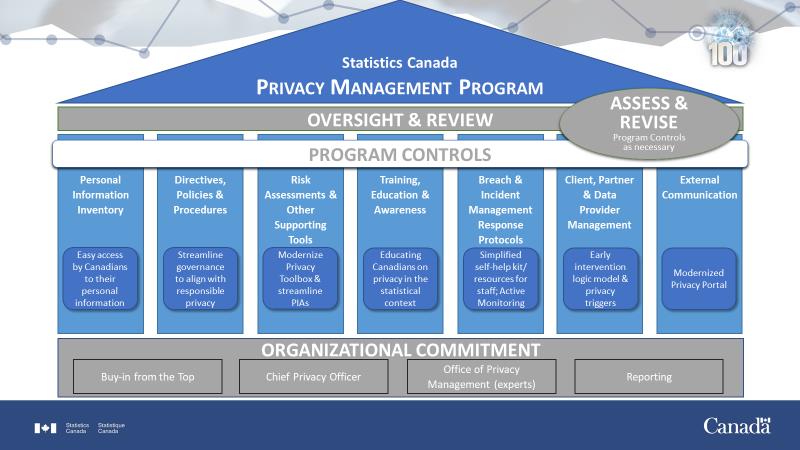
Description - Privacy Management Program
Statistics Canada Privacy Management Program
Oversight & Review
- Assess & Revise Program Controls as neccessary
Program Controls
- Personal information inventory
Easy access by Canadians to their personal information - Directives, Policies & Procedures
Streamline governance to align with responsible privacy - Risk Assessments & Other Supporting Tools
Modernize Privacy Toolbox & streamline PIAs - Training, Education & Awareness
Educating Canadians on privacy in the statistical context - Breach & Incident Management Response Protocols
Simplified self-help kit/resources for staff; Active Monitoring - Client, Partner & Data Provider Management
Early intervention logic model & privacy triggers - External Communication
Modernized Privacy Portal
Organizational Commitment
- Buy-in from the Top
- Chief Privacy Officer
- Office of Privacy Management (experts)
- Reporting
Costs
In 2024-2025, the ATIP Office spent approximately $36,726 on salaries and $532 on administrative costs to administer the Privacy Act.
Training and Awareness
In 2024–2025, the Access to Information and Privacy (ATIP) Office offered informal one-on-one sessions to help employees understand their obligations under the Privacy Act and related internal policies.
During the reporting period, there was no need for additional training for liaison officers. With minimal turnover, liaisons maintained strong relationships and open communication with the ATIP Office.
The Office of Privacy Management and Information Coordination (OPMIC) also offers training on topics related to the Statistics Act, Privacy Act, and supporting policies.
Courses include:
- Privacy Impact Assessment
- Privacy and Confidentiality
They focus on the appropriate use of personal information about employees, clients, and the public.
Additionally, all employees must complete mandatory online confidentiality training, including an introductory course for new hires.
During the reporting period, OPMIC hosted Privacy Awareness Week 2025, from April 28 to May 2, showcasing the Privacy Management Team’s services. The Chief Privacy Officer moderated a discussion between a panel of experts on enhancing privacy in government. The event saw high engagement and positive feedback. Regular bilateral meetings between Statistics Canada and the Office of the Privacy Commissioner (OPC) continue to support dialogue on programs and privacy practices.
Policies, Guidelines and Procedures
Internal Tools and Support
The ATIP Office maintains a suite of internal tools to support sector contacts in fulfilling their responsibilities related to privacy requests. These tools include:
- A concise checklist outlining the steps for preparing responsive records;
- Ongoing support from a designated ATIP advisor throughout the request process.
These resources ensure consistency and accuracy in the handling of privacy requests across the Agency.
Alignment with Government-Wide Policies
The ATIP Office ensures compliance with Government of Canada policies and directives issued by the Treasury Board of Canada Secretariat (TBS) concerning the protection of personal information. All personal and confidential information is protected under the Privacy Act and the Statistics Act and is disclosed only in accordance with the provisions of these Acts.
Privacy Governance Framework
Statistics Canada has developed and published a comprehensive Privacy Framework that outlines the full scope of privacy controls embedded within its operations. This framework consolidates approved practices, procedures, and governance mechanisms related to privacy.
The Director of the Office of Privacy Management and Information Coordination has been formally designated as the Chief Privacy Officer (CPO) for Statistics Canada by the Chief Statistician. The CPO provides strategic leadership on privacy matters, ensures privacy is integrated into business decisions, and oversees the implementation of administrative policies and best practices to safeguard personal information.
Upholding Privacy and Safety of Public Servants
The Access to Information and Privacy Implementation Notice 2024-01, effective November 13, 2024, is intended to assist Access to Information and Privacy (ATIP) offices in managing and processing sensitive access to information (ATI) and personal information requests that may pose risks to the safety and well-being of public servants. Specifically, it addresses situations where the nature of the request raises concerns not due to the professional duties of the individual, but because of their personal identity or characteristics.
These requests may seek information that intrudes upon the private lives of government employees or officers. The notice also provides guidance for circumstances in which acknowledging or disclosing the requested information could reasonably be expected to threaten the life, physical integrity, or psychological health and safety of a public servant.
Initiatives and Projects to Improve Privacy
The ATIP Office continues to use the ATIP Online Reporting Tool to receive and respond to requests submitted electronically. During this reporting period, the Online Reporting Tool was updated to allow for release packages to be sent securely to requesters who created a profile. This method allows for documents to be sent securely, with larger packages being sent than can normally be accommodated via email.
During the reporting period, the ATIP Office reinitiated engagement with key partners – including the Treasury Board of Canada Secretariat (TBS), Shared Services Canada (SSC), Public Services and Procurement Canada (PSPC), Statistics Canada (Field 9), and OPEXUS – to advance discussions on the modernization of the technology platforms supporting ATIP operations. This collaborative effort is aimed at enhancing the efficiency, accessibility, and responsiveness of the ATIP process to better serve the needs of requesters.
Summary of Key Issues and Actions Taken on Complaints
The Office of the Privacy Commissioner of Canada (OPC) received one informal complaint of unauthorized use and disclosure of personal information against StatCan. It was resolved through OPC’s early resolution process.
As of the end of the reporting period, neither of the two ongoing complaints has been resolved. The ATIP Office continues to work closely with the Office of the Privacy Commissioner (OPC) to address the issues raised and remains committed to resolving both matters in a timely and transparent manner.
Material Privacy Breaches
The Privacy and Information Breach Protocol provides clear identification of the various roles and responsibilities in the event of a breach. It includes the requirement to complete an enhanced process which incorporates the elements in the Treasury Board Secretariat's guidelines on how to respond to a privacy breach. The template has been approved by the Agency's senior management. At a minimum, the incident report will contain the following information:
- a description of the incident (who, what, when, where, why, how)
- the actions already taken and planned for the future
- a description of the risks/impacts
- any other information that might be helpful in locating any lost item(s) or in assessing the consequences of loss or compromise
- recommendations for mitigating or eliminating the risk of the event recurring in future
- information on whether the individuals or organizations whose information was breached were informed of the incident
- indication if the individuals, Office of the Privacy Commissioner (OPC) and Treasury Board Secretariat will be informed of the incident and if not, a rationale for not informing them.
Best practices to eliminate or reduce future recurrences that are identified during an investigation must be communicated to other employees to prevent a recurrence of the breach.
Breaches are coordinated by a centralized group in the Privacy Management team to ensure that all programs impacted by the breach provide input.
There were seven (7) privacy breaches at Statistics Canada during the reporting period, and of these breaches, none were material in nature. A total of 10 people were affected by six (6) of these breaches. While no unauthorised disclosure was confirmed for the 7th incident related to an internal case management system that handles HR information, sensitive attachments submitted by 250 to 1000 employees via the system could have been accessible to managers without need to know for those employees.
Privacy Impact Assessments
The Statistics Canada Directive on Conducting Privacy Impact Assessments (PIAs) specifies the roles and responsibilities of its senior managers and privacy specialists regarding the collection, use and disclosure of personal information. This directive applies to all statistical and non-statistical programs that engage in the collection, use or disclosure of personal information.
Statistics Canada’s Generic PIA covers all aspects of the Agency’s statistical programs that collect, use and disseminate information in support of the mandate under the Statistics Act. The Generic PIA addresses the ten privacy principles and includes a threat and risk assessment for various collection and access modes.
Supplements to the Generic PIA are produced for new and significantly redesigned collections, uses or disclosures of personal information that raise unique or additional privacy, confidentiality, or security risks. The Generic PIA and its supplements are posted on the Statistics Canada website: Generic privacy impact assessment.
When it relates to the administration of the institution other PIAs are conducted for new or redesigned administrative programs and services that involve the collection, use and disclosure of personal information that are not addressed in the Generic PIA. Summaries of completed privacy impact assessments can be found on the Statistics Canada website: Privacy impact assessments.
In the current reporting period, 14 privacy assessments, including two (2) PIAs, six (6) supplements, and six (6) amendments or addendums were approved and submitted to the Office of the Privacy Commissioner and the Treasury Board Secretariat. The following are brief descriptions:
Safety and Security for the Centre for Direct Health Measures Mobile Examination Centre – Security Camera System
A PIA was conducted to determine if there were any privacy, confidentiality or security issues associated with the addition of security cameras at Statistics Canada’s Centre for Direct Health Measures (CDHM) Mobile Examination Centre (MEC), and if so, to make recommendations for their resolution or mitigation. The security cameras provide crime prevention and detection, public safety, and evidence collection emergency response. The assessment did not identify any privacy risks that cannot be managed using existing safeguards and additional safeguards that have been put in place.
StatsCAN app
A PIA was conducted to determine if there were any privacy, confidentiality or security issues with the new functionalities being introduced to the StatsCAN app and, if so, to make recommendations for their resolution or mitigation. New functionalities such as a feedback form, in-app metrics, and push notifications were implemented that utilize some user data. The assessment did not identify any privacy risks that cannot be managed using existing safeguards.
Canadian Housing Survey
A supplement to the Generic PIA was conducted to determine if there were any privacy, confidentiality or security issues associated with the collection of new information in the Canadian Housing Survey (CHS) and if so, to make recommendations for their resolution or mitigation. This voluntary survey which collects sensitive sociodemographic information of adults and minors particularly through proxy response for other members of the household was expanded to include questions on age, sex at birth, gender identity and expression, sexual orientation, immigration and citizenship, ethnic and cultural origins, religion, long-term conditions and disability, and marital status. Information from the survey helps to understand and address issues such as access to affordable housing, and to improve housing conditions. The assessment did not identify any privacy risks that cannot be managed using existing safeguards.
Canadian Survey on Working Conditions
A supplement to the Generic PIA was conducted to determine if there were any privacy, confidentiality or security issues associated with the Canadian Survey on Working Conditions (CSWC) and if so, to make recommendations for their resolution or mitigation. This voluntary survey collects information on experiences as victims of harassment, violence, and discrimination in work related settings. It complements data from the Labour Force Survey (LFS) and its supplements to offer a comprehensive picture of the quality of employment in Canada, and it highlights differences in the labour market and working conditions of subpopulations such as immigrants and racialized groups. It helps inform research and policies related to the quality of employment in Canada. The assessment did not identify any privacy risks that cannot be managed using existing safeguards.
Parental Experiences Survey
A supplement to the Generic PIA was conducted to determine if there were any privacy, confidentiality or security issues associated with the Parental Experiences Survey (PES) and if so, to make recommendations for their resolution or mitigation. This voluntary survey collects potentially sensitive information from respondents aged 15 years and older, such as pregnancy history and loss, difficult experiences during pregnancy and birth, mental health, substance use and experiences of domestic violence or childhood abuse. The results help inform national recommendations for maternal and newborn care as well as efforts to improve the mental health and well-being of parents and families across Canada. The assessment did not identify any privacy risks that cannot be managed using existing safeguards.
Survey of Safety in Public and Private Spaces
A supplement to the Generic PIA was conducted to determine if there were any privacy, confidentiality or security issues associated with the Survey of Safety in Public and Private Spaces (SSPPS) and if so, to make recommendations for their resolution or mitigation. This voluntary survey collects sensitive information from respondents aged 15 years and older. It describes additional measures implemented to support respondents during collection, and protections surrounding access to the information. The survey provides insights on the prevalence and nature of harassment, discrimination, and violent victimization in Canadian homes, work-related settings, schools, public spaces, and online, and explore differences in these experiences based on age, sex and gender, sexual orientation, and other socio-demographic factors, which will inform policies, laws, programs, and support services aimed at preventing and addressing victimization. The assessment did not identify any privacy risks that cannot be managed using existing safeguards.
Survey on Family Transitions
A supplement to the Generic PIA was conducted to determine if there were any privacy, confidentiality or security issues associated with the Survey on Family Transitions (SFT) and if so, to make recommendations for their resolution or mitigation. This voluntary survey includes questions about the respondents’ family life and trajectories, including some personal information regarding dates of family events, gender identity, sexual orientation, ex-spouses/ex-partners, children, and other family/household members. The data is used to better understand how the needs of Canadian families have been changing over the past decades and assess the relevance of programs and policies related to families. This assessment did not identify any privacy risks that cannot be managed using existing safeguards.
Survey Series on First Nations People, Métis and Inuit
A supplement to the Generic PIA was conducted to determine if there were any privacy, confidentiality or security issues associated with the Survey Series on First Nations People, Métis and Inuit (SSFNPMI) and if so, to make recommendations for their resolution or mitigation. This voluntary survey includes sensitive questions about health care discrimination and access to health care services, trust in institutions, impacts of rising prices, and income. The data serves to provide insights and fill data gaps in the areas of health care access, discrimination in a health care setting, well-being, the impact of rising prices, emergency preparedness and access to drinking water for First Nations Peoples living off reserve, Métis and Inuit. This assessment did not identify any privacy risks that cannot be managed using existing safeguards.
Engaging DisAbility Innovation Study
An amendment to the Engaging DisAbility Innovation Study: Employment and Accessibility Survey and the EDI Recollective Engagement PIA was conducted to determine if there were any privacy, confidentiality or security issues associated with the introduction of the usage of Drupal to conduct the survey and the additional linkage of certain administrative HR data (Personnel Employee Record) to replace the need to administer a handful of survey questions, thus improving data quality and reducing response burden, and if so, to make recommendations for their resolution or mitigation. Drupal is an established web-based direct collection interface currently in use at Statistics Canada that has been assessed and authorized to operate on Protected B information by the department’s IT security team. The assessment did not identify any privacy risks that cannot be managed using existing safeguards.
Public Service Employee Survey
An amendment to the Public Service Employee Survey (PSES) PIA was conducted to determine if there were any privacy, confidentiality or security issues with the proposed changes and additional activities, namely the acquisition of PSES 2018, 2019 and 2020 data from the Treasury Board Secretariat of Canada (TBS) under the authority of the Statistics Act; and the removal of the cumulative number of respondents from the Collection Rate. Reporting Tool used for PSES 2022-23 and for future uses of the tool as it is deemed to no longer be required, and if so, to make recommendations for their resolution or mitigation. This assessment did not identify any privacy risks that cannot be managed using existing safeguards.
2024 Census Test
An addendum to the Supplement to Statistics Canada’s Generic PIA related to the 2024 Census Test was conducted to determine if there were any privacy, confidentiality or security issues associated with the addition of a question on sexual orientation that is being considered for the 2026 Census and the possible concerns of Canadians about the intrusiveness of the collection and if so, to make recommendations for their resolution or mitigation. The data would seek to fill an identified gap and respond to identified stakeholder needs, ensuring that all Canadians are represented, and to support programs that provide equal opportunity for everyone to share in the social, cultural, and economic life of Canada. The assessment did not identify any privacy risks that cannot be managed using existing safeguards.
Canadian Correctional Services Survey
An addendum to the Supplement to Statistics Canada's Generic PIA related to the Canadian Correctional Services Survey (CCSS) was conducted to determine if there were any privacy, confidentiality or security issues associated with the addition of sensitive personal information to the survey and if so, to make recommendations for their resolution or mitigation. This voluntary survey has added questions on sex at birth and gender, multiple identities for racialized groups, homelessness indicator and Intensive Rehabilitation Custody and Supervision (IRCS) program number. The new data elements help meet data gaps and allow enhanced analytical capacity that inform and contribute to the creation of evidence-based policy and program development which will benefit correctional services programs and justice partners, as well as the Canadian public. The assessment did not identify any privacy risks that cannot be managed using existing safeguards.
Canadian Health Measures Survey
An addendum to the Supplement to Statistics Canada’s Generic PIA related to the Canadian Health Measures Survey (CHMS) was conducted to determine if there were any privacy, confidentiality or security issues associated with the use of USB keys at temporary health clinics and with the use of stand-alone laptops and USB keys to transfer data between unconnected devices and devices connected to Statistics Canada’s secure private network servers at temporary health clinics and if so, to make recommendations for their resolution or mitigation. The assessment did not identify any privacy risks that cannot be managed using existing safeguards.
Canadian Health Survey on Children and Youth
An addendum to the Supplement to Statistics Canada’s Generic PIA related to the Canadian Health Survey on Children and Youth (CHSCY) was conducted to determine if there were any privacy, confidentiality or security issues associated with changes in the content, methodology, and respondent communication strategy for the survey and if so, to make recommendations for their resolution or mitigation. This voluntary survey which will now comprise in a single collection period rather than two, is now also significantly shorter as several modules were removed and new ones introduced. The program is also expanded to include the territories, providing a more comprehensive demographic coverage. The assessment did not identify any privacy risks that cannot be managed using existing safeguards.
Microdata Linkage
As outlined in Statistics Canada’s Directive on Microdata Linkage, linkages of different records pertaining to the same individual are carried out only for statistical purposes and only in cases where the public good is clearly evident. One of the primary objectives of these linkages is to produce statistical information that facilitates a better understanding of Canadian society, the economy, and the environment.
All microdata linkage proposals must satisfy a prescribed review process as outlined in the directive. In addition to demonstrating the public benefit, each submission must provide details of the output. The public dissemination of any information resulting from microdata linkage, like all other statistical information, is only at an aggregate level which protects the confidentiality of the information of individuals.
In 2024-2054, there were 30 approved microdata linkages that involved personal information. A summary of these microdata linkages is found in Appendix B.
Public Interest Disclosures
No disclosures were made under paragraph 8(2)(m) of the Privacy Act during the reporting period.
Monitoring Compliance
At Statistics Canada, the ATIP Office processes and monitors requests by registering them in a comprehensive system known as Privasoft – Access Pro Case Management. An acknowledgement of the request is sent to the client and a retrieval form is forwarded to the relevant program area, Office of Primary Interest (OPI), for responsive records. If the OPI and/or the ATIP Office need to clarify the request, the ATIP Office contacts the client.
The retrieval form provided to the OPI was created by the ATIP Office at Statistics Canada and is based upon the Policy on Access to Information and the Directive on Access to Information Requests from the Treasury Board Secretariat of Canada. The form includes the text of the request, the name and phone number of the ATIP Officer, and the date by which records are required (normally 5 to 10 days). The form includes a checklist, which the OPIs complete to confirm that they have conducted a thorough search, and a recommendation schedule for identifying sensitive information and the specific nature of the injury that could be caused by release. The individual providing the records is asked to identify any records which may be sensitive in nature (e.g., legal issues, Cabinet confidences, personal information, company information, advice to the Minister), which may require consultations, and/or which may generate media interest. The Director General, or appropriate delegate, of the program area sign-off the form.
The ATIP Office assists the program areas with administrative procedures related to the retrieval of records. Once the documents are received from the OPI, the ATIP Office ensures a retrieval form is duly completed by the program executive. The OPI and program executives are reminded of the importance of responding to ATIP requests in a timely and comprehensive manner. The performance of OPIs to respond to requests for records is reported to senior management in a monthly dashboard, to ensure that any issues are identified and addressed.
When reviewing responsive records, if there are documents that were created by or pertain to another department, we only consult under the Privacy Act if we have reason to believe that redactions would be applied. Under the Privacy Act we seek to limit consultations as much as possible, to retain the confidentiality of the requester. For Privacy requests received this fiscal year, our only consultations have been to the Department of Justice where there was an active court case.
The information requested under the Privacy Act can typically be provided within the 30-day time period. Census information can be requested under the Act, or through the Census and Pension Search Centre. The volume of requests received by the organization is not onerous enough to necessitate creating an alternate method of availability.
Appendix A: Delegation Order
Access to Information and Privacy Acts Delegation Order
The Minister of Innovation, Science and Industry, pursuant to section 73 of the Access to Information Act and section 73 of the Privacy Act, hereby designates the persons holding the positions set out in the schedule hereto, or the persons occupying on an acting basis those positions, to exercise the powers and functions of the Minister as the head of Statistics Canada, under the section of the Act set out in the schedule opposite each position. This Delegation Order supersedes all previous Delegation Orders.
Schedule
| Position | Access to Information Act and Regulations | Privacy Act and Regulations |
|---|---|---|
| Chief Statistician of Canada | Full authority | Full authority |
| Chief of Staff, Office of the Chief Statistician | Full authority | Full authority |
| Director, Office of Privacy Management and Information Coordination | Full authority | Full authority |
| Assistant Director, Office of Privacy Management and Information Coordination | Full authority | Full authority |
| Senior Access to Information and Privacy Project Manager | Sections: 7(a), 8(1), 9, 11(2), 11(3), 11(4), 11(5), 11(6), 13, 14, 15, 16, 17, 18, 19, 20, 21, 22, 23, 24, 25, 26, 27(1), 27(4), 28(1)(b), 28(2), 28(4), 68, 69, 71(1) Regulations: Sections: 6(1), 7(1), 7(2), 7(3), 8, 8.1 |
Sections: 8(2)(j), 8(2)(m), 10, 14, 15, 17(2)(b), 17(3)(b), 18(2), 19(1), 19(2), 20, 21, 22, 23, 24, 25, 26, 27, 28, 70 Regulations: Sections: 9, 11(2), 11(4), 13(1), 14 |
| Senior Access to Information and Privacy Project Officer | Sections: 7(a), 8(1), 9, 11(2), 11(3), 11(4), 11(5), 11(6), 13, 14, 15, 16, 17, 18, 19, 20, 21, 22, 23, 24, 25, 26, 27(1), 27(4), 28(1)(b), 28(2), 28(4), 68, 69, 71(1) Regulations: Sections: 6(1), 7(1), 7(2), 7(3), 8, 8.1 |
Sections: 8(2)(j), 8(2)(m), 10, 14, 15, 17(2)(b), 17(3)(b), 18(2), 19(1), 19(2), 20, 21, 22, 23, 24, 25, 26, 27, 28, 70 Regulations: Sections: 9, 11(2), 11(4), 13(1), 14 |
| Analyst, Access to Information and Privacy | Sections: 7(a), 8(1), 9, 11(2), 11(3), 11(4), 11(5), 11(6), 13, 14, 15, 16, 17, 18, 19, 20, 21, 22, 23, 24, 25, 26, 27(1), 27(4), 28(1)(b), 28(2), 28(4), 68, 69, 71(1) Regulations: Sections: 6(1), 7(1), 7(2), 7(3), 8, 8.1 |
Sections: 8(2)(j), 8(2)(m), 10, 14, 15, 17(2)(b), 17(3)(b), 18(2), 19(1), 19(2), 20, 21, 22, 23, 24, 25, 26, 27, 28, 70 Regulations: Sections: 9, 11(2), 11(4), 13(1), 14 |
| Intake Officer, Access to Information and Privacy | Sections 7(a), 8(1), 9, 11(2), 11(3), 11(4), 11(5), 11(6), 13, 14, 15, 16, 17, 18, 19, 20, 21, 22, 23, 24, 25, 26, 27(1), 27(4), 28(1)(b), 28(2), 28(4), 68, 69, 71(1) Regulations: Sections: 6(1), 7(1), 7(2), 7(3), 8, 8.1 |
Sections: 8(2)(j), 8(2)(m), 10, 14, 15, 17(2)(b), 17(3)(b), 18(2), 19(1), 19(2), 20, 21, 22, 23, 24, 25, 26, 27, 28, 70 Regulations: Sections: 9, 11(2), 11(4), 13(1), 14 |
The original version was signed by
The Honourable François-Philippe Champagne
Minister of Innovation, Science and Industry
Dated, at the City of Ottawa
May 18, 2021
Appendix B: Statistical Report on the Privacy Act
Name of institution: Statistics Canada
Reporting period: 2024-04-01 to 2025-03-31
Section 1: Requests Under the Privacy Act
1.1 Number of requests recevied
| Number of Requests | ||
|---|---|---|
| Received during reporting period | 40 | |
| Outstanding from previous reporting periods | 1 | |
|
Outstanding from previous reporting period
|
1 | |
|
Outstanding from more than one reporting period
|
0 | |
| Total | 41 | |
| Closed during reporting period | 34 | |
| Carried over to next reporting period | 7 | |
|
Carried over within legislated timeline
|
5 | |
|
Carried over beyond legislated timeline
|
2 | |
1.2 Channels of requests
| Source | Number of Requests |
|---|---|
| Online | 38 |
| 2 | |
| 0 | |
| In person | 0 |
| Phone | 0 |
| Fax | 0 |
| Total | 40 |
Section 2: Informal requests
2.1 Number of requests received
| Number of Requests | ||
|---|---|---|
| Received during reporting period | 1 | |
| Outstanding from previous reporting periods | 0 | |
|
Outstanding from previous reporting period
|
0 | |
|
Outstanding from more than one reporting period
|
0 | |
| Total | 1 | |
| Closed during reporting period | 1 | |
| Carried over to next reporting period | 0 | |
2.2 Channels of informal requests
| Source | Number of Requests |
|---|---|
| Online | 0 |
| 1 | |
| 0 | |
| In person | 0 |
| Phone | 0 |
| Fax | 0 |
| Total | 1 |
2.3 Completion time of informal requests
| 0 to 15 Days | 16 to 30 Days | 31 to 60 Days | 61 to 120 Days | 121 to 180 Days | 181 to 365 Days | More Than 365 Days | Total |
|---|---|---|---|---|---|---|---|
| 0 | 1 | 0 | 0 | 0 | 0 | 0 | 1 |
2.4 Pages released informally
| Less Than 100 Pages Released | 100-500 Pages Released | 501-1000 Pages Released | 1001-5000 Pages Released | More Than 5000 Pages Released | |||||
|---|---|---|---|---|---|---|---|---|---|
| Number of Requests | Pages Released | Number of Requests | Pages Released | Number of Requests | Pages Released | Number of Requests | Pages Released | Number of Requests | Pages Released |
| 1 | 36 | 0 | 0 | 0 | 0 | 0 | 0 | 0 | 0 |
Section 3: Requests Closed During the Reporting Period
3.1 Disposition and completion time
| Disposition of Requests | Completion Time | |||||||
|---|---|---|---|---|---|---|---|---|
| 0 to 15 Days | 16 to 30 Days | 31 to 60 Days | 61 to 120 Days | 121 to 180 Days | 181 to 365 Days | More Than 365 Days | Total | |
| All Disclosed | 3 | 4 | 1 | 0 | 0 | 0 | 0 | 8 |
| Disclosed in part | 0 | 10 | 7 | 0 | 0 | 0 | 0 | 17 |
| All exempted | 0 | 0 | 0 | 0 | 0 | 0 | 0 | 0 |
| All excluded | 0 | 0 | 0 | 0 | 0 | 0 | 0 | 0 |
| No records exist | 1 | 2 | 0 | 0 | 0 | 0 | 0 | 3 |
| Request abandoned | 3 | 0 | 1 | 0 | 0 | 0 | 0 | 4 |
| Neither confirmed nor denied | 0 | 2 | 0 | 0 | 0 | 0 | 0 | 2 |
| Total | 7 | 18 | 9 | 0 | 0 | 0 | 0 | 34 |
3.2 Exemptions
| Section | Number of Requests |
|---|---|
| 18(2) | 0 |
| 19(1)(a) | 1 |
| 19(1)(b) | 0 |
| 19(1)(c) | 0 |
| 19(1)(d) | 0 |
| 19(1)(e) | 0 |
| 19(1)(f) | 0 |
| 20 | 0 |
| 21 | 0 |
| 22(1)(a)(i) | 0 |
| 22(1)(a)(ii) | 0 |
| 22(1)(a)(iii) | 0 |
| 22(1)(b) | 0 |
| 22(1)(c) | 0 |
| 22(2) | 0 |
| 22.1 | 0 |
| 22.2 | 0 |
| 22.3 | 0 |
| 22.4 | 0 |
| 23(a) | 0 |
| 23(b) | 0 |
| 24(a) | 0 |
| 24(b) | 0 |
| 25 | 1 |
| 26 | 16 |
| 27 | 2 |
| 27.1 | 0 |
| 28 | 0 |
3.3 Exclusions
| Section | Number of Requests |
|---|---|
| 69(1)(a) | 0 |
| 69(1)(b) | 0 |
| 69.1 | 0 |
| 70(1) | 0 |
| 70(1)(a) | 0 |
| 70(1)(b) | 0 |
| 70(1)(c) | 0 |
| 70(1)(d) | 0 |
| 70(1)(e) | 0 |
| 70(1)(f) | 0 |
| 70.1 | 0 |
3.4 Format of information released
| Paper | Electronic | Other | |||
|---|---|---|---|---|---|
| E-record | Data set | Video | Audio | ||
| 2 | 23 | 0 | 0 | 0 | 0 |
3.5 Complexity
3.5.1 Relevant pages processed and disclosed for paper, e-record and dataset formats
| Number of Pages Processed | Number of Pages Disclosed | Number of Requests |
|---|---|---|
| 3813 | 2660 | 31 |
3.5.2 Relevant pages processed per request disposition for paper, e-record and dataset formats by size of requests
| Disposition | Less Than 100 Pages Processed | 100-500 Pages Processed | 501-1000 Pages Processed | 1001-5000 Pages Processed | More Than 5000 Pages Processed | |||||
|---|---|---|---|---|---|---|---|---|---|---|
| Number of Requests | Pages Processed | Number of Requests | Pages Processed | Number of Requests | Pages Processed | Number of Requests | Pages Processed | Number of Requests | Pages Processed | |
| All disclosed | 7 | 35 | 1 | 101 | 0 | 0 | 0 | 0 | 0 | 0 |
| Disclosed in part | 10 | 342 | 5 | 1249 | 1 | 517 | 1 | 1569 | 0 | 0 |
| All exempted | 0 | 0 | 0 | 0 | 0 | 0 | 0 | 0 | 0 | 0 |
| All excluded | 0 | 0 | 0 | 0 | 0 | 0 | 0 | 0 | 0 | 0 |
| Request abandoned | 4 | 0 | 0 | 0 | 0 | 0 | 0 | 0 | 0 | 0 |
| Neither confirmed nor denied | 2 | 0 | 0 | 0 | 0 | 0 | 0 | 0 | 0 | 0 |
| Total | 23 | 377 | 6 | 1350 | 1 | 517 | 1 | 1569 | 0 | 0 |
3.5.3 Relevant minutes processed and disclosed for audio formats
| Number of Minutes Processed | Number of Minutes Disclosed | Number of Requests |
|---|---|---|
| 0 | 0 | 0 |
3.5.4 Relevant minutes processed per request disposition for audio formats by size of requests
| Disposition | Less than 60 Minutes processed | 60-120 Minutes processed | More than 120 Minutes processed | |||
|---|---|---|---|---|---|---|
| Number of requests | Minutes Processed | Number of requests | Minutes Processed | Number of requests | Minutes Processed | |
| All disclosed | 0 | 0 | 0 | 0 | 0 | 0 |
| Disclosed in part | 0 | 0 | 0 | 0 | 0 | 0 |
| All exempted | 0 | 0 | 0 | 0 | 0 | 0 |
| All excluded | 0 | 0 | 0 | 0 | 0 | 0 |
| Request abandoned | 0 | 0 | 0 | 0 | 0 | 0 |
| Neither confirmed nor denied | 0 | 0 | 0 | 0 | 0 | 0 |
| Total | 0 | 0 | 0 | 0 | 0 | 0 |
3.5.5 Relevant minutes processed and disclosed for video formats
| Number of Minutes Processed | Number of Minutes Disclosed | Number of Requests |
|---|---|---|
| 0 | 0 | 0 |
3.5.6 Relevant minutes processed per request disposition for video formats by size of requests
| Disposition | Less than 60 Minutes processed | 60-120 Minutes processed | More than 120 Minutes processed | |||
|---|---|---|---|---|---|---|
| Number of requests | Minutes Processed | Number of requests | Minutes Processed | Number of requests | Minutes Processed | |
| All disclosed | 0 | 0 | 0 | 0 | 0 | 0 |
| Disclosed in part | 0 | 0 | 0 | 0 | 0 | 0 |
| All exempted | 0 | 0 | 0 | 0 | 0 | 0 |
| All excluded | 0 | 0 | 0 | 0 | 0 | 0 |
| Request abandoned | 0 | 0 | 0 | 0 | 0 | 0 |
| Neither confirmed nor denied | 0 | 0 | 0 | 0 | 0 | 0 |
| Total | 0 | 0 | 0 | 0 | 0 | 0 |
3.5.7 Other complexities
| Disposition | Consultation Required | Legal Advice Sought | Interwoven Information | Other | Total |
|---|---|---|---|---|---|
| All disclosed | 0 | 0 | 0 | 0 | 0 |
| Disclosed in part | 0 | 1 | 0 | 0 | 1 |
| All exempted | 0 | 0 | 0 | 0 | 0 |
| All excluded | 0 | 0 | 0 | 0 | 0 |
| Request abandoned | 0 | 0 | 0 | 0 | 0 |
| Neither confirmed nor denied | 0 | 0 | 0 | 0 | 0 |
| Total | 0 | 1 | 0 | 0 | 1 |
3.6 Closed requests
3.6.1 Number of requests closed within legislated timelines
| Number of requests closed within legislated timelines | 27 |
|---|---|
| Percentage of requests closed within legislated timelines (%) | 79.41176471 |
3.7 Deemed refusals
3.7.1 Reasons for not meeting legislated timelines
| Number of requests closed past the legislated timelines | Principal Reason | |||
|---|---|---|---|---|
| Interference with operations / Workload | External Consultation | Internal Consultation | Other | |
| 7 | 0 | 0 | 0 | 7 |
3.7.2 Request closed beyond legislated timelines (including any extension taken)
| Number of days past legislated timelines | Number of requests past legislated timeline where no extension was taken | Number of requests past legislated timeline where an extension was taken | Total |
|---|---|---|---|
| 1 to 15 days | 4 | 0 | 4 |
| 16 to 30 days | 2 | 0 | 2 |
| 31 to 60 days | 0 | 0 | 0 |
| 61 to 120 days | 1 | 0 | 1 |
| 121 to 180 days | 0 | 0 | 0 |
| 181 to 365 days | 0 | 0 | 0 |
| More than 365 days | 0 | 0 | 0 |
| Total | 7 | 0 | 7 |
3.8 Requests for translation
| Translation Requests | Accepted | Refused | Total |
|---|---|---|---|
| English to French | 0 | 0 | 0 |
| French to English | 0 | 0 | 0 |
| Total | 0 | 0 | 0 |
Section 4: Disclosures Under Subsections 8(2) and 8(5)
| Paragraph 8(2)(e) | Paragraph 8(2)(m) | Subsection 8(5) | Total |
|---|---|---|---|
| 0 | 0 | 0 | 0 |
Section 5: Requests for Correction of Personal Information and Notations
| Disposition for Correction Requests Received | Number |
|---|---|
| Notations attached | 0 |
| Requests for correction accepted | 0 |
| Total | 0 |
Section 6: Extensions
6.1 Reasons for extensions
| Number of extensions taken | 15(a)(i) Interference with operations | 15(a)(ii) Consultation | 15(b) Translation purposes or conversion | |||||
|---|---|---|---|---|---|---|---|---|
| Further review required to determine exemptions | Large volume of pages | Large volume of requests | Documents are difficult to obtain | Cabinet ConfidenceSection (Section 70) | External | Internal | ||
| 3 | 1 | 1 | 0 | 1 | 0 | 0 | 0 | 0 |
6.2 Length of extensions
| Length of Extensions | 15(a)(i) Interference with operations | 15(a)(ii) Consultation | 15(b) Translation purposes or conversion | |||||
|---|---|---|---|---|---|---|---|---|
| Further review required to determine exemptions | Large volume of pages | Large volume of requests | Documents are difficult to obtain | Cabinet ConfidenceSection (Section 70) | External | Internal | ||
| 1 to 15 days | 0 | 0 | 0 | 0 | 0 | 0 | 0 | 0 |
| 16 to 30 days | 1 | 1 | 0 | 1 | 0 | 0 | 0 | 0 |
| 31 days or greater | 0 | |||||||
| Total | 1 | 1 | 0 | 1 | 0 | 0 | 0 | 0 |
Section 7: Consultations Received From Other Institutions and Organizations
7.1 Consultations received from other Government of Canada institutions and other organizations
| Consultations | Other Government of Canada Institutions | Number of Pages to Review | Other Organizations | Number of Pages to Review |
|---|---|---|---|---|
| Received during the reporting period | 0 | 0 | 0 | 0 |
| Outstanding from the previous reporting period | 0 | 0 | 0 | 0 |
| Total | 0 | 0 | 0 | 0 |
| Closed during the reporting period | 0 | 0 | 0 | 0 |
| Carried over within negotiated timelines | 0 | 0 | 0 | 0 |
| Carried over beyond negotiated timelines | 0 | 0 | 0 | 0 |
7.2 Recommendations and completion time for consultations received from other organizations outside the Government of Canada
| Recommendation | Number of Days Required to Complete Consultation Requests | |||||||
|---|---|---|---|---|---|---|---|---|
| 0 to 15 Days | 16 to 30 Days | 31 to 60 Days | 61 to 120 Days | 121 to 180 Days | 181 to 365 Days | More Than 365 Days | Total | |
| Disclose entirely | 0 | 0 | 0 | 0 | 0 | 0 | 0 | 0 |
| Disclose in part | 0 | 0 | 0 | 0 | 0 | 0 | 0 | 0 |
| Exempt entirely | 0 | 0 | 0 | 0 | 0 | 0 | 0 | 0 |
| Exclude entirely | 0 | 0 | 0 | 0 | 0 | 0 | 0 | 0 |
| Consult other institution | 0 | 0 | 0 | 0 | 0 | 0 | 0 | 0 |
| Other | 0 | 0 | 0 | 0 | 0 | 0 | 0 | 0 |
| Total | 0 | 0 | 0 | 0 | 0 | 0 | 0 | 0 |
7.3 Recommendations and completion time for consultations received from other organizations outside the Government of Canada
| Recommendation | Number of days required to complete consultation requests | |||||||
|---|---|---|---|---|---|---|---|---|
| 0 to 15 Days | 16 to 30 Days | 31 to 60 Days | 61 to 120 Days | 121 to 180 Days | 181 to 365 Days | More Than 365 Days | Total | |
| Disclose entirely | 0 | 0 | 0 | 0 | 0 | 0 | 0 | 0 |
| Disclose in part | 0 | 0 | 0 | 0 | 0 | 0 | 0 | 0 |
| Exempt entirely | 0 | 0 | 0 | 0 | 0 | 0 | 0 | 0 |
| Exclude entirely | 0 | 0 | 0 | 0 | 0 | 0 | 0 | 0 |
| Consult other institution | 0 | 0 | 0 | 0 | 0 | 0 | 0 | 0 |
| Other | 0 | 0 | 0 | 0 | 0 | 0 | 0 | 0 |
| Total | 0 | 0 | 0 | 0 | 0 | 0 | 0 | 0 |
Section 8: Completion Time of Consultations on Cabinet Confidences
8.1 Requests with Legal Services
| Number of Days | Fewer Than 100 Pages Processed | 100-500 Pages Processed | 501-1000 Pages Processed | 1001-5000 Pages Processed | More Than 5000 Pages Processed | |||||
|---|---|---|---|---|---|---|---|---|---|---|
| Number of Requests | Pages Disclosed | Number of Requests | Pages Disclosed | Number of Requests | Pages Disclosed | Number of Requests | Pages Disclosed | Number of Requests | Pages Disclosed | |
| 1 to 15 | 0 | 0 | 0 | 0 | 0 | 0 | 0 | 0 | 0 | 0 |
| 16 to 30 | 0 | 0 | 0 | 0 | 0 | 0 | 0 | 0 | 0 | 0 |
| 31 to 60 | 0 | 0 | 0 | 0 | 0 | 0 | 0 | 0 | 0 | 0 |
| 61 to 120 | 0 | 0 | 0 | 0 | 0 | 0 | 0 | 0 | 0 | 0 |
| 121 to 180 | 0 | 0 | 0 | 0 | 0 | 0 | 0 | 0 | 0 | 0 |
| 181 to 365 | 0 | 0 | 0 | 0 | 0 | 0 | 0 | 0 | 0 | 0 |
| More than 365 | 0 | 0 | 0 | 0 | 0 | 0 | 0 | 0 | 0 | 0 |
| Total | 0 | 0 | 0 | 0 | 0 | 0 | 0 | 0 | 0 | 0 |
8.2 Requests with Privy Council Office
| Number of Days | Fewer Than 100 Pages Processed | 100-500 Pages Processed | 501-1000 Pages Processed | 1001-5000 Pages Processed | More Than 5000 Pages Processed | |||||
|---|---|---|---|---|---|---|---|---|---|---|
| Number of Requests | Pages Disclosed | Number of Requests | Pages Disclosed | Number of Requests | Pages Disclosed | Number of Requests | Pages Disclosed | Number of Requests | Pages Disclosed | |
| 1 to 15 | 0 | 0 | 0 | 0 | 0 | 0 | 0 | 0 | 0 | 0 |
| 16 to 30 | 0 | 0 | 0 | 0 | 0 | 0 | 0 | 0 | 0 | 0 |
| 31 to 60 | 0 | 0 | 0 | 0 | 0 | 0 | 0 | 0 | 0 | 0 |
| 61 to 120 | 0 | 0 | 0 | 0 | 0 | 0 | 0 | 0 | 0 | 0 |
| 121 to 180 | 0 | 0 | 0 | 0 | 0 | 0 | 0 | 0 | 0 | 0 |
| 181 to 365 | 0 | 0 | 0 | 0 | 0 | 0 | 0 | 0 | 0 | 0 |
| More than 365 | 0 | 0 | 0 | 0 | 0 | 0 | 0 | 0 | 0 | 0 |
| Total | 0 | 0 | 0 | 0 | 0 | 0 | 0 | 0 | 0 | 0 |
Section 9: Complaints and Investigations Notices Received
| Section 31 | Section 33 | Section 35 | Court action | Total |
|---|---|---|---|---|
| 0 | 0 | 0 | 0 | 0 |
Section 10: Privacy Impact Assessments (PIAs) and Personal Information Banks (PIBs)
10.1 Privacy Impact Assessments
| Number of PIAs completed | 3 |
|---|---|
| Number of PIAs modified | 12 |
10.2 Institution-specific and Central Personal Information Banks
| Personal Information Banks | Active | Created | Terminated | Modified |
|---|---|---|---|---|
| Institution-specific | 62 | 3 | 0 | 1 |
| Central | 0 | 0 | 0 | 0 |
| Total | 62 | 3 | 0 | 1 |
Section 11: Privacy Breaches
11.1 Material Privacy Breaches reported
| Number of material privacy breaches reported to TBS | 0 |
|---|---|
| Number of material privacy breaches reported to OPC | 0 |
11.2 Non-Material Privacy Breaches
| Number of non-material privacy breaches | 7 |
|---|
Section 12: Resources Related to the Privacy Act
12.1 Allocated Costs
| Expenditures | Amount | |
|---|---|---|
| Salaries | $35,745 | |
| Overtime | $981 | |
| Goods and Services | $532 | |
|
Professional services contracts
|
$0 | |
|
Other
|
$532 | |
| Total | $37,258 | |
12.2 Human Resources
| Resources | Person Years Dedicated to Privacy Activities |
|---|---|
| Full-time employees | 0.380 |
| Part-time and casual employees | 0.000 |
| Regional staff | 0.000 |
| Consultants and agency personnel | 0.000 |
| Students | 0.000 |
| Total | 0.380 |
| Note: Enter values to three decimal places. | |
Appendix C: Microdata linkages 2024-2025
Approved microdata linkages containing personal information
Human Rights Tribunal Pilot Linkage to - Census data, tax data, justice data and health data to determine the prevalence, nature, and impact of filing a human rights complaint in Canada, to better inform prevention measures and other forms of complainant support (008-2024)
Purpose: The purpose of this project is to help fill current data gaps related to the impacts of filing a human rights complaint on complainants, up to, and following, resolution of the matter in Canada. These data are required to help create an improved body of knowledge about the prevalence, nature, and impact of filing a human rights complaint in Canada, which will better inform prevention measures and other forms of complainant support. The data will also help provide representative information about the risk factors and subpopulations with the greatest probability of experiencing discrimination, therefore better informing future prevention measures and forms of support.
Output: The linked data will be used by Statistics Canada to produce analytical outputs for the client and data providers in the form of custom tables, fact sheets, and an analytical report.
Diversity characteristics of full-time and part-time teaching staff at Canadian Universities. (009-2024)
Purpose: The purpose of this microdata linkage project is to gather diversity related characteristics from other data sources and integrate them with administrative data on full-time and part-time/contract teaching staff in Canadians universities. This combined information will be used to create aggregate statistics on diverse populations within Canadian universities. These statistics may serve to report on the representation of diverse population groups among teaching personnel in Canadian universities and help measure progress toward an academic community that accurately reflects the Canadian population.
Output: The final microdata output from this linkage will be anonymized. All access to the linked microdata file will be restricted to Statistics Canada employees (including Statistics Canada deemed employees) whose work activities require access. Only non-confidential aggregate statistical outputs and insights that conform to the confidentiality provisions of the Statistics Act will be released outside of Statistics Canada. Aggregate findings at the institutional level will be presented in a feasibility study, internal and external reporting documents, and presentations.
Microdata linkage of income tax files (T1 Family File, T4, T4E and T5007) to emergency shelter users and Housing First participants in Alberta between 2009 and 2018. (010-2024)
Purpose: The purpose of this project is to prepare and conduct analysis of a longitudinal administrative tax dataset for people that stayed in a shelter or participated in a Housing First program in Alberta between 2009 and 2018. The linkage between the Alberta data and tax data will enable researchers and governments to gain insight into the income and employment outcomes of Housing First program participants, and employment situations prior to entering a shelter. This insight will help in the development of strategies to mitigate some of the causes of homelessness and assess the effectiveness of the Housing First program in terms of participant outcomes concerning income and employment. Researchers and governments will have access to the analytical paper, and the linked datasets through the Research Data Centres.
Output: The findings of this project will be published in an analytical report made available on the Statistics Canada website. Engagement will be conducted with appropriate Indigenous stakeholders prior to release of any publications, tables, or other products using the linked datasets. The analytical files, without identifiers, will be made available for validation purposes via Statistics Canada’s Research Data Centres (RDCs). When this validation process is complete, then the final data will be made available to the broader RDC network. Access will only be granted to Statistics Canada deemed employees following the standard approval process. Only non-confidential aggregated statistics and analyses conforming to the confidentiality provisions of the Statistics Act and any applicable requirements of the Privacy Act, will be released outside of Statistics Canada.
Microdata Linkage for the Canadian Legal Industry Earnings Tabulation. (011-2024)
Purpose: The goal of this project is to provide the Seventh Quadrennial Judicial Compensation and Benefits Commission at the Department of Justice (DOJ) with statistics about the level and distribution of lawyers’ private practice compensation levels. The outputs will be aggregated statistical tables that will allow DOJ to evaluate and determine competitive compensation for federally appointed judges.
To undertake this project, Statistics Canada will compile and join the data for law professional corporations (LPCs) and legal partnerships with the corresponding Canadian Employer-Employee Dynamics Database and T5013 income tax fillings, for the latest year available, 2021. The work will focus only on legal corporations and partnerships under the NAICS code 541110 - Offices of lawyers. No other NAICS code will be considered.
Output: Aggregated statistical tables will be made available only to the Department of Justice, the client for this project. These will consist of tables on total incomes of private sector self-employed lawyers, law professional corporations (LPCs) and legal partnerships for the most recent year the income tax source data is available. Statistics calculated on professional income of self-employed lawyers will include the number, mean, median, standard deviation, and 75th percentile values, by age and Census Metropolitan Areas (CMAs) groups and the low-income cut-off of $80,000. Same statistics will also be calculated for legal partnerships (number, size, count of partner types), and the income generated and distributed to partners.
Linkage of the Census of the Population to the Longitudinal Administrative Databank (LAD) for Sociodemographic and Economic Analyses. (013-2024)
Purpose: This project is intended to enhance the ability of researchers and policy makers to address pressing questions in a timely manner, to help them to measure the outcome of policies and programs already in place, and possibly put in place new measures or improved public policy decisions that benefit Canadians. It allows for the creation of two linkage key files between the LAD, and the 2016 and 2021 censuses. These two files will be available in Statistics Canada’s research data centres (RDCs) to researchers with approved projects. It will fill important data gaps by providing a better understanding of the various socioeconomic backgrounds of Canadians and the long-term incomes (life cycle, income trajectories over time) and will facilitate research and recommendations on various challenges for the daily lives of Canadians.
Output: The final output will be two evergreen linkage key files updated annually when the LAD is updated: (1) linkage keys of the LAD to the 2016 Census and (2) linkage keys of the LAD to the 2021 Census. Each linkage key file will contain two fields representing non-confidential record identifiers: the first field will be the LAD identification number and the second will be the census identification number. These two fields will allow Statistics Canada deemed employees to link the LAD data with the relevant census long-form data. These linkage key files will be made available via Statistics Canada Secure Access Points (such as Research Data Centers), and access will be granted to Statistics Canada deemed employees following the standard approval process.
Only non-confidential aggregate statistics and analyses conforming to the confidentiality provisions of the Statistics Act and any applicable requirements of the Privacy Act will be released outside Statistics Canada.
All products resulting from the linkage of the census and the LAD using the linkage key files covered by this linkage project will be disseminated in accordance with Statistics Canada's policies, guidelines and standards. Outputs from this linkage could include a wide range of analysis and standard data tables, as well as custom tabulations. Any data circulated outside of RDCs or Statistics Canada will be vetted according to the appropriate confidentiality rules in place for the products prior to circulation.
Canada Summer Jobs Microdata Linkage With Census and Administrative Records. (014-2024)
Purpose: As per the request by the Office of the Auditor General (OAG), Social Analysis and Modelling Division (SAMD) at Statistics Canada will link the Canada Summer Jobs (CSJ) program data to the census and administrative analytical files maintained by Statistics Canada. The linked file will allow SAMD to produce statistics related to the representation and potential outcomes associated with the CSJ by comparing program participants with suitable comparison groups.
For this purpose, data from the CSJ (2008 to 2023) will be linked to a suite of data files at Statistics Canada, including the long-form Census of Population (2016 and 2021), the Longitudinal Worker File (2008 to 2021), and the Postsecondary Student Information System (2009 to 2021).
Output: Tables with statistics related to the representation and potential outcomes associated with the CSJ will be delivered to the OAG (the client). Only aggregated statistics and findings from descriptive and multivariate analysis of this study will be released to the client in the form of custom tables.
Linkage of British Columbia’s Ministry of Agriculture and Food - Food & Beverage Branch (FBB) programs under the Canadian Agricultural Partnership (CAP) to the Business-Linkable File Environment (B-LFE) to estimate the effect of the programs on the financial performance of the recipients. (015-2024)
Purpose: The main objective of this project is to estimate the effect of B.C.’s Ministry of Agriculture and Food’s FBB programs under the CAP on the financial performance of the recipients. Participants of B.C.’s FBB programs under the CAP will be linked to the B-LFE to extract key performance indicators which will be used in an impact study. The results of the study will support a better understanding of the impact on enterprises in B.C receiving support through the CAP.
Output: The output will be in the form of summary tables and fix effects models which will compare the economic performance of businesses that received financing support to the performance of non-supported businesses. The linked B.C.’s Ministry of Agriculture and Food - Food & Beverage Branch (FBB) programs list of businesses will be housed at Statistics Canada’s Centre for Special Business Project (CSBP).
A research dataset will be produced, and the full integrated database will be used by a Statistics Canada deemed employee to produce an analysis and custom-designed tables of non-confidential aggregate statistics for Agriculture and Agri-food Canada. The output will be analysed for confidentiality by CSBP employees.
Only non-confidential aggregate statistical outputs and analyses that conform to the confidentiality provisions of the Statistics Act will be released outside of Statistics Canada.
Linking the Nursing and Residential Care Facilities Survey (NRCFS) with selected employer-employee information to analyse the working conditions of long-term care workers in Canada. (016-2024)
Purpose: The proposed linkage will bring together the Nursing and Residential Care Facilities Survey (NRCFS) with selected files from the Canadian Employer-Employee Dynamic Database (CEEDD) to support research on the working conditions of the long-term care (LTC) workforce. The objective is to provide insights on the poorer economic and health outcomes experienced by workers in the LTC sector before and during the COVID-19 outbreak.
Output: An analytical file, with no personal identifiers, will be produced from this linkage process. Methodological and analytical findings resulting from these linked data may be used to prepare research findings for: publication in analytical reports or peer-reviewed scientific journals; presentation at conferences, workshops, or meetings; or tabular data or indicators for release on Statistics Canada’s website. Confidentiality vetting rules will be developed and applied in concordance with rules currently in place. Only non-confidential aggregated data and analytical products that conform to the confidentiality provision of the Statistics Act and any applicable requirements of the Privacy Act will be released outside of Statistics Canada. The linkage proposal is to address a current need to answer a specific research question and is not designed to provide a permanent linkage of CEEDD with NRCFS.
Linkage of Value-Added Agricultural Programs administered by Alberta’s Ministry of Agriculture and Irrigation (AGI), under the Canadian Agricultural Partnership to the Business-Linkable File Environment (B-LFE) to estimate the effect of these programs on the financial performance of the recipients. (017-2024)
Purpose: The main objective of this project is to estimate the effect of the Alberta Ministry of Agriculture and Irrigation (AGI) Value-Added Agricultural Programs:
- Emerging Opportunities and Food and Agri-Processing (EOFA)
- Emerging Opportunities Program (EOP)
- Products to Market Program (PTM)
- Value-Added Products to Markets Program (VAPM)
- On Farm Value-Added Program (VAPM)
- Value-Added Program (VAP)
under the Canadian Agricultural Partnership on the financial performance of the recipients. The initial phase will involve preparing profiles of program participants and comparing them to eligible non-participants using the variables in the Business-Linkable File Environment (B-LFE) and the Diversity and Skills Database (DSD). The second phase will involve the use of matching to build a control group, and the use of regression models to study the effect of the programs on the financial performance of the recipients (e.g., revenues).
Output: The output will be in the form of summary tables and a fixed effects model which will examine the economic performance of businesses that received financial support from Alberta’s Ministry of Agriculture and Irrigation (AGI) Value-Added Agricultural Programs under the Canadian Agricultural Partnership to non-supported businesses. The linked Alberta Ministry of Agriculture and Irrigation (AGI) list of businesses will be housed at Statistics Canada’s Centre for Special Business Project (CSBP).
A research dataset will be produced, and the full integrated database will be used by a Statistics Canada deemed employee research team to produce an analysis and custom-designed tables of non-confidential aggregate statistics for Agriculture and Agri-Food Canada. The output will be analysed for confidentiality by CSBP employees. The output of this project will not be sent to the Canadian Centre for Data Development and Economic Research (CDER).
Only non-confidential aggregate statistical outputs and analyses that conform to the confidentiality provisions of the Statistics Act will be released outside of Statistics Canada.
The Role of Environmental Policies in Manufacturers' Energy Price Forecasts and Production Choices. (019-2024)
Purpose: This research project aims to measure Canadian manufacturers' responses to changes in environmental policies. The findings may contribute to public debate by evaluating the economic and environmental impacts of these policies. Additionally, it may help policymakers assess the effectiveness of environmental policies from both economic and environmental to better evaluate existing environmental policies and design better ones in the future.
Output: The anonymized data files will be made available via Statistics Canada Secure Access Points (such as Research Data Centres (RDC)), and access will only be granted to Statistics Canada deemed employees following the standard approval process. Researchers from the University of British Columbia and the Consumer Financial Protection Bureau will use the linked anonymized data files to produce a study for submission to a peer-reviewed journal. The anonymized data files will remain in the RDCs for future projects. Only non-confidential aggregate data that conforms to the confidentiality provisions of the Statistics Act will be released outside of Statistics Canada.
Only non-confidential aggregate data that conforms to the confidentiality provisions of the Statistics Act will be released outside of Statistics Canada.
Indigenous Community Corrections Initiative Re-Contact Study (020-2024)
Purpose: The purpose of this project is to assess the effectiveness of the Indigenous Community Corrections Initiative (ICCI) in reducing re-contact with the criminal justice system. The ICCI supports alternatives to incarceration and reintegration projects responsive to the unique circumstances of Indigenous people in Canada.
Output: Linked analytical files and anonymized linking keys will be used by Statistics Canada to produce non-confidential aggregate statistical tables and analytical reports for Public Safety Canada.
The impact of proposed government taxation on capital gains. (021-2024)
Purpose: The Parliamentary Budget Officer (PBO) proposes a study to examine the distributional impacts of the proposed change in the inclusion rate of realized capital gains. To facilitate PBO’s analysis, Statistics Canada will link a set of selected variables from the Longitudinal Administrative Data (LAD), T1 family files (T1FF), T2 corporation tax files as well as T4 employment remuneration files and T5013 partnership tax files, covering the years from 2013 to 2022. The results of this study will enable PBO to better understand the distribution of households most affected by the proposed tax changes to capital gains and to provide evidence based, independent and non-partisan advice to parliamentarians on the proposed change, thus promoting greater budget transparency and accountability and supporting the development of fair and efficient tax policies in the best interests of Canadians.
Output: This microdata linkage will conform to Statistics Canada’s policies and standards and business and personal identifiers will be removed from the analysis file once linkage is complete. PBO researchers as Statistics Canada deemed employees will access the analytical file via Statistics Canada Secure Access Points to conduct proposed distribution analysis on realized capital gains. Only non-confidential analysis that will not result in the identification of an individual, business or organization will be released outside of Statistics Canada. Once the analysis is complete, the PBO will publish a report that will be made publicly available on its website and tabled in both Chambers of Parliament.
Linkage of the Agriculture and Agri-Food Canada’s (AAFC) AgriInnovate program to the Business-Linkable File Environment (B-LFE) to estimate the effect of this program on the financial performance of the recipients. (022-2024)
Purpose: The main objective of this project is to estimate the effect of the AAFC AgriInnovate program on the financial performance of the recipients. The initial phase will involve preparing profiles of program participants and comparing them to eligible non-participants and rejected participants using the variables in the Business-Linkable File Environment (B-LFE), including tax data, the Diversity and Skills Database (DSD) and Census variables of enterprise owners. The second phase will involve the use of matching to build a control group, and the use of regression models to study the effect of the program on the financial performance of the recipients (e.g., revenues).
Output: The output will be in the form of summary tables and a fixed effects model which will examine the economic performance of businesses that received financial support from the AAFC AgriInnovate program and those that did not receive support or were rejected applicants from the program. The linked AAFC AgriInnovate program list of businesses will be housed at Statistics Canada’s Centre for Special Business Project (CSBP), and a team of Statistics Canada deemed employee researchers from AAFC will prepare an impact study using tax variables.
Linkage of British Columbia Student Learning Survey to the Education Labour Market Longitudinal Platform to conduct analysis on student satisfaction on academic outcomes. (023-2024)
Purpose: The goal of this project is to understand how the school experiences of students in the British Columbia kindergarten to grade 12 system differ based on demographic characteristics and to evaluate educational and labour market outcomes of students based on their school satisfaction. By linking to data in the Education Labour Market Longitudinal Platform, the demographics and trajectories of students can be modeled at the microdata level.
Output: Access to linked analytical file will be provided to researchers at the British Columbia Ministry of Education and Child Care working as deemed employees of Statistics Canada. Researchers will have access to the anonymized project files following the Statistics Canada standard procedures for deemed employees accessing files in the Statistics Canada Research Data Centres. Findings from the project will be made public as part of the BC Government’s ARDA (Anti-Racism Data Act) initiative.
Linkage of Impact Canada Challenge Program data to the Canadian Employer-Employee Dynamics Database to evaluate the effect of winning the challenge on business performance. (025-2024)
Purpose: The goal of this project is to conduct a quantitative impact assessment of the Impact Canada Challenge Program. In particular, the project seeks to compare the outcomes of businesses that win the challenge to those of similar businesses that did not participate or did not win the Challenge. The ultimate objective is to probe the relationship between Challenge participation and firm outcomes related to innovation and business performance. The results will be used to improve Impact Canada’s ongoing Challenge program, including making informed changes to future Challenges, and tailoring them to better support participating firms going forward.
Output: Only non-confidential aggregate statistical outputs and analyses that conform to the confidentiality provisions of the Statistics Act will be released outside of Statistics Canada. The release of the vetted outputs will be done by Statistics Canada staff. The information will be presented in the form of tables of regression results and summary statistics related to the project’s goal. The anonymized analytical file will be made available through Statistics Canada Secure Access Points (such as research data centres), and access will be granted to Statistics Canada deemed employees following the standard approval process. The clients will also have to become Statistics Canada deemed employee to access the data through an approved secure access point.
Bridging the Gap: Analyzing Risk Capital Interactions for Canadian Startups (027-2024)
Purpose: The goal of the project is to investigate Business Development Bank of Canada (BDC) Capital’s role in the ecosystem of start-ups. By leveraging BDC’s unique position within Canada’s entrepreneurship ecosystem, this project will provide Innovation, Science and Economic Development Canada (ISED) a more comprehensive understanding of the funding landscape for startups. In particular, the project will investigate the impact of BDC Capital on company performance by comparing the growth, innovation, and competitiveness of BDC-backed firms with those receiving capital from other sources, highlighting BDC Capital's unique contributions to small and medium-sized enterprises success.
To undertake this project, ISED will provide BDC Capital client data alongside complementary information from private risk capital sources and government programs to link to Statistics Canada's Business Register and National Accounts Longitudinal Microdata File. The resulting linked data will be used to compare outcomes of firms supported by BDC Capital to a similar sample of firms.
Output: Only non-confidential aggregate statistical outputs and analyses that conform to the confidentiality provisions of the Statistics Act will be released outside of Statistics Canada. The information will be presented in the form of tables of regression results and summary statistics. The anonymized analytical file will be accessed by Statistics Canada deemed employees at the Statistics Canada Federal Research Data Centre.
Linkage of Canadian Employer-Employee Dynamics Database to Country-by-Country Report data to analyze wages, productivity, and profit shifting of Canadian Multinational Enterprises (028-2024)
Purpose: The goal of this project is to assess the extent to which Canadian multinational enterprises (MNEs) engage in profit shifting and its impact on wages, productivity, and income inequality. By linking the Canadian Employer-Employee Dynamics Database with Country-by-Country Report data from 2016 to 2022, this study will examine the following:
- What happens to the corporate income of Canadian MNEs that is not spent on taxes?
- Are workers' wages higher at MNEs engaged in profit shifting?
- How is profit shifting related to wage inequality? Are wage gains greater for high-skilled workers in high-income occupations compared to low-skilled workers at MNEs engaged in profit shifting?
- Are workers at profit shifting MNEs more productive?
Are profit shifting MNEs more productive than other similar corporations in Canada?
Output: The linked data will be used to write a research paper including a description of the methodology, non-confidential summary tables and non-confidential tabulations of the estimation results. This research will be disseminated through external publications (academic journals), Statistics Canada’s internal publications, presented at conferences and potentially to other federal government agencies.
Security measures for the linking keys, identifiers and linked analysis file will conform to Statistics Canada’s policies and standards. All direct business and individual identifiers will be removed from the analysis file once linkage is complete.
Determining the business size of suppliers to the Government of Canada in order to generate estimates of the dollar amount of procurement by Small Medium Enterprises by contract size, and department for fiscal years 2021-2024. (029-2024)
Purpose: The goal of the microdata linkage is to determine the business size of suppliers to the Government of Canada. Understanding business size of suppliers is critical to support evidence-based decisions in the context of a budget proposal to target a certain level of SME procurement that is being considered for inclusion in the 2024 Fall Economic Statement.
Output: The aggregate tables produced for Innovation, Science and Economic Development Canada (ISED) and will be shared publicly after STATCAN Confidentiality business rules are applied.
The microdata linkage results will be made available via Statistics Canada Secure Access Points (such as RDCs), and access will only be granted to Statistics Canada deemed employees following the standard approval process.
The microdata linkage results have been requested by ISED to be made available in the Federal Research Data Centre (FRDC)
Food insecurity and income using the Canadian Income Survey (CIS) and T1 Family Files (T1FF) (030-2024)
Purpose: The purpose of this project is to better understand what accounts for the persistently high and accelerating prevalence of food insecurity despite a falling poverty rate in order to inform the development of effective policy responses to reduce household food insecurity. This project aims to determine the extent to which the misalignment of poverty and food insecurity rates through detailed exploration of the different reference periods for the measurement of household food insecurity and income in CIS, and the presence of households’ assets and debt. It also aims to determine the contribution of households’ recent experiences of negative income shocks to their current probability of food insecurity, and identify the key drivers of those shocks to inform public policy interventions.
As part of this cost-recovery project, Statistics Canada will be linking the CIS to a subset of variables from the T1 Family File. Access to the merged dataset will made be through the RDCs to employees of the PROOF research program of the University of Toronto. Only vetted tables with no identifiable information will be transferred to the researchers.
Output: The final linked analytical files without personal identifiers will be made available within Statistics Canada secure access points. Access will only be granted to researchers following the standard approval process. Research reports and presentations will be generated from the analysis files. Only non-confidential aggregate statistics and tables conforming to the confidentiality provisions of the Statistics Act and any applicable requirements of the Privacy Act will be released outside of Statistics Canada.
Assessing the impact of Canada Emergency Response Benefit on Opioid Overdose Crisis. (032-2024)
Purpose: The objective of this project is to assess the impact of the Canada Emergency Response Benefit (CERB) as a possible contributor to the spike in opioid overdoses during the COVID-19 pandemic. The researchers will be exploring the hypothesis that the unexpected, temporary increase in available cash provided through the CERB may have had a detrimental impact on a vulnerable segment of the population with a prescription history of opioids or mental illness leading to an increased use or addiction to opioids.
The study will include the new linkage of the Canadian Community Health Survey (CCHS) to the CERB and Employment Insurance Status Vector (EISV).
Output: Only aggregate data that conform to the confidentiality provisions of the Statistics Act will be released outside of Statistics Canada. Analytical datasets will be placed in the Research Data Centres (RDCs) and access will be granted following the standard RDC approval process. The source datasets will be anonymized and will respect variable restrictions in effect for the source datasets. Major findings will be used to create research papers for publication in peer-reviewed journals and presentations at workshops and conferences.
Corrections Population Mortality Dataset: Microdata Linkage of the Canadian Coroner and Medical Examiner Database (CCMED) to the Canadian Correctional Services Survey (CCSS) and Canadian Vital Statistics Database – Death (CVSD) (001-2025)
Purpose: The main objective of the Corrections Population Mortality Dataset is to provide academic researchers and government policy analysts additional narrative around individuals who experience mortality after correctional involvement. Using data from the Canadian Coroner and Medical Examiner Database (CCMED), the Canadian Correctional Services Survey (CCSS) and the Canadian Vital Statistics database (CVSD), we will be able to understand additional information around these unnatural deaths and the circumstances surrounding them. This includes deaths due to accidents, intentional self-harm, unintentional drug overdoses, and homicide. This study will attempt to address the existing significant data gaps around this highly vulnerable population.
Output: Only non-confidential aggregated tables, conforming to the confidentiality provisions of the Statistics Act, will be released outside of Statistics Canada. The analytical file, without personal identifiers, will be made available via Statistics Canada’s Secure Access Points and access will only be granted to Statistics Canada deemed employees following the standard Statistics Canada approval process.
Productivity of businesses supported by Investissement Québec. (002-2025)
Purpose: The goal of the project is to examine trends in the labour productivity of businesses supported through Investissement Québec’s Initiative Productivité Innovation program. Since Investissement Québec do not collect information on the labour productivity of businesses, they will provide the list of businesses they support to Statistics Canada, who will link the businesses to the Business Register and subsequently to the National Accounts Longitudinal Microdata File. The latter database contains businesses’ financial characteristics, which make it possible to calculate measures of productivity.
Output: Only non-confidential aggregate statistical outputs and analyses that conform to the confidentiality provisions of the Statistics Act will be released outside of Statistics Canada. The output will be provided in the form of tables including trends in productivity of businesses by year and industry, in current and constant dollars, from 2015 to the most recent year available.
Linkage of the Census of Population to the Integrated Criminal Court Survey (ICCS) and the Canadian Correctional Services Survey (CCSS) to explore the characteristics of people who come into contact with the criminal justice system relative to those who do not. (004-2025)
Purpose: The objective of this project is to examine the extent to which group differences in socioeconomic opportunities and circumstances can explain group differences in contacts with the criminal justice system. In particular, this project will focus on groups that are overrepresented in the criminal justice system.
Output: The analytical files and linking keys, without identifiers, will be made available via Statistics Canada’ Research Data Centres. Access will only be granted to Statistics Canada deemed employees following the standard approval process. Linked analytical files and anonymized linking keys may also be used by Statistics Canada to produce non-confidential aggregate statistical tables and analytical reports, such as reports for Statistics Canada’s flagship justice and public safety publication, Juristat.
Exploring differences between Our Health Counts Community Partnered Respondent Driven Sampling Methods to Enumerate First Nations, Metis, and Inuit Populations in Thunder Bay and Kenora and Statistics Canada Population Counts. (005-2025)
Purpose: Our Health Counts (OHC) projects are conducted in partnership by Indigenous health scholars and local Indigenous health service providers and have produced estimates of the number of First Nations, Inuit and Métis people living in several urban areas, including London, Kenora, Ottawa, Thunder Bay and Toronto. These population estimates are higher than the corresponding 2016 Census counts from May 10, 2016. This collaborative project between OHC and Statistics Canada will explore these differences with the aim of improving the enumeration of First Nations, Métis and Inuit peoples living in urban and related homelands.
The project will involve a linkage between OHC data for First Nations, Métis and Inuit people living in Thunder Bay and Kenora, and Statistics Canada data holdings including the 2016 Census of Population, and the Derived Record Depository (Social Data Linkage Environment). All aspects of the project, including determining relevant data holdings to link to the OHC data, appropriate analysis methods, and dissemination of findings will be determined collaboratively. The OHC data will be provided by Anishnawbe Mushkiki (OHC Thunder Bay) and Waasegiizhig Nanaandawe’iyewigamig (OHC Kenora), who are the legal custodians of these OHC datasets. Survey respondents were asked if they consent to have their data linked to Census data. Only those who consented will be linked. Both the linked datasets and the original OHC data will be destroyed by Statistics Canada upon project completion.
Output: The output will include the proportion of OHC respondents who were linked to the 2016 Census and other datasets, as well as a description of the demographic characteristics (i.e., age, gender and geography) of those who were not successfully linked. Census enumeration status will also be compared to self-reported Census completion information in the OHC study. Only aggregate estimates that have been vetted for disclosure control will be disseminated.
Businesses in the Life Sciences industries (006-2025)
Purpose: The goal of this project is to provide a profile of the Life Sciences industry to Health Canada so that it can understand the industry’s economic environment and assess potential impacts arising from the implementation of new regulations. Health Canada will provide a list of names of businesses that they have identified as being part of the subsector medical devices in Life Science Industries, which will be linked to the Business Register and subsequently to the National Accounts Longitudinal Microdata File. The latter database will be used to produce aggregate statistics on revenue and employment.
Output: Only non-confidential aggregate statistical outputs and analyses that conform to the confidentiality provisions of the Statistics Act will be released outside of Statistics Canada. The output will be provided in a dashboard, showing aggregate statistics of employment and revenue for the industry. This dashboard will be provided to Health Canada and will only be accessible to approved members of the OLRM.
Intensive Rehabilitative Custody and Supervision (IRCS) microdata linkage project with Criminal Justice, Health, Education, Census, and Tax data. (007-2025)
Purpose: The federal Intensive Rehabilitative Custody and Supervision (IRCS) Program is a contribution program with all provinces and territories for the delivery of specialized therapeutic programs and services for youth with mental health needs who are convicted of a serious violent offence. The IRCS program is an important component of correctional supervision of youth in Canada. The main objective of this project is to allow linkage opportunities to identify criminal justice system re-contacts and other outcomes for the IRCS population. Summarized information describing outcomes of youth after participating in IRCS programs, and where appropriate, contrasting with outcomes for non-participant cohorts, has been a critical data gap in terms of evaluating the success of IRCS programs for many years. Working with participating youth corrections programs and Justice Canada, Statistics Canada aims to address this gap in its statistical program on youth corrections by integrating IRCS data with other social data to understand the impacts of the IRCS program. Justice partners and stakeholders as well as the Canadian public will benefit from the results compiled as the information contributes to the creation of evidence-based policy and program development, and thereby contributes to the public interest. These data will help fill the need to inform evidence-driven approaches to crime prevention and programs aimed at reducing recidivism, as well as programs designed for rehabilitation, community integration, and public safety.
Output: Statistics Canada will perform record linkage of these data under established governance and privacy framework, to develop analytical datasets to determine social outcomes of youth after participating in IRCS programs. Results, interpretation, and conclusions from the analysis using the linked data will be with respect to the linked participants and not generalized to the total IRCS population. A report on statistical aggregates will be made available to Justice Canada employees involved in the IRCS project. Only non-confidential aggregated tables, conforming to the confidentiality provisions of the Statistics Act, will be released outside of Statistics Canada.
Linking Canadian Oral Health Survey (COHS) and Canadian Dental Care Plan (CDCP) data to sociodemographic and socioeconomic variables and health outcomes. (008-2025)
Purpose: The purpose of the project is to improve understanding of Canadians' oral health, risk factors, and insurance coverage, aiming to inform policy development and monitor oral health trends over time. It supports the Canadian Dental Care Plan (CDCP) launched by Health Canada in December 2023, by providing essential data to enhance dental care services across Canada. The findings will aid in the CDCP's effective rollout and evaluation, ensuring equitable access to dental care and addressing regional and socio-economic disparities, ultimately benefiting the public good.
Output: The analytical files, without identifiers, will be made available via secure Statistics Canada access points such as the Federal Research Data Centre (FDRC) and research data centre network (RDC). Access will only be granted to Statistics Canada employees (including Statistics Canada deemed employees) whose work activities require access following the standard approval process.
Microdata Linkage for Creation of a Social Surveys Person-Level Sampling Frame (009-2025)
Purpose: The purpose of this linkage project is to produce person-level information instead of dwelling-level information to be used for person-level social survey sampling purposes. This use of microdata linkage provides better-quality, detailed information for small communities and populations, saves time and money, and ensures that person-level social surveys remain accurate, relevant, and cost-efficient.
Output: The data from these linkages are integrated to produce sampling frames for social surveys. None of the statistical information resulting from the linkages will be disseminated.