
Evaluation Division
July 2025
Contents
The report in short
The Disaggregated Data Action Plan (DDAP), established through Budget 2021, is a whole-of-government approach led by Statistics Canada to collect, analyze, and disseminate disaggregated data pertaining to the four employment equity (EE) groups: women, Indigenous Peoples, racialized populations, and persons with disabilities. Where relevant and possible, it also covers lower levels of geography and other equity- and rights-seeking groups (e.g., Two-Spirit, lesbian, gay, bisexual, transgender, queer and intersex people and those who use other terms related to gender or sexual diversity [2SLGBTQI+ population]; immigrants; low-income populations; children; and seniors). The DDAP aims to support governmental and societal efforts to address known inequalities by integrating fairness and inclusion considerations into decision making. Budget 2021 allocated $172 million to support the DDAP's first five years, and another $36.3 million was allocated to sustain ongoing related activities.
The DDAP governance structure included agency-level and interdepartmental governance bodies. Within Statistics Canada, the Assistant Chief Statisticians (ACS) Steering Committee is supported by the Director General Governance Committee and its related working groups. External bodies include the Assistant Deputy Minister Federal Advisory Committee on Disaggregated Data and the Federal Advisory Committee on the Disaggregation of Justice and Community Safety Statistics. Administrative and logistical support is provided by the DDAP Secretariat.
The DDAP is expected to contribute to building a more equitable Canada by advancing more representative data collection, enhancing statistics on diverse populations, addressing systemic racism and gender discrimination, and integrating fairness and inclusion into decision-making processes to achieve the intended impact. The DDAP included various projects aimed at enhancing the agency's capacity to disaggregate data. Agency leadership also promoted a cultural shift toward prioritizing disaggregated data and analysis. Although the majority (66%) of funding was allocated to the Social, Health and Labour Statistics Field (Field 8), almost all fields benefited from DDAP initiatives.
Since its inception, the DDAP has supported a variety of projects and activities through core funding and targeted calls for applications. Ten core-funded projects formed the foundational of the DDAP's commitment, receiving continuous funding across multiple fiscal years or until project completion. Projects funded through the call for applications process were selected based on criteria aligned with the DDAP's goals and were intended to support early-stage or ongoing work. By 2024/2025, the DDAP supported 74 projects and activities. As the initiative moves into the final year of its five-year funding, the $172 million has been fully allocated.
The objective of this evaluation is to provide credible and neutral information on the relevance, design and delivery, and performance of the DDAP. The scope of the evaluation covered the DDAP's design and delivery, including its governance structure; the sustainability of new activities within the agency's ongoing operations; and progress toward its intended short-, medium-, and long-term results.
Key findings and recommendations
The DDAP is supporting Canada's information needs and aligns with government-wide priorities, as well as Statistics Canada's strategic priorities and core responsibilities. DDAP projects and activities align with the federal government's data priorities and needs outlined in recent federal budgets, strategies, and reports, as well as agency-wide priorities for more disaggregated data, leading-edge methods and data integration described in mandate letters and strategic documents.
The DDAP governance structure and mechanisms facilitate oversight across the federal government and the agency, but they focus primarily on monitoring implementation rather than tracking progress toward intended outcomes. While the governance structure provides some elements of accountability, gaps remain, and the emphasis on implementation over strategic direction limits its ability to facilitate the achievement of medium- and long-term outcomes.
Consultative efforts informed some DDAP priorities and projects; however, concerns remain that some disaggregated data products are released without sufficient consultation, risking the advancement of a deficit narrative. While DDAP activities built upon, and in some cases improved, existing infrastructure, resources and capabilities, initiatives dependent on oversampling are unsustainable. Efforts to sustain new DDAP-funded activities by integrating them within the agency's ongoing operations were limited. Cost-recovery agreements could help, but the current fiscal climate limits this option.
Although the DDAP is making progress toward its intended results, some areas require further attention. Awareness-raising and training activities have helped participants better understand data disaggregation, yet some barriers to applying and acquiring disaggregated data knowledge were identified. The DDAP is helping to address information gaps, but the reliance on oversampling to produce disaggregated data from flagship surveys was identified as a challenge to sustainably doing so. The action plan is improving certain aspects of data quality; however, some issues with relevance and accessibility persist.
The DDAP is supporting and reinforcing a cultural shift that prioritizes disaggregated data and intersectional analysis by expanding the availability of disaggregated data and related products. However, further progress will require greater emphasis on awareness and training. Some early evidence suggests that the DDAP is positively impacting data users, but these impacts are limited in part by data users' and decision makers' capacities to understand and use disaggregated data and analytical products. There is also some concern that the DDAP's long-term outcome is outside Statistics Canada's influence and mandate.
In light of these findings, the following recommendations are proposed.
Recommendation 1
The ACS of Field 8 should ensure that the DDAP governance is strengthened to directly support the initiative in achieving its intermediate and ultimate outcomes by:
- updating DDAP oversight committees' mandates to clearly articulate accountabilities, particularly around the provision of strategic direction and the achievement of the DDAP's medium- and long-term objectives
- focusing future projects and activities on sustainability
- establishing effective communication (e.g., leveraging proposed governance tables) to ensure that priorities, expected outcomes, and performance measures are well understood by staff, key partners and stakeholders (e.g., on a regular basis, using two-way dialogue).
Recommendation 2
The ACS of Field 8 should ensure that outreach and engagement efforts are comprehensive and consistent, so that the ongoing needs of data users, including those from EE groups, are understood and being met by the DDAP's disaggregated data and analytical products.
Acronyms and abbreviations
- 2SLGBTQI+
- Two-Spirit, lesbian, gay, bisexual, transgender, queer and intersex people and those who use other terms related to gender or sexual diversity
- ACS
- Assistant chief statistician
- ADM
- Assistant deputy minister
- CSDS
- Centre for Statistical and Data Standards
- CSPS
- Canada School of Public Service
- DDAP
- Disaggregated Data Action Plan
- DG
- Director general
- EDI
- Equity, diversity, and inclusion
- EE
- Employment equity
- Field 6
- Strategic Data Management, Methods and Analysis Field
- Field 7
- Census, Regional Services and Operations Field
- Field 8
- Social, Health and Labour Statistics Field
- GBA Plus
- Gender-based Analysis Plus
- GC
- Government of Canada
- OGD
- Other government department
- SMC
- Strategic Management Committee
- UCASS
- University and College Academic Staff System
What is covered
Background
Statistics Canada's mandate is to produce objective, high-quality data to help Canadians better understand their social, economic and environmental conditions to inform the development and evaluation of public policies and programs and improve decision making. However, as demonstrated by the COVID-19 pandemic, which resulted in uneven social and economic realities for various groups, Canadians' social, economic and environmental conditions are not universal. To address these disparities, more detailed data that are broken down—or disaggregated—into sub-categories such as gender, ethnocultural characteristics, age, sexual orientation, disability, and geography, are needed.
The Disaggregated Data Action Plan (DDAP), established through Budget 2021, is a whole-of-government approach led by Statistics Canada to collect, analyze, and disseminate disaggregated data pertaining to the four employment equity (EE) groups: women, Indigenous Peoples, racialized populations and persons with disabilities. Where relevant and possible, it also covers lower levels of geography and other equity- and rights-seeking groups (e.g., Two-Spirit, lesbian, gay, bisexual, transgender, queer and intersex people and those who use other terms related to gender or sexual diversity [2SLGBTQI+ population]; immigrants; low-income populations; children; and seniors). The DDAP aims to support governmental and societal efforts to address known inequalities by integrating fairness and inclusion considerations into decision making. Budget 2021 allocated $172 million to support the DDAP's first five years, and another $36.3 million was allocated to sustain ongoing related activities.
The DDAP is guided by the following four principles:
- Data and analyses should be disaggregated at the lowest possible level of population detail while including Gender-based Analysis Plus (GBA Plus) considerations and respecting quality and confidentiality.
- Analysis should focus on intersectionality (e.g., young, Black, women), as opposed to binary interactions. A GBA Plus lens should be applied to data analysis.
- Statistics Canada's approved standards should be used for disaggregation across all programs.
- Data should be released at the lowest possible level of geography.
The DDAP activities are organized into five pillars outlined in Table 1.
| Expanding disaggregated data assets | Increasing intersectional and longitudinal insights | Access to enhanced disaggregated data | Statistical standards | Enhanced engagement and communication |
|---|---|---|---|---|
| To provide more information on populations at various levels of geography | To shed light on inequities and promote fairness and inclusion | To give access for the public, all levels of government, and other data users | To review, develop and promote statistical standards to enable data comparisons over time and across jurisdictions | To better reflect the experiences of population groups and meet the needs of data users |
Governance
The DDAP's governance structure included agency-level and interdepartmental governance bodies (see Figure 1).
Within Statistics Canada, the Strategic Management Committee (SMC), the agency's senior governance body chaired by the chief statistician and composed of assistant chief statisticians (ACSs), provides broad strategic direction for the agency, including the DDAP.
The ACS Steering Committee makes high-level decisions and is responsible for coordinating, facilitating, and monitoring the implementation of the DDAP within Statistics Canada. This committee is co-chaired by the ACS of the Social, Health, and Labour Statistics Field (Field 8) and the ACS of the Census, Regional Services and Operations Field (Field 7).
The Directors General (DG) Governance Committee is responsible for making recommendations to the ACS Steering Committee for decisions and supporting the monitoring of the DDAP projects. The DG Governance Committee is co-chaired by the DGs in the Strategic Data Management, Methods and Analysis Field (Field 6) and Field 8.
In the first two fiscal years of the DDAP, six agency-level working groups were established to address its five pillars: Engagement and Communication, Data Standards, Data Development and Acquisition, Access and Dissemination, Analytical Insights, and Statistical Infrastructure. These groups reported to the DG Governance Committee and were responsible for making recommendations to support DDAP activities.
The DDAP Secretariat, in the Centre for Population and Social Statistics of Field 8, provides administrative and logistical support to the agency and external DDAP committees, except the SMC.
The external Assistant Deputy Minister (ADM) Federal Advisory Committee on Disaggregated Data advises Statistics Canada on DDAP implementation and is responsible for promoting collaboration and coordination among federal departments; identifying and addressing data needs; and promoting program-level disaggregated data collection strategies, including the use of national data standards. The committee is co-chaired by the ACS of Field 8 and the Assistant Secretary to the Cabinet, Priorities and Planning and Results and Delivery Unit, of the Privy Council Office. Membership includes ADMs from across the federal government.Footnote 2 Four interdepartmental working groups established in 2023 reported to the ADM committee: Engagement and Collaboration, Access to Disaggregated Data, Privacy and Confidentiality, and Expanding Data Assets.
The external Federal Advisory Committee on the Disaggregation of Justice and Community Safety Statistics is leveraged to provide advice specific to justice-related DDAP projects.
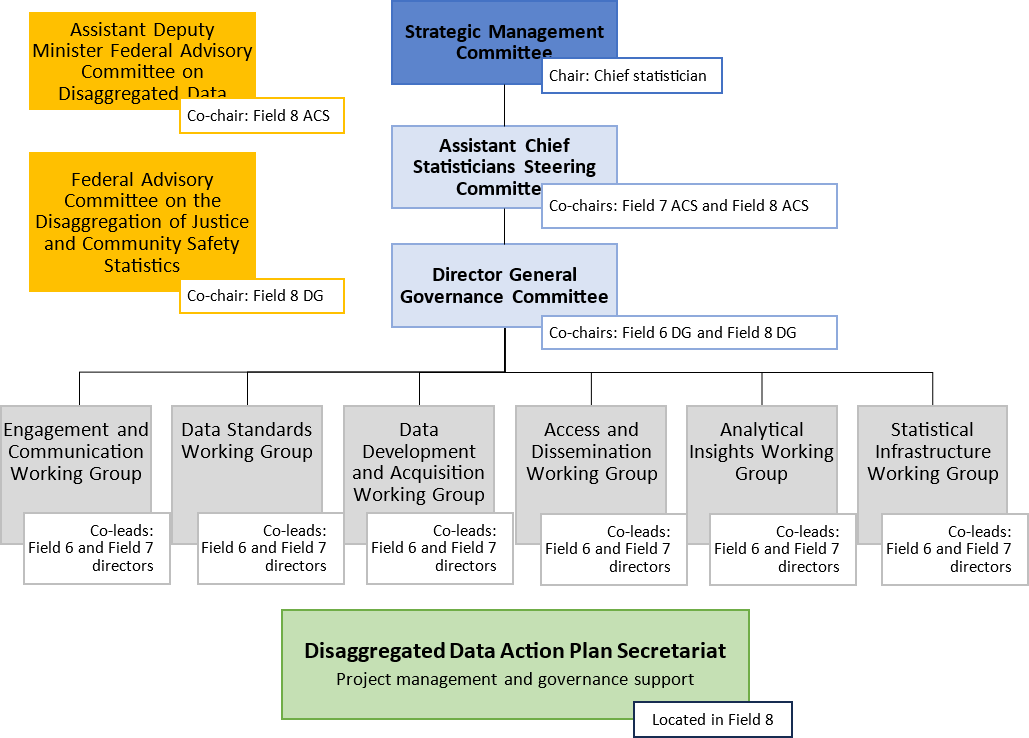
Description - Figure 1. Disaggregated Data Action Plan governance structure
Figure 1 depicts an organizational chart of the Disaggregated Data Action Plan (DDAP) governance structure.
Within Statistics Canada, there are the following committees:
- The Strategic Management Committee (SMC) chaired by the chief statistician and composed of assistant chief statisticians (ACSs).
- The ACS Steering Committee co-chaired by the ACS of the Social, Health, and Labour Statistics Field (Field 8) and the ACS of the Census, Regional Services and Operations Field (Field 7).
- The Directors General (DG) Governance Committee co-chaired by the DGs in the Strategic Data Management, Methods and Analysis Field (Field 6) and Field 8. The DG Governance Committee is supported by six working groups, each co-led by the directors of Field 6 and Field 7:
- Engagement and Communication
- Data Standards
- Data Development and Acquisition
- Access and Dissemination
- Analytical Insights
- Statistical Infrastructure.
The DDAP Secretariat, located in Field 8, provides administrative and logistical support to the agency and external DDAP committees, except the SMC.
Outside of Statistics Canada, there are the two following committees:
- The external Assistant Deputy Minister (ADM) Federal Advisory Committee on Disaggregated Data, which is co-chaired by the ACS of Field 8.
- The external Federal Advisory Committee on the Disaggregation of Justice and Community Safety Statistics, which is co-chaired by the DG of Field 8.
Expected outcomes
The DDAP is expected to contribute to building a more equitable Canada by advancing more representative data collection, enhancing statistics on diverse populations, addressing systemic racism and gender discrimination, and integrating fairness and inclusion into decision making processes to achieve the intended impact. The DDAP's expected immediate, intermediate, and long-term outcomes are summarized in Table 2.
| Timeline | Outcomes | Associated performance indicators |
|---|---|---|
| Immediate outcomes (1 to 3 years) |
|
Proportion of indicators disaggregated for employment equity group (women, Indigenous Peoples, racialized populations, and persons with disabilities) |
| Intermediate outcome (3 to 5 years) |
|
Not applicable |
| Long-term outcome (5 years and more) |
|
Not applicable |
To achieve these outcomes, Statistics Canada has pursued and will continue to pursue the following core activities:
- administrative data development
- disaggregation of labour market indicators
- disaggregation of social indicators
- disaggregation of population health indicators
- disaggregation of web panel surveys
- longitudinal social data development program
- universal crime reporting expansion
- survey on not-for-profit board diversity
- survey on business conditions
- enhancements to the Centre for Gender, Diversity and Inclusion Statistics.
Funded projects and activities
The DDAP included various projects aimed at enhancing the agency's capacity to disaggregate data. Agency leadership also promoted a cultural shift towards prioritizing disaggregated data and analysis. Although the majority (66%) of funding was allocated to Field 8, almost all fields benefited from DDAP initiatives.
Since its inception, the DDAP has supported a variety of projects and activities through core funding and targeted calls for applications. Ten core-funded projects, which formed the foundation of the DDAP's commitment, and other specific activities for communication, engagement and training to support consultation and promotion for the DDAP received continuous funding across multiple fiscal years or until project completion. Projects funded through the call for applications process were selected based on criteria aligned with the DDAP's goals. These projects were reviewed and selected by the DG Governance Committee and were intended to support early-stage or ongoing work. For fiscal years 2022/2023 and 2023/2024, projects funded through the call for applications process received annual or multi-year funding. However, the call for applications in 2023/2024 was not as widely advertised as in 2022/2023, and only a few projects selected in Field 8 were chosen.
In 2022/2023, the DDAP's projects faced budgetary constraints as a result of the broader financial context within the agency, which affected project leads' ability to fully implement activities as planned. As new initiatives were funded, uncertainty arose about whether some projects could meet staffing requirements. To address this, additional funding amounts beyond the original allocations were planned for 2022/2023, and corrective actions were taken midway, including delaying some projects, reducing overall project budgets, and realigning funds to prioritize projects directly aligned with the DDAP's core objectives. By 2024/2025, the DDAP supported 74 projects and activities. As the initiative moves into the final year of its five-year funding, the $172 million has been fully allocated.
About the evaluation
Authority
The evaluation was conducted in accordance with the Treasury Board Policy on Results and Statistics Canada's Risk-Based Audit and Evaluation Plan (2024/2025 to 2028/2029).
Objective and scope
The objective of the evaluation is to provide credible and neutral information on the relevance, design and delivery, and performance of the DDAP.
The scope of the evaluation covered the design and delivery of the DDAP, including its governance structure; sustainability of new activities within the agency's ongoing operations; and progress towards its intended short-, medium-, and long-term results. The scope was established in collaboration with the office of primary interest, and the evaluation was conducted from November 2024 to February 2025. It followed a pre-consultation process with senior managers and project leads and included the development of a logic model during the planning phase.
Approach and methodology
The following three evaluation questions were identified:
- To what extent is the DDAP relevant in supporting federal needs and priorities, including Statistics Canada's?
- To what extent are the design and delivery of the DDAP facilitating the achievement of its intended outcomes?
- To what extent is the DDAP progressing towards its intended outcomes in the short, medium, and long term?
More information about the evaluation questions and related indicators can be found in Appendix A.
The data collection methods outlined in Figure 2 were used to inform the evaluation. The findings outlined in this report are based on the triangulation of these data collection methods.
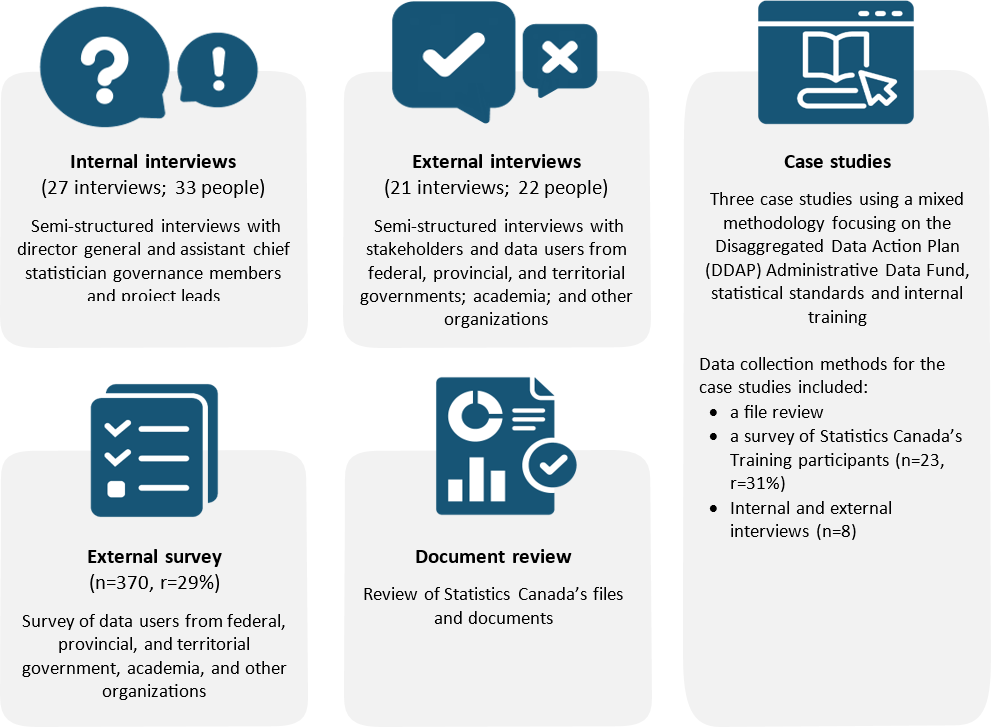
Description - Figure 2. Data collection methods
Figure 2 outlines the methods used by the evaluation for data collection.
- Internal interviews: Semi-structured interviews were conducted with members of the DG and ACS governance committees and project leads. 27 internal interviews were conducted with 33 people.
- External interviews: Semi-structured interviews were conducted with stakeholders and data users from federal, provincial, and territorial governments; academia; and other organizations. 21 external interviews were conducted with 22 people.
- Case studies: Three case studies were carried out, using a mixed methodology focusing on the DDAP Administrative Data Fund, statistical standards and internal training. Data collection methods for the case studies included:
- a file review
- a survey of Statistics Canada's Training participants. The sample size was 23 with a response rate of 31%.
- 8 internal and external interviews
- External survey: A survey of data users from federal, provincial, and territorial government, academia, and other organizations was conducted. The sample size was 370 with a response rate of 29%.
- Document Review: A review of Statistics Canada's files and documents was carried out.
Two main limitations were identified, and mitigation strategies were employed, as outlined in Table 3.
| Limitations | Mitigation strategies |
|---|---|
| The perspectives gathered through external interviews may not be fully representative, as disaggregated data funded by the Disaggregated Data Action Plan (DDAP) are not always distinguishable as Statistics Canada data or as disaggregated data. | Interviewees were selected using specific criteria to maximize strategic reach. Multiple recruitment strategies were used. Evaluators were able to find consistent overall patterns. |
| Detailed financial information on DDAP spending and its allocation across the agency was limited. | The evaluation attempted to fill these gaps, to the extent possible, through the other lines of evidence, including interviews with key informants. |
What we learned
Relevance
To what extent is the Disaggregated Data Action Plan relevant in supporting federal needs and priorities, including Statistics Canada's?
The Disaggregated Data Action Plan (DDAP) is supporting Canada's information needs and aligns with government-wide priorities, as well as Statistics Canada's strategic priorities and core responsibilities. DDAP projects and activities align with the federal government's data priorities and needs outlined in recent federal budgets, strategies, and reports, as well as agency-wide priorities for more disaggregated data, leading-edge methods and data integration described in mandate letters and strategic documents.
DDAP projects and activities align with the federal government's data priorities and needs outlined in recent federal budgets, strategies, and reports.
DDAP projects and activities that contribute to expanding disaggregated data assets, increasing intersectional analysis and enhancing access to disaggregated data align with several federal priorities and strategies seeking to understand social, economic and environmental issues; advance equity; address issues affecting vulnerable communities; and support evidence-based policy making.
- In 2018, the Government of Canada (GC) called for greater data disaggregated by gender and other intersecting identify factors to support the implementation of its Gender Results Framework and its Women Entrepreneurship Strategy.
- Disaggregated data broken down by race or ethnocultural origins and intersecting identities were collected and analyzed to support Building a Foundation for Change: Canada's Anti-Racism Strategy 2019–2022 and Changing Systems, Transforming Lives: Canada's Anti-Racism Strategy 2024–2028.
- Budget 2021 prioritized the collection and use of disaggregated data to modernize Canada's justice system, strengthen evidence-based policy making and support the Quality of Life Framework to inform federal decision making and budgeting. Also in 2021, Canada's Federal Implementation Plan for the 2030 Agenda identified the need for federal departments to identify gaps in disaggregated data that inform the Sustainable Development Goals and to work in partnership with Statistics Canada to address data gaps.
The DDAP is well aligned with the 2023–2026 Data Strategy for the Federal Public Service, which calls on federal organizations to develop a whole-of-government approach to data standards to generate greater insights, reduce data duplication and enable interoperability. Both initiatives share a common vision and emphasize the importance of developing and integrating statistical standards and building capacity within the public service.
In addition to aligning with federal strategies and priorities, the DDAP's whole-of-government approach and pillars align with several recommendations from the Office of the Auditor General calling for
- greater collaboration amongst federal departments, including Statistics Canada, to identify and prioritize disaggregated data needs to inform the Sustainable Development Goals
- increased collection and use of disaggregated data to support GBA Plus to inform and evaluate policies and programs.
DDAP projects and activities are also aligned with agency-wide priorities and departmental strategies.
DDAP projects and activities are reflected in the agency's 2021 mandate letter, which called on Statistics Canada to support a whole-of-government approach to improving the collection, analysis and availability of disaggregated data. The DDAP's focus on enhanced access, data standards, and engagement and collaboration aligns with Statistics Canada's modernization strategy, which emphasizes user-centric service delivery, leading-edge methods and data integration, statistical capacity building and leadership, and sharing and collaboration. It also aligns with the Statistics Canada Data Strategy—specifically data discovery and interoperability.
Design and delivery
To what extent are the design and delivery of the Disaggregated Data Action Plan facilitating the achievement of its intended outcomes?
The Disaggregated Data Action Plan (DDAP) governance structure and mechanisms facilitate oversight across the federal government and the agency, but they focus primarily on monitoring implementation rather than tracking progress toward intended outcomes. While the governance structure provides some elements of accountability, gaps remain, and the emphasis on implementation over strategic direction limits its ability to facilitate the achievement of medium- and long-term outcomes.
Consultative efforts informed some DDAP priorities and projects; however, concerns remain that some disaggregated data products are released without sufficient consultation, risking the advancement of a deficit narrative. While DDAP activities built on, and in some cases improved, existing infrastructure, resources and capabilities, initiatives dependent on oversampling are unsustainable. Efforts to sustain new DDAP-funded activities by integrating them within the agency's ongoing operations were limited. Cost-recovery agreements could help, but the current fiscal climate limits this option.
The DDAP governance structure and mechanisms facilitate oversight across the federal government and the agency, supporting the achievement of DDAP project and activity deliverables and the management of DDAP funds.
The external ADM Federal Advisory Committee on Disaggregated Data provided sufficient oversight to ensure the work plan priorities pursued by the four interdepartmental working groups were on track to achieve their expected deliverables. The ADM committee's quarterly meetings, supported by the DDAP Secretariat, served to monitor progress on the working groups' deliverables through regularly scheduled presentations from the working group co-leads. The oversight efforts of the ADM committee supported the timely completion of working group deliverables. According to ADM committee meeting minutes, all expected deliverables, including the launch of the Disaggregated Data Resource Hub, were on track to be completed by early 2025. However, the evaluation evidence does not clearly indicate the extent to which the ADM committee is prepared to monitor the deployment and uptake of the work plan deliverables across the federal government.
The DG Governance Committee, with support from the DDAP Secretariat, provided sufficient oversight to ensure that the deliverables of agency-led projects and activities were on track or revised to reflect changing circumstances. Every quarter, the DG Governance Committee reviewed the project dashboard reportFootnote 4 to determine whether any steps were required to address projects that were off track, delayed or cancelled. The quarterly project reports enabled the DG Governance Committee to anticipate projects expecting a budget surplus and quickly identify others that could use the funding.Footnote 5 The DG Governance Committee also provided sufficient monitoring to support the achievement of agency-level working group deliverables via presentations by the working group co-leads. Before disbanding, each working group presented its recommendations and any associated tools or strategies to the DG Governance Committee. However, the extent to which the committee's oversight supported the effectiveness of the working groups and their deliverables was unclear. Some agency representatives reported that the working groups primarily functioned as discussion groups and lacked clear direction on the issues they were aiming to resolve.
The DG and ACS committees provided financial oversight to manage the allocation of DDAP funding. Financial oversight was informed through the quarterly project trackers and project-level and strategic-level costing workbooks. The financial oversight efforts of the ACS Steering Committee resulted in a reduction of project funding to address the planned funding overallocation in 2022/2023.
Oversight of some performance indicators provided by DDAP governance helped achieve some short-term outcomes, but the limited number of performance indicators restricted the extent to which DDAP governance could monitor progress on expected results.
The DG Governance Committee provided some oversight of progress in addressing information gaps via the DDAP Secretariat's annual reports on the proportion of indicators disaggregated by the four EE groups. This oversight highlighted that the proportion of indicators disaggregated by racialized populations and persons with disabilities was falling short of its target. To address this, committee members were asked to work with their respective teams to increase indicators for racialized populations. The committee determined that no further action was required for persons with disabilities because the release of the five-year Canadian Survey on Disability was expected to fill this gap. The absence of additional developed performance indicators limited the ability of DDAP governance to oversee progress toward expected results.
Recent changes to oversight efforts within the DG Governance Committee are intended to facilitate monitoring project outcomes to better understand how they contribute to achieving intended results.
In 2024/2025, the DG Governance Committee extended its oversight of DDAP projects and activities to include progress towards intended project outcomes to improve its ability to monitor the alignment of DDAP projects with expected results. To support this expanded oversight, the DG Governance Committee implemented additional efforts. These included returning to monthly meetings (instead of quarterly); revising quarterly project reports to integrate more variables around risks—specifically, the capacity to drive progress and the degree of challenge in achieving the milestones; and inviting project teams to present on their progress, including how the DDAP funds were used.
DDAP governance provides some elements of accountability, and steps were taken to improve governance accountability to ensure projects align with DDAP goals.
Evidence suggests that mechanisms were established to uphold governance accountability. These mechanisms included governance mandates and terms of reference for the DDAP Secretariat, the DG Governance Committee, the ACS Steering Committee, the ADM Federal Advisory Committee on Disaggregated Data, and agency-level committees and working groups that outline their purpose, roles and responsibilities, and reporting structure. The mechanisms also included a formalized evaluation approach to inform the selection and funding of projects through calls for proposals, regular project-level reporting, and a few established performance indicators. However, challenges in governance accountability contributed to issues with the recommendation and approval of DDAP projects.
DDAP projects funded through the call for applications process were selected by the DG Governance Committee and approved by the ACS Steering Committee. The DDAP Secretariat used an evaluation matrix to ensure the initial list of potential projects brought to the DG Governance Committee aligned with the DDAP's core principles. However, neither committee appeared to have additional mechanisms to verify that the recommendation and approval of funded projects aligned with the DDAP's expected results. It was reported that having very little time to deliberate on funding recommendations further limited the ACS Steering Committee's accountability for approving recommended projects. The gaps in project recommendation and approval accountability created a risk that some DDAP-funded projects could be misaligned with the expected outcomes. In 2022/2023, the ACS Steering Committee issued a directive to strengthen accountability in project selection by requiring all projects to align with core DDAP commitments. As a result, some projects were scaled down or defunded to complement the financial corrective actions noted above.
Internal interviewees noted a lack of transparency and communication in the call for applications and project selection processes. Better communication of expectations throughout these processes would have improved the alignment of proposals, although some mechanisms existed to provide support. During the first year of implementation, some projects also faced initial challenges because of unclear expectations and undefined reporting mechanisms, which were eventually resolved. The timing of funding decisions was another concern, as it did not align with project planning, leaving project teams with little time to plan activities and secure resources.
Gaps in governance accountability potentially impede the achievement of medium- and long-term outcomes.
Working group deliverables were intended to advance the culture change within the agency and across the federal government. Gaps in accountability for the implementation of working group deliverables were noted for the DG and the ADM committees. The DG Governance Committee did not have a clear plan or dedicated resources to implement and monitor the agency working groups' recommendations, hindering their full execution. The ADM Federal Advisory Committee on Disaggregated Data does not appear to have a plan to support the uptake and application of the resources generated by the interdepartmental working groups and made available through the Disaggregated Data Resources Hub. While the data hub is part of the Canada School of Public Service (CSPS) platform, it is unclear whether the ADM committee is accountable for monitoring and updating it.
The investment in oversampling flagship surveys was used to enable the timely production of disaggregated data to support the achievement of short-term outcomes. However, the DG and the ACS committees recognized that this oversampling was an unsustainable means of producing disaggregated data given the relatively high costs and declining response rates. While some noted steps were taken to address the reliance on oversampling within the DG Governance Committee,Footnote 6 the evaluation found little evidence to indicate that either committee was accountable for advancing the development or application of alternative methods. This accountability gap in directing efforts to address oversampling challenges hinders the achievement of medium- and long-term outcomes. Without viable alternatives, key interviewees reported that surveys are expected to revert to more aggregated datasets.
Strategic direction to support the achievement of intended outcomes was limited because of inadequate foundational documents, and a short-term focus over a long-term vision.
The extent to which DDAP governance could provide strategic direction was limited by its absence from the mandates and priorities of the DG, ACS and ADM committees. At the agency-level, the priorities of the DG and ACS committees focused on allocating funding and implementing projects and activities rather than providing strategic guidance. The external ADM committee prioritized implementing the work plan to address barriers to the collection and use of disaggregated data, but there was limited evidence of additional efforts to strategically plan for a whole-of-government approach to achieving the medium- and long-term expected outcomes.
The priorities and direction of the DDAP were largely reported to be informed by foundational documents. However, these documents did not include a logic model that clearly articulated the expected outcomes, performance indicators and measurement strategy specific to the DDAP. Instead, they included a more generic logic model aligned with the agency's departmental results. Including a DDAP-specific logic model in the foundational documents could have facilitated more strategic thinking by DDAP governance to guide the development, monitoring and adjustments of the action plan. The evaluation found no evidence that performance indicators of medium- and long-term outcomes were being measured, monitored or reported by DDAP governance, indicating limitations in its ability to identify performance gaps and strategically adjust the plan.
Various consultative efforts informed some DDAP projects and activities to meet the needs of data users.
DDAP consultation efforts included online questionnaires; targeted engagement with partners, stakeholders, underrepresented and marginalized groups, provinces and territories, and academic subject-matter experts; and internal (agency and GC) discussions. The extent to which all DDAP projects and activities incorporated stakeholder consultations could not be determined through the evaluation. However, according to some internal documents, over one-third of DDAP projects reported planned or completed consultation activities. In addition to formal stakeholder consultations, standing stakeholder meetings with data users (e.g., provincial and territorial focal points or the Federation of Canadian Municipalities) were reported to inform some projects.
Consultation feedback is an important component of accountability and helps clarify and confirm stakeholders' needs to ensure that the disaggregated data and analytical products are relevant. According to the surveyed data users who reported participating in disaggregated data consultations, 63%Footnote 7 (n=177) reported receiving a summary or updates on the feedback provided to Statistics Canada, and 90% were satisfied with Statistics Canada's efforts to understand their disaggregated data needs and perspectives. A few data users reported that improvements to Statistics Canada consultations over the last five years, particularly with Indigenous Peoples, had resulted in greater satisfaction with disaggregated data and analytical products.
Consultations improved the relevance of some DDAP projects. However, there were some concerns that disaggregated data and associated products released without sufficient consultation risked reinforcing a deficit narrative.
Input from consultations was reported to have influenced some projects. Project leads reported several improvements to their projects as a result of stakeholder consultations, helping to ensure that the needs of data users were being met. Examples include:
- revisions to survey content to better meet the needs of data users and align with DDAP priorities (e.g., labour market indicators and the Diversity of Charity and Non-profit Boards crowdsourcing questionnaire)
- the development of a guidelines document and analytical framework and the establishment of a special purpose committee under the Canadian Association of Chiefs of Police to support jurisdictions' development of a data collection approach for police-reported Indigenous and racialized identity data
- adjustments to the scope of the project related to environmental, social and governance Indigenous indicators to focus on creating a guideline for developing Indigenous indicators, following a deeper understanding of the complexities involved in their creation.
Some concerns were raised that consultations on various DDAP project-related data or analytical products did not sufficiently involve representatives of the population group before release. Releasing data without sufficient input from these representatives can inadvertently support deficit narratives, as important contextual factors may be overlooked, resulting in data that do not meet stakeholders' needs (e.g., Indigenous Peoples). While some DDAP projects engaged with communities to inform DDAP deliverables (e.g., portraits for selected racialized population groups), some key interviewees recommend that the agency spend more time engaging with external stakeholders to inform the messaging of disaggregated data products.
Some DDAP projects are delivered efficiently through existing infrastructure, improved methodological and sampling approaches, and internal expertise. A few projects reported advancing Statistics Canada's capabilities and resources.
Most of the project leads reported that they had sufficient internal skills and partnerships to meet the needs of their project and that DDAP funding helped secure staff to address any outstanding knowledge or resource gaps. There is evidence that some DDAP projects helped minimize additional costs by using existing infrastructure, resources, and capabilities, such as:
- using corporate survey infrastructure already in place for collecting, processing, and disseminating data
- using data from other surveys or linked databases (e.g., Uniform Crime Reporting Survey, census, Longitudinal Immigration Database) to support data disaggregation
- applying current methodological approaches (e.g., small area estimation) to generate greater data granularity in the Labour Force Survey
- leveraging the work of other government department (OGD) initiatives to advance DDAP outcomes, such as the partnership with the CSPS to advance disaggregated data training programs and resources
- creating survey samples targeting specific population groups (e.g., racialized people) from the census and associated administrative data sources to increase response rates and reduce sample sizes
- using the expertise and experience within Statistics Canada's communications team and the Centre for Indigenous Statistics and Partnerships to support consultation and communication activities.
A few DDAP initiatives reported advancing Statistics Canada capabilities and resources. For example, one project focused on advancing methodological capabilities by working with the data science team to apply machine learning to address survey non-response. The working groups produced several resources to support agency employees' and other federal employees' disaggregated data collection, analysis and communication needs, including a disaggregated data hub with resources and links to OGD- or agency-developed disaggregated data resources, guides and training materials. However, the extent to which these resources have improved skills or knowledge within the agency is unclear.
Some DDAP activities were designed to support ongoing data disaggregation beyond the funding timeline, but efforts to sustain DDAP-funded activities were not adequately prioritized.
Some DDAP activities were designed to support outcomes long after the DDAP funding envelope concludes. Standards and data acquisition activities aim to fill information gaps and avoid additional surveys, while the development of accessible resources and a disaggregated data hub for federal staff is intended to increase awareness and understanding of the need for disaggregated data and foster a culture that prioritizes them. DG Governance Committee representatives described the funding provided through the call for applications process as seed money to help projects get off the ground and demonstrate their value to stakeholders. However, efforts to sustain project activities were not reported to be consistently prioritized, and there is an expectation that continued funding is necessary for ongoing data disaggregation. This reliance on DDAP financial support underscores the need for a more strategic approach to ensure the long-term viability of the DDAP's outcomes.
Oversampling is an unsustainable practice, yet relatively little focus was devoted to exploring or adopting alternative methodological approaches.
When the DDAP was developed, oversampling was used to produce disaggregated data. Most agency staff involved in projects relying on ongoing oversampling stated that no alternative method could produce similar data results. Agency staff recognized the high costs of oversampling, but given the ongoing challenges of declining response rates, any reduction in oversampling funding was reported to limit the ability of flagship surveys to produce disaggregated data.
Evidence suggests that DDAP funding contributed to methodological efforts to support efficient sampling;Footnote 8 improve understanding of non-response and develop guidelines for synthetic data. However, there was limited evidence that efforts to advance methodological solutions to oversampling were strategically prioritized early in the initiative. Some agency representatives expect the Methodological Acceleration initiative to identify emerging techniques for application to the DDAP, but the extent of the progress being made in this regard remains unclear.
Disaggregated Data Action Plan Administrative Data Fund
The Disaggregated Data Action Plan (DDAP) Administrative Data Fund aims to provide external partners with an opportunity to enhance their disaggregated administrative data holdings by providing funding to cover direct costs. Divisions that have identified partners are invited to submit proposals through a formal application process. Currently, five projects from various sectors have been funded or are ongoing. Collaboration with external partners, government departments and Statistics Canada across multiple projects has been essential in advancing data modernization efforts.
For example, the University and College Academic Staff System (UCASS) Modernization project demonstrates how the DDAP supported innovative problem-solving to sustainably address compound challenges, such as response burden, while advancing its priorities. By adding variables to staff surveys and combining them with data from other sources (e.g., the Census of Population), the pilot project provided valuable insights for equity, diversity and inclusion (EDI) initiatives and identified areas for improvement within the universities, without compromising survey respondents' privacy. The UCASS Modernization project has since been expanded to include data on groups previously unrepresented in the system. There are plans to add UCASS data to Statistics Canada's Social Data Linkage Environment, and this could provide a robust framework for EDI analysis across various demographic indicators. External partners are optimistic about the project's future and its continued positive impact, but, as with other DDAP projects, securing future funding sources remains a priority to ensure ongoing success.
Cost-recovery agreements can help sustain some DDAP projects, but the current fiscal climate significantly limits the viability of this option.
Key interviewees reported that the more limited ongoing DDAP funding will be used to support mission-critical projects, such as the Labour Force Survey, while other projects can expect funding reductions. To address project sustainability, DDAP governance is discussing the potential for some DDAP initiatives to transition into cost-recovery projects.
At least one project (the Indigenous satellite account) transitioned to a cost-recovery agreement with Indigenous Services Canada to continue for a second year, and a few other projects reported exploring cost-recovery options with federal (e.g., Canadian Heritage, Employment and Social Development Canada) and provincial and territorial partners. However, many interviewees noted that while the DDAP is generating data and analysis that meet the needs of data users, cost-recovery opportunities are limited and more challenging given the current fiscal climate. Furthermore, some interviewees reported that data users are less inclined to use their own funds, as Statistics Canada received substantial funding to expand and enhance disaggregated data and analysis.
Performance
To what extent is the Disaggregated Data Action Plan progressing towards its intended outcomes in the short, medium, and long term?
Although the Disaggregated Data Action Plan (DDAP) is making progress toward its intended results, some areas require further attention. Awareness-raising and training activities have helped participants better understand data disaggregation, yet some barriers to applying and acquiring disaggregated data knowledge were identified. The DDAP is helping to address information gaps, but the reliance on oversampling to produce disaggregated data from flagship surveys was identified as a challenge to sustainably doing so. The action plan is improving certain aspects of data quality; however, some issues with relevance and accessibility persist.
The DDAP is supporting and reinforcing a cultural shift that prioritizes disaggregated data and intersectional analysis by expanding the availability of disaggregated data and related products. However, further progress will require greater emphasis on awareness and training. Some early evidence suggests that the DDAP is positively impacting data users, though these impacts are limited in part by data users' and decision makers' capacities to understand and use disaggregated data and analytical products. There is also some concern that the DDAP's long-term outcome is outside Statistics Canada's influence and mandate.
DDAP awareness-raising and training activities are contributing to, and sustaining, strong awareness and understanding of the importance of disaggregated data and GBA Plus.
Numerous activities have been implemented to increase awareness of the need for disaggregated data and GBA Plus within and outside Statistics Canada. By the end of 2022/2023, the DDAP Secretariat delivered over 100 presentations across the agency, to OGDs and to external stakeholdersFootnote 9 to raise awareness of the importance of disaggregated data and the DDAP's priorities. Other internal and external awareness-raising efforts include a dedicated agency intranet webpage; a government-wide disaggregated data hub; presentations at the agency's research forum; social media posts; podcasts; conference and workshop presentations; and a two-part introduction to disaggregated data video, which received over 850 views in its first five months. The majority (79%) of surveyed data users (n=370) reported that they were familiar with the concept of disaggregated data.
In response to an identified need for training to support stakeholders' understanding of disaggregated data and GBA Plus, the DDAP funded six training programsFootnote 10 for agency and other federal government staff. The courses covered a variety of key areas related to the use and importance of disaggregated data (e.g., privacy, confidentiality, accessibility, utility, ethics, small area estimation, data types and formats, frameworks, guidelines, application, strategies, case studies). From 2022 to 2024, over 350 federal (agency and non-agency) staff participated in the synchronous programs.
Most highly knowledgeable, long-time users of Statistics Canada data reported that their awareness and understanding of the need for disaggregated data and GBA Plus have remained unchanged over the past four years, as they were already at a high level. While a few data users reported a greater awareness and importance attributed to disaggregated data among their stakeholders, the increase could not be attributed to the DDAP.
DDAP training activities are contributing to participants' understanding of data disaggregation, but some barriers to applying and acquiring disaggregated data knowledge were identified.
Statistics Canada participants reported high satisfaction with DDAP training courses. According to the case study survey, the initial Disaggregated Data Analytical Workshop positively influenced participants' knowledge and awareness of the DDAP and its components, including ethical considerations, confidentiality practices and data standards. The workshop effectively enhanced the application of knowledge for most participants. Furthermore, the training courses strengthened and expanded the community network of disaggregated data users, as participants learned about and established new contacts they could later reach out to during their work. However, participants also noted some barriers to fully using the skills they learned during training. These included insufficient disaggregated data to perform the required level of analysis, the need for additional analytical training, a lack of resources (budget, staff or technology), and limited time to apply what they learned.
Outside Statistics Canada, some evidence suggests that the disaggregated data training programs could benefit from additional awareness-raising efforts. Just over half (53%) of surveyed data users who were federal government employees (n=231) reported being unaware of the training, while 15% had participated in at least some of the training. Of those who participated, the most commonly reported outcome was an increased understanding of disaggregated data and how they can inform policy making.
The DDAP is helping to address information gaps by increasing the proportion of disaggregated indicators for the four EE groups, but few data users reported specific impacts from the increase in disaggregated data.
Since 2020/2021, the percentage of socioeconomic indicators disaggregated for gender, racialized populations, Indigenous Peoples and persons with disabilities has increased. By 2023/2024, gender indicators exceeded the target by 17 percentage points, indicators for racialized populations were 1 percentage point away from reaching their target, and indicators for Indigenous Peoples and persons with disabilities increased but remained 6 and 8 percentage points, respectively, from their targets (see Figure 3).
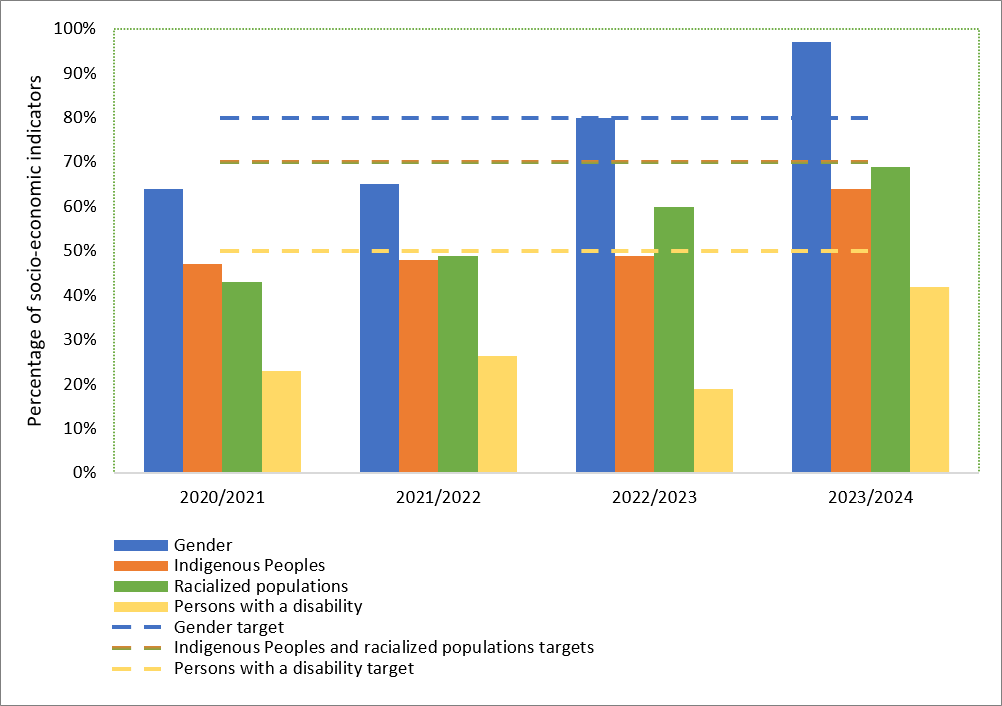
Description - Figure 3. Percentage of statistical indicators regularly produced by the Socio-economic Statistics program that relate to people and are disaggregated by employment equity group, 2020/2021 to 2023/2024
Figure 3 is a chart with columns that shows the percentage of statistical indicators regularly produced by the Socio-economic Statistics program that relate to people and are disaggregated by employment equity group for the fiscal years 2020/2021 to 2023/2024.
For gender, the target is 80% and the percentage for each fiscal year was as follows:
- 2020/2021: 64%
- 2021/2022: 65%
- 2022/2023: 80%
- 2023/2024: 97%
For Indigenous Peoples, the target is 70% and the percentage for each fiscal year was as follows:
- 2020/2021: 47%
- 2021/2022: 48%
- 2022/2023: 49%
- 2023/2024: 64%
For racialized populations, the target is 70% and the percentage for each fiscal year was as follows:
- 2020/2021: 43%
- 2021/2022: 49%
- 2022/2023: 60%
- 2023/2024: 69%
For persons with a disability, the target is 50% and the percentage for each fiscal year was as follows:
- 2020/2021: 23%
- 2021/2022: 26%
- 2022/2023: 19%
- 2023/2024: 42%
Approximately 65% of surveyed data users who responded to the question regarding the extent to which Statistics Canada's disaggregated data are filling information gaps since 2021 (n=342) reported that they are indeed filling information gaps, with 23% reporting that gaps were filled to a large or very large extent. Data users' perception of Statistics Canada's effectiveness in producing data to better understand EE groups is highest for women (55%), followed by racialized populations (44%), Indigenous Peoples (42%), and persons with a disability (34%). However, few interviewees could report whether, and how, the increase in disaggregated data was contributing to decision making, research or policy debates. Data users who could speak to the contribution of the DDAP on their organization reported that the increase in disaggregated data is informing the kinds of research questions members of their organization are pursuing, providing the evidence to advocate for funding and investment revisions, and informing organizational research and data collection activities.
As already stated, the sustainability of oversampling to produce disaggregated data from flagship surveys was identified as a challenge to addressing information gaps. However, it is unclear to what extent the agency has increased its capacity to avoid or reduce its dependency on oversampling by advancing methodologies that help address the declining response rates.
The DDAP is enhancing some dimensions of data quality, but a few relevance and accessibility gaps were noted.
The DDAP is producing data that many data users reported to be meeting their needs. However, key interviewees and surveyed data users also reported a need for greater disaggregation beyond the four EE groups, especially for the 2SLGBTQI+ population and at lower geographic levels.Footnote 11 Although disaggregation for the 2SLGBTQI+ population and at smaller geographic levels is included in the DDAP's priorities, projects prioritizing populations outside of the four EE groups have reportedly not been prioritized. Data users recommended that Statistics Canada focus on developing appropriate estimation or sampling methods to address privacy or confidentiality concerns that contribute to the ongoing gaps.
DDAP standards are contributing to data coherence and comparability. The DDAP supported the approval and adoption of two disaggregated data standardsFootnote 12 within the federal government and the approval and adoption of sexual orientation and gig employment standards within the agency. Efforts to improve the usability of the standards include providing a dedicated web page and making DDAP standards accessible through the Reference Data as a Service application programming interface. However, the development of standards is a complex and lengthy process, and adoption is required outside of Statistics Canada to ensure interoperability across government and non-government agencies.
Statistical standards
To address the inconsistent use of statistical standards for disaggregated data across Statistics Canada and the Government of Canada (GC), and to meet the need for more user-centric products, services, and communications, Statistics Canada's Centre for Statistical and Data Standards (CSDS) launched several initiatives in support of the Disaggregated Data Action Plan. These initiatives provide guidance on survey methodologies, improve interoperability, and engage extensively with internal and external stakeholders. The CSDS has also focused on expanding the accessibility of standards through an enhanced website and consultations with key groups. Additionally, the team has developed training resources to support analysts and survey managers in effectively applying these standards.
The CSDS used established processes, tools and governance structures, along with data standards repositories and consultation networks, to help set key statistical standards across the GC. For instance, it developed a proof of concept using some quality of life variables to disseminate disaggregated data at the lowest level possible while still respecting data confidentiality and quality. Furthermore, consultations with over 300 groups and individuals have informed the development of inclusive data collection frameworks. This has helped harmonize data on gender and sexual orientation across various surveys and refine these standards.
Looking forward, the focus is on securing sustainable funding, integrating new standards into legacy systems and educating stakeholders on the value of standardization, as adapting survey questions across jurisdictions requires careful attention to underlying concepts to ensure consistency.
The DDAP also supported greater accessibility to disaggregated data and analytical products by updating Statistics Canada's Gender, Diversity and Inclusion Statistics Hub and launching the Centre for Municipal and Local Data; releasing more analytical publications and data tables online and through Statistics Canada's official release bulletin, The Daily; and promoting new disaggregated data and analysis through social media. Some data users reported that the DDAP has increased access to disaggregated data for more organizations because data that used to be accessible only through cost-recovery report requests are now accessible through the Statistics Canada website at no additional cost. However, less than half (35%) of surveyed data users (n=370) reported that it was somewhat easy or better to access Statistics Canada's disaggregated data. Barriers included website navigation issues, limited hub value for advanced needs, limited data linking with external sources and users' limited internal capacity.
Priorities related to data sovereignty were identified as a potential challenge to enhancing access to disaggregated data by collecting and integrating data from other sources. Key interviewees recognized that the agency is still developing its approach to supporting data sovereignty for various jurisdictions and populations, but expressed ongoing concern that sharing data with the agency would result in losing control of the data and how they are used. To address this concern, key interviewees recommended that the agency continue to work with other data stewards to determine how the data can be shared in a way that respects the needs and commitments of those involved.
The DDAP is reinforcing a cultural shift that prioritizes disaggregated data and intersectional analysis by expanding the availability of disaggregated data and analytical products. To advance the cultural shift outside the agency, greater emphasis should be placed on awareness and training efforts.
Interviewees within the agency reported that the DDAP is supporting a culture change. This can be seen by the increased attention to disaggregated statistics and greater intersectional analysis in branches outside Field 8, such as those in the Economic Statistics Field. They also indicated that considering disaggregated data earlier in the process has increased since the implementation of the DDAP.
Results from the case study survey align with this, as 78.3% of respondents indicated that the agency fosters an environment that promotes horizontality for disaggregated data work, as well as the importance of intersectional analysis and longitudinal insights. However, a slightly lower proportion (61.7%) of participants who responded to the question reported an emphasis on applying the GBA Plus lens to all projects and initiatives.
Evidence of a cultural change within the federal government included an increased demand for disaggregated data among federal data users. However, a few interviewees noted that the cultural change is not progressing at the same pace within every department. A department's data literacy, its mandate for research and its leadership's commitment appear to have a greater influence on its use of disaggregated data.
Interviewed data users reported that the DDAP supports a cultural shift toward prioritizing the collection and use of disaggregated data and GBA Plus. However, many noted that this shift started before the implementation of the DDAP. Data users also reported that because Statistics Canada is perceived as a data leader, the increased availability of disaggregated data and analytical products is helping to spread and solidify this cultural change. To further advance a cultural change that prioritizes the collection and analysis of disaggregated data, some data users recommended that greater awareness and training efforts be directed to non-federal data users to help them better understand what information is available and how it can be used in their work.
Some early evidence suggests that the DDAP is positively impacting data users' decision making, research and policy debates, but these impacts are limited by data users' and decision-makers' capacity to understand and use disaggregated data.
As the DDAP enters the final year of its five-year funding, some signs of progress toward achieving its long-term outcome can be seen. Among surveyed data users who responded to the question about whether Statistics Canada's disaggregated data are enhancing their research, decision making or policy debates (n=340), 61% reported they were having a positive impact. However, evidence also shows that some data users are still determining the overall impact of Statistics Canada's disaggregated data, given that just under one-quarter (23%) of respondents reported not knowing whether the data were enhancing their work. Specific benefits of Statistics Canada's disaggregated data include filling or identifying information gaps, highlighting specific trends or inequalities, informing interventions or policies, and targeting resources or recommendations.
As noted, few key interviewees could report any tangible DDAP-related impacts on their decision making, research or policy debates. Disaggregated data had a positive impact on the implementation and effectiveness of GBA Plus in federal budgets. The long-term outcome of increasingly fair and inclusive policy, program or legislation development is limited by data users' and decision-makers' capacities to understand and use disaggregated data and corresponding analytical products. Key interviewees reported that smaller jurisdictions, non-governmental organizations and government staff often lack the capacity or resources to understand and use disaggregated data, limiting the impact of the DDAP on policy and program development. Suggestions to address these capacity gaps include sustained awareness and training efforts within and outside the federal government, particularly at the federal leadership levels.
There is some concern that the DDAP's long-term outcome is outside Statistics Canada's influence and mandate.
Some concerns were reported that the DDAP's long-term outcome of increasingly fair and inclusive policy, programs and legislation is outside Statistics Canada's mandate. While DDAP activities are primarily focused on increasing disaggregated data and analytical products, Statistics Canada has limited influence on whether, and how, the data are considered in program and policy development. Achieving the DDAP's long-term outcome is considered more the collective responsibility of leaders across the federal government. However, doubts have been raised about whether the current ADM Federal Advisory Committee on Disaggregated Data is effectively designed to advance the federal leadership's commitment to applying disaggregated data and intersectional analysis.
How to improve the program
Recommendation 1
The ACS of Field 8 should ensure that the DDAP governance is strengthened to directly support the initiative in achieving its intermediate and ultimate outcomes by:
- updating DDAP oversight committees' mandates to clearly articulate accountabilities, particularly around the provision of strategic direction and the achievement of the DDAP's medium- and long-term objectives
- focusing future projects and activities on sustainability
- establishing effective communication (e.g., leveraging proposed governance tables) to ensure that priorities, expected outcomes, and performance measures are well understood by staff, key partners, and stakeholders (e.g., on a regular basis, using two-way dialogue).
Recommendation 2
The ACS of Field 8 should ensure that outreach and engagement efforts are comprehensive and consistent, so that the ongoing needs of data users, including those from the EE groups, are understood and being met by DDAP's disaggregated data and analytical products.
Management response and action plan
Recommendation 1
The ACS of Field 8 should ensure that the DDAP governance is strengthened to directly support the initiative in achieving its intermediate and ultimate outcomes by:
- updating DDAP oversight committees' mandates to clearly articulate accountabilities, particularly around the provision of strategic direction and the achievement of the DDAP's medium- and long-term objectives
- focusing future projects and activities on sustainability
- establishing effective communication (e.g., leveraging proposed governance tables) to ensure that priorities, expected outcomes, and performance measures are well understood by staff, key partners, and stakeholders (e.g., on a regular basis, using two-way dialogue).
Management response
Management agrees with the recommendation.
- The terms of reference for the DG, ACS and ADM committees will be revised to include accountability pertaining to the provision and communication of strategic direction and around the achievement of the DDAP's medium- and long-term objectives.
-
- An integrated annual plan will be developed, incorporating Statistics Canada's strategic direction for the DDAP and disaggregation of data as a key principle, with a detailed workplan to guide implementation and monitoring. The integrated annual plan will integrate considerations of sustainability (e.g., alternative methodological approaches beyond oversampling) and alignment with the DDAP's medium- and long-term outcomes. The DG Governance Committee will recommend the integrated annual plan to the ACS Steering Committee for approval.
- The ADM Committee will track DDAP outcomes and capture how disaggregated data have informed OGDs' policy formulation and program implementation/evaluation. These outcomes will form part of the 2024/2025 annual achievements report released by Statistics Canada.
- Existing communication and dissemination opportunities (e.g., the CSPS collaboration space, OGDs' dissemination mechanisms) will be leveraged to promote, share and showcase disaggregated data outcomes, best practices, and training opportunities, and to raise their awareness.
Deliverables and timelines
- Revised and approved terms of references for the DG, ACS, and ADM committees. (September 2025)
-
- Approved integrated annual plan (October 2025, ongoing afterwards) that incorporates a detailed work plan and logic framework approach, which includes:
- the DDAP's medium- and long-term objectives
- measurable indicators to be used to monitor progress against these objectives
- an approach that will be used to monitor progress against these objectives
- clear articulation on how priorities will be determined with a focus on sustainability.
- Annual achievements report for 2024/2025 will include for the first time outcomes/impacts shared by OGDs. (December 2025).
- Approved integrated annual plan (October 2025, ongoing afterwards) that incorporates a detailed work plan and logic framework approach, which includes:
- Robust and updated CSPS collaborative space to showcase best practices, leverage CSPS training opportunities and raise awareness. (November 2025).
Recommendation 2
The ACS of Field 8 should ensure that outreach and engagement efforts are comprehensive and consistent, so that the ongoing needs of data users, including those from the EE groups, are understood and being met by DDAP's disaggregated data and analytical products.
Management response
Management agrees with the recommendation.
An outreach and engagement plan will be developed to establish communication with DDAP partners and stakeholders, including emphasis on leveraging external networks at the ADM and ACS levels (internal and external to GC).
The plan may include the organization of engagement sessions or surveys among EE groups (and those beyond the four EE groups, as needed and as possible).
Deliverables and timelines
Outreach and engagement plan approved by the ADM Federal Advisory Committee on Disaggregated Data (April 2026).
Appendix A: Evaluation questions and indicators
| Evaluation questions | Evaluation indicators |
|---|---|
|
1. To what extent is the Disaggregated Data Action Plan (DDAP) relevant in supporting federal needs and priorities, including Statistics Canada's? |
1.1 Extent of the alignment between Statistics Canada's DDAP projects and activities and (a) the agency's strategic priorities and (b) government-wide DDAP priorities. |
|
2. To what extent are the design and delivery of the DDAP facilitating the achievement of its intended outcomes? |
2.1 Extent to which the DDAP's governance provides effective strategic direction, oversight, and accountability across all levels (federal government, agency, program, and project levels).
2.2 Extent to which consultation was conducted to inform priorities and projects.
2.3 Extent to which DDAP activities built on or enhanced existing infrastructure, resources and capabilities (skills, partnerships), minimizing additional cost and effort. 2.4 Extent to which measures have been taken to ensure the sustainability of the new activities within the agency's ongoing operations. |
|
3. To what extent is the DDAP progressing towards its intended outcomes in the short, medium and long term? |
3.1 Extent to which internal and external barriers to achieving expected results were identified and mitigated. 3.2 Extent of progress toward short-term results.
3.3 Extent of progress toward medium-term results.
3.4 Extent of progress toward long-term outcomes.
|
Appendix B: Interview quantification scale
Interview responses are quantified and categorized in this report using the scale shown in the table below.
| Term | Definition |
|---|---|
| One | One is used when one participant provided the answer. |
| Few | Few is used when 4% to 15% of participants responded with similar answers. The sentiment of the response was articulated by these participants but not by other participants. |
| Some | Some is used when 16% to 45% of participants responded with similar answers. |
| About half | About half is used when 46% to 55% of participants responded with similar answers. |
| Most or a majority | Most, or a majority, is used when 56% to 89% of participants responded with similar answers. |
| Almost all | Almost all is used when 90% to 99% of participants responded with similar answers. |
| All | All is used when 100% of participants responded with similar answers. |