Contribute to the development of Statistics Canada's Selected Health Indicators in Canada dashboard
Current status: open
Consultation period: February 25, 2026 to March 11, 2026
Contribute to the development of Statistics Canada's Selected Health Indicators in Canada dashboard
Consultation period: February 25, 2026 to March 11, 2026
This document describes the results from a consultation initiated in August 2023 concerning proposals for changes to the North American Industry Classification System (NAICS) Canada. The revised classification will be NAICS Canada 2027 Version 1.0. Statistics Canada invited data producers and data users, representatives of business associations, government bodies at the federal, provincial and local levels, academics and researchers and all other interested parties to submit proposals for the revision to NAICS Canada.
The revisions for which proposals were sought may include any element of the classifications including the structure of the classification, wording of definitions, and examples and exclusions attached to classes. The input of business, government, academia and private citizens in updating NAICS Canada is valued so that updates meet the needs of users, while still respecting statistical classification principles and guidelines.
NAICS Canada is Statistics Canada's primary classification for industries and is widely used throughout business programs at Statistics Canada, in academia and business. Effective December 15, 2023, NAICS Canada became the data reference standard on industry classification for the government of Canada. Statistics Canada updates NAICS Canada on a 5-year revision cycle. The next revision to this classification is scheduled to be released in January 2027.
The consultation was conducted electronically through public announcements that described the upcoming NAICS Canada revisions, listed the types of inputs sought, provided a timeline for the consultation and gave contact information for users to make submissions and contact Statistics Canada with questions and comments. The announcements were disseminated through the Statistics Canada's website (Consulting Canadians and Standards, Data Sources and Methods pages), and Facebook, LinkedIn, Twitter, and Reddit, as well as GCXchange.
In addition to soliciting proposals from external users and stakeholders outside of Statistics Canada, one of the key parts of the consultation on the revision of NAICS Canada is the on-going interactions within the Agency. The Centre for Statistical Standards and Geomatics consulted numerous statistical programs, the Business Register and the System of National Accounts during the consultation and revision process.
This report summarizes the feedback received from the consultation. The consultation process and period are described below.
NAICS was released for the first time in 1997, with NAICS 1997. This classification was developed through the cooperation of Statistics Canada, Mexico's Instituto Nacional de Estadistica y Geografia (INEGI) and the Economic Classification Policy Committee (ECPC) of the United States. Each country maintains its own version of NAICS (NAICS Canada, NAICS U.S., and NAICS Mexico). The three country versions are generally the same with some differences found primarily in wholesale trade, retail trade and government, and at the 6-digit national industry level.
NAICS replaced the existing industry classification system used in Canada, which was the Standard Industrial Classification (SIC). Since then, NAICS Canada, U.S. and Mexico have been revised on a 5-year cycle in 2002, 2007, 2012, 2017 and 2022. The three NAICS partner agencies meet regularly to discuss possible changes to the common NAICS structure.
Statistics Canada has adopted a permanent consultation process with regards to NAICS Canada, which means proposals for changes to the classification may be submitted and reviewed on an ongoing basis. A cut-off date for considering proposed changes to be included into a new version of NAICS Canada has been instituted. This is why, for example, for NAICS Canada 2027, the deadline to submit proposal for changes to be included was set to the end of June 2025.
NAICS has a 6-digit, 5-level classification structure, consisting of 2-digit sectors, 3-digit sub-sectors, 4-digit industry groups, 5-digit industries and 6-digit national industries. Changes were invited for any level, but changes to the 2-digit to 5-digit levels will be subject to trilateral negotiation and approval. Changes to the 6-digit national industry level are at the discretion of each trilateral partner (i.e., Statistics Canada makes the final decision about changes to 6-digit industries in NAICS Canada).
North American Industry Classification System (NAICS) Canada 2022 Version 1.0 is the latest version of the classification for the participants of this consultation were to base their input on.
The purpose of the consultation was to solicit comments from data producers and users, representatives of business associations, government bodies at the federal, provincial and local levels, academics and researchers and all other interested parties to submit proposals for the revision to NAICS Canada. The revised version will be called NAICS Canada 2027 Version 1.0. User input is highly valued by Statistics Canada in updating NAICS Canada so that it continues to meet user needs. See: Invitation to participate in the revision of the North American Industry Classification System (NAICS) Canada
We sought proposals for changes for two main reasons:
The type of feedback requested included any proposed changes to NAICS Canada and how they classify industries. These might be changes to the structure of the classification (i.e. addition of classes or deletion of classes), changes to the wording of definitions, and changes to examples, inclusion and exclusions.
Interested parties were invited to submit written proposals to Statistics Canada. The official public consultation period started in October 2023 and closed at the end of June 2025.
Statistics Canada received responses by e-mail. These responses consisted of written descriptions of the desired changed to NAICS Canada for 2022, including structures, definitions, examples, inclusions, and exclusions.
Staff from the Centre for Statistical Standards and Geomatics (formerly Centre for Statistical and Data Standards) at Statistics Canada managed the responses to the public consultation announcement. These responses were all received by e-mail.
For NAICS Canada 2027, in response to this invitation, we received proposals related to the following:
Overall, we have received approximately 100 requests for changes to NAICS generated internally or in consultation with our American and Mexican partners. These included structural changes to NAICS governing electric vehicle and electric vehicle battery production, lithium mining, as well as numerous non-structural changes affecting definitions, examples, inclusions, and exclusions in a large number of NAICS classes. Examples of these non-structural proposals for NAICS changes include the addition of a large number of new examples to more clearly document the classification of emerging activities related to the bioeconomy, the addition of new examples to clarify the treatment of cryptocurrency related activities, numerous updates to the translation of existing terms, and the creation or revision of examples to cover a broad array of other topics, such as child care and cloud seeding. Many of these changes, even if quite minor in effect, require extensive research and analysis to confirm the proper language to be used and the proper placement of activities in the classification.
Following receipt of proposals for changes we investigated the changes with respect to the criteria set out for evaluating changes, which included the rationale for the proposed changes, the empirical significance (i.e. revenue, expenses, value-added, employment) of any new industries, consistency with classification principles (e.g. mutual exclusivity, exhaustiveness, and homogeneity within categories), and relevance to present analytical interest and data. We consulted with our subject matter experts and the system of national accounts on the changes. During the revision process we had regular meetings with our American and Mexican counterparts on changes that affect the trilateral (i.e. shared by the three countries) classes of NAICS. We shared information on the changes we were investigating and negotiated changes that would respect the trilateral nature of NAICS. In addition, we followed and explored updates to other industrial classifications, the International Standard Industrial Classification of All Economic Activities (ISIC) Rev. 5 in particular, to learn how those changes might help inform the changes that we are making. Revision for ISIC Rev. 5 affected, among other areas, intermediation service activities, cryptocurrency related activities, electricity generation and storage and telecommunications.
The task team is currently reviewing all proposals in accordance with the statistical classification principles, the underlying concepts, and the classification criteria for NAICS, as outlined in the Appendix of this report. Following this review, Statistics Canada will issue a public notice in spring 2026 outlining the final approved proposals for inclusion in NAICS 2027 V1.0, with the public release of NAICS 2027 V1.0 scheduled for January 2027.
Principle 1: Follow internationally accepted practices and principles on how to classify industries and their statistical units (e.g., establishment, enterprise) (also see Introduction to the North American Industry Classification System (NAICS) Canada 2022 Version 1.0). Because the purpose of NAICS is primarily to provide a framework to support consistent statistical information on Canadian economic activities, it is important to specify the scope of each category in the classification. Principle 1 supports the production and dissemination of consistent and sound statistics. The NAICS team and the Trilateral steering committee on NAICS use this information to evaluate whether proposed changes are properly placed in the classification structure.
Principle 2: Respect of the internationally recognized principles of well-described statistical classifications, being:
Principle 3: The classification is related to data that is collectible and publishable (collectability and reportability): whether data can be collected and reported on the industry class . For a detailed industry to be included in NAICS and expecting statistics to come out of it, Statistics Canada must be able to collect and report data, otherwise, categories will not provide opportunities to produce relevant statistics. Statistics Canada is responsible for producing data across a broad range of industries in Canada and conducts comprehensive surveys that collect industry and labour market data.
Principle 4: The classification supports the maintenance of time series continuity to the extent possible; that is, the ability to maintain data series over time without interruption due to classification changes. To the extent possible, new industry classes proposed for the current version of NAICS and beyond should be easily linked by appropriate correspondence to previous version the NAICS (e.g., NAICS 2022 to NAICS 2017 and NAICS 2017 to NAICS 2012).
Guidelines developed by Statistics Canada provided for the launch of the permanent consultation process for NAICS will assist users and the NAICS team and working groups in consistently making changes to NAICS.
Principle 5: The classification continues to be relevant, that is, it must be of analytical interest, result in data useful to users, and be based on appropriate statistical research, subject-matter expertise and administrative relevance aligned with statistical classification principles and needs.
Principle 6: The prevalence of classification principles and statistical needs: NAICS is designed primarily for statistical purposes. Although there can be various uses of NAICS for non-statistical purposes (e.g., for administrative, regulatory, or policy functions), the requirements of government agencies or private users that choose to use NAICS for non-statistical purposes are responsible for such use of the classification. As a result, the NAICS team reviews comments and develops its recommendations based on established statistical classification principles and guidelines. Making changes for strictly administrative rather than classification purposes is not supported. Similarly, the volume of comments does not determine what the recommendations will be, and just submitting a request for a change does not automatically result into a change in NAICS.
NAICS is designed for the compilation of production statistics and, therefore, for the classification of data relating to establishments. It takes into account the specialization of activities generally found at the level of the producing units of businesses. The criteria used to group establishments into industries in NAICS are similarity of input structures, labour skills and production processes.
NAICS can also be used for classifying companies and enterprises. However, when NAICS is used in this way, the following caveat applies: NAICS has not been specially designed to take account of the wide range of vertically- or horizontally-integrated activities of large and complex, multi-establishment companies and enterprises. Hence, there will be a few large and complex companies and enterprises whose activities may be spread over the different sectors of NAICS, in such a way that classifying them to one sector will misrepresent the range of their activities. However, in general, a larger proportion of the activities of each complex company and enterprise is more likely to fall within the sector, subsector and industry group levels of the classification than within the industry levels. Hence, the higher levels of the classification are more suitable for the classification of companies and enterprises than are the lower levels. It should also be kept in mind that when businesses are composed of establishments belonging to different NAICS industries, their company- and enterprise-level data will show a different industrial distribution, when classified to NAICS, than will their establishment-level data, and the data will not be directly comparable.
While NAICS is designed for the classification of units engaged in market and non-market production, as defined by the System of National Accounts, it can also be used to classify own-account production, such as the unpaid work of households.
The unit of observation of the industrial classification is the producing unit or establishment, and the industrial classification groups producing units, not products. Groupings of producing units permit the collection of data on inputs and outputs on a comparable basis. Because establishments each produce a number of products in different combinations and using different technologies, it is hardly possible to group all the establishments producing a particular product. It is more useful to use a production-oriented approach to bring together, into industries, establishments with common input structures, and to compile data on their outputs. This permits the compilation of comprehensive data on the total output of each product by industry and across all industries.
NAICS has been designed for statistical purposes. Government departments and agencies and other users that use it for administrative, legislative and other non-statistical purposes take responsibility for applying the classification in this manner.
NAICS is based on a production-oriented, or supply-based conceptual framework in that establishments are grouped into industries according to similarity in the production processes used to produce goods and services. The production process refers to the combination of inputs used in producing a certain quantity of outputs. A production-oriented industry classification system ensures that statistical agencies in the three countries can produce information on inputs and outputs, industrial performance, productivity, unit labour costs, employment, and other statistics that reflect structural changes occurring in the three economies.
Producing units are grouped into industries according to similarities in their production processes as defined earlier. The boundaries between industries demarcate, in principle, differences in input structures and production technologies. This means that, in the language of economics, producing units within an industry have similar production functions that differ from those of producing units in other industries.

Feedback on the General Social Survey: Closed consultation
Consultation period: February 25, 2026 to April 25, 2026
Results pending
Correct Answer: C
Correct Answer: B
Correct Answer: C
Correct Answer: B
Correct Answer: C
Correct Answer: B
Correct Answer: A
Correct Answer: C
Correct Answer: D
Correct Answer: A
Correct Answer: A
Correct Answer: A
Correct Answer: D
Correct Answer: D
Correct Answer: B
Correct Answer: A
Correct Answer: A
Correct Answer: C
Correct Answer: C
Correct Answer: A
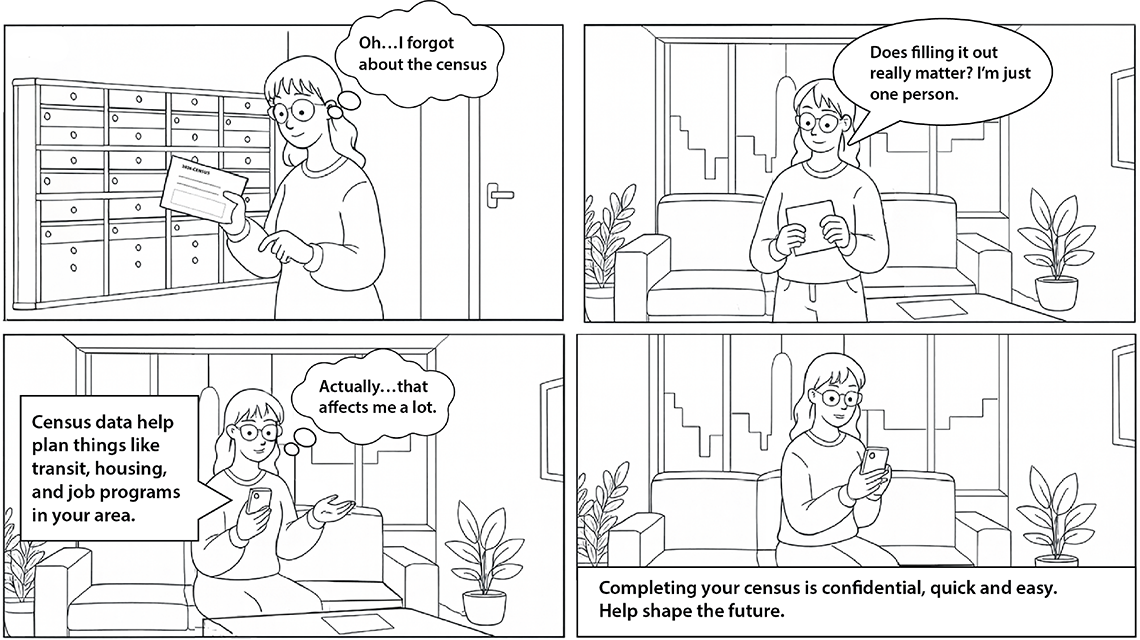
Setting: A young adult living alone in a high-rise apartment in a busy city.
Frame 1:
Scene: A young adult checks their mailbox, and pulls out an envelope marked "2026 Census"
Thought bubble: "Oh… I forgot about the census."
Frame 2:
Scene: Inside the apartment, the young adult holds the census envelope, looking unsure.
Speech bubble (to self): "Does filling it out really matter? I'm just one person."
Frame 3:
Scene: The young adult sits on a couch and looking at the census website on their phone.
Caption box: "Census data help plan things like transit, housing, and job programs in your area."
Thought bubble: "Actually… that affects me a lot."
Frame 4:
Scene: The young adult smiles slightly while completing the census online on their smartphone. The background shows the city skyline through the window.
Caption box: "Completing your census is confidential, quick and easy. Help shape the future."
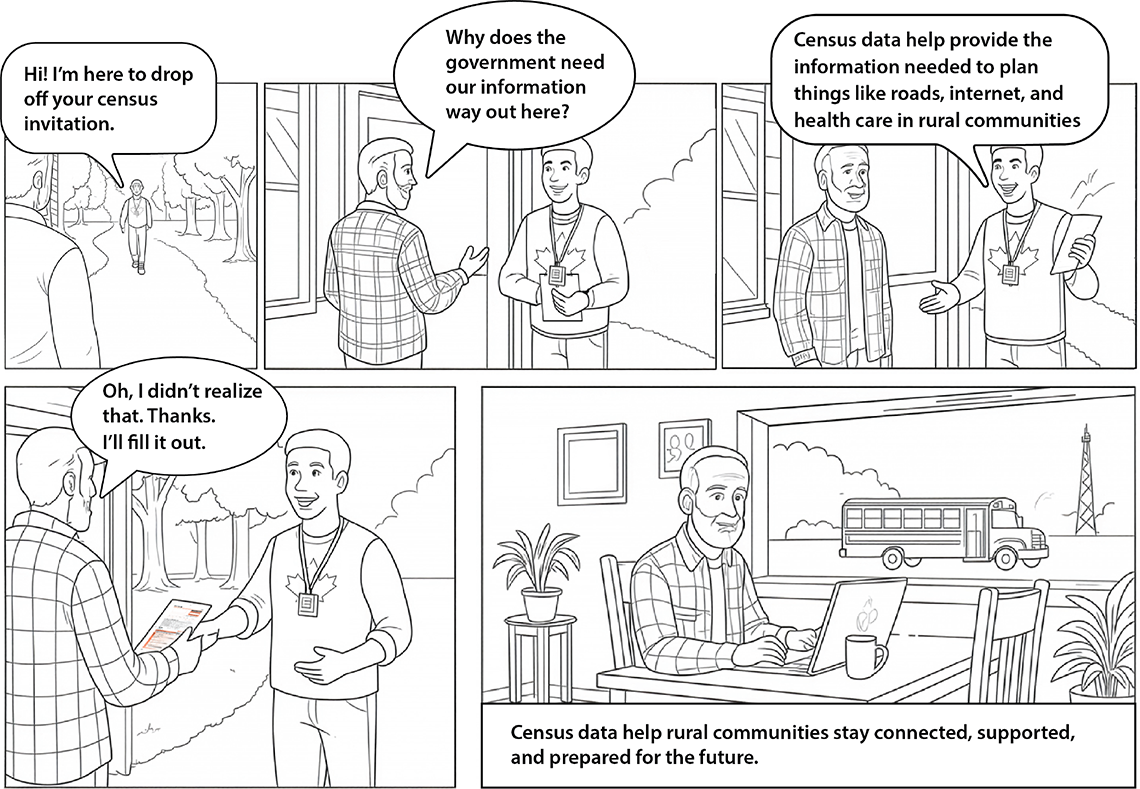
Setting: A rural household in a remote or small-town area.
Frame 1:
Scene: A census worker arrives at a house with a long, forested driveway. The resident opens the door.
Census worker (speech bubble): "Hi! I'm here to drop off your census invitation."
Frame 2:
Scene: The resident looks curious or uncertain.
Resident (speech bubble): "Why does the government need our information way out here?"
Frame 3:
Scene: The census worker holds a form and gestures helpfully.
Census worker (speech bubble): "Census data helps provide the information needed to plan things like roads, internet, and healthcare in rural communities."
Frame 4:
Scene: The resident nods, now understanding, and accepts the invitation.
Resident (speech bubble): "Oh, I didn't realize that. Thanks. I'll fill it out."
Frame 5:
Scene: The resident is at the kitchen table, filling out the census on their laptop. In the background, we see a glimpse of their life.
Caption box: "Census data help rural communities stay connected, supported, and prepared for the future."
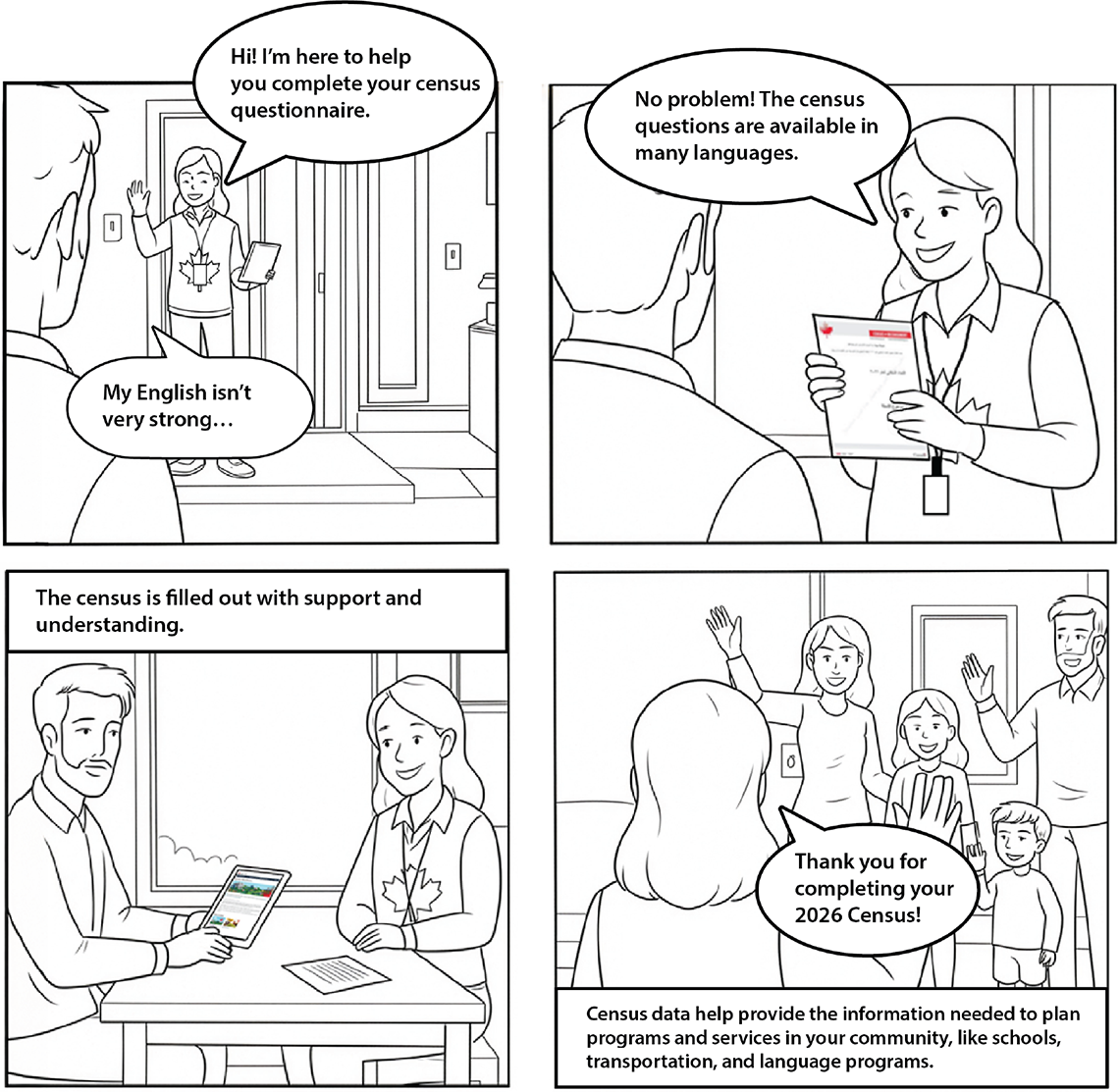
Setting: A newcomer family recently settled in Canada receives a visit from a friendly census worker.
Frame 1:
Scene: A census worker stands at the door of a home.
Census worker (speech bubble): "Hi! I'm here to help you complete your census questionnaire."
Resident (speech bubble): "My English isn't very strong…"
Frame 2:
Scene: The census worker holds up a paper with translated text.
Census worker (speech bubble): "No problem! The census questions are available in many languages."
Frame 3:
Scene: The resident sits at the table with the census worker. He is smiling as he fills out the census online in his language.
Caption box: "The census is filled out with support and understanding."
Frame 4:
Scene: The census worker waves goodbye at the door. The resident and their family stands inside, smiling and waving back.
Census worker (speech bubble): "Thank you for completing your 2026 Census."
Caption box: "Census data help provide the information needed to plan programs and services in your community, like schools, transportation, and language programs."
Fill in the maple leaf below with a "snapshot" of your classroom, and show details from the data you collected about your class.
The following list presents the types of support associated with the value of support to ultimate beneficiaries for the reference year 2023/2024.
Type of support
The following list identifies the program streams that are covered under the Business Innovation and Growth Support statistical program for the reference year 2023/2024.
| Department/agency | Program stream name |
|---|---|
| Agriculture and Agri-Food Canada | AgriInnovate Program |
| Agriculture and Agri-Food Canada | AgriInnovation Program |
| Agriculture and Agri-Food Canada | AgriProcessing Initiative |
| Agriculture and Agri-Food Canada | AgriScience Program |
| Agriculture and Agri-Food Canada | Agricultural Clean Technology Program |
| Agriculture and Agri-Food Canada | Agricultural Climate Solutions - Living Labs |
| Agriculture and Agri-Food Canada | Agricultural Climate Solutions - On-Farm Climate Action Fund |
| Agriculture and Agri-Food Canada | Agricultural Innovation Program |
| Agriculture and Agri-Food Canada | Canadian Agriculture Strategic Priorities Program |
| Atlantic Canada Opportunities Agency | Atlantic Innovation Fund |
| Atlantic Canada Opportunities Agency | Black Entrepreneurship Program - National Ecosystem Fund |
| Atlantic Canada Opportunities Agency | Business Development Program |
| Atlantic Canada Opportunities Agency | Canada Coal Transition Initiative |
| Atlantic Canada Opportunities Agency | Canadian Experiences Fund |
| Atlantic Canada Opportunities Agency | Community Futures Program |
| Atlantic Canada Opportunities Agency | Innovative Communities Fund |
| Atlantic Canada Opportunities Agency | Jobs and Growth Fund |
| Atlantic Canada Opportunities Agency | Regional Economic Growth Through Innovation - Business Scale-up and Productivity |
| Atlantic Canada Opportunities Agency | Regional Economic Growth Through Innovation - Regional Innovation Ecosystems |
| Atlantic Canada Opportunities Agency | Women Entrepreneurship Strategy - Ecosystem Fund |
| Canada Economic Development for Quebec Regions | Black Entrepreneurship Program - Ecosystem Fund |
| Canada Economic Development for Quebec Regions | Community Futures Program |
| Canada Economic Development for Quebec Regions | Economic Development Initiative |
| Canada Economic Development for Quebec Regions | Jobs and Growth Fund |
| Canada Economic Development for Quebec Regions | Quebec Regional Economic Infrastructure Development Initiative |
| Canada Economic Development for Quebec Regions | Regional Economic Growth Through Innovation - Business Scale-up and Productivity |
| Canada Economic Development for Quebec Regions | Regional Economic Growth Through Innovation - Regional Innovation Ecosystems |
| Canada Economic Development for Quebec Regions | Regional Quantum Innovation |
| Canadian Space Agency | Space Technology Development Program |
| Canadian Space Agency | smartEarth contribution |
| Canadian Northern Economic Development Agency | Canada Community Revitalization Fund |
| Canadian Northern Economic Development Agency | Economic Development Initiative |
| Canadian Northern Economic Development Agency | Inclusive Diversification and Economic Advancement in the North |
| Canadian Northern Economic Development Agency | Jobs and Growth Fund |
| Canadian Northern Economic Development Agency | Northern Indigenous Economic Opportunities Program |
| Canadian Northern Economic Development Agency | Northern Isolated Community Initiatives Fund |
| Canadian Northern Economic Development Agency | Regional Economic Growth Through Innovation - Regional Innovation Ecosystems |
| Department of Fisheries and Oceans | Aquaculture Collaborative Research and Development Program |
| Department of Fisheries and Oceans | Atlantic Fisheries Fund |
| Department of Fisheries and Oceans | British Columbia Salmon Restoration and Innovation Fund |
| Department of Fisheries and Oceans | Fisheries and Aquaculture Clean Technology Adoption Program |
| Department of Fisheries and Oceans | Quebec Fisheries Fund |
| Department of National Defence | Innovation for Defence, Excellence and Security |
| Environment and Climate Change Canada | Low Carbon Economy Fund |
| Environment and Climate Change Canada | Output-Based Pricing System Proceeds Fund |
| Environment and Climate Change Canada | Science Horizons Youth Internship Program |
| Employment and Social Development Canada | Temporary Foreign Worker Program - Global Talent Stream |
| Federal Economic Development Agency for Southern Ontario | Advanced Manufacturing Fund |
| Federal Economic Development Agency for Southern Ontario | Black Entrepreneurship Program - Ecosystem Fund |
| Federal Economic Development Agency for Southern Ontario | Community Economic Development and Diversification |
| Federal Economic Development Agency for Southern Ontario | Community Futures Program |
| Federal Economic Development Agency for Southern Ontario | Investing in Business Growth and Productivity |
| Federal Economic Development Agency for Southern Ontario | Investing in Business Innovation |
| Federal Economic Development Agency for Southern Ontario | Jobs and Growth Fund |
| Federal Economic Development Agency for Southern Ontario | Regional Economic Growth Through Innovation - Business Scale-up and Productivity |
| Federal Economic Development Agency for Southern Ontario | Regional Economic Growth Through Innovation - Regional Innovation Ecosystems |
| Federal Economic Development Agency for Southern Ontario | Regional Quantum Initiative |
| Federal Economic Development Agency for Northern Ontario | Canadian Experiences Fund |
| Federal Economic Development Agency for Northern Ontario | Community Futures Program |
| Federal Economic Development Agency for Northern Ontario | Economic Development Initiative |
| Federal Economic Development Agency for Northern Ontario | Northern Ontario Development Program |
| Federal Economic Development Agency for Northern Ontario | Regional Economic Growth Through Innovation - Business Scale-up and Productivity |
| Federal Economic Development Agency for Northern Ontario | Regional Economic Growth Through Innovation - Regional Innovation Ecosystems |
| Federal Economic Development Agency for Northern Ontario | The Jobs and Growth Fund |
| Global Affairs Canada | CanExport Associations |
| Global Affairs Canada | CanExport Innovation |
| Global Affairs Canada | CanExport SMEs |
| Global Affairs Canada | Canadian International Innovation Program |
| Global Affairs Canada | Canadian Technology Accelerators |
| Global Affairs Canada | Trade Commissioner Service |
| Innovation, Science and Economic Development Canada | 2SLGBTQI+ Entrepreneurship Program |
| Innovation, Science and Economic Development Canada | Accelerated Growth Service |
| Innovation, Science and Economic Development Canada | Automotive Innovation Fund |
| Innovation, Science and Economic Development Canada | Black Entrepreneurship Program - Black Entrepreneurship Knowledge Hub |
| Innovation, Science and Economic Development Canada | Black Entrepreneurship Program - Black Entrepreneurship Loan |
| Innovation, Science and Economic Development Canada | Fund |
| Innovation, Science and Economic Development Canada | CANARIE Inc. |
| Innovation, Science and Economic Development Canada | Canada Digital Adoption Program |
| Innovation, Science and Economic Development Canada | Canada Small Business Financing Program |
| Innovation, Science and Economic Development Canada | Clean Growth Hub |
| Innovation, Science and Economic Development Canada | Communications Research Centre Canada |
| Innovation, Science and Economic Development Canada | Futurpreneur Canada |
| Innovation, Science and Economic Development Canada | Genome Canada |
| Innovation, Science and Economic Development Canada | Global Innovation Clusters |
| Innovation, Science and Economic Development Canada | Indigenous Intellectual Property Program Grant |
| Innovation, Science and Economic Development Canada | Innovative Solutions Canada |
| Innovation, Science and Economic Development Canada | Mitacs Inc. |
| Innovation, Science and Economic Development Canada | Stem Cell Network |
| Innovation, Science and Economic Development Canada | Strategic Aerospace and Defence Initiative (SADI) |
| Innovation, Science and Economic Development Canada | Strategic Innovation Fund |
| Innovation, Science and Economic Development Canada | Sustainable Development Technology Canada (SDTC) |
| Innovation, Science and Economic Development Canada | Technology Partnerships Canada |
| Innovation, Science and Economic Development Canada | Women Entrepreneurship Strategy |
| Innovation, Science and Economic Development Canada | adMare BioInnovations |
| Natural Resources Canada | Clean Energy for Rural and Remote Communities |
| Natural Resources Canada | Clean Growth Program |
| Natural Resources Canada | Critical Minerals Innovation and Global Partnerships |
| Natural Resources Canada | Critical Minerals Research, Development and Demonstration Program |
| Natural Resources Canada | Electric Vehicle Infrastructure Demonstration Program |
| Natural Resources Canada | Emerging Renewables Power Program (ERPP) |
| Natural Resources Canada | Energy Efficient Buildings Research, Development and Demonstration (RD&D) |
| Natural Resources Canada | Energy Innovation Program |
| Natural Resources Canada | Forest Innovation Program |
| Natural Resources Canada | Forest Research Institute Initiative |
| Natural Resources Canada | GeoConnections Program |
| Natural Resources Canada | Green Construction through Wood program |
| Natural Resources Canada | Green Mining Innovation |
| Natural Resources Canada | Indigenous Forestry Initiative |
| Natural Resources Canada | Investments in Forest Industry Transformation Program |
| Natural Resources Canada | Oil Spill Response Challenge |
| Natural Resources Canada | Science and Technology Internship Program - Green Jobs |
| Natural Resources Canada | Smart Grid Program |
| Natural Resources Canada | Smart Renewables and Electrification Pathways Program (SREPs) |
| National Research Council of Canada | Advanced Electronics and Photonics |
| National Research Council of Canada | Aerospace |
| National Research Council of Canada | Aquatic and Crop Resource Development |
| National Research Council of Canada | Automotive and Surface Transportation |
| National Research Council of Canada | Challenge-Superclusters |
| National Research Council of Canada | Construction |
| National Research Council of Canada | Digital Technologies |
| National Research Council of Canada | Energy, Mining and Environment |
| National Research Council of Canada | Human Health Therapeutics |
| National Research Council of Canada | Ideation Fund |
| National Research Council of Canada | Industrial Research Assistance Program |
| National Research Council of Canada | Medical Devices |
| National Research Council of Canada | Ocean, Coastal, and River Engineering |
| Natural Sciences and Engineering Research Council of Canada | Alliance grants |
| Natural Sciences and Engineering Research Council of Canada | Applied Research and Development Grants |
| Natural Sciences and Engineering Research Council of Canada | Business-Led Networks of Centres of Excellence |
| Natural Sciences and Engineering Research Council of Canada | Collaborative Research and Development Grants |
| Natural Sciences and Engineering Research Council of Canada | College-University Idea to Innovation Grants |
| Natural Sciences and Engineering Research Council of Canada | Industrial Research Chairs |
| Natural Sciences and Engineering Research Council of Canada | Innovation Enhancement Grants |
| Natural Sciences and Engineering Research Council of Canada | Strategic Partnership Grants for Networks |
| Natural Sciences and Engineering Research Council of Canada | Technology Access Centres Grants |
| Natural Sciences and Engineering Research Council of Canada | University Idea to Innovation Grants |
| Pacific Economic Development Canada | Aerospace Regional Recovery Initiative |
| Pacific Economic Development Canada | Black Entrepreneurship Program - National Ecosystem Fund |
| Pacific Economic Development Canada | Community Futures Program |
| Pacific Economic Development Canada | Jobs and Growth Fund |
| Pacific Economic Development Canada | Regional Air Transportation Initiative |
| Pacific Economic Development Canada | Regional Economic Growth Through Innovation - Business Scale-up and Productivity |
| Pacific Economic Development Canada | Regional Economic Growth Through Innovation - Regional Innovation Ecosystems |
| Pacific Economic Development Canada | Western Diversification Program |
| Pacific Economic Development Canada | Western Innovation Initiative |
| Pacific Economic Development Canada | Women's Enterprise Initiative |
| Canadian Heritage | Canada Book Fund |
| Canadian Heritage | Canada Media Fund- Experimental Stream |
| Canadian Heritage | Canada Music Fund- Individual and Collective Initiatives |
| Canadian Heritage | Canada Periodical Fund |
| Canadian Heritage | Creative Export Canada |
| Canadian Heritage | Digital Citizen Contribution Program |
| Canadian Heritage | Indigenous Screen Office Program |
| Prairies Economic Development Canada | Aerospace Regional Recovery Initiative |
| Prairies Economic Development Canada | Black Entrepreneurship Program - National Ecosystem Fund |
| Prairies Economic Development Canada | Canada Coal Transition Initiative |
| Prairies Economic Development Canada | Community Futures Program |
| Prairies Economic Development Canada | Economic Development Initiative |
| Prairies Economic Development Canada | Jobs and Growth Fund |
| Prairies Economic Development Canada | Regional Air Transportation Initiative |
| Prairies Economic Development Canada | Regional Economic Growth Through Innovation - Business Scale-up and Productivity |
| Prairies Economic Development Canada | Regional Economic Growth Through Innovation - Regional Innovation Ecosystems |
| Prairies Economic Development Canada | Regional Quantum Initiative |
| Prairies Economic Development Canada | Western Diversification Program |
| Prairies Economic Development Canada | Western Innovation Initiative |
| Prairies Economic Development Canada | Women Entrepreneurship Strategy - Ecosystem Fund |
| Prairies Economic Development Canada | Women's Enterprise Initiative |
The following list identifies the program streams that provided innovation and growth support to ultimate beneficiaries for the reference year 2023/2024.
| Department/agency | Program stream name |
|---|---|
| Agriculture and Agri-Food Canada | AgriInnovate Program |
| Agriculture and Agri-Food Canada | AgriScience Program |
| Agriculture and Agri-Food Canada | Agricultural Clean Technology Program |
| Agriculture and Agri-Food Canada | Agricultural Climate Solutions - Living Labs |
| Agriculture and Agri-Food Canada | Canadian Agriculture Strategic Priorities Program |
| Atlantic Canada Opportunities Agency | Atlantic Innovation Fund |
| Atlantic Canada Opportunities Agency | Black Entrepreneurship Program - National Ecosystem Fund |
| Atlantic Canada Opportunities Agency | Business Development Program |
| Atlantic Canada Opportunities Agency | Canada Coal Transition Initiative |
| Atlantic Canada Opportunities Agency | Canadian Experiences Fund |
| Atlantic Canada Opportunities Agency | Innovative Communities Fund |
| Atlantic Canada Opportunities Agency | Jobs and Growth Fund |
| Atlantic Canada Opportunities Agency | Regional Economic Growth Through Innovation - Business Scale-up and Productivity |
| Atlantic Canada Opportunities Agency | Regional Economic Growth Through Innovation - Regional Innovation Ecosystems |
| Atlantic Canada Opportunities Agency | Women Entrepreneurship Strategy - Ecosystem Fund |
| Canada Economic Development for Quebec Regions | Black Entrepreneurship Program - Ecosystem Fund |
| Canada Economic Development for Quebec Regions | Economic Development Initiative |
| Canada Economic Development for Quebec Regions | Jobs and Growth Fund |
| Canada Economic Development for Quebec Regions | Quebec Regional Economic Infrastructure Development Initiative |
| Canada Economic Development for Quebec Regions | Regional Economic Growth Through Innovation - Business Scale-up and Productivity |
| Canada Economic Development for Quebec Regions | Regional Economic Growth Through Innovation - Regional Innovation Ecosystems |
| Canada Economic Development for Quebec Regions | Regional Quantum Innovation |
| Canadian Space Agency | Space Technology Development Program |
| Canadian Space Agency | smartEarth contribution |
| Canadian Northern Economic Development Agency | Canada Community Revitalization Fund |
| Canadian Northern Economic Development Agency | Economic Development Initiative |
| Canadian Northern Economic Development Agency | Inclusive Diversification and Economic Advancement in the North |
| Canadian Northern Economic Development Agency | Jobs and Growth Fund |
| Canadian Northern Economic Development Agency | Northern Indigenous Economic Opportunities Program |
| Canadian Northern Economic Development Agency | Northern Isolated Community Initiatives Fund |
| Canadian Northern Economic Development Agency | Regional Economic Growth Through Innovation - Regional Innovation Ecosystems |
| Department of Fisheries and Oceans | Aquaculture Collaborative Research and Development Program |
| Department of Fisheries and Oceans | Atlantic Fisheries Fund |
| Department of Fisheries and Oceans | British Columbia Salmon Restoration and Innovation Fund |
| Department of Fisheries and Oceans | Fisheries and Aquaculture Clean Technology Adoption Program |
| Department of Fisheries and Oceans | Quebec Fisheries Fund |
| Department of National Defence | Innovation for Defence, Excellence and Security |
| Environment and Climate Change Canada | Low Carbon Economy Fund |
| Environment and Climate Change Canada | Output-Based Pricing System Proceeds Fund |
| Environment and Climate Change Canada | Science Horizons Youth Internship Program |
| Employment and Social Development Canada | Temporary Foreign Worker Program - Global Talent Stream |
| Federal Economic Development Agency for Southern Ontario | Black Entrepreneurship Program - Ecosystem Fund |
| Federal Economic Development Agency for Southern Ontario | Community Economic Development and Diversification |
| Federal Economic Development Agency for Southern Ontario | Community Futures Program |
| Federal Economic Development Agency for Southern Ontario | Jobs and Growth Fund |
| Federal Economic Development Agency for Southern Ontario | Regional Economic Growth Through Innovation - Business Scale-up and Productivity |
| Federal Economic Development Agency for Southern Ontario | Regional Economic Growth Through Innovation - Regional Innovation Ecosystems |
| Federal Economic Development Agency for Southern Ontario | Regional Quantum Initiative |
| Federal Economic Development Agency for Northern Ontario | Canadian Experiences Fund |
| Federal Economic Development Agency for Northern Ontario | Community Futures Program |
| Federal Economic Development Agency for Northern Ontario | Economic Development Initiative |
| Federal Economic Development Agency for Northern Ontario | Northern Ontario Development Program |
| Federal Economic Development Agency for Northern Ontario | Regional Economic Growth Through Innovation - Business Scale-up and Productivity |
| Federal Economic Development Agency for Northern Ontario | Regional Economic Growth Through Innovation - Regional Innovation Ecosystems |
| Federal Economic Development Agency for Northern Ontario | The Jobs and Growth Fund |
| Global Affairs Canada | CanExport Innovation |
| Global Affairs Canada | CanExport SMEs |
| Global Affairs Canada | Canadian International Innovation Program |
| Global Affairs Canada | Canadian Technology Accelerators |
| Global Affairs Canada | Trade Commissioner Service |
| Innovation, Science and Economic Development Canada | Accelerated Growth Service |
| Innovation, Science and Economic Development Canada | Black Entrepreneurship Program - Black Entrepreneurship Knowledge Hub |
| Innovation, Science and Economic Development Canada | Black Entrepreneurship Program - Black Entrepreneurship Loan Fund |
| Innovation, Science and Economic Development Canada | CANARIE Inc. |
| Innovation, Science and Economic Development Canada | Canada Digital Adoption Program |
| Innovation, Science and Economic Development Canada | Canada Small Business Financing Program |
| Innovation, Science and Economic Development Canada | Clean Growth Hub |
| Innovation, Science and Economic Development Canada | Communications Research Centre Canada |
| Innovation, Science and Economic Development Canada | Futurpreneur Canada |
| Innovation, Science and Economic Development Canada | Genome Canada |
| Innovation, Science and Economic Development Canada | Global Innovation Clusters |
| Innovation, Science and Economic Development Canada | Indigenous Intellectual Property Program Grant |
| Innovation, Science and Economic Development Canada | Innovative Solutions Canada |
| Innovation, Science and Economic Development Canada | Mitacs Inc. |
| Innovation, Science and Economic Development Canada | Stem Cell Network |
| Innovation, Science and Economic Development Canada | Strategic Innovation Fund |
| Innovation, Science and Economic Development Canada | Sustainable Development Technology Canada (SDTC) |
| Innovation, Science and Economic Development Canada | Women Entrepreneurship Strategy |
| Innovation, Science and Economic Development Canada | adMare BioInnovations |
| Natural Resources Canada | Clean Energy for Rural and Remote Communities |
| Natural Resources Canada | Clean Growth Program |
| Natural Resources Canada | Critical Minerals Innovation and Global Partnerships |
| Natural Resources Canada | Critical Minerals Research, Development and Demonstration Program |
| Natural Resources Canada | Electric Vehicle Infrastructure Demonstration Program |
| Natural Resources Canada | Emerging Renewables Power Program (ERPP) |
| Natural Resources Canada | Energy Efficient Buildings Research, Development and Demonstration (RD&D) |
| Natural Resources Canada | Energy Innovation Program |
| Natural Resources Canada | Forest Innovation Program |
| Natural Resources Canada | Forest Research Institute Initiative |
| Natural Resources Canada | GeoConnections Program |
| Natural Resources Canada | Green Construction through Wood program |
| Natural Resources Canada | Green Mining Innovation |
| Natural Resources Canada | Indigenous Forestry Initiative |
| Natural Resources Canada | Investments in Forest Industry Transformation Program |
| Natural Resources Canada | Oil Spill Response Challenge |
| Natural Resources Canada | Science and Technology Internship Program - Green Jobs |
| Natural Resources Canada | Smart Grid Program |
| Natural Resources Canada | Smart Renewables and Electrification Pathways Program (SREPs) |
| National Research Council of Canada | Advanced Electronics and Photonics |
| National Research Council of Canada | Aerospace |
| National Research Council of Canada | Aquatic and Crop Resource Development |
| National Research Council of Canada | Automotive and Surface Transportation |
| National Research Council of Canada | Challenge-Superclusters |
| National Research Council of Canada | Construction |
| National Research Council of Canada | Digital Technologies |
| National Research Council of Canada | Energy, Mining and Environment |
| National Research Council of Canada | Human Health Therapeutics |
| National Research Council of Canada | Ideation Fund |
| National Research Council of Canada | Industrial Research Assistance Program |
| National Research Council of Canada | Medical Devices |
| National Research Council of Canada | Ocean, Coastal, and River Engineering |
| Natural Sciences and Engineering Research Council of Canada | Alliance grants |
| Natural Sciences and Engineering Research Council of Canada | Applied Research and Development Grants |
| Natural Sciences and Engineering Research Council of Canada | Business-Led Networks of Centres of Excellence |
| Natural Sciences and Engineering Research Council of Canada | Collaborative Research and Development Grants |
| Natural Sciences and Engineering Research Council of Canada | College-University Idea to Innovation Grants |
| Natural Sciences and Engineering Research Council of Canada | Industrial Research Chairs |
| Natural Sciences and Engineering Research Council of Canada | Innovation Enhancement Grants |
| Natural Sciences and Engineering Research Council of Canada | Strategic Partnership Grants for Networks |
| Natural Sciences and Engineering Research Council of Canada | Technology Access Centres Grants |
| Natural Sciences and Engineering Research Council of Canada | University Idea to Innovation Grants |
| Pacific Economic Development Canada | Aerospace Regional Recovery Initiative |
| Pacific Economic Development Canada | Black Entrepreneurship Program - National Ecosystem Fund |
| Pacific Economic Development Canada | Community Futures Program |
| Pacific Economic Development Canada | Jobs and Growth Fund |
| Pacific Economic Development Canada | Regional Economic Growth Through Innovation - Business Scale-up and Productivity |
| Pacific Economic Development Canada | Regional Economic Growth Through Innovation - Regional Innovation Ecosystems |
| Pacific Economic Development Canada | Western Diversification Program |
| Pacific Economic Development Canada | Women's Enterprise Initiative |
| Canadian Heritage | Canada Book Fund |
| Canadian Heritage | Canada Media Fund- Experimental Stream |
| Canadian Heritage | Canada Periodical Fund |
| Canadian Heritage | Creative Export Canada |
| Canadian Heritage | Digital Citizen Contribution Program |
| Prairies Economic Development Canada | Aerospace Regional Recovery Initiative |
| Prairies Economic Development Canada | Black Entrepreneurship Program - National Ecosystem Fund |
| Prairies Economic Development Canada | Canada Coal Transition Initiative |
| Prairies Economic Development Canada | Community Futures Program |
| Prairies Economic Development Canada | Economic Development Initiative |
| Prairies Economic Development Canada | Jobs and Growth Fund |
| Prairies Economic Development Canada | Regional Economic Growth Through Innovation - Business Scale-up and Productivity |
| Prairies Economic Development Canada | Regional Economic Growth Through Innovation - Regional Innovation Ecosystems |
| Prairies Economic Development Canada | Regional Quantum Initiative |
| Prairies Economic Development Canada | Western Diversification Program |
| Prairies Economic Development Canada | Women Entrepreneurship Strategy - Ecosystem Fund |
| Prairies Economic Development Canada | Women's Enterprise Initiative |