Monthly Survey of Food Services and Drinking Places: CVs for Total Sales by Geography - November 2025

CVs for Total sales by geography
Geography Month
202411 202412 202501 202502 202503 202504 202505 202506 202507 202508 202509 202510 202511
percentage
Canada 0.19 0.14 0.17 0.22 0.16 0.15 0.16 0.09 0.10 0.07 0.06 0.11 0.23
Newfoundland and Labrador 0.75 0.71 0.69 1.01 0.63 0.78 0.45 0.50 0.46 0.32 0.31 0.72 2.76
Prince Edward Island 4.09 4.39 4.99 1.26 1.09 0.87 0.72 0.81 0.79 0.52 0.55 1.48 4.95
Nova Scotia 0.38 0.42 0.48 1.57 0.60 0.58 0.42 0.35 0.33 0.26 0.25 0.54 2.20
New Brunswick 0.57 0.62 0.59 0.82 0.57 0.51 0.42 0.49 0.38 0.30 0.34 0.59 2.72
Quebec 0.56 0.24 0.29 0.54 0.36 0.53 0.26 0.16 0.20 0.18 0.14 0.31 0.29
Ontario 0.31 0.29 0.34 0.35 0.31 0.23 0.36 0.17 0.16 0.11 0.10 0.18 0.33
Manitoba 0.48 0.55 0.70 0.74 0.75 0.56 0.50 0.39 0.47 0.37 0.31 0.59 0.96
Saskatchewan 0.75 0.99 0.65 0.69 0.52 0.54 0.47 0.53 0.51 0.37 0.41 0.59 0.96
Alberta 0.31 0.28 0.38 0.59 0.41 0.32 0.34 0.25 0.29 0.20 0.18 0.27 0.43
British Columbia 0.26 0.22 0.29 0.49 0.29 0.20 0.24 0.16 0.23 0.16 0.13 0.23 0.41
Yukon Territory 2.42 2.25 3.18 26.12 3.86 2.69 2.04 2.49 2.63 1.70 1.56 2.06 14.29
Northwest Territories 2.91 3.57 3.42 34.07 18.21 2.90 17.86 3.30 2.66 2.20 1.79 2.62 18.24
Nunavut 61.05 6.85 4.28 129.91 6.89 59.24 66.28 9.14 9.60 44.04 3.40 5.24 48.80

Eh Sayers Episode 30 - GDP Explained Without Putting You to Sleep (We Promise!)

Release date: February 2, 2026

Catalogue number: 45200003
ISSN: 2026002

Listen to "Eh Sayers" on:

The Gross Domestic Product (GDP) tells us about the health and size of Canada's economy. But for those of us who don't own or operate multi-million-dollar companies, why does it matter at all? In this episode, Amanda Sinclair, Assistant director for the National Economic Accounts at Statistics Canada, explains some surprising ways GDP can be useful and why, for certain Canadian households, the numbers don't always seem to add up.

Economic accounts statistics

Host

Max Zimmerman

Guest

Amanda Sinclair

Listen to audio

Eh Sayers Episode 30 - GDP Explained Without Putting You to Sleep (We Promise!) - Transcript

Max: Welcome to Eh Sayers!, a podcast by Statistics Canada, where we meet the people behind the data, and explore the stories behind the numbers. I'm your host, Max Zimmerman.

If you flip on the news, read the business section or hear politicians sparring about Canada's economy, there's one thing that always seems to get brought up: the GDP or Gross Domestic Product.

But, I didn't realize just how much the GDP affected me personally until recently when I became a first-time home buyer. This is when I learned that the interest rate that I will be paying on my mortgage for the next 5 years is influenced by, you guessed it, the GDP.

I wanted to know more... What other aspects of my life are so closely intertwined with Canada's GDP numbers? I had to talk to someone here at Statistics Canada that knows what they're talking about.

Amanda: Hi, my name is Amanda Sinclair and I'm an assistant director for the National Economic Accounts at Statistics Canada.

Max: So I know that economists here at StatCan and have a preferred method of measuring the economy. Can you tell us what that method is and how it's measured?

Amanda: Yeah. Gross domestic product, I would say is the key measure of our economy's size, performance, and general health. And it measures the final value of all the goods and services that we produce in Canada in a given period of time. That could be a quarter or a year. There are three ways to measure GDP. The first is the production or value-added approach where we estimate the total value of all the goods and services produced, and we subtract out the inputs of the cost of the inputs to produce those things.

So for an example, a bakery producing bread, we measure the value that they sell that bread for to final consumers. And we take out all of the inputs, like the flour and the sugar, even the electricity to run the bakery. We subtract that out and that gives us an indicator of the value added. The second approach to measuring GDP is the income approach, and for this one, we estimate all of the incomes that accrue from producing goods and services. So for example, with the bakery example, there would be employees who would be earning wages from producing or baking that that bread. There would also be the business owner who would get a return, and governments can also earn income from production. The main example here being that there's GST or sales tax charged when goods are sold.

The final approach is called the expenditure approach. And here we add up all of the final consumption that takes place in a given period. This could be households, purchasing goods and services for their own consumption, governments also buy goods and services, businesses could be investing in capital assets, or we could sell our goods and services to other countries in the form of exports. And when we do exports, we actually do it on a net basis to remove imports. So it's exports minus imports.

But these three ways allow us to measure the overall size and performance of the economy in a given period. And it really is a strength of our system here in Canada that we, on a quarterly and annual basis, we do all three approaches. So we're not just relying on one set of data, we do all three ways, and then they're reconciled in order to provide a coherent, consistent picture of what's going on in our economy.

Max: So we're measuring productivity with the GDP, and if I as a worker become more productive as time goes on, what difference does that make in my life? Because it's easy to see how, if I'm more productive, that's beneficial to my agency or my company. But how does that actually benefit me in the long run?

If I take your example of the bakery, let's say… If I'm a baker and some revolutionary technology, machinery comes around that allows me to make dough at a way faster rate or something like that… I can easily see how that would benefit the bakery. The bakery is going to make more money, and that in turn is going to, you know, increase the GDP, the value added that the bakery can add to the economy. So that's good for the bakery, it's good for the economy. How is it actually good for the baker, the worker themselves?

Amanda: Yeah. So yeah, you're talking about labor productivity. It's another key, economic indicator of evaluating how our economy is performing.
It's an indicator of the efficiency. And so, as you indicated, if people can produce more output with the same or less amount of time, they would be considered more productive, more efficient. And generally there's a close relationship between labor productivity and real wages. So as those employees can produce the same amount of output for their company with the same amount of input—so the same amount of hours worked—generally, there's an incentive there to have real wages increase. So the company could therefore turn around and provide wage increases to those employees, which would then benefit their cost of living and living standards. So productivity is tightly correlated with supporting rising standards of living.

Max: I'm curious about some of the limitations of the GDP. If the GDP is strong for a country, does that mean everything is good? Or if it's bad, does that mean that everything is going badly? Like how do we make sense of that?

Amanda: GDP is a great economic tool to understand how the economy is performing. However, it is an aggregate picture of what's going on, and therefore it can overlook inequalities or vulnerabilities that exist. For example, when we produce GDP, we also calculate a household saving rate. However, this is an aggregate measure of how much all Canadian households might be saving in a given period, and it doesn't highlight how there is great inequality that could exist amongst households with some faring much better than others. GDP also excludes unpaid household work and volunteer work, and these take place outside of the general market economy, which is why they're not included in GDP. However, these activities do have a very significant impact on a country's economic productivity and social value.

For example, people could not go to work and support the economy if they didn't have people at home doing those activities like childcaring and cooking and cleaning. And finally, GDP does not account directly for the depletion of natural resources. Another common critique, I would say of the GDP measure is that it overlooks these environmental harms that can be caused by economic activities.

However, I would say that the system of national accounts, which is that international framework for how countries should measure GDP does get updated periodically, and there's been a very strong recognition that some of these limitations that I just mentioned should be accounted for. And so with the newest version of this framework, there are recommendations that countries produce separate sort of extension or satellite accounts that take into account these various limitations.

And a good example of this is that Statistics Canada produces something called the distributions of household economic accounts, where we estimate how income consumption, savings, and wealth are distributed across different types of households. And this product allows us to see that while, for example, maybe the household saving rate is increasing, it is not improving for all households. Some are faring better than others.

Max: Yeah, that's so interesting because I think that oftentimes when we hear officials or reporters cite these numbers on GDP and we hear, oh, the economy is rebounding or doing well, like especially coming out of COVID, I think that that doesn't necessarily always resonate with Canadians because like you said, different households have different experiences and if we're being told the economy's doing great and it doesn't feel like that for you, it can be confusing.

Amanda: Absolutely, absolutely. And sometimes those aggregate indicators that are included in GDP can be driven by a small segment of the population. If we're saying that, you know, households are spending more, it could be that households of higher income might be driving that spending where other households are looking at their own experience saying, that's not what's going on for me. So these additional products that really go below the top line number and dig into the data in a more granular way, help us and Canadians and policymakers really understand where there could be those vulnerabilities.

Max: Okay, nice. And for those of us that follow economic news, we hear reporters frequently talk about the GDP, but I understand that there might be a difference in the way that they're talking about GDP and the way that we talk about it here at StatCan. Could you talk more about that for us?

Amanda: Yeah, so when Statistics Canada reports the latest GDP data, we focus on the quarter-to-quarter percent change in the real GDP. So real GDP is an indicator of the volume of activity that takes place. So this removes the impact of price changes. We don't want to necessarily say that the economy increased just because prices went up. We're really looking to see whether or not, after we removed price change, did the economy in fact produce more goods and services. So that's what Statistics Canada focuses on.

However, sometimes media outlets, people will often hear them quote the annualized quarterly percent change. And the main difference here is that the annualized rate compounds the quarterly growth rate by assuming that the same percent change will occur for four consecutive quarters.

So when people look at the media or the news headlines, they'll see often a larger number quoted, both are accurate. The one that we report, the quarterly figure, or the one that the media reports, which is often the annualized quarterly figure, they're both accurate, but users should just take note in terms of understanding which one is being quoted.

Max: Yeah, that makes sense. So if Canadians would like to learn more about the GDP or Canada's economy, where could they go?

Amanda: So the Statistics Canada website would be a great starting point. We have the Daily article that provides an overview of the main stories and drivers of the most recent GDP data. But the economic account statistics portal is a good one-stop shop where you can find all of the latest data tables and analytical articles.

Max: Thank you so much for coming in, Amanda. Thanks for your time and your expertise.

Amanda: Of course. Thank you for having me.

Max: You've been listening to Eh Sayers! Thank you to our guest, Amanda Sinclair. If you'd like to learn more about the GDP, you can visit the link in our show notes. This podcast is available wherever you get your podcasts. There, you can also find the French version of our show called Hé-coutez bien! If you like this show, please rate, review and subscribe. And as always, thanks for listening.

Labour Market Indicators – February 2026

In February 2026, questions measuring the Labour Market Indicators were added to the Labour Force Survey as a supplement.

Questionnaire flow within the collection application is controlled dynamically based on responses provided throughout the survey. Therefore, some respondents will not receive all questions, and there is a small chance that some households will not receive any questions at all. This is based on their answers to certain LFS questions.

Labour Market Indicators

ENTRY_Q01 / EQ 1 - From the following list, please select the household member that will be completing this questionnaire on behalf of the entire household.

RES_Q01 / EQ 2 - Imagine that you found a suitable job. What is the lowest amount of pay, before taxes, that you would be prepared to accept?

  1. Per hour
  2. Per day
  3. Per week
  4. Per two weeks
  5. Per month
  6. Per year
  7. Minimum wage
  8. Other

Introduction to Some Key Elements of a Well-Designed Questionnaire (19220010)

In this session, we will look at key elements of a questionnaire that encourage respondents to complete a survey. The focus will be on elements such as the introduction, accompanying text as well as appeal, and not on the different ways of formulating the questions. The objective is to provide those who occasionally design questionnaires practical advice to help make a questionnaire stand out. This session is intended for beginners. Some familiarity with basic statistical concepts would be beneficial/advantageous but not required.

English Information Sessions

French Information Sessions

Posters to encourage census completion

Print and post these in high-traffic community spots to encourage census completion.

On this page

Poster — The 2026 Census is underway across Canada!

Census data are essential for planning programs and services that support employment, transit, education, health care and more.

Complete your census questionnaire online today: census.gc.ca

Poster — The 2026 Census is underway across Canada! (bilingual)

Census data are essential for planning programs and services that support employment, transit, education, health care and more.

Complete your census questionnaire online today: census.gc.ca

Le Recensement de 2026 est en cours partout au Canada!

Les données du recensement sont essentielles à la planification des programmes et des services qui soutiennent l’emploi, le transport en commun, l’éducation, les soins de santé et plus encore.

Remplissez votre questionnaire du recensement en ligne dès aujourd’hui : recensement.gc.ca

Poster — 2026 Census collection across Canada

The 2026 Census has begun!

  • Census data are essential for planning programs and services that support employment, transit, education, health care and more.
  • Households will receive a census invitation letter in the mail with instructions on how to complete their questionnaire.
  • The census questions are available in alternate formats and 28 non-official languages for reference purposes.
  • All information is collected under the authority of the Statistics Act and will be kept strictly confidential.

Complete your census questionnaire online today: census.gc.ca

If you require additional assistance, please contact the Census Help Line.
Toll-free number: 1-833-852-2026
Teletypewriter (TTY): 1-833-830-3109

Postcard — The 2026 Census is underway

Your Census. Your Community. Our Future.

Your participation matters.

Check your mail for your census invitation letter and follow the instructions to complete your questionnaire online.

What you need to know

  • Your census is easy to fill out and completely confidential.
  • The information you provide helps plan programs and services in your community that support employment, transit, education, health care and more.
  • The census questions are available in alternate formats and 28 languages for reference purposes.

For more information and to complete your census online, visit census.gc.ca

If you require additional assistance, please contact the Census Help Line.
Toll-free number: 1-833-852-2026
Teletypewriter (TTY): 1-833-830-3109

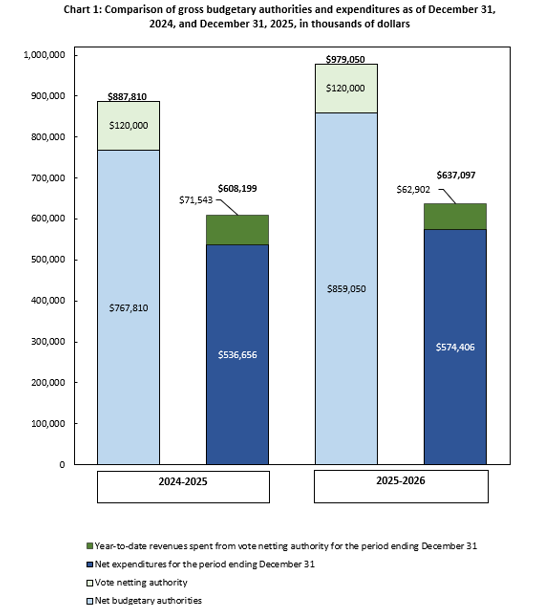
Statistics Canada's Future-Oriented Statement of Operations, March 31, 2027

Future-Oriented Statement of Operations (unaudited)
for the year ending March 31

(in thousands of dollars)
  Forecast results 2025-26 Planned results 2026-27
Expenses
Statistical information
914,537 1,260,329
Internal services
104,277 92,274
Total expenses 1,018,814 1,352,603
Revenues
Special statistical services
133,657 144,107
Services to other government departments
158 162 
Other revenues
30 31
Revenues earned on behalf of the Government of Canada
-23,769 -24,300
Total revenues 110,076 120,000
Net cost of operations before government funding and transfers 908,738 1,232,603

The accompanying notes form an integral part of the Future-Oriented Statement of Operations

Notes to the Future-Oriented Statement of Operations (unaudited) for the year ending March 31

1. Methodology and significant assumptions

The Future-Oriented Statement of Operations has been prepared based on government priorities and departmental plans as described in the Departmental Plan.

The information in the forecasted results for fiscal year 2025-26 is based on actual results as at October 31, 2025 and on forecasts for the remainder of the fiscal year. Forecasts have been made for the planned results for fiscal year 2026-27.

The main assumptions underlying the forecasts are as follows:

  • The agency's activities will remain substantially the same as in the previous year.
  • Expenses and revenues, including the determination of amounts internal and external to the government, are based on historical trends and known cyclical changes.

These assumptions are made as at November 1, 2025.

2. Variations and changes to the forecast financial information

Although every attempt has been made to forecast final results for the remainder of 2025-26 and for 2026-27, actual results achieved for both years are likely to differ from the forecasted information presented, and this variation could be material.

In preparing this Future-Oriented Statement of Operations, Statistics Canada has made estimates and assumptions about the future. These estimates and assumptions may differ from the subsequent actual results. Estimates and assumptions are based on experience and other factors, including expectations of future events that are believed to be reasonable under the circumstances, and are continually evaluated.

Factors that could lead to material differences between the Future-Oriented Statement of Operations and the historical statements of operations include:

  • the timing and the amount of acquisitions and disposals of property and equipment which may affect gains, losses and amortization expense;
  • the implementation of new collective agreements;
  • economic conditions, which may affect both the amount of revenue earned and the collectability of receivables; and
  • other changes to the operating budget, such as new initiatives or technical adjustments made later in the fiscal year.

After the Departmental Plan is tabled in Parliament, the agency will not be updating the forecasts for any changes in financial resources made in ensuing supplementary estimates. Variances will be explained in the Departmental Results Report.

3. Summary of significant accounting policies

The Future-Oriented Statement of Operations has been prepared using the Government of Canada's accounting policies in effect for fiscal year 2025-26 and is based on Canadian public sector accounting standards. The presentation and results using the stated accounting policies do not result in any significant differences from Canadian public sector accounting standards.

Significant accounting policies are as follows:

(a) Expenses

Transfer payments are recorded as an expense in the year the transfer is authorized, and all eligibility criteria have been met by the recipient.

Other expenses are generally recorded when goods are received or services are rendered and include expenses related to personnel, professional and special services, repair and maintenance, utilities, materials and supplies, as well as amortization of tangible capital assets. Provisions to reflect changes in the value of assets or liabilities, such as provisions for bad debts, advances and inventory obsolescence, as well as utilization of inventories and prepaid expenses, and other are also included in other expenses.

(b) Revenues

Revenues received for special statistical services are recorded as deferred revenue upon receipt. These amounts are recognized as revenue in the period in which the services are rendered and related expenses are incurred.

Deferred revenue consists of amounts received prior to the provision of goods or services that will be recognized as revenue in a subsequent fiscal year as the performance obligations are met.

Other revenues are recognized in the period the event giving rise to the revenues occurred.

Revenues that are non-respendable are not available to discharge the agency's liabilities. While the Chief Statistician is expected to maintain accounting control, he has no authority regarding the disposition of non-respendable revenues. As a result, non-respendable revenues are earned on behalf of the Government of Canada and are therefore presented as a reduction of the entity's gross revenues.

4. Parliamentary authorities

The agency is financed in part by the Government of Canada through parliamentary authorities. Financial reporting of authorities provided to the agency differs from financial reporting according to generally accepted accounting principles because authorities are based mainly on cash flow requirements. Items recognized in the Future-Oriented Statement of Operations in one year may be funded through parliamentary authorities in prior, current or future years. Accordingly, the agency has a different net cost of operations for the year on a government funding basis than on an accrual accounting basis. The differences are reconciled in the following tables:

(a) Reconciliation of net cost of operations to requested authorities (in thousands of dollars)

Reconciliation of net cost of operations to requested authorities (in thousands of dollars)
  Forecast results 2025-26 Planned results 2026-27
Net cost of operations before government funding and transfers 908,738 1,232,603
Adjustments for items affecting net cost of operations but not affecting authorities:
Amortization of tangible capital assets
-26,712 -30,840
Loss on disposal/write-off of tangible capital assets, including adjustments
-64 0
Services provided without charge by other federal government departments
-102,124 -106,784
Increase in vacation pay and compensatory leave
-1,212 -873
Increase in employee future benefits
-22 -540
Refunds of previous years expenditures
67 0
Consumption of prepaid expenses
-8,662 -8,542
Bad debt expense
-132 -133
Increase in accrued salary receivables
398 0
Total items affecting net cost of operations but not affecting authorities
-138,463 -147,712
Adjustments for items not affecting net cost of operations but affecting authorities:
Acquisition of tangible capital assets
16,914 12,618
Acquisition of prepaid expenses
7,582 7,735
Payments for pay equity settlement
4 0
Total items not affecting net cost of operations but affecting authorities
24,500 20,353
Requested authorities forecasted to be used 794,775 1,105,244

(b) Authorities requested (in thousands of dollars)

Authorities requested (in thousands of dollars)
  Forecast results 2025-26 Planned results 2026-27
Authorities requested
Vote 1: operating expenditures
755,115 989,135
Statutory amounts
100,724 116,109
Total authorities requested 855,839 1,105,244
Less: Estimated unused authorities and other adjustments
-61,064 0
Requested authorities forecasted to be used 794,775 1,105,244

2026 Census for Collective Dwellings

Getting started

Why are we conducting the census?

Thank you for participating in the 2026 Census. The information you provide is used to produce statistics that communities, businesses, and governments rely on to plan services, develop programs, and make informed decisions about employment, schools, public transportation, hospitals and more.

The answers are collected under the authority of the Statistics Act and kept strictly confidential. By law, all residents living in facilities and establishments must be included in the 2026 Census of Population.

Statistics Canada makes use of existing sources of information such as immigration, income tax and benefits data to reduce the burden placed on respondents.

The information you provide may be used by Statistics Canada for other statistical and research purposes or may be combined with other survey or administrative data sources.

Include the residents of this facility or establishment in Canada's statistical portrait by completing the census questionnaire as soon as possible.

Other important information

Authorization to collect this information

Data are collected under the authority of the Statistics Act, Revised Statutes of Canada, 1985, Chapter S-19.

Confidentiality

By law, Statistics Canada is prohibited from releasing any information it collects that could identify any person, business or organization, unless consent has been given or as permitted by the Statistics Act.

Record linkages

The information you provide may be used by Statistics Canada for other statistical and research purposes or may be combined with other surveys or administrative data sources.

Facility and contact information

1. Verify or provide the facility name and correct where needed.

  • Facility name

2. Is this the civic address of this facility?
Note: If the address below is missing or incomplete, please answer "No" and provide the complete address.

  • Yes
  • No
    • Please enter the civic address of this facility.

      Note: For a non-civic address, please provide a rural route or land description in the "Street name" answer field.

      Example: 63532 Range Rd 444 or NW-34-42-4-W3

      • Civic number
      • Suffix
      • Unit number
      • Street name
      • Street type
      • Direction
      • City, municipality, town or village
      • Province or territory
      • Postal code
        • Example: A9A 9A9

3. Verify or provide the following information of the designated contact person for this facility and correct where needed.

Note: The designated contact person is the person who should receive this questionnaire, but may not always be the one who actually completes the questionnaire.

  • First name
  • Last name
  • Title
  • Preferred language of communication
  • Email address
    Example: user@example.gov.ca
  • Telephone number (including area code)
    Example: 123-123-1234
  • Extension number (if applicable)

Collective dwelling types

A collective dwelling is a dwelling of a commercial, institutional, or communal nature. It must provide care or services, or have common facilities shared by the occupants.

1. Which of the following best describes this facility or establishment?

  • Hospital
    • If selected, go to Question 4.
      • Is this facility licensed as a hospital?
        • Yes
        • No
  • Long-term care home or residence for older adults
    • Select the most applicable:
      • Long-term care home
        A facility that provides 24-hour nursing care or personal care. Residents receive help for most or all daily activities.
      • Residence for older adults
        A facility that offers personal support and assisted living care. Services are provided as part of the rent or available for an additional fee paid to the facility, e.g., retirement homes or assisted living homes. These facilities do not provide 24-hour nursing or personal care.
      • Both long-term care home and residence for older adults
      • No care or services are provided to residents
        • If selected, go to Question 6.
  • Residential care facility, related to disabilities, mental health, addiction, etc.
    • This facility is for:
      Select all that apply.
      • primarily children or minors
      • persons with psychological disabilities
      • persons with an addiction
      • persons with physical challenges or disabilities
      • persons with developmental disabilities
      • persons with other disabilities
        • Specify the types of disabilities
  • Shelter
    • This facility is primarily for:
      • persons lacking a fixed address, such as homeless persons
      • persons released from custody or on conditional release
      • victims of domestic violence or abuse
      • refugees and asylum seekers
      • other persons
        • Specify persons
  • Correctional or custodial facility, including municipal detachments
    • What type of facility is this?
      • Young offenders' facility
      • Temporary lock-up (e.g., police holding cell)
      • provincial or territorial detention centre or custodial facility
      • Federal correctional facility
  • Religious establishment
  • Establishment with temporary accommodation services
    • What type of establishment is this?
      • Hotel, motel or tourist establishment
      • Campground or park
      • Other establishment with temporary accommodation services, such as a YMCA-YWCA, Ronald McDonald House, or hostel
  • Hutterite colony
    • If selected, exit survey.
  • Lodging or rooming house
    • If selected, exit survey.
  • Other establishment
    • What type of establishment is this?
      • Residence for school or training centre
      • Military base
      • Commercial vessel
      • Work camp
      • Government vessel
      • Other type of establishment
  • None of the above
    • If selected, go to Question 2.

Go to Question 5, unless otherwise specified.

The following question will help determine whether this establishment should be included in this questionnaire or not.

2. Does this establishment allow for a person or group of persons to stay overnight?

  • Yes
    • Does this establishment provide care, services or shared amenities?

      Include:

      • any medical service, health care or personal care that is provided by the facility
      • shared amenities, which include access to a common kitchen, dining room or bathroom.

      Exclude:

      • short-term vacation rentals, such as bed and breakfasts (e.g., Airbnb, Vrbo, etc.)
      • services not provided by the establishment (e.g., Uber, SkipTheDishes, Hello Fresh, etc.).
      • Yes
      • No
        • If no, go to Question 6.
  • No
    • If no, go to Question 6.

3. Based on the answers provided, this facility must be included. Which of the following options best describes the primary purpose of this facility or establishment?

  • Hospital
    • If selected, go to Question 4.
      • Is this facility licensed as a hospital?
        • Yes
        • No
  • Long-term care home or residence for older adults
    • Select the most applicable:
      • Long-term care home
        A facility that provides 24-hour nursing care or personal care. Residents receive help for most or all daily activities.
      • Residence for older adults
        A facility that offers personal support and assisted living care. Services are provided as part of the rent or available for an additional fee paid to the facility, e.g., retirement homes or assisted living homes. These facilities do not provide 24-hour nursing or personal care.
      • Both long-term care home and residence for older adults
  • Residential care facility related to disabilities, mental health, addiction, etc.
    • This facility is for:
      Select all that apply.
      • primarily children or minors
      • persons with psychological disabilities
      • persons with an addiction
      • persons with physical challenges or disabilities
      • persons with developmental disabilities
      • persons with other disabilities
        • Specify the types of disabilities
  • Shelter
    • This facility is primarily for:
      • persons lacking a fixed address, such as homeless persons
      • persons released from custody or on conditional release
      • victims of domestic violence or abuse
      • refugees and asylum seekers
      • other persons
        • Specify persons
  • Correctional or custodial facility, including municipal detachments
    • What type of facility is this?
      • Young offenders' facility
      • Temporary lock-up (e.g., police holding cell)
      • provincial or territorial detention centre, or custodial facility
      • Federal correctional facility
  • Religious establishment
  • Establishment with temporary accommodation services
    e.g., hotel, campground
    • What type of establishment is this?
      • Hotel, motel or tourist establishment
      • Campground or park
      • Other establishment with temporary accommodation services, such as a YMCA-YWCA, Ronald McDonald House, or hostel
  • Hutterite colony
    • If selected, exit survey.
  • Lodging or rooming house
    • If selected, exit survey.
  • Other establishment
    e.g., residence for school, work camp
    • What type of establishment is this?
      • Residence for school or training centre
      • Military base
      • Commercial vessel
      • Work camp
      • Government vessel
      • Other type of establishment
        • Specify the type of establishment
  • Go to Question 5, unless otherwise specified.

4. What services are provided at this hospital?

  • Short-term care
  • Long-term acute care
    • Is there also a care home for older adults at this facility?
      • Yes
      • No
  • Both short-term care and long-term acute care
    • Is there also a care home for older adults at this facility?
      • Yes
      • No

Maximum capacity

5. What is the maximum number of persons who could stay overnight?

If the number of persons is unknown, enter your best estimate.

  • Maximum number
    • If 0, go to Question 6.
  • Go to Question 7, unless otherwise specified.

Operation status

6. Based on the answers provided, this establishment either does not allow for persons to stay overnight or does not provide care, services, or shared amenities and as a result does not meet the requirements for this questionnaire.

Select the option that best describes the operational status.

  • Seasonal operations
    • When did this establishment close for the season?
      Example: YYYY-MM-DD
    • When does this establishment expect to resume operations?
      Example: YYYY-MM-DD
  • Temporarily inactive
    • When did this establishment become temporarily inactive?
      Example: YYYY-MM-DD
    • When does this establishment expect to resume operations?
      Example: YYYY-MM-DD
    • Why is this establishment temporarily inactive?
  • Ceased operations
    • When did this establishment cease operations?
      Example: YYYY-MM-DD
    • Why did this establishment cease operations?
      • Bankruptcy
      • Liquidation
      • Dissolution
      • Other
        • Specify the other reasons why operations ceased
  • Private dwelling
    • When did this establishment become a private dwelling?

      Example: YYYY-MM-DD

  • Other
    • Specify
  • Go to Question 26, unless otherwise specified.

Resident information

The census counts people at the place where they usually live.

7. How many persons live at this facility and consider it to be their main residence?

Include persons:

  • whose main residence is at this facility, even if they are temporarily away
  • who do not have a residence elsewhere
  • who have been living at this facility for six months or more (i.e., moved in or were admitted on or before November 12, 2025)
  • who are live-in employees (e.g., staff, managers, and owners).

Exclude persons:

  • who live in a private dwelling attached to this facility
  • who are residents of another country visiting Canada.
  • Number of persons
    • If 0, go to Question 8.
    • If greater than 20, go to Question 9.
    • If 1 to 20, go to Question 10.

8. Is there anyone who is staying at this address temporarily and has their main residence elsewhere?

  • Yes
  • No
  • Go to Question 24, unless otherwise specified.

To complete the 2026 Census, Statistics Canada requires that you provide the following information for the residents who live at this facility.

This information includes:

  • first name and last name
  • date of birth, gender, and sex at birth
  • marital status and common-law status
  • status at facility
  • languages.

By law, all residents living in facilities and establishments must be counted for the 2026 Census. Participation is required under the authority of the Statistics Act.

The administrator of a facility or establishment is required to provide the information and Statistics Canada is authorized to collect this information. The information collected is kept strictly confidential.

9. How will you provide this information for each resident?

  • Complete the online questionnaire
    Provide the information for each resident online
  • Fill in and upload the template provided by Statistics Canada
    Provide the residents’ information in the downloadable Collective Template (Excel, 87 KB)
    • If selected, go to Question 23a.
  • Upload this facility’s administrative records
    Attach the facility’s records that contains the residents’ information
    • If selected, go to Question 23b.

10. List the persons whose main residence is at this facility.

People whose main residence is at this facility

  • First name
  • Last name

After two hours of inactivity, the session will time out and the information may not be accessible. If the questionnaire cannot be completed in one session, save the information by pressing the Save and finish later button at the bottom left of any page when prompted to enter information. The session can be resumed at another time.

11. Select from the options below to provide information about each resident.

12. What is this person's unit or room number?

  • Unit or room number

Demographic information

13. What is this person's date of birth?

If exact date of birth is not known, enter best estimate.

  • Day
  • Month
  • Year

Example: 1974

14. What is this person's gender?

Gender refers to an individual's personal and social identity as a man (or a boy), a woman (or a girl), or a person who is not exclusively a man (or a boy) or a woman (or a girl), for example, non-binary, agender, gender fluid, queer or Two-Spirit.

  • Man or boy
  • Woman or girl
  • Non-binary person

15. What was this person's sex at birth?

Sex at birth refers to the sex recorded on a person's first birth certificate. It is typically observed based on a person's reproductive system and other physical characteristics.

  • Male
  • Female

16. What is this person's status at this facility?

  • Resident (e.g., client, tenant, patient)
  • Roommate, lodger or boarder
  • Employee (e.g., staff, manager, owner)
  • Employee's family member
  • Other status
    • Specify other status

17. What is the relationship between this person and any other persons living in the same unit or room?

  • Lives alone
  • Lives with a spouse or partner
  • Lives with others, excluding spouse or partner

18. What is this person's marital status?

  • Never legally married
  • Legally married (and not separated)
  • Separated, but still legally married
  • Divorced
  • Widowed

19. Is this person living with a common-law partner?

Common-law refers to two people who live together as a couple and who are not married, regardless of the duration of the relationship.

  • Yes
  • No

Languages for this person

20. Can this person speak English or French well enough to conduct a conversation?

  • English only
  • French only
  • Both English and French
  • Neither English nor French

21 a. What language(s) does this person speak on a regular basis at home?

  • English
  • French
  • Other language(s)
    • Specify language 1
    • Specify language 2
    • Specify language 3
    • Specify any other language(s)

21 b. Of these languages, which one does this person speak most often at home?

Indicate more than one language only if they are spoken equally at home.

  • English
  • French
  • Other language
    • Specify language based on answers given to question 21 a.

22. What is the language that this person first learned at home in childhood and still understands?

If the person no longer understands the first language learned, indicate the second language learned.

  • English
  • French
  • Other language
    • Specify other language

File containing information about residents

After two hours of inactivity, the session will time out and the information may not be accessible. If the questionnaire cannot be completed in one session, save the information by pressing the Save and finish later button at the bottom left of any page when prompted to enter information. The session can be resumed at another time.

23 a. Provide the information for all residents whose main residence is at this facility using the template.

  1. Select the link to download the Collective Template (Excel, 87 KB).
  2. Provide the information about the residents.
  3. Save the completed template to your computer.
  4. Select "Attach files" and attach the template.

23 b. Provide the information for all residents whose main residence is at this facility using administrative records.

The records should contain the following information for each resident:

  • first name and last name
  • date of birth, gender and sex at birth
  • marital status and common-law status
  • status at facility
  • languages.

Administrative records maintained by this facility can be attached below in the following formats: .txt, .pdf, .docx, .xlsx.

To attach files

  • Press the Attach files button.
  • Choose the file to attach. Multiple files can be attached.

Note

  • Each file must not exceed 5 MB.
  • The attachments combined must not exceed 50 MB.
  • The name and size of each file attached will be displayed on the page.

Private dwellings at this facility

A private dwelling attached to a collective dwelling is a separate set of living quarters located within the collective grounds or attached to the collective dwelling structure.

A private dwelling:

  • shares the same civic address as the collective dwelling but has a different apartment or unit number, and
  • must have a separate entrance either from outside the building or from a common hall or lobby, and
  • is not affiliated with, or considered part of, the collective dwelling.

Residents of a private dwelling do not receive any care or services provided by the collective dwelling.

24. Are there any private dwellings that share this address with this facility?

  • Yes
    • Number of dwellings
    • If 0 or greater than 99, go to Question 26.
    • If 1 to 99, go to Question 25.
  • No
  • If no, go to Question 26.

25. Provide the information for each private dwelling.

  • Unit or apartment number
    Is this dwelling occupied or unoccupied?
  • Occupied
    • Number of occupants
  • Unoccupied

Comments

26. Please use this section if you have concerns, suggestions or comments.

For example, you may have concerns, suggestions or comments about:

  • the steps to follow or the content of this questionnaire (a question that was difficult to understand or to answer, etc.)
  • the characteristics of the online questionnaire (the navigation, the online help, the design, the format, the size of the text, etc.)
  • any technical issues encountered.
    • Enter your comments.

Health Data Webinar Series – Session 2

Making the Most of the Canadian Health Measures Survey

The Health Statistics Program at Statistics Canada is pleased to introduce a new webinar series tailored for health data users. These 1-hour sessions held every 2–3 months, will be customized based on your feedback to reflect your needs and interests.

Upcoming Session

Date: February 4, 2026

French session: 11:00am (EST)

English session: 1:00pm (EST)

Register now: Complete the registration form to secure your spot.

What You'll Learn

Join us to:

  • Understand the Canadian Health Measures Survey (CHMS):
    Explore what makes CHMS unique and why it's essential for health research and policy.
  • Discover recent health insights:
    Review highlights of key indicators such as obesity, physical activity, and oral health trends.
  • Learn how to access CHMS data:
    Find out about Real-Time Remote Access, Research Data Centres and custom data services.
  • Get practical tips and resources:
    Access tools, documentation, and supports to help you make the most of CHMS data.
  • Preview what's next:
    See what upcoming data releases and future cycles are on the horizon.

Presenters

  • Janine Clarke, Unit Head, Analytical Insights, Centre for Health Data Integration and Direct Measures (English session)
  • Mélie St-Laurent, Manager, Analytical Insights, Centre for Health Data Integration and Direct Measures (French session)

Who Should Attend

Researchers, analysts, policymakers, and health professionals interested in leveraging Statistics Canada’s health data for research and decision-making.

For questions, contact: statcan.hspoutreach-sensibilisationpss.statcan@statcan.gc.ca

Performing arts companies: CVs for operating revenue 2024

CVs for operating revenue 2024
Table summary
This table displays the results of CVs for operating revenue 2024. The information is grouped by Geography (appearing as row headers), calculated using percentage units of measure (appearing as column headers).
Geography CVs for operating revenue
percent
Canada 0.01
Newfoundland and Labrador 0.00
Prince Edward Island 0.00
Nova Scotia 0.01
New Brunswick 0.01
Quebec 0.01
Ontario 0.01
Manitoba 0.00
Saskatchewan 0.00
Alberta 0.01
British Columbia 0.02
Yukon 0.00
Northwest Territories 0.00
Nunavut 0.00

Estimation methodology for assets, liabilities, equity, and financial ratios

The balance sheet is derived, for the most part, using data already produced by the Agriculture Division. Since the capital value series uses reference data at July 1 while the balance sheet uses data at December 31, estimates for the two series are not the same. Also, the capital value series includes the personal share of assets while the balance sheet (set 2) excludes it.

In this series, data are provided only for the Balance Sheet of the Agricultural Sector (set 2). This is because set 2 most closely reflects the assets employed in the production of agricultural products. The other sets of balance sheet accounts are available on request. The four sets of aggregate balance sheets produced for Canadian agriculture are described in the attached document: Description of assets, liabilities, equity, and financial ratios.

Although not published in the capital value series, the components of farm real estate, machinery and livestock are available as a result of the estimation process used to derive the capital value and depreciation series. The business share of homes, autos and trucks are estimated using the same assumptions used in the depreciation series.

The value of assets obtained from the capital value and depreciation series represents roughly 90% of the total value of assets in the balance sheet. These estimates are considered to be of good quality. Further data quality is available by referring to the Value of farm capital (record number 3471) and Farm operating expenses and depreciation charges (record number 5214).

The other long-term assets, which include long-term investments as well as AgriInvest balances, represent roughly 1%.

The year-end value of crops, obtained from the Farm Prices Unit, represents roughly 3% of the total values of assets, and is considered to be of good quality.

The other four components of assets (cash, bonds and savings; accounts receivable; inputs; and quota) represent roughly 7% of the value of total assets. They are derived using Farm Credit Canada (FCC) survey data for the years 1980, 1983, 1987, 1989 and 1991 and the Farm Financial Survey (FFS) since 1993. In intervening years, interpolations are made.

Total liabilities are derived from the debt outstanding series of the Farm debt outstanding (record number 3472). Total debt outstanding is split between current and long-term liabilities using ratios derived from the FCC or FFS survey data. These sources are considered to be of good quality.

The personal share of long-term debt is excluded using the ratio of farm real estate excluding the personal share to farm real estate including it. It is assumed that none of the current liabilities are for personal use. These assumptions are considered reasonable.

Estimates of the balance sheet components are calculated for each province and year. Canada level estimates are derived by summing provincial estimates. Annual financial ratios are calculated separately for each province and Canada.

As the balance sheet is essentially an integrated account, incorporating data from other data series, the revision process is determined by the various sources (farm debt outstanding, farm capital value, and value added account). For a better understanding of this process, users should refer to the section of the concepts and methods of these bulletins.

Current assets are the sum of cash, bonds, and savings; accounts receivable; and inventories.

Cash, bonds, and savings estimates are based on FCC or FFS survey data. There is no adjustment between sets.

Accounts receivable estimates are based on FCC or FFS survey data. There is no adjustment between sets.

Inventory estimates are based on several sources including the Production of Poultry and Eggs survey (record number 5039) and the  Biannual Livestock Survey (record number 3460)  There are three components of inventories: poultry and market livestock; crops; and inputs. All of the value of inventories is assumed to pertain to farm businesses. Estimates for sets 2, 3 and 4 are the same as those for set 1.

The year-end value of poultry and market livestock is the sum of year-end values for poultry plus market livestock. These are derived by multiplying inventory figures by value per head data (from administrative sources). Market livestock include beef slaughter heifers, steers, calves, pigs other than boars or sows, and market lambs. The value of fur animals intended for pelting is not calculated separately as most fur animals are pelted in the fall.

The value of crops is derived by adding year-end values for wheat excluding durum, durum wheat, oats, barley, rye, corn, flaxseed, canola, soybeans, mustard seed, canary seed, sunflower seed, dry peas, chickpeas, lentils, tobacco, and potatoes. These year-end values are derived by multiplying averages of December and January prices by year-end stocks estimates.

Estimates of the value of inputs are based on FCC or FFS survey data.

Prior to 1991, the value of household contents is derived from the value of homes. Household contents are assumed to be 60% of the value of homes. This assumption is based on the structure of home insurance policy packages where coverage on contents is generally insured at 60% of the dwelling value. For each set, the value of household contents is calculated to be 60% of the corresponding value of homes. As described later, the value of homes estimate varies from set to set as adjustments are made to exclude the personal share and the portion leased from non-operator landlords.

Quota estimates for all sets are based on FCC or FFS survey data.

For all sets the year-end value of breeding livestock is the sum of year-end values for bulls, dairy cows, beef cows, dairy heifers, beef replacement heifers, boars, sows, rams, ewes, replacement lambs and breeding stock on fur farms. These are derived by multiplying inventory values by value per head data (from administrative sources). The value of animals on fur farms is derived by multiplying the number of animals on farms at year end by a value per head which is based on changes in pelt prices. Data for animals on fur farms are obtained from the Livestock Section of Agriculture Division and may include some animals which were not pelted during the normal fall pelting season.

There are three components of machinery: autos, trucks, and other machinery.

Auto and truck estimates for sets 1 and 3, as well as other machinery estimates for all sets, are derived from Agriculture Division's capital value series (included in this publication). July 1 values are averaged to estimate year-end values. For the most current year, the July 1 value is used as a proxy for the year-end value. Auto and truck estimates for sets 2 and 4 exclude the personal share of farm operator households.

There are three components of farm real estate: land, service buildings and homes. Estimates of these values for set 1 are derived from Agriculture Division's capital value of land and buildings series. July 1 values are averaged to estimate year-end values. For the most current year, the July 1 value is used as a proxy for the year-end value.

For set 2, the values of land and service buildings are the same as those in set 1. The farm business portion of homes is derived by multiplying the value of homes in set 1 by 15%. It is assumed that 15% of the farm operator's home is used for farm business purposes. This approach is consistent with that used in related series.

For set 3, the value of farm real estate owned by nonoperator landlords is excluded by multiplying estimates of land, service buildings and homes from set 1 by annual provincial ratios. These ratios are based on land tenure data from the FCC or FFS surveys.

For set 4, both the personal household share of the value of homes and the value of real estate leased from nonoperator landlords need to be excluded. Estimates of the value of land and service buildings are the same as those for set 3, but the value of homes from set 3 is multiplied by 15% to obtain the business share.

Other long-term assets include long-term investments based on the Farm Financial Survey, as well as AgriInvest balances (beginning in 2008). Prior to the end of the programs in 2007, and the subsequent closure of all the producer accounts in 2009, Net Income Stabilization Account (NISA) balances and, in Québec, balances in the "Compte de stabilisation du revenu agricole" (CSRA), were also included. AgriInvest, CSRA and NISA balances are all from administrative data. This series starts in 1991.

Total assets are the sum of current assets, quota, breeding livestock, machinery, farm real estate and other long-term assets.

Current liabilities are based on Agriculture Division's total debt outstanding series. Estimates of total debt outstanding for each province are multiplied by ratios of current debt to total debt which are derived from FCC or FFS survey data. No adjustments are made.

For set 1, long-term liabilities are calculated as total debt outstanding less current liabilities. Long-term liabilities are then adjusted to exclude the portions for non-operator landlords and farm operator households.

For set 2, the value of long-term liabilities (excluding the farm household) is calculated by multiplying estimates of long-term liabilities from set 1, by the ratio of the total value of farm real estate from set 2 (which excludes households), to the total value of farm real estate including households from set 1.

For set 3, the value of long-term liabilities (excluding the non-operator landlord's share) is calculated by multiplying estimates of long-term liabilities from set 1, by the ratio of the total value of farm real estate from set 3 (which excludes the non-operator landlord's share), to the total value of farm real-estate including the non-operator landlord's share from set 1.

For set 4, the non-operator landlord's share and the personal household share of long-term liabilities are both excluded. Values of long-term liabilities from set 3 (which exclude the non-operator landlord's share), are multiplied by the ratio of the total value of farm real estate from set 4 (which excludes the farm household), to the total value of farm real estate including the farm households from set 3.

Total liabilities are the sum of current and long term liabilities.

Equity equals total assets less total liabilities.

The balance sheet is used to derive all of the liquidity and solvency ratios.

To calculate the profitability and financial efficiency ratios, the balance sheet and the value added account are both used.

The current ratio (CA/CL) is calculated as current assets (CA) divided by current liabilities (CL).

The acid-test (quick) ratio [(C+AR)/CL] is cash and marketable securities plus accounts receivable, divided by current liabilities. To calculate this ratio, the value of cash, bonds and savings (C) is used as a proxy for cash plus marketable securities. The acid-test ratio is calculated as cash, bonds and savings (C) plus accounts receivable (AR), divided by current liabilities (CL).

The debt structure ratio (CL/TL) is the current liabilities (CL) divided by total liabilities (TL).

The leverage ratio (TL/E) is calculated as total liabilities (TL) divided by equity (E).

The equity ratio (E/TA) equals equity (E) divided by total assets (TA).

The debt ratio (TL/TA) is calculated as total liabilities (TL) divided by total assets (TA).

The capital turnover ratio (R/TA) is calculated as revenue divided by total assets. For our purposes, revenue (R) is derived from the value added account by summing: sales of agricultural products, sales of non-agricultural products, and other sources of the value of production. The value used for total assets (TA) is the value of total assets at the beginning of the period in which revenues were earned (i.e. the value of total assets at December 31 of the previous year).

Return on assets equals net income before taxes (NIBT) plus interest (I) expense divided by average total assets (ATA). For set 1, net income before taxes plus interest expense is derived from the value added series by adding rent to non-operators, corporate profits, wages to family, unincorporated operator returns and interest. For sets 2 and 4, wages to family are not included. Rent to nonoperators is not included for sets 3 and 4. Average total assets (ATA) are calculated as the average of total assets at the beginning and end of the year. Thus, return on assets is calculated as [(NIBT+I)/ATA].

Return on equity consists of net income divided by average equity. Because of the difficulty involved in separating the value of income taxes attributable to farm income from that attributable to non-farm income, income tax expense cannot be estimated for the agricultural sector. Thus, net income after taxes cannot be estimated for the agricultural sector, so net income before taxes (NIBT) is used a proxy for net income. For set 1, net income before taxes is derived from the value added series by adding rent to non-operators, corporate profits, wages to family, and unincorporated operator returns. For sets 2 and 4, wages to family are not included. Rent to nonoperators is not included for sets 3 and 4. Average equity (AE) is calculated as the average of equity at the beginning and end of the year. Thus, return on equity is calculated as (NIBT/AE).

The interest coverage ratio [(NIBT+I)/I] is defined as net income before taxes plus interest expense, divided by interest expense. The method for deriving the numerator (NIBT+I) is described in the earlier paragraph on the return on assets. The denominator (interest expense) is also from the value added account.