Frequently asked questions—Provisional estimates and excess mortality in Canada

The Canadian Vital Statistics Death (CVSD) database is the authoritative source for cause of death data in Canada. Statistics Canada collaborates with partners at the federal, provincial and territorial levels to provide Canadians with timely data insights on deaths and mortality in Canada. To respond to emergent data needs in the wake of the COVID-19 pandemic, Statistics Canada has begun providing new, provisional estimates on excess deaths and mortality.

To learn more about our data sources, methods and other important information, please explore the answers to some frequently asked questions below.

Data Sources

1.1 How are vital statistics collected?

Canada's national vital statistics system is a complex and decentralized system, based on collaboration between provincial/territorial vital statistics registrars and Statistics Canada.

The Vital Statistics Registry in each province and territory registers all deaths occurring in their province and transmits the information to Statistics Canada. The form for the registration of a death consists of personal information, supplied to the funeral director by an informant (next of kin), and the medical certificate of cause of death, completed by the medical practitioner last in attendance, or by a coroner/ medical examiner.

Provincial and territorial vital statistics agencies share the information they collected through their death registration processes with Statistics Canada, where it is compiled in the Canadian Vital Statistics Deaths (CVSD) database.

The Canadian Vital Statistics system operates under an agreement between the Government of Canada and governments of the provinces and territories. The Vital Statistics Council for Canada is an advisory committee composed of representatives from the provincial and territorial vital statistics offices and Statistics Canada, that oversees the policy and operational matters associated with the collection of vital statistics information.

More information on the data sources for the Canadian Vital Statistics – Death Database is available on the Statistics Canada website.

1.2 What does it mean that the Canadian Vital Statistics Deaths (CVSD) data are "provisional"?

Statistics Canada's ability to provide timely information depends on receiving information from the provinces and territories.

The Provincial or Territorial Vital Statistics office submits data to Statistics Canada in 2 steps: the fact of death and the images of the death certificate, which are used to code the causes of death. Typically, the death event (fact of death) will be registered in the system first. For several jurisdictions, this death information is typically sent within 30 days of the death event, while for others it is sent 30 to 60 days, or more, following the death event. There may be a further delay in Statistics Canada's receipt of cause of death information – particularly with unnatural deaths that warrant medical investigation or autopsy.

Provisional death counts and causes of death do not include all deaths occurring in the reference period due to reporting delays. Provisional death estimates are adjusted to account for the incomplete nature of the counts, where possible. These adjustments add to the counts to incorporate deaths not yet reported to Statistics Canada, based on past and current provincial and territorial reporting patterns. The provisional estimates are revised in future releases as more information is reported.

More information on the data sources and methodology for the Canadian Vital Statistics – Death Database is available on the Statistics Canada website.

1.3 What information is contained within the provisional Canadian Vital Statistics Deaths (CVSD) database released each month?

The provisional deaths database contains the following information for each death occurring in Canada:

  • Age, sex, marital status, place of residence and birthplace of the deceased
  • Date of death
  • Underlying cause of death classified to the "World Health Organization International Statistical Classification of Disease and Related Health Problems" (ICD)
  • Province or territory of occurrence of death
  • Province or territory of residence of the deceased.

There are two interactive tools and four data tables that present the most recently-release provisional data from the Canadian Vital Statistics – Death Database.

2. Timelines

2.1 When are the provisional Canadian Vital Statistics Deaths data released?

In order to better understand the impacts of the pandemic on Canadian families and communities, Statistics Canada has adopted, and continues to adopt, new ways to meet the need for more timely information. As a result, the provisional Canadian Vital Statistics Deaths database is released on a monthly basis for reporting provinces and territories.

Please consult Statistics Canada's The Daily release schedule for scheduled dates of release.

2.2 Why are estimates missing for certain weeks?

The quality of the weekly adjusted counts is largely contingent on the level of completeness of the data, that is, the extent to which all deaths have been reported to Statistics Canada. Missing estimates are more likely for the weeks most recent to the release date, as there is sometimes a lag in reporting. As the information is submitted to Statistics Canada, the data become more complete for subsequent releases.

Only estimates for weeks where the level of completeness reaches 75% or more are shown. This threshold offers a compromise between the robustness and the timeliness of estimates. The level of completeness reaches 90% or more for almost all weeks, with a few exceptions. Although useful to signal potential new recent trends in regard to excess mortality, estimates based on weekly data with a lower level of completeness should be used with caution as they carry more uncertainty and are more sensitive to model assumptions (such as the choice of the reference period). Consequently, these estimates are subject to change noticeably in subsequent releases as the number of reported deaths increase for these weeks.

2.3 Why do the numbers in the most recent release not match the numbers from previous releases?

Statistics Canada receives information from the provinces and territories on a continuous basis. The provisional data and estimates are updated on a monthly basis with the addition of new weeks of data and revisions to those weeks for which data have previously been released.

3. Methodology

3.1 Why are death counts adjusted?

In order to provide more up-to-date information on deaths during the pandemic, recent improvements in methodology and timeliness have been made to our data collection process. As a result, the provisional death counts for the 2020 and 2021 reference years have been adjusted to account for reporting delays, where possible, that would otherwise result in under-coverage within the data. These adjustments add to the counts to incorporate deaths not yet reported to Statistics Canada, based on past provincial and territorial reporting patterns.

During the production of each month's death statistics, data from previous months/years may be revised to reflect any updates or changes that have been received from the provincial and territorial vital statistics offices.

Data from the 2017, 2018, and 2019 reference years are also preliminary, as updates from the vital statistics offices are also recorded.

More information on the data sources and methodology for the Canadian Vital Statistics – Death Database is available on the Statistics Canada website.

3.2 Why are data missing for certain jurisdictions?

Statistics Canada's capacity to provide useful and timely information is dependent on its ability to receive the information from the provinces and territories. For several jurisdictions this information is typically sent within 30 days of the death event, while for others it is sent 30 to 60 or more days following the death event. For this reason, data for certain provinces and territories for certain weeks are suppressed.

3.3 Why do the provisional death counts and estimates that are released by Statistics Canada not match figures from other sources?

The data that are released each month by Statistics Canada are based on the data that are reported by the provincial and territorial vital statistics registries, which are the official source for death statistics in Canada. Statistics Canada adjusts the counts to account for reporting delays. Cause of death information within the Canadian Vital Statistics Deaths (CVSD) database is obtained from the medical certificate of cause of death, which is completed by medical professionals, coroners, or medical examiners.

Data produced by other sources may be collected for surveillance purposes from other organizations, such as the provincial and territorial health authorities or media outlets. These data may be based on confirmed cases of the virus causing COVID-19 only, which means that the data may not always include cases where someone died of COVID-19 before getting tested. In addition, surveillance figures may be based on the date that the death was reported, rather than the date that the death occurred. Lastly, these figures may use cause of death definitions that differ from those applied by the Vital Statistics agencies and registrars using guidelines from the International Classification of Diseases.

From January to August 2020, the official death counts from COVID-19 across Canada were about 5% higher than the surveillance figures for the same period.

3.4 Why are some provisional causes of death listed as unknown?

The more recent reference periods contain a higher number of provisional causes of death that are unknown or pending investigation. Some deaths, such as possible suicides, or accidental deaths require lengthy investigations. What this means is that Statistics Canada has yet to receive definitive cause of death information from the provincial and territorial vital statistics agencies, due to outstanding medical investigations into the decedents' cause of death.

When the number of unknowns is high in these data, the provisional cause of death data should not be used to report on the leading causes of death until the data become more complete.

3.5 Why are some numbers in the provisional data rounded and others are not?

Depending upon the analyses conducted, the cause of death information may contain small counts, which makes it necessary to protect confidentiality through a standard rounding process for the cause of death variable. Only the cause of death information is rounded; rounding is conducted to the base 5. This means that all cause of death information is presented in units of 5 or 10 (e.g., 0, 5, 10, 15, etc.).

Due to the provisional nature of the data, the frequency of provincial and territorial updates of the data, as well as the cause of death rounding practice, more variability may be observed among the cause of death variable – compared to the rest of variables in the database – between monthly releases.

4. Analysis

4.1 What is excess mortality and why are we measuring it?

COVID-19 continues to affect communities and families in Canada and across the world. Beyond deaths attributed to the disease itself, the pandemic could also have indirect consequences that increase or decrease the number of deaths as a result of various factors, including delayed medical procedures or increased substance use.

To understand both the direct and indirect consequences of the pandemic, it is important to measure excess mortality.

Excess mortality occurs when there are more deaths during a period of time than what would be expected for that period. It should be noted that, even without a pandemic, there is always some year-to-year variation in the number of people who die in a given week. This means that the number of expected deaths should fall within a certain range of values. There is evidence of excess mortality when weekly deaths are consistently higher than the number expected, but especially when they exceed the range of what would be expected over consecutive weeks.

Measuring excess mortality requires some way to determine the number of deaths that would be expected if there wasn't a pandemic. There are a number of ways to estimate expected deaths, including comparisons with previous yearly counts or using historical averages—for example, over the previous four years. In the Canadian context, with an aging and growing population, the number of deaths has been steadily increasing over recent years, and so a higher number of deaths would be expected in 2020 (or 2021) regardless of COVID-19. For these reasons, Statistics Canada is using an approach that has also been adopted by other countries to estimate expected deaths, using a statistical model to project forward recent trends in mortality.

More information on estimating excess mortality during the COVID-19 pandemic in Canada is available in the article Excess mortality in Canada during the COVID-19 pandemic.

5. More on mortality

5.1 Where can Canadians find more information on mortality statistics in Canada for 2020?

Vitali-T-Stat Mobile Application - Privacy impact assessment summary

Introduction

Under the authority of the Statistics ActFootnote 1, Statistics Canada is developing and implementing a mobile application as a new method to invite respondents to access the agency’s secure survey collection infrastructure and complete a survey. The application itself does not collect any personal information; it simply prompts respondents and points them to the secure collection environment housed at Statistics Canada where they complete the survey questionnaire. It will first be used in the context of the longitudinal Pilot Study on Everyday Well-being which will collect data on the well-being of Canadians, and for which a separate supplement to Statistics Canada’s Generic PIA supplement was developed.

Objective

A privacy impact assessment (PIA) for the Vitali-T-Stat Mobile Application was conducted to determine if there were any privacy, confidentiality or security issues with this initiative and, if so, to make recommendations for their resolution or mitigation.

Description

The application will be hosted on the Google Play and Apple App stores, and this first iteration will be named Vitali-T-Stat.

Canadians will be invited to participate in the voluntary longitudinal study and given instructions on how to download the application. The mobile application is a hybrid application which means that it includes a native component that is stored and operates on a mobile device, and links to web-based components that are stored on a web portal and accessed through a web browser.

The native component of the application enables a person to download the application from an app store and store it on their device, secure it with a password and a security question, and receive notifications to participate in the study. It also contains Getting Started information specific to the Pilot Study on Everyday Well-being, Terms and Conditions for using the application, contact information for Statistics Canada, Frequently Asked Questions for using the application, and a settings menu. Within the settings menu, the respondent can customize their notification settings.

The application links to two web-based components that require the respondent to be connected to data or Wi-Fi while in use:

  1. START
    This component will connect the respondent to Statistics Canada’s secure anonymous collection portal where they will complete and submit their questionnaires.
  2. Results
    This component will connect the respondent to a secure Statistics Canada web portal where they can review aggregated trends of their personal data.

When the respondent selects either of these components, an Application Programming Interface (API) will be activated. An API is a software intermediary which allows two applications to talk to each other through a secure channel. The API will authorize access to Statistic’s Canada secure collection web portal through the API connection, and will present the respondent with the questionnaire if they select START, or their personalized data dashboard if they select Results. The questionnaire and the dashboard are presented within the application, but they both remain stored on Statistics Canada secure web portals where the information will reside.

Risk Area Identification and Categorization

The PIA identifies the level of potential risk (level 1 is the lowest level of potential risk and level 4 is the highest) associated with the following risk areas:

a) Type of program or activity

Program or activity that does not involve a decision about an identifiable individual.
Risk scale: 1

b) Type of personal information involved and context

Not-applicable. The Vitali-T-Stat mobile application does not collect or handle any personal information. The survey itself is collected on Statistics Canada’s secure collection infrastructure which is assessed in Statistics Canada’s Generic Privacy Impact Assessment.
Risk scale: N/A

c) Program or activity partners and private sector involvement

Private sector organizations, international organizations or foreign governments.
Risk scale: 4

d) Duration of the program or activity

Short-term program or activity.
Risk scale: 2

e) Program population

Not-applicable. The Vitali-T-Stat mobile application does not collect or handle any personal information. The survey itself is collected on Statistics Canada’s secure collection infrastructure for statistical purposes, under the authority of the Statistics Act.
Risk scale: N/A

f) Personal information transmissionn

Not-applicable. The Vitali-T-Stat mobile application does not collect or transmit any personal information. The survey itself is collected on Statistics Canada’s secure collection infrastructure for statistical purposes, under the authority of the Statistics Act.
Risk scale: N/A

g) Technology and privacy

This application has been developed as a new way for respondents to access the agency’s existing secure survey collection infrastructure. After respondents select the START menu item in the application, they will be redirected with an Application Programming Interface (API - a software intermediary which allows two applications to talk to each other through a secure channel) to Statistics Canada’s secure anonymous collection portal, where the respondent will complete and submit their questionnaire(s). This secure portal is entirely autonomous from the application.

The mobile hybrid application does not create, collect or handle any personal information.

A unique identifier will be generated by the application when the respondent installs it. This unique identifier will be sent to Statistics Canada’s server when the respondent submits their questionnaire data. This will enable Statistics Canada to complete record linkages both to populate the respondent’s results dashboard, as well as for analytical purposes. To populate the results dashboard, the unique identifier will be sent with the questionnaire responses to Statistics Canada’s secure server. The server will then create a secure access code (SAC) and assign it to the unique identifier. The questionnaire data will then be released to a secure Statistics Canada web portal. When the respondent selects the results dashboard in the application, the unique identifier in the respondent’s application will be validated against the SAC on the secure web portal. If the validation is successful, a static image of aggregate results specific to the respondent will be presented. If the validation is not successful, the dashboard will remain blank.

Statistics Canada’s Collection Management Portal was modified to enable the generation of the SAC, process the respondent’s data, generate a static image presenting the respondent’s aggregate individual dashboard, and complete the validation to release the image back to the respondent.

In addition, minor modifications were made to present the electronic questionnaire, accessible from Statistics Canada’s secure collection web portal, in a mobile application-friendly look and feel. These modifications were cosmetic and did not impact functionality.

h) Potential risk that in the event of a privacy breach, there will be an impact on the individual or employee.

There is a very low risk of personal information being disclosed without proper authorization. The impact on the individual would be low as the Vitali-T-Stat mobile application itself does not collect or handle any personal information.

i) Potential risk that in the event of a privacy breach, there will be an impact on the institution.

There is a very low risk of personal information being disclosed without proper authorization. The impact on the institution would be low as the Vitali-T-Stat mobile application itself does not collect or handle any personal information.

Conclusion

This assessment concludes that the Vitali-T-Stat mobile application does not add risk to Statistics Canada’s data collection practices and did not identify any privacy risks that cannot be managed using existing safeguards.

Archived - Statistics Canada Fees Report, Fiscal year 2020-21

Catalogue no. 892600012021001
ISSN 2562-1602

Statistics Canada Fees Report, 2020-2021 (PDF, 462.36 KB)

Table of contents

Minister's message

The referenced media source is missing and needs to be re-embedded.

On behalf of Statistics Canada, I am pleased to present our report on fees for 2020–21.

Statistics Canada reports to the Minister of Innovation, Science and Industry. Its mandate, as defined in the Statistics Act, is to “collect, compile, analyse, abstract and publish statistical information relating to the commercial, industrial, financial, social, economic and general activities and condition of the people of Canada.”

As part of the Innovation, Science and Economic Development portfolio, Statistics Canada has the authority to collect fees set by contract from external clients for cost-recovered statistical services.

I will continue to lead my department’s transition to the reporting regime provided under the Service Fees Act.

The Honourable François-Philippe Champagne, P.C., M.P.
Minister of Innovation, Science and Industry

About this report

This report, which is tabled under section 20 of the Service Fees Act, including the Low-Materiality Fees Regulations and subsection 4.2.8 of the Directive on Charging and Special Financial Authorities, contains information about the fees that Statistics Canada had the authority to set in 2020–21.Footnote 1

Government of Canada departments may set fees for services, licences, permits, products, the use of facilities, for other authorizations of rights or privileges, or to recover, in whole or in part, costs incurred in relation to a regulatory scheme.

For reporting purposes, fees must be categorized under the following three fee-setting mechanisms:

  • Act, regulation or fees notice
    • An act of Parliament delegates the fee-setting authority to a department, minister or Governor in Council.
  • Contract
    • Ministers have the authority to enter into contracts, which are usually negotiated between the minister and an individual or organization, and which cover fees and other terms and conditions. In some cases, that authority may also be provided by an act of Parliament.
  • Market rate or auction
    • The authority to set these fees is pursuant to an act of Parliament or regulation, and the minister, department or Governor in Council has no control over the fee amount.

This report contains information about fees that are under Statistics Canada’s authority. No fees under Statistics Canada’s authority are set by act, regulation or fees notice. This report therefore only covers fees set by contract. It provides total revenue and costs only.

Although the fees that Statistics Canada charges under the Access to Information Act were subject to the Service Fees Act, they are not included in this report. Information on Statistics Canada’s access to information fees for 2020–21 can be found in our access to information report, which is posted on our Web page: Corporate Management Reporting.

Overall totals, by fee setting mechanism

The following table presents the total revenue and total cost for all fees that Statistics Canada had the authority to set in 2020–21, by fee-setting mechanism.

Overall totals for 2020–21, by fee setting mechanism
Fee setting mechanism Revenue ($) Cost ($)
Fees set by contract 22,135,093 22,135,093
Fees set by market-rate, auction or both 0 0
Total 22,135,093 22,135,093

Endnotes

Business Innovation and Growth Support – Additional Documentation 2019/2020

The following list presents the types of support associated with the value of support to ultimate beneficiaries for the reference year 2019/2020.

Type of support

  • Advisory service
  • Conditionally Repayable Contribution
  • Grant
  • N/A
  • Non-Repayable Contribution
  • Other Financial Support
  • Service Fully Cost-Recovered
  • Service Fully Subsidized
  • Service Partially Cost-Recovered
  • Targeted Procurement
  • Unconditionally Repayable Contribution

The following list identifies the program streams that provide innovation and growth support to ultimate beneficiaries or intermediaries for the reference year 2019/2020.

Program streams that provide innovation and growth support to ultimate beneficiaries or intermediaries for the reference year 2019/2020.
Department/agency Program Stream Name
Agriculture and Agri-Food Canada AgriInnovate Program
Agriculture and Agri-Food Canada AgriInnovation Program
Agriculture and Agri-Food Canada AgriMarketing Program: Small and Medium-sized Entreprise Component
Agriculture and Agri-Food Canada AgriProcessing Initiative
Agriculture and Agri-Food Canada AgriScience Program
Agriculture and Agri-Food Canada Agricultural Clean Technology Program
Agriculture and Agri-Food Canada Agricultural Greenhouse Gases Program
Agriculture and Agri-Food Canada Agricultural Innovation Program
Agriculture and Agri-Food Canada Canadian Agriculture Strategic Priorities Program
Agriculture and Agri-Food Canada Innovative Solutions Canada program
Agriculture and Agri-Food Canada Living Laboratories Initiative
Atlantic Canada Opportunities Agency Atlantic Innovation Fund
Atlantic Canada Opportunities Agency Business Development Program
Atlantic Canada Opportunities Agency Canada Coal Transition Initiative
Atlantic Canada Opportunities Agency Canadian Experiences Fund
Atlantic Canada Opportunities Agency Community Futures Program
Atlantic Canada Opportunities Agency Regional Growth Through Innovation - Business Scale-up and Productivity
Atlantic Canada Opportunities Agency Regional Growth Through Innovation - Regional Innovation Ecosystems
Atlantic Canada Opportunities Agency Regional Growth Through Innovation - Steel and Aluminium Initiative
Atlantic Canada Opportunities Agency Women Entrepreneurship Fund
Atlantic Canada Opportunities Agency Women Entrepreneurship Strategy - Ecosystem Fund
Economic Development Agency of Canada for the Regions of Quebec Canadian Experiences Fund
Economic Development Agency of Canada for the Regions of Quebec Community Futures Program
Economic Development Agency of Canada for the Regions of Quebec Regional Economic Growth Through Innovation - Steel and Aluminium Initiative
Economic Development Agency of Canada for the Regions of Quebec Regional Growth Through Innovation - Business Scale-up and Productivity
Economic Development Agency of Canada for the Regions of Quebec Regional Growth Through Innovation - Regional Innovation Ecosystems
Economic Development Agency of Canada for the Regions of Quebec Women Entrepreneurship Fund
Economic Development Agency of Canada for the Regions of Quebec Women Entrepreneurship Strategy - Ecosystem Fund
Canadian Institutes of Health Research Industry-Partnered Collaborative Research
Canadian Institutes of Health Research eHealth Innovations Partnership Program
Canadian Space Agency Space Technology Development Program
Canadian Space Agency smartEarth contribution
Canadian Northern Economic Development Agency Canadian Experiences Fund
Canadian Northern Economic Development Agency Entrepreneurship and Business Development
Canadian Northern Economic Development Agency Inclusive Diversification and Economic Advancement in the North
Canadian Northern Economic Development Agency Northern Isolated Community Initiatives Fund
Canadian Northern Economic Development Agency Regional Growth Through Innovation - Business Scale-up and Productivity
Canadian Northern Economic Development Agency Regional Growth Through Innovation - Regional Innovation Ecosystems
Canadian Northern Economic Development Agency Women Entrepreneurship Fund
Canadian Northern Economic Development Agency Women Entrepreneurship Strategy - Ecosystem Fund
Fisheries and Oceans Canada Aquaculture Collaborative Research and Development Program
Fisheries and Oceans Canada Atlantic Fisheries Fund
Fisheries and Oceans Canada British Columbia Salmon Restoration and Innovation Fund
Fisheries and Oceans Canada Fisheries and Aquaculture Clean Technology Adoption Program
Fisheries and Oceans Canada Quebec Fisheries Fund
Department of National Defence Innovation for Defence, Excellence and Security
Environment and Climate Change Canada Low Carbon Economy Challenge
Environment and Climate Change Canada Science Horizons Youth Internship Program
Employment and Social Development Canada Temporary Foreign Worker Program - Global Talent Stream
Federal Economic Development Agency for Southern Ontario Advanced Manufacturing Fund
Federal Economic Development Agency for Southern Ontario Canadian Experiences Fund
Federal Economic Development Agency for Southern Ontario Community Economic Development and Diversification
Federal Economic Development Agency for Southern Ontario Community Futures Program
Federal Economic Development Agency for Southern Ontario Investing in Business Growth and Productivity
Federal Economic Development Agency for Southern Ontario Investing in Business Innovation
Federal Economic Development Agency for Southern Ontario Regional Economic Growth Through Innovation - Steel and Aluminium Initiative
Federal Economic Development Agency for Southern Ontario Regional Growth Through Innovation - Business Scale-up and Productivity
Federal Economic Development Agency for Southern Ontario Regional Growth Through Innovation - Regional Innovation Ecosystems
Federal Economic Development Agency for Southern Ontario Women Entrepreneurship Fund
Federal Economic Development Agency for Southern Ontario Women Entrepreneurship Strategy - Ecosystem Fund
Global Affairs Canada CanExport Innovation
Global Affairs Canada CanExport SMEs
Global Affairs Canada Canadian International Innovation Program
Global Affairs Canada Canadian Technology Accelerators
Global Affairs Canada Trade Commissioner Service
Innovation, Science and Economic Development Canada Accelerated Growth Service
Innovation, Science and Economic Development Canada Automotive Innovation Fund
Innovation, Science and Economic Development Canada Automotive Supplier Innovation Fund
Innovation, Science and Economic Development Canada CANARIE Inc.
Innovation, Science and Economic Development Canada Centre for Drug Research and Development
Innovation, Science and Economic Development Canada Clean Growth Hub
Innovation, Science and Economic Development Canada Communications Research Centre Canada
Innovation, Science and Economic Development Canada FedNor Canadian Experiences Fund
Innovation, Science and Economic Development Canada FedNor Community Futures Program
Innovation, Science and Economic Development Canada FedNor Regional Growth Through Innovation - Business Scale-up and Productivity
Innovation, Science and Economic Development Canada FedNor Regional Growth Through Innovation - Regional Innovation Ecosystems
Innovation, Science and Economic Development Canada FedNor Women Entrepreneurship Fund
Innovation, Science and Economic Development Canada FedNor Women Entrepreneurship Strategy - Ecosystem Fund
Innovation, Science and Economic Development Canada Futurpreneur Canada
Innovation, Science and Economic Development Canada Genome Canada
Innovation, Science and Economic Development Canada Innovation Superclusters Initiative
Innovation, Science and Economic Development Canada Innovative Solutions Canada
Innovation, Science and Economic Development Canada Mitacs Inc.
Innovation, Science and Economic Development Canada Northern Ontario Development Program
Innovation, Science and Economic Development Canada Regional Economic Growth Through Innovation - Steel and Aluminium Initiative
Innovation, Science and Economic Development Canada Stem Cell Network
Innovation, Science and Economic Development Canada Strategic Aerospace and Defence Initiative (SADI)
Innovation, Science and Economic Development Canada Strategic Innovation Fund
Innovation, Science and Economic Development Canada Sustainable Development Technology Canada
Innovation, Science and Economic Development Canada Technology Demonstration Program
Innovation, Science and Economic Development Canada Technology Partnerships Canada
Natural Resources Canada Clean Energy for Rural and Remote Communities
Natural Resources Canada Clean Growth in the Natural Resource Sectors Innovation Program
Natural Resources Canada Clean Technology Challenges
Natural Resources Canada Contributions in support of the Forest Research Institute Initiative
Natural Resources Canada Electric Vehicle Infrastructure Demonstration Program
Natural Resources Canada Electric Vehicle and Alternative Fuel Infrastructure Deployment Initiative
Natural Resources Canada Emerging Renewables Power Program
Natural Resources Canada Energy Efficiency Program
Natural Resources Canada Energy Efficient Buildings
Natural Resources Canada Energy Innovation Program
Natural Resources Canada Forest Innovation Program
Natural Resources Canada GeoConnections Program
Natural Resources Canada Green Construction Through Wood Program
Natural Resources Canada Green Jobs - Science and Technology Internship Program
Natural Resources Canada Investments in Forest Industry Transformation
Natural Resources Canada Mining Innovation
Natural Resources Canada Oil Spill Response Science Program
Natural Resources Canada Program of Energy, Research & Development
Natural Resources Canada Smart Grid Deployment Program
Natural Resources Canada Smart Grid Infrastructure Demonstrations Program
Natural Resources Canada ecoENERGY for Renewable Power
National Research Council of Canada Advanced Electronics and Photonics
National Research Council of Canada Aerospace
National Research Council of Canada Aquatic and Crop Resource Development
National Research Council of Canada Automotive and Surface Transportation
National Research Council of Canada Challenge-Supercluster
National Research Council of Canada Construction
National Research Council of Canada Digital Technologies
National Research Council of Canada Energy, Mining and Environment
National Research Council of Canada Human Health Therapeutics
National Research Council of Canada Ideation Fund
National Research Council of Canada Industrial Research Assistance Program
National Research Council of Canada Medical Devices
National Research Council of Canada Ocean, Coastal, and River Engineering
Natural Sciences and Engineering Research Council Applied Research and Development Grants
Natural Sciences and Engineering Research Council Business-Led Networks of Centres of Excellence
Natural Sciences and Engineering Research Council Centres of Excellence for Commercialization and Research
Natural Sciences and Engineering Research Council Collaborative Research and Development Grants
Natural Sciences and Engineering Research Council College-University Idea to Innovation Grants
Natural Sciences and Engineering Research Council Engage Grants
Natural Sciences and Engineering Research Council Experience Awards
Natural Sciences and Engineering Research Council Industrial Research Chairs
Natural Sciences and Engineering Research Council Innovation Enhancement Grants
Natural Sciences and Engineering Research Council Strategic Partnership Grants for Networks
Natural Sciences and Engineering Research Council Strategic Partnership Grants for Projects
Natural Sciences and Engineering Research Council Technology Access Centres Grants
Natural Sciences and Engineering Research Council University Idea to Innovation Grants
Department of Canadian Heritage Business Innovation
Department of Canadian Heritage Experimental Stream
Department of Canadian Heritage Music Entrepreneur Component
Department of Canadian Heritage New Musical Works
Department of Canadian Heritage Support for Publishers
Western Economic Diversification Canada Canadian Coal Transition Initiative
Western Economic Diversification Canada Canadian Experiences Fund
Western Economic Diversification Canada Community Futures Program
Western Economic Diversification Canada Regional Economic Growth Through Innovation - Steel and Aluminium Initiative
Western Economic Diversification Canada Regional Growth Through Innovation - Business Scale-up and Productivity
Western Economic Diversification Canada Regional Growth Through Innovation - Regional Innovation Ecosystems
Western Economic Diversification Canada Western Diversification Program
Western Economic Diversification Canada Western Innovation Initiative
Western Economic Diversification Canada Women Entrepreneurship Fund
Western Economic Diversification Canada Women Entrepreneurship Strategy - Ecosystem Fund
Western Economic Diversification Canada Women's Entreprise Initiative

The following list identifies the program streams that provide innovation and growth support to ultimate beneficiaries for the reference year 2019/2020.

Program streams that provide innovation and growth support to ultimate beneficiaries for the reference year 2018
Department/agency Program Stream Name
Agriculture and Agri-Food Canada AgriInnovate Program
Agriculture and Agri-Food Canada AgriMarketing Program: Small and Medium-sized Entreprise Component
Agriculture and Agri-Food Canada AgriScience Program
Agriculture and Agri-Food Canada Agricultural Clean Technology Program
Agriculture and Agri-Food Canada Agricultural Greenhouse Gases Program
Agriculture and Agri-Food Canada Canadian Agriculture Strategic Priorities Program
Agriculture and Agri-Food Canada Innovative Solutions Canada program
Agriculture and Agri-Food Canada Living Laboratories Initiative
Atlantic Canada Opportunities Agency Atlantic Innovation Fund
Atlantic Canada Opportunities Agency Business Development Program
Atlantic Canada Opportunities Agency Canada Coal Transition Initiative
Atlantic Canada Opportunities Agency Canadian Experiences Fund
Atlantic Canada Opportunities Agency Regional Growth Through Innovation - Business Scale-up and Productivity
Atlantic Canada Opportunities Agency Regional Growth Through Innovation - Regional Innovation Ecosystems
Atlantic Canada Opportunities Agency Regional Growth Through Innovation - Steel and Aluminium Initiative
Atlantic Canada Opportunities Agency Women Entrepreneurship Fund
Atlantic Canada Opportunities Agency Women Entrepreneurship Strategy - Ecosystem Fund
Economic Development Agency of Canada for the Regions of Quebec Canadian Experiences Fund
Economic Development Agency of Canada for the Regions of Quebec Regional Economic Growth Through Innovation - Steel and Aluminium Initiative
Economic Development Agency of Canada for the Regions of Quebec Regional Growth Through Innovation - Business Scale-up and Productivity
Economic Development Agency of Canada for the Regions of Quebec Regional Growth Through Innovation - Regional Innovation Ecosystems
Economic Development Agency of Canada for the Regions of Quebec Women Entrepreneurship Fund
Economic Development Agency of Canada for the Regions of Quebec Women Entrepreneurship Strategy - Ecosystem Fund
Canadian Institutes of Health Research Industry-Partnered Collaborative Research
Canadian Institutes of Health Research eHealth Innovations Partnership Program
Canadian Space Agency Space Technology Development Program
Canadian Space Agency smartEarth contribution
Canadian Northern Economic Development Agency Canadian Experiences Fund
Canadian Northern Economic Development Agency Entrepreneurship and Business Development
Canadian Northern Economic Development Agency Inclusive Diversification and Economic Advancement in the North
Canadian Northern Economic Development Agency Northern Isolated Community Initiatives Fund
Canadian Northern Economic Development Agency Regional Growth Through Innovation - Business Scale-up and Productivity
Canadian Northern Economic Development Agency Regional Growth Through Innovation - Regional Innovation Ecosystems
Canadian Northern Economic Development Agency Women Entrepreneurship Fund
Fisheries and Oceans Canada Aquaculture Collaborative Research and Development Program
Fisheries and Oceans Canada Atlantic Fisheries Fund
Fisheries and Oceans Canada British Columbia Salmon Restoration and Innovation Fund
Fisheries and Oceans Canada Fisheries and Aquaculture Clean Technology Adoption Program
Fisheries and Oceans Canada Quebec Fisheries Fund
Department of National Defence Innovation for Defence, Excellence and Security
Environment and Climate Change Canada Low Carbon Economy Challenge
Environment and Climate Change Canada Science Horizons Youth Internship Program
Employment and Social Development Canada Temporary Foreign Worker Program - Global Talent Stream
Federal Economic Development Agency for Southern Ontario Canadian Experiences Fund
Federal Economic Development Agency for Southern Ontario Community Economic Development and Diversification
Federal Economic Development Agency for Southern Ontario Regional Economic Growth Through Innovation - Steel and Aluminium Initiative
Federal Economic Development Agency for Southern Ontario Regional Growth Through Innovation - Business Scale-up and Productivity
Federal Economic Development Agency for Southern Ontario Regional Growth Through Innovation - Regional Innovation Ecosystems
Federal Economic Development Agency for Southern Ontario Women Entrepreneurship Fund
Federal Economic Development Agency for Southern Ontario Women Entrepreneurship Strategy - Ecosystem Fund
Global Affairs Canada CanExport Innovation
Global Affairs Canada CanExport SMEs
Global Affairs Canada Canadian International Innovation Program
Global Affairs Canada Canadian Technology Accelerators
Global Affairs Canada Trade Commissioner Service
Innovation, Science and Economic Development Canada Accelerated Growth Service
Innovation, Science and Economic Development Canada Automotive Innovation Fund
Innovation, Science and Economic Development Canada Automotive Supplier Innovation Fund
Innovation, Science and Economic Development Canada Centre for Drug Research and Development
Innovation, Science and Economic Development Canada Clean Growth Hub
Innovation, Science and Economic Development Canada Communications Research Centre Canada
Innovation, Science and Economic Development Canada FedNor Canadian Experiences Fund
Innovation, Science and Economic Development Canada FedNor Regional Growth Through Innovation - Business Scale-up and Productivity
Innovation, Science and Economic Development Canada FedNor Regional Growth Through Innovation - Regional Innovation Ecosystems
Innovation, Science and Economic Development Canada FedNor Women Entrepreneurship Fund
Innovation, Science and Economic Development Canada FedNor Women Entrepreneurship Strategy - Ecosystem Fund
Innovation, Science and Economic Development Canada Futurpreneur Canada
Innovation, Science and Economic Development Canada Genome Canada
Innovation, Science and Economic Development Canada Innovation Superclusters Initiative
Innovation, Science and Economic Development Canada Innovative Solutions Canada
Innovation, Science and Economic Development Canada Mitacs Inc.
Innovation, Science and Economic Development Canada Northern Ontario Development Program
Innovation, Science and Economic Development Canada Regional Economic Growth Through Innovation - Steel and Aluminium Initiative
Innovation, Science and Economic Development Canada Stem Cell Network
Innovation, Science and Economic Development Canada Strategic Aerospace and Defence Initiative (SADI)
Innovation, Science and Economic Development Canada Strategic Innovation Fund
Innovation, Science and Economic Development Canada Sustainable Development Technology Canada
Innovation, Science and Economic Development Canada Technology Demonstration Program
Natural Resources Canada Clean Energy for Rural and Remote Communities
Natural Resources Canada Clean Growth in the Natural Resource Sectors Innovation Program
Natural Resources Canada Clean Technology Challenges
Natural Resources Canada Contributions in support of the Forest Research Institute Initiative
Natural Resources Canada Electric Vehicle Infrastructure Demonstration Program
Natural Resources Canada Electric Vehicle and Alternative Fuel Infrastructure Deployment Initiative
Natural Resources Canada Emerging Renewables Power Program
Natural Resources Canada Energy Efficiency Program
Natural Resources Canada Energy Efficient Buildings
Natural Resources Canada Energy Innovation Program
Natural Resources Canada Forest Innovation Program
Natural Resources Canada GeoConnections Program
Natural Resources Canada Green Construction Through Wood Program
Natural Resources Canada Green Jobs - Science and Technology Internship Program
Natural Resources Canada Investments in Forest Industry Transformation
Natural Resources Canada Mining Innovation
Natural Resources Canada Oil Spill Response Science Program
Natural Resources Canada Program of Energy, Research & Development
Natural Resources Canada Smart Grid Deployment Program
Natural Resources Canada Smart Grid Infrastructure Demonstrations Program
Natural Resources Canada ecoENERGY for Renewable Power
National Research Council of Canada Advanced Electronics and Photonics
National Research Council of Canada Aerospace
National Research Council of Canada Aquatic and Crop Resource Development
National Research Council of Canada Automotive and Surface Transportation
National Research Council of Canada Challenge-Supercluster
National Research Council of Canada Construction
National Research Council of Canada Digital Technologies
National Research Council of Canada Energy, Mining and Environment
National Research Council of Canada Human Health Therapeutics
National Research Council of Canada Ideation Fund
National Research Council of Canada Industrial Research Assistance Program
National Research Council of Canada Medical Devices
National Research Council of Canada Ocean, Coastal, and River Engineering
Natural Sciences and Engineering Research Council Applied Research and Development Grants
Natural Sciences and Engineering Research Council Collaborative Research and Development Grants
Natural Sciences and Engineering Research Council College-University Idea to Innovation Grants
Natural Sciences and Engineering Research Council Engage Grants
Natural Sciences and Engineering Research Council Experience Awards
Natural Sciences and Engineering Research Council Industrial Research Chairs
Natural Sciences and Engineering Research Council Innovation Enhancement Grants
Natural Sciences and Engineering Research Council Strategic Partnership Grants for Networks
Natural Sciences and Engineering Research Council Strategic Partnership Grants for Projects
Natural Sciences and Engineering Research Council Technology Access Centres Grants
Natural Sciences and Engineering Research Council University Idea to Innovation Grants
Department of Canadian Heritage Business Innovation
Department of Canadian Heritage Experimental Stream
Department of Canadian Heritage Music Entrepreneur Component
Department of Canadian Heritage Support for Publishers
Western Economic Diversification Canada Canadian Coal Transition Initiative
Western Economic Diversification Canada Canadian Experiences Fund
Western Economic Diversification Canada Regional Economic Growth Through Innovation - Steel and Aluminium Initiative
Western Economic Diversification Canada Regional Growth Through Innovation - Business Scale-up and Productivity
Western Economic Diversification Canada Regional Growth Through Innovation - Regional Innovation Ecosystems
Western Economic Diversification Canada Western Diversification Program
Western Economic Diversification Canada Western Innovation Initiative
Western Economic Diversification Canada Women Entrepreneurship Fund
Western Economic Diversification Canada Women Entrepreneurship Strategy - Ecosystem Fund

Wholesale Trade Survey (monthly): CVs for Total sales by geography – August 2021

Wholesale Trade Survey (monthly): CVs for Total sales by geography – August 2021
Geography Month
202008 202009 202010 202011 202012 202101 202102 202103 202104 202105 202106 202107 202108
percentage
Canada 0.7 0.7 0.5 0.6 0.8 0.8 0.7 0.6 0.7 0.9 0.8 0.6 0.6
Newfoundland and Labrador 0.4 0.4 0.4 0.4 0.4 0.6 0.5 0.2 1.2 2.3 0.3 0.3 0.4
Prince Edward Island 0.0 0.0 0.0 0.0 0.0 0.0 0.0 0.0 0.0 0.0 0.0 0.0 0.0
Nova Scotia 1.9 1.7 2.7 3.4 6.3 1.8 1.7 2.6 4.8 8.1 3.0 2.3 2.6
New Brunswick 3.6 3.5 2.9 5.0 3.5 3.4 2.6 1.1 1.1 1.9 3.4 2.1 2.1
Quebec 2.3 1.9 1.5 1.4 1.7 1.8 1.8 1.9 1.8 3.1 2.9 1.6 1.7
Ontario 0.9 1.0 0.8 0.9 1.3 1.2 1.1 0.9 1.1 1.2 0.9 0.8 1.0
Manitoba 1.8 2.8 1.7 1.4 2.5 1.7 2.4 1.8 2.8 5.3 1.7 0.8 1.1
Saskatchewan 1.4 0.7 0.9 0.9 1.0 1.0 1.6 1.2 0.8 0.7 0.8 0.5 1.3
Alberta 1.9 3.4 1.3 1.3 1.7 1.0 1.2 1.1 1.2 1.4 1.2 1.5 1.1
British Columbia 1.9 1.8 1.4 1.5 1.4 1.5 1.4 1.5 1.3 1.4 1.4 1.5 1.4
Yukon Territory 0.0 0.0 0.0 0.0 0.0 0.0 0.0 0.0 0.0 0.0 0.0 0.0 0.0
Northwest Territories 0.0 0.0 0.0 0.0 0.0 0.0 0.0 0.0 0.0 0.0 0.0 0.0 0.0
Nunavut 0.0 0.0 0.0 0.0 0.0 0.0 0.0 0.0 0.0 0.0 0.0 0.0 0.0

Microsoft 365 - Privacy Impact Assessment Summary

Introduction

Microsoft 365 is an enterprise-level, cloud-based version of the Microsoft office productivity tools for creating documents, presentations, and spreadsheets, for internal communications, for managing emails, for work planning, and for other common administrative tasks. This integrated suite of tools supports the daily activities of Statistics Canada's employees, including collaboration within the organization.

Objective

A privacy impact assessment (PIA) for Microsoft 365 (M365) was conducted to determine if there were any privacy, confidentiality or security issues with this product and, if so, to make recommendations for their resolution or mitigation.

Description

Microsoft 365 will replace the Microsoft Office suite (e.g., Word, Excel, PowerPoint) and the current email system. It also provides other applications and products (e.g., Planner, Power Apps) that will help staff work effectively.

Risk Area Identification and Categorization

The PIA identifies the level of potential risk (level 1 is the lowest level of potential risk and level 4 is the highest) associated with the following risk areas:

a) Type of program or activity

Administration of program or activity and services.

Risk scale: 2

b) Type of personal information involved and context

Personal information may include an individual's Social Insurance Number, medical, financial or other sensitive personal information, context surrounding personal information that is sensitive, personal information of minors or of legally incompetent individuals or involving a representative acting on behalf of the individual.

Risk scale: 3

c) Program or activity partners and private sector involvement

Private sector organizations, international organizations or foreign governments.

Risk scale: 4

d) Duration of the program or activity

Long-term program or activity (ongoing).

Risk scale: 3

e) Program population

The program's use of personal information for internal administrative purposes affects all employees.

Risk scale: 2

f) Personal information transmission

The personal information is transmitted using wireless technologies.

Risk scale:4

g) Technology and privacy

M365 includes updated and new office productivity applications and software tools that will support the creation, use, and storage of personal information by employees as part of their day-to-day work.

h) Potential risk that in the event of a privacy breach, there will be an impact on the individual or employee

There is a risk that a privacy breach could impact an individual. Depending on the type of information disclosed, the impact could include financial harm, harm to reputation, personal embarrassment or inconvenience.

The overall risk of a privacy breach is low because of system controls and procedures in place.

i) Potential risk that in the event of a privacy breach, there will be an impact on the institution

There is a risk that a privacy breach could impact Statistics Canada. Depending on the type of information disclosed, the impact could include harm to reputation, loss of confidence by employees in the security of this tool, and inconvenience. The overall risk of a privacy breach is low because of system controls and procedures in place.

Conclusion

This assessment of Microsoft 365 did not identify any privacy risks that cannot be managed using existing safeguards.

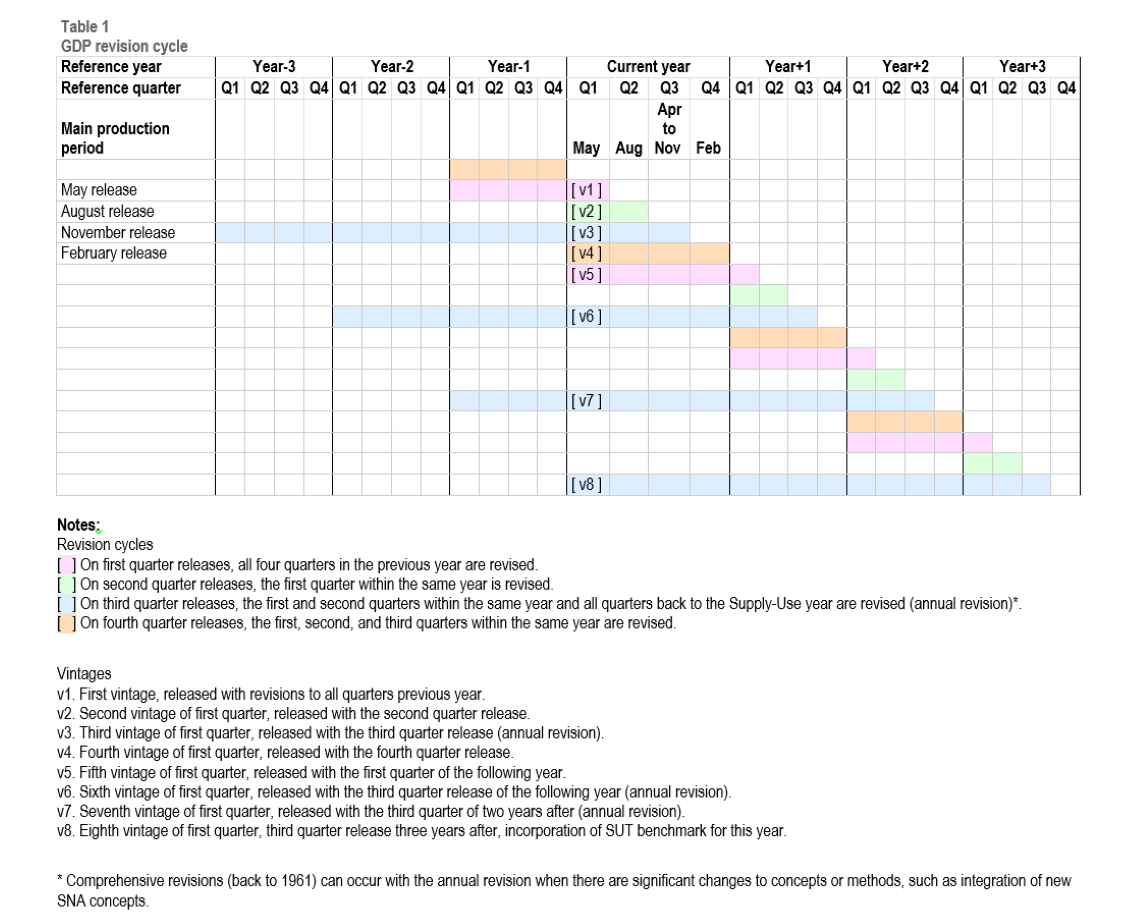
GDP revision cycle

The GDP revisions cycle is a set cycle year-to-year. Revisions occur to previously released quarters based on the reference period open with each release:

  • a first quarter release includes revisions to all quarters of the previous year;
  • a second quarter release includes revisions to only the first quarter of the same year;
  • a third quarter release is the annual revision* and includes revisions to all quarters back three years (due to incorporation of Supply-Use Table);
    * Comprehensive revisions (back to 1961) can occur with the annual revision when there are significant changes to concepts or methods, such as integration of new SNA concepts; and
  • a fourth quarter release includes revisions to all quarters of the same year.
Table 1: GDP revision cycle
Description - Table 1

The GDP revisions cycle is a set cycle year-to-year. Revisions occur to previously released quarters based on the reference period open with each release. For the first quarter of GDP by income and by expenditure, the release includes revisions to all quarters of the previous year; a second quarter release includes revisions to only the first quarter of the same year; a third quarter release is the annual revision and includes revisions to all quarters back three years (due to incorporation of the Supply-Use Table (SUT) for three years prior); and a fourth quarter release includes revisions to all quarters of the same year.

Comprehensive revisions (quarterly, back to 1961) can occur with the annual revision when there are significant changes to concepts or methods, such as integration of new System of National Accounts concepts.

The table illustrates the main production period for each quarter, the corresponding reference quarter/year and the release date. Using the first quarter of a year as an example: the first vintage of those estimates is released in May of the same reference year with revisions to all quarters previous year. The second vintage of the first quarter is released in August with the second quarter release. The third vintage of the first quarter is released with the third quarter release (annual revision) in November. The fourth vintage of the first quarter is released in February of the following year with the fourth quarter release. The fifth vintage of the first quarter is released in May with the first quarter of the following year. The sixth vintage of the first quarter is released with the third quarter release of the following year (annual revision) in November. The seventh vintage of the first quarter is released with the third quarter of two years after (annual revision) in November. The eighth vintage of the first quarter and the last revision vintage (excluding comprehensive revisions) is released in November with the third quarter release three years after, and reflects the incorporation of the SUT benchmark for that year.

Have your say

We want to hear from you. When you take the time to respond to surveys, participate in consultations, or provide us with feedback, you are helping us serve you better. Better data lead to better outcomes for all the people of Canada. Have your say today!

Consulting Canadians

Check out our Consulting Canadians page to see the various ways we seek input on new programs, initiatives, website features, and more.

Data service centres

We want to expand and strengthen our partnerships, which is why we put you, the data user, at the centre of our activities to enhance access, awareness and ease of use of the agency’s data and services via our Data service centres.