Archived - Labour Market Indicators – June 2024

In June 2024, questions measuring the Labour Market Indicators were added to the Labour Force Survey as a supplement.

Questionnaire flow within the collection application is controlled dynamically based on responses provided throughout the survey. Therefore, some respondents will not receive all questions, and there is a small chance that some households will not receive any questions at all. This is based on their answers to certain LFS questions.

Labour Market Indicators

ENTRY_Q01 / EQ 1 - From the following list, please select the household member that will be completing this questionnaire on behalf of the entire household.
WFH_Q01 / EQ 2 - At the present time, in which of the following locations [do/does] [you/respondent name/this person] usually work as part of [your/his/her/their] main job or business?

  1. At a fixed location outside the home
  2. Outside a home with no fixed location
  3. At home

WFH_Q03 / EQ 3 - Among those locations, where [do/does] [you/Respondent name/this person] usually work the most hours?

  1. At a fixed location outside the home
  2. Outside a home with no fixed location
  3. At home

CWFH_Q01 / EQ 4 - You mentioned that [you/Respondent name/this person] usually work[s] most of [your/his/her/their] hours at home as part of [your/his/her/their] main job or business.

Is that mostly:

  1. In [your/his/her/their] own home
  2. At a farm owned or operated by [yourself/Respondent name/this person] or another member of the household
  3. In a separate business premise on the same property as [your/Respondent’s name/this person’s] home
  4. On someone else’s property, farm or business 

CWFH_Q02 / EQ 5 - Where is the office or work site which [you/Respondent name/this person] report[s] to in [your/his/her/their] main job located?

  1. In [your/his/her/their] own town or nearby
  2. In another part of the province
  3. In another province or territory
  4. Outside Canada

CWFH_Q03 / EQ 6 - In which province or territory is the office or work site which [you/Respondent name/this person] report[s] to located?

Select province or territory.

CWFH_Q04 / EQ 7 - Where are the [colleagues or co-workers/the people] with whom [you/Respondent name/this person] interact[s] with in [your/his/her/their] main [job/business] mostly located?

  1. In [your/Respondent’s name/this person’s] own town or nearby
  2. In another part of the province
  3. In another province or territory
  4. Outside Canada

Canadian Economic News, May 2024 Edition

This module provides a concise summary of selected Canadian economic events, as well as international and financial market developments by calendar month. It is intended to provide contextual information only to support users of the economic data published by Statistics Canada. In identifying major events or developments, Statistics Canada is not suggesting that these have a material impact on the published economic data in a particular reference month.

All information presented here is obtained from publicly available news and information sources, and does not reflect any protected information provided to Statistics Canada by survey respondents.

Resources

  • Calgary-based Trans Mountain Corporation announced that May 1st signified the commercial commencement date for the Expanded System and that tankers would be able to receive oil from Line 2 by mid-May.
  • Calgary-based Imperial Oil Ltd. announced that its Grand Rapids oil sands project had started production at Cold Lake using lower emission technology. Imperial said production will continue to ramp up over the next few months to achieve full rates of 15,000 gross barrels per day later this year.
  • Calgary-based AltaGas Ltd. and Royal Vopak of the Netherlands announced a positive final decision on the Ridley Island Export Facility, a large-scale liquefied petroleum gas (LPG) and bulk liquids terminal with rail, logistics, and marine infrastructure on Ridley Island, British Columbia. The companies said the projected gross Joint Venture capital cost of the project is $1.35 billion, excluding governmental incentives and support, and is expected to come online near 2026 year-end.
  • Calgary-based Canadian Utilities Limited announced a new $2 billion energy infrastructure project, called the Yellowhead Mainline project, which will consist of building approximately 200 kilometres of high-pressure natural gas pipeline and related control and compression facilities that will run from Peers, Alberta, to the northeast Edmonton area. The company said construction is expected to commence in 2026, subject to regulatory and company approvals, and is planned to be on-stream in the fourth quarter of 2027.
  • Vancouver-based Canfor Corporation announced the permanent closure of its Polar sawmill in Bear Lake, British Columbia and the suspension of its planned reinvestment in Houston, British Columbia. Canfor said this follows the announcement by its subsidiary company, Canfor Pulp, that one line of production will be indefinitely curtailed at the Northwood Pulp Mill.

Manufacturing

  • Winnipeg-based NFI Group Inc. (NFI) announced that NFI subsidiary New Flyer of America Inc. (New Flyer) had been awarded a contract from the New Jersey Transit Corporation for the purchase of up to 1,300 Xcelsior® 40-foot clean-diesel transit buses. NFI said New Flyer had received an initial firm order for 175 buses with the option to purchase up to 1,125 additional 40-foot buses.
  • Unifor announced on May 5th that 461 workers at the Toronto Nestle plant had decided to strike. Unifor said the plant produces Kit Kat, Aero, and Coffee Crisp chocolate bars, as well as Smarties. On May 29th, Unifor announced that workers had ratified a new three-year contract.
  • Japan-based Asahi Kasei announced it will construct its previously announced integrated lithium-ion battery (LIB) separator plant in Port Colborne, Ontario. Asahi had announced an initial investment of approximately $1.56 billion and said the start of commercial production is currently slated for 2027. The Governments of Canada and Ontario said the project is expected to benefit from federal support through tax credit while Ontario expects to support the project with both direct and indirect incentives.

Other news

  • The Government of Canada announced it was launching the first phase of a national pharmacare plan, including making contraception medications and devices free and making diabetes medications, like insulin, free.
  • On May 24th, the Government of the Northwest Territories released Budget 2024-25, which included a fiscal strategy to restore fiscal sustainability by increasing operating surpluses, reducing short-term debt, realigning health spending to make the programs more sustainable, allocating funding to priorities, and increasing fiscal capacity to ensure the Greater Northwest Territories (GNWT) can respond to future fiscal shocks. The Government forecasts a $294 million operating surplus for 2024-2025 and a contraction in real GDP of 1.1% in 2024.
  • Quebec's minimum wage increased from $15.25 to $15.75 per hour on May 1st.
  • Minnesota-based ALLETE, Inc., which includes utilities and renewable energy companies, and a partnership led by Canada Pension Plan Investment Board of Toronto and Global Infrastructure Partners of New York announced they had entered into a definitive agreement under which the partnership will acquire ALLETE for USD $6.2 billion including the assumption of debt. ALLETE said the transaction is expected to close in mid-2025, subject to the approval of ALLETE's shareholders, the receipt of regulatory approvals, and other customary closing conditions.

United States and other international news

  • United States President Joseph R Biden, Jr. announced an increase in tariffs under Section 301 of the Trade Act of 1974 on $18 billion of imports from China across strategic sectors such as steel and aluminum, semiconductors, electric vehicles, batteries, critical minerals, solar cells, ship-to-shore cranes, and medical products.
  • The U.S. Federal Open Market Committee (FOMC) maintained the target range for the federal funds rate at 5.25% to 5.50%. The last change in the target range was a 25 basis points increase in July 2023. The Committee also said it will continue reducing its holdings of Treasury securities and agency debt and agency mortgage-backed securities and that, beginning in June, the Committee will slow the pace of decline of its securities holdings by reducing the monthly redemption cap on Treasury securities from $60 billion to $25 billion.
  • The Monetary Policy and Financial Stability Committee of Norway's Norges Bank left the policy rate unchanged at 4.5%. The last change in the policy rate was a 25 basis points increase in December 2023.
  • The Bank of England's Monetary Policy Committee (MPC) voted to maintain the Bank Rate at 5.25%. The last change in the Bank Rate was a 25 basis points increase in August 2023.
  • The Reserve Bank of Australia (RBA) left the cash rate target unchanged at 4.35%. The last change in the cash rate target was a 25 basis points increase in November 2023.
  • The Executive Board of Sweden's Riksbank lowered the repo rate by 25 basis points to 3.75%. The last change in the repo rate was a 25 basis points increase in September 2023.
  • The Reserve Bank of New Zealand (RBNZ) left the Official Cash Rate (OCR), its main policy rate, unchanged at 5.50%. The last change in the OCR was a 25 basis points increase in May 2023.
  • Florida-based Red Lobster Management LLC, owner and operator of the Red Lobster® restaurant chain, announced that the Company had voluntarily filed for relief under Chapter 11 of the Bankruptcy Code in the United States. The Company said it intends to use the proceedings to drive operational improvements, simplify the business through a reduction in locations, and pursue a sale of substantially all of its assets as a going concern. The company also said Red Lobster's restaurants will remain open and operating as usual during the Chapter 11 process.
  • Texas-based ConocoPhillips and Marathon Oil Corporation announced they had entered into a definitive agreement pursuant to which ConocoPhillips will acquire Marathon Oil in an all-stock transaction with an enterprise value of USD $22.5 billion. The companies said the transaction is expected to close in the fourth quarter of 2024, subject to the approval of Marathon Oil stockholders, regulatory clearance, and other customary closing conditions.

Financial market news

  • West Texas Intermediate crude oil closed at USD $76.99 per barrel on May 31st, down from a closing value of USD $81.93 at the end of April. Western Canadian Select crude oil traded in the USD $63 to $67 per barrel range throughout May. The Canadian dollar closed at 73.33 cents U.S. on May 31st, up from 72.75 cents U.S. at the end of April. The S&P/TSX composite index closed at 22,269.12 on May 31st, up from 21,714.54 at the end of April.

Information for survey participants (ISP)

Start your survey

Some Statistics Canada surveys can be completed online. If you have been invited, via email or mail, to participate in an online survey, complete the following steps to log in to the survey.

Step 1: Visit the electronic questionnaire portal and select Start my survey.

Step 2: Enter your secure access code (you will find this code in the invitation letter or email you previously received from Statistics Canada).

Step 3: Complete the survey.

Are you missing your secure access code, or do you need help?

Phone:

1-877-949-9492
(TTY: 1-800-363-7629)
Monday to Friday (except holidays) from 8:00 a.m. to 7:00 p.m., Eastern time

If you use an operator-assisted relay service, you can call us during regular business hours. You do not need to authorize the operator to contact us.

Email:

infostats@statcan.gc.ca

Statistics Canada values the well-being of all staff and respondents in all communications. Any aggressive or abusive behaviour will not be tolerated.

Frequently asked questions

Do you have general questions about Statistics Canada or surveys being conducted? Have a look at our FAQs to find some answers.

List of surveys in collection

To search for a particular survey, view the list of surveys currently in collection.

My community

There's power in numbers. Discover the benefits that various population groups enjoy and the challenges they face, thanks to a broad range of information from Statistics Canada surveys. You'll find presentations, articles, videos and infographics on subjects of interest.

Did you know?

Search box

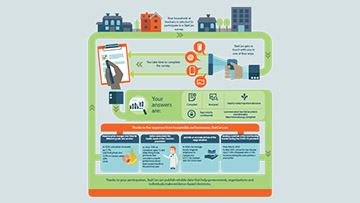
Infographic - The Journey of Statistics Canada Data

Statistics Canada collects data on all aspects of life in Canada, and you have a key role to play.

Retail Commodity Survey: CVs for Total Sales March 2024

Retail Commodity Survey: CVs for Total Sales March 2024
Table summary
This table displays the results of Retail Commodity Survey: CVs for Total Sales (March 2024). The information is grouped by NAPCS-CANADA (appearing as row headers), and Month (appearing as column headers).
NAPCS-CANADA Month
202312 202401 202402 202403
Total commodities, retail trade commissions and miscellaneous services 0.50 0.70 0.66 0.59
Retail Services (except commissions) [561] 0.49 0.69 0.65 0.59
Food and beverages at retail [56111] 0.41 0.48 0.43 0.43
Cannabis products, at retail [56113] 0.00 0.00 0.00 0.00
Clothing at retail [56121] 1.24 0.76 0.85 0.98
Jewellery and watches, luggage and briefcases, at retail [56123] 3.49 2.01 2.46 2.03
Footwear at retail [56124] 0.99 1.26 1.08 1.30
Home furniture, furnishings, housewares, appliances and electronics, at retail [56131] 0.80 0.91 0.86 0.88
Sporting and leisure products (except publications, audio and video recordings, and game software), at retail [56141] 1.77 2.53 2.81 2.48
Publications at retail [56142] 5.29 5.34 7.39 7.17
Audio and video recordings, and game software, at retail [56143] 3.91 4.06 3.80 3.90
Motor vehicles at retail [56151] 1.85 2.48 2.24 1.85
Recreational vehicles at retail [56152] 5.15 5.24 4.89 4.64
Motor vehicle parts, accessories and supplies, at retail [56153] 1.35 2.50 1.89 1.66
Automotive and household fuels, at retail [56161] 1.71 1.65 1.54 1.68
Home health products at retail [56171] 3.06 3.32 3.27 3.38
Infant care, personal and beauty products, at retail [56172] 2.83 2.92 2.80 2.80
Hardware, tools, renovation and lawn and garden products, at retail [56181] 1.48 1.80 1.65 1.76
Miscellaneous products at retail [56191] 2.26 2.17 2.11 2.23
Retail trade commissions [562] 2.35 2.05 1.76 2.03

Advance indicators—Frequently asked questions

By Steve Matthews, Kyle Virgin and Ramdane Djoudad—Statistics Canada

This special-edition article provides nontechnical answers to questions related to the production, use and interpretation of advance indicators for Statistics Canada's Monthly Survey of Manufacturing, Monthly Wholesale Trade Survey and Monthly Retail Trade Survey. Organized as a set of frequently asked questions, this reference document complements the technical documentation on definitions, data sources and methods available for individual programs. It is composed of two sections. Section 1 reviews concepts and definitions that are central to the production of advance indicators, while Section 2 relates to the analysis and interpretation of these special statistical products.

Section 1: Context, definitions and terminology

1 What is an advance indicator?

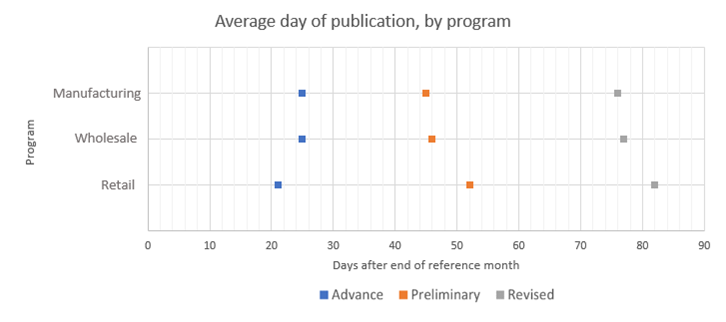
Advance indicators are statistical estimates designed to provide early information on economic activities for a given reference period. For the surveys listed above, advance indicators are generated when information for a portion of respondents has been received but data collection is still underway. Advance indicators for monthly manufacturing, wholesale trade and retail trade are typically published 21 to 25 days after the end of a reference month, while preliminary indicators are published approximately one month later. For example, the monthly retail advance indicator for the January reference month would be published in February (21 to 25 days after), while the preliminary indicator for January would be published in March (one month later). Therefore, a February publication would showcase a preliminary indicator for December, as well as an advance indicator for January.

Chart 1 shows the average number of days to publish advance, preliminary and revised indicators for the three programs following the end of the reference month.

Chart 1 - Average day of publication, by program

Average day of publication, by program
Description - Average day of publication, by program
Average day of publication, by program
Program Advance Preliminary Revised
Manufacturing 25 45 76
Wholesale 25 46 77
Retail 21 52 82
2 What led Statistics Canada to publish advance indicators?

Statistics Canada first published advance indicators in 2020. This work was done primarily to provide users with more timely information, given the economic uncertainty that arose from the COVID-19 pandemic. Demand was high for advance indicators to monitor the economic impacts of COVID-19 in different areas of the Canadian economy and to provide early signals and information about the direction of trends. By using early respondent data, Statistics Canada was able to compile timely and reliable economic signals based on observed data.

Reference month of first release of advance indicator
Program Reference month of first release of advance indicator
Monthly Retail Trade Survey April 2020
Monthly Survey of Manufacturing May 2020
Monthly Wholesale Trade Survey August 2020
3 How does Statistics Canada produce advance indicators?

Statistics Canada uses a technique called flash estimation to produce advance indicators for selected survey programs. Flash estimation refers to a type of advance indicator that uses the same methods used to produce preliminary indicators, but these methods are applied to a more limited dataset, at an earlier point in time. For example, to produce the advance retail trade indicator, only responses that have been received by a predetermined point in the collection period are used. Once collection is complete, the same non-response treatments and weighting methods are used on the full set of received data, which is then used to produce the preliminary indicator.

The amount of collected data incorporated into an advance indicator varies from month to month and across surveys. Table 1 shows that in 2023, the average response rates for advance indicators (rounded to the nearest percentage point) were 68% for the Monthly Survey of Manufacturing, 59% for the Monthly Wholesale Trade Survey and 45% for the Monthly Retail Trade Survey. These response rates are typically published along with each advance indicator to provide users with information on the quality of that month's figure.

Table 1 - Average response rates, 2023
Program Advance indicator Preliminary indicator Revised indicator
Manufacturing 68% 87% 94%
Wholesale trade 59% 69% 75%
Retail trade 45% 83% 88%

The monthly gross domestic product (GDP) by industry program uses the advance indicators discussed in this article to compile its own advance indicators of GDP. More information on estimates of monthly GDP can be found in Revisions to Canada's GDP.

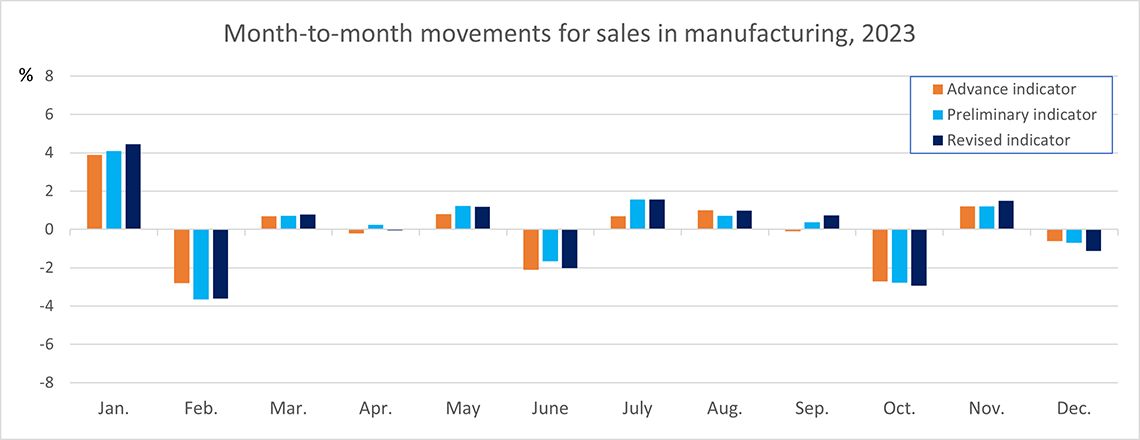
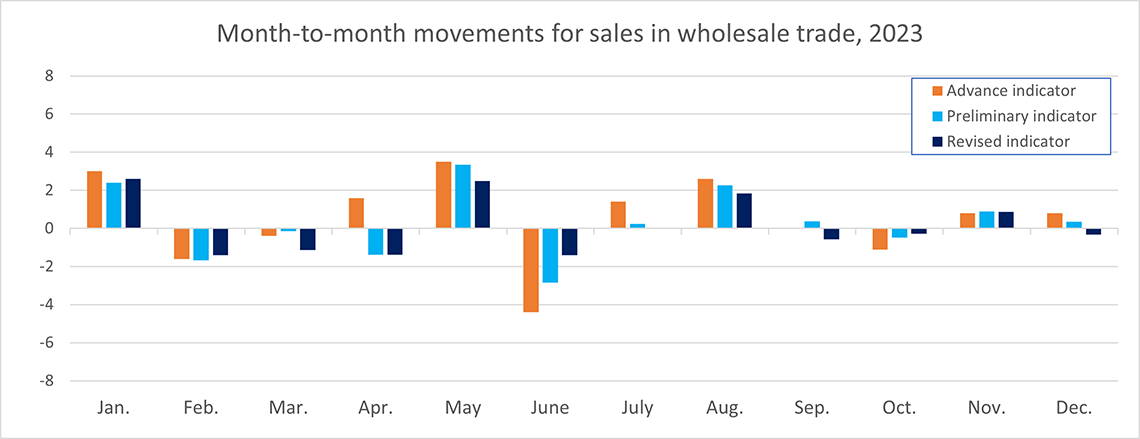
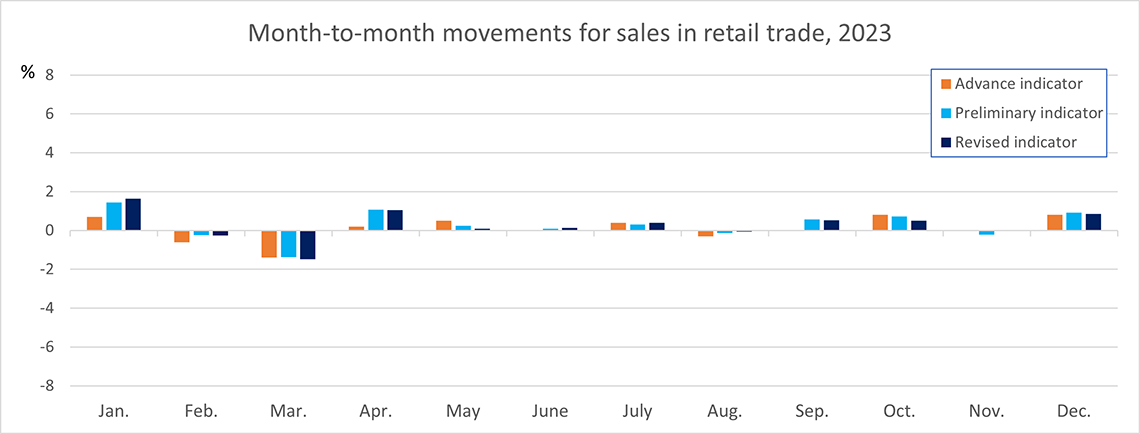
Figure 1 illustrates the published month-to-month movements for sales in manufacturing, wholesale trade and retail trade throughout the 2023 reference year. The advance, preliminary and revised indicators are highly coherent, in terms of both the direction (increase or decrease) and the magnitude of the month-to-month change in sales.

Figure 1 - Comparison of month-to-month movements from advance, preliminary and revised indicatorsFootnote 1

Month-to-Month Movements for Sales in Manufacturing, 2023
Description - Month-to-Month Movements for Sales in Manufacturing, 2023
Month-to-month movements for sales in manufacturing, 2023
  Advanced indicator Preliminary indicator Revised indicator
January 3.9 4.1 4.5
February -2.8 -3.6 -3.6
March 0.7 0.7 0.8
April -0.2 0.3 -0.1
May 0.8 1.2 1.2
June -2.1 -1.7 -2.0
July 0.7 1.6 1.6
August 1.0 0.7 1.0
September -0.1 0.4 0.7
October -2.7 -2.8 -2.9
November 1.2 1.2 1.5
December -0.6 -0.7 -1.1
Month-to-Month Movements for Sales in Wholesale, 2023
Description - Month-to-Month Movements for Sales in Wholesale, 2023
Month-to-month movements for sales in wholesale, 2023
  Advanced indicator Preliminary indicator Revised indicator
January 3.0 2.4 2.6
February -1.6 -1.7 -1.4
March -0.4 -0.1 -1.1
April 1.6 -1.4 -1.4
May 3.5 3.3 2.5
June -4.4 -2.8 -1.4
July 1.4 0.2 0.0
August 2.6 2.3 1.8
September 0.0 0.4 -0.6
October -1.1 -0.5 -0.3
November 0.8 0.9 0.9
December 0.8 0.3 -0.3
Month-to-Month Movements for Sales in Retail, 2023
Description - Month-to-Month Movements for Sales in Retail, 2023
Month-to-month movements for sales in retail, 2023
  Advanced indicator Preliminary indicator Revised indicator
January 0.7 1.4 1.6
February -0.6 -0.2 -0.2
March -1.4 -1.4 -1.5
April 0.2 1.1 1.0
May 0.5 0.2 0.1
June 0.0 0.1 0.1
July 0.4 0.3 0.4
August -0.3 -0.1 -0.1
September 0.0 0.6 0.5
October 0.8 0.7 0.5
November 0.0 -0.2 -0.0
December 0.8 0.9 0.9
4 Are there other approaches that can produce advance indicators?

Besides flash estimation, nowcasting is another method that can be used to produce advance indicators. In contrast to flash estimation, nowcasting encompasses more types of advance indicators that use either different input data or different compilation methods than preliminary indicators. For example, a nowcast may include estimators based entirely on models that use information from alternative sources available at the time when the model is applied to generate the nowcast. Similar to flash estimation, nowcasting models typically yield advance indicators that are less precise than preliminary indicators.

An important distinction exists between advance indicators produced at Statistics Canada and what are commonly referred to as forecasts. Typically, forecasting models are used to project data forward to describe future reference periods and as a consequence no information is available on the reference period of interest. The absence of observed data in forecasts increases the risk of inaccurate results because models rely on the assumption that historical trends and patterns will continue. In contrast, Statistics Canada incorporates some form of observed data in the production of advance indicators. Advance indicators released by Statistics Canada use direct observations as much as possible, such as data received from respondents or administrative data for a reference period of interest. The appropriate use of these data reduces the risk of large differences between advance indicators and preliminary indicators.

Section 2: Issues related to analysis and interpretation

1 What are the strengths and weaknesses of advance indicators?

Advance indicators provide timelier information to users; however, they are less precise than preliminary and revised indicators produced at a later date. Statistics Canada follows a multidimensional framework to assess data quality (Statistics Canada, 2019), including the dimensions of accuracy and timeliness. Statistical products typically aim to strike a balance between these dimensions to best meet the needs of data users. In this particular framework, advance indicators are intended to be timelier, with some compromise in accuracy. Because of this compromise in accuracy, the advance indicators are published at more aggregated levels of detail, such as the national level rather than the provincial level, compared with preliminary and revised indicators. They are also not released through the official Statistics Canada data repository but are only disseminated as part of articles in Statistics Canada's official release bulletin, The Daily.

2 How is the quality of advance indicators monitored?

Before this initiative, studies demonstrated that publishing advance indicators would provide a desirable balance of data timeliness and accuracy for users. In particular, the criteria used for accuracy accounted for the direction and the magnitude of relative month-to-month movements. This element is particularly important because it identifies turning points in a time series; the magnitude of movements is a key consideration because it estimates the pace of economic change. The historical performance of advance indicators produced with flash estimation was assessed, and these indicators outperformed forecasting and nowcasting methods with comparable timeliness. Furthermore, advance indicators can be generated approximately one month earlier than preliminary indicators.

Each month, Statistics Canada compares advance indicators with the preliminary indicators that follow for the same reference period to monitor the size of the differences between them, as well as their coherence in terms of the direction of the month-to-month movement.

Additionally, a comprehensive review of advance indicators and their past performance is conducted periodically. This review includes analysis of descriptive statistics over time, as well as any noteworthy differences observed for individual reference periods.

3 Why are advance indicators and preliminary indicators different?

Since advance indicators are derived using the same methods as preliminary indicators, they are subject to the same types of sampling and non-sampling errors, but with different sensitivities to these sources of error. The differences between advance and preliminary indicators can be attributed to the following sources:

  1. Responses received after the production of advance indicators: Imputation, designed to produce unbiased and accurate aggregate estimates, is used to estimate values for each non-responding unit when advance indicators are produced. If an individual unit does not respond in time for the advance indicator but provides a response before the preliminary indicator is produced, this causes a difference between the advance and preliminary indicators. Large differences can occur when individual units have notable differences, or when relatively small differences accumulate from many units.
  2. Improvements to imputation from additional responses received: Even for units that do respond in time for the advance indicator, the imputed values themselves can differ between advance and preliminary indicators. Since imputation for the preliminary indicator is based on more complete information, this indicator should be viewed as an improved estimate for non-responding units versus the advance indicator. While these differences are typically small, they can accumulate to yield notable differences between the advance and preliminary indicators.
  3. Updates made to data after the advance indicator: When advance indicators are produced, respondent data are subjected to a further revision and are updated as part of the data validation process, which can result in differences between the advance and preliminary indicators.
4 Are other approaches being considered to produce advance indicators?

Statistics Canada continually seeks to adopt leading-edge methods to maximize data quality. To support these efforts, Statistics Canada collaborates regularly with other national statistical offices, other statistical organizations and academia to identify, develop and evaluate methods that would assist in producing advance indicators. In particular, nowcasting approaches hold promise to further improve timeliness, if statistical models with suitable accuracy relying only on the information available can be developed.

5 Where can I find more information?

Eurostat (2017), Handbook on Rapid Estimates, 2017 Edition (PDF).

Statistics Canada (2019), Statistics Canada Quality Guidelines – Sixth Edition.

Audit of Staffing

November 2023
Project number: 80590-127

Table of contents

Executive summary

People are Statistics Canada's most valuable resource. Collectively, they drive the agency's mandate and priorities in producing statistics that help Canadians better understand their country. Staffing processes must be effective and efficient to ensure Statistics Canada hires the right people with the right competencies at the right time.

Staffing processes are a shared responsibility between the hiring manager and the staffing advisor. The hiring manager is responsible for making selection decisions that respect the public service values and ethics while acting in conformity with organizational goals. The staffing advisor is responsible for providing options, strategic advice, and guidance on the available staffing mechanisms and associated risks and considerations. The human resources (HR) assistant works alongside their assigned staffing advisor by being responsible for administrative components of the staffing process, such as creating and maintaining the staffing action file in GCdocs. Finally, Corporate Staffing is responsible for designing the staffing process; monitoring; and overseeing many of the fundamental components that support staffing advisors and HR assistants in executing staffing actions, such as developing tools and templates, developing training and guidance, and representing the agency in the event of a complaint.

The agency has experienced an extraordinary staffing landscape since the onset of the COVID-19 pandemic . Annual staffing actions processed by the agency grew from 6,473 in 2019/2020 to 13,947 in 2021/2022, before falling to 8,643 in 2022/2023. As hiring ramped up to meet the demands of new projects and programs, staffing processes were strained, leading to a backlog of staffing actions. This sudden increase took place during a period when HR leadership and teams were seized with efforts to transition the agency to full telework (followed by a shift to a hybrid model), multiple implementations of vaccine reporting, the hiring of thousands of contact tracers and the implementation of a rapid testing program for census employees. However, through significant work and effort, and without additional resources, the agency successfully recruited all required employees to work on the new projects and programs. This extraordinary staffing volume is not expected to be repeated in the foreseeable future.

Why is this important?

Staffing actions more than doubled over the last few years, leading to a persistent backlog and increasing the length of time to hire. An effective and efficient staffing process is critical to ensuring Statistics Canada has the HR required to achieve its mandate and priorities.

Further, according to the Public Service Commission's Appointment Framework, Statistics Canada is required to conduct a cyclical assessment at least once every five years. This assessment takes a broad look at the health of the organizational staffing system and identifies areas that need to be strengthened, as well as potential measures to address weaknesses. This Audit of Staffing contributes to fulfilling this requirement.

Overall conclusion

The agency's staffing processes have been stressed by a sudden increase in the volume of staffing transactions, combined with the departure of experienced staffing advisors. To optimize the effectiveness and efficiency of the staffing process as the agency moves towards more regular staffing levels, opportunities for improvement were identified in the areas of staffing advisor support and development, process design and documentation, staffing integrated systems, and the monitoring of and reporting on the process.

Key findings

Hiring managers' views on staffing

While the agency has been successful in recruiting employees to meet the increased demand in recent years, the administrative burden of staffing processes on hiring managers has resulted in some frustration among hiring managers. They find it cumbersome and overly compliance driven, inefficient, and sometimes ineffective in finding the best candidate. While acknowledging the challenges faced by staffing advisors, hiring managers would like to better leverage HR expertise throughout the staffing process.

Staffing advisor and human resources function views on staffing

There has been significant turnover in the staffing team in recent years. Most staffing advisors are new to their role, yet do not feel adequately supported. Staffing processes are not well defined, are not optimized at the agency level, are inadequately supported by integrated information systems and undergo frequent change. Together, these factors add administrative burden for staffing advisors and make it difficult for them to fully meet hiring manager expectations.

Monitoring the efficiency and effectiveness of the staffing process

There is limited reporting on metrics related to the efficiency and effectiveness of staffing processes overall. This type of monitoring would support data-driven decision making and the ongoing improvement of the effectiveness and efficiency of the staffing process.

Conformance with professional standards

The audit was conducted in accordance with the Mandatory Procedures for Internal Auditing in the Government of Canada, which include the Institute of Internal Auditors'International Standards for the Professional Practice of Internal Auditing.

Sufficient and appropriate audit procedures have been conducted, and evidence has been gathered to support the accuracy of the findings and conclusions in this report and to provide an audit level of assurance. The findings and conclusions are based on a comparison of the conditions, as they existed at the time, against pre-established audit criteria. The findings and conclusions are applicable to the entity examined and for the scope and period covered by the audit.

Steven McRoberts
Chief Audit and Evaluation Executive

Introduction

Background

People are Statistics Canada's most valuable resource. Collectively, they drive the agency's mandate and priorities in producing statistics that help Canadians better understand their country. Staffing processes must be effective and efficient to ensure Statistics Canada hires the right people with the right competencies at the right time.

The agency has defined three specific objectives for the staffing process that can be summarized as follows:

  • Achieving operational objectives: The agency must build an agile and competent workforce through effective human resources (HR) planning activities and staffing and recruitment strategies adapted to its organizational context and business needs.
  • Compliance: The agency must ensure compliance with the Public Service Employment Act (PSEA), the Values and Ethics Code for the Public Sector, and requirements of internal and central agency policies.
  • Equity, diversity and inclusion: Hiring managers should always look for the best qualified person to fill a position. They must also put in place strategies to attract talent from different backgrounds who offer a wide variety of ideas and strengths that, together, lead to innovative outcomes.

Staffing processes are a shared responsibility between the hiring manager and the staffing advisor. The hiring manager is responsible for planning for their workforce; identifying needs; engaging meaningfully with HR throughout the process; providing information as required; and ultimately making selection decisions that respect public service values and ethics, legislation, and policies while acting in conformity with organizational goals. The staffing advisor is responsible for providing options, strategic advice, and guidance on the available staffing mechanisms and associated risks and considerations. The HR assistant works alongside their assigned staffing advisor by being responsible for administrative components of the staffing process, such as creating and maintaining the staffing action file in GCdocs. Finally, Corporate Staffing is responsible for designing the staffing process; monitoring; and overseeing many of the fundamental components that support staffing advisors and HR assistants in executing staffing actions, such as developing tools and templates, developing training and guidance, and representing the agency in the event of a complaint.

Staffing mechanisms within the federal public service are subject to the PSEA, the Treasury Board's Policy on People Management, and the Public Service Commission's (PSC) Appointment Framework. Notably, the PSC's Appointment Framework was launched in 2016 with the intention of streamlining requirements, reducing administrative burden, offering greater flexibility and accountability, encouraging agile and customized approaches to staffing and policies, and increasing focus on outcomes. Within Statistics Canada, hiring also adheres to the agency's Staffing Governance Framework, which took effect on May 15, 2022.

In 2020/2021, like all organizations, Statistics Canada responded to the COVID-19 pandemic quickly, pivoting operations to focus on mission-critical programs and, with an unprecedented need for data, delivering data-driven insights to Canadians at a time when they were needed most. Throughout this time, the agency experienced an extraordinary staffing landscape as annual staffing actions processed by the agency grew from 6,473 in 2019/2020 to 13,947 in 2021/2022, before falling to 8,643 in 2022/2023. This sudden increase took place during a period when HR leadership and teams were seized with efforts to transition to full telework (some 7,500 employees were moved to telework, a great advance), followed by a shift to a hybrid model (including the use of personas, pulse surveys and an employee wellness survey to support employees' transition to a hybrid work environment); multiple implementations of vaccine reporting; the hiring of thousands of contact tracers (over 2,000 additional Statistical Survey Operations employees were hired in less than four months); and the implementation of a rapid testing program for census employees. As hiring ramped up to meet the demands of new projects and programs, the agency struggled to keep pace, leading to a persistent backlog of staffing actions. However, through significant work and effort, and without additional resources, the agency successfully recruited all required employees to work on the new projects and programs. This extraordinary staffing volume is not expected to be repeated in the foreseeable future.

Audit objective

The objective of this audit is to provide reasonable assurance on the effectiveness and efficiency of staffing processes and tools to facilitate appropriate and timely staffing of personnel.

Scope

The scope of the engagement included an examination of selected components of the agency's management control framework for staffing, including processes to

  • ensure management and the Workforce and Workplace Branch work in partnership to execute on staffing needs and priorities
  • enable all parties to understand and adhere to their respective staffing responsibilities
  • enable effective and timely staffing in accordance with management's needs.

Compliance with the PSC's Appointment Framework was excluded from the engagement scope, as the Workforce and Workplace Branch conducts annual self-assessments of staffing files to assess compliance and identify areas for improvement.

For the purposes of this engagement, the staffing process was considered to begin when the hiring manager identifies a need to fill a vacancy and to be complete once the letter of offer is issued to the selected candidate.

The scope period covered processes in place for the fiscal years 2021/2022 to 2022/2023.

Executive staffing was excluded from the engagement scope, as it follows different processes and requirements from other staffing actions.

Finally, the engagement scope also excluded the following elements, as they would be better assessed through separate, targeted engagements: the parts of the hiring process that take place after the selection of the successful candidate (including the security clearance process and pay-related processes); equity, diversity and inclusion initiatives; official languages measures; and financial management controls.

Approach and methodology

This audit was conducted in accordance with the Mandatory Procedures for Internal Auditing in the Government of Canada, which include the Institute of Internal Auditors' International Standards for the Professional Practice of Internal Auditing.

The audit work consisted of

  • examination and analysis of relevant internal documentation
  • questionnaires for hiring managers and staffing advisors
  • interviews and walkthroughs with hiring managers from across the agency, staffing operations team leads, staffing advisors, HR assistants and a team lead, along with representatives from Corporate Staffing and HR management.

Authority

The audit was conducted under the authority of the approved Statistics Canada Integrated Risk-based Audit and Evaluation Plan (2023/2024 to 2027/2028).

Findings, recommendations and management response

Hiring managers' views on staffing

While the agency has been successful in recruiting employees to meet the increased demand in recent years, the administrative burden of staffing processes on hiring managers has resulted in some frustration among hiring managers. They find it cumbersome and overly compliance driven, inefficient, and sometimes ineffective in finding the best candidate. While acknowledging the challenges faced by staffing advisors, hiring managers would like to better leverage HR expertise throughout the staffing process.

Staffing is a shared responsibility between hiring managers, staffing advisors and HR assistants. Staffing advisors and HR assistants support the administration of the process, while hiring managers are accountable for planning their staffing needs, making selection decisions, and ensuring compliance with staffing-related legislation and policies.

Staffing processes are cumbersome and overly compliance driven

While the agency's objectives for staffing do not explicitly include the concept of efficiency, achieving the three objectives in the least amount of time and at the lowest cost to the agency remains an important, yet unstated, goal. Further, these objectives are sometimes in tension with one another, requiring careful balancing to optimize results. Specifically, achieving operational objectives and ensuring compliance are often at odds, as attaining compliance adds burden to the process and can delay staffing actions, putting operational objectives at risk.

Hiring managers noted that staffing templates, established to demonstrate compliance, are burdensome and time-consuming to complete. They questioned whether the agency was striking the right balance between operational and compliance objectives, noting that often the feedback they received when completing the forms added marginal business value. Hiring managers also reported that staffing advisors each had their own interpretation of what was required and the point at which compliance requirements were satisfied.

Completing the Candidate Assessment Validation (CAV) form was identified as a common challenge in this regard. This form exists to fulfill compliance objectives and the PSEA requirement that the hiring decision for non-advertised appointments be documented. Staffing advisors and hiring managers alike noted that hiring managers spend significant time in completing the document and that it often included multiple rounds of going back and forth between the hiring manager and staffing advisor. The CAV template did not provide detailed guidance on what could represent sufficient documentation of the hiring decision, leaving room for varying interpretations of the point at which the documentation was acceptable.  

Striving for perfection in achieving compliance can lead to inefficiencies and unnecessary complications. While it is essential to meet the requirements set by the PSC, aiming for perfection beyond the established threshold can result in prolonged staffing processes, increased administrative burden and cost, and delays in filling critical positions. An overemphasis on perfection can also divert resources and attention from other pressing matters, leading to an imbalance in priorities.

Certain staffing processes are slow and may not result in finding good candidates

Two-thirds of hiring managers noted that traditional staffing processes and assessments were not always effective in finding the right candidate. While candidates often looked good on paper and answered questions appropriately in the interview stage, their on-the-job performance was not always reflective of their assessment results. Certain types of staffing actions are very labour-intensive for hiring managers, with varying results in finding candidates with the specific skills they are looking for. Other challenges included processes receiving too few applicants and taking too long (applicants often accepted positions elsewhere when the processes took too long).

Hiring managers also reported using several staffing actions to expedite employee start dates with the agency. In such scenarios, once a candidate is selected, they are offered an acting appointment to allow time for an indeterminate appointment to be processed. While this practice effectively speeds hiring, it also increases the workload for both staffing advisors and hiring managers as it creates two staffing actions in the place of one.

Siloed human resources functions create extra steps in the process for hiring managers

There are various HR functions that can be involved in a hiring process, including staffing and classification, along with other functions within the Corporate Strategy and Management Field (e.g., security, official languages and finance). Hiring managers reported taking on the facilitator role between the various HR functions, which were viewed as siloed. Several hiring managers noted that they are uncertain which group to reach out to for various HR issues, and this could add to the complexity and time of the staffing process. Members of the staffing function also expressed similar concerns.

Hiring managers want to better leverage strategic support from their staffing advisors

While acknowledging the challenges faced by staffing advisors, hiring managers indicated they would like staffing advisors to take on more responsibility throughout the staffing process. This would allow the agency to leverage the expertise of the staffing advisors and would align with the desired evolution of the staffing function. This change would include support such as providing strategic advice, assisting with screening large numbers of candidates and helping with the completion of mandatory compliance documentation. As the staffing function is not currently resourced or equipped to provide this level of support, some fields and divisions have created staffing "shadow shops" to perform these tasks. Using their knowledge of the hiring manager's business needs and past knowledge of the staffing process, these support teams act as a liaison between hiring managers and staffing advisors.

However, these shadow shops create challenges for staffing advisors. They disconnect the staffing advisor from the business, resulting in the advisor focusing mostly on the administrative aspects. Further, the guidance provided by the shadow shops may not align with that of the staffing advisor. While some of these shops have been disbanded or reduced, the demand for their services has not waned. Many staffing advisors acknowledged the need for the services these shadow shops provide. The team of staffing advisors wants to better support clients and acknowledged the challenges in the current environment, which include the high volume of staffing actions, the number and diverse needs of hiring managers they serve, and the administrative burdens caused by a manual and inefficient staffing process (discussed further in the Monitoring the efficiency and effectiveness of the staffing process section below).

The staffing process has not been designed to optimize efficiency and effectiveness

Many of the issues identified point towards a staffing process that has been designed based on accountabilities, rather than efficiency and effectiveness. Along these lines, the total cost of the staffing process is not known or monitored. While the cost of the staffing function itself is known, the considerable time invested by hiring managers in staffing is not tracked. Hiring manager time has thus become an unmeasured resource when designing the staffing process, and over time the process can drift towards being optimized at the staffing function level rather than the agency level. This results in tasks being assigned to hiring managers because they are accountable for them, not because they are the most efficient or effective people to perform them. In many cases, tasks for which hiring managers are accountable may be better or more efficiently performed by a centralized resource with the knowledge and volume of transactions to become proficient in the tasks.

For example, hiring managers are accountable for the selection decision. Consequently, they are expected to define the competencies required for a position, develop assessment tools for each competency, and evaluate the assessment tools for bias—all with limited support or training in these activities. Each of these activities can benefit from in-depth knowledge and experience and may be more effectively and efficiently performed, or guided, by a centralized resource with expertise in competencies and their assessment. Under an agency-level mindset, a more efficient and effective process might have a centralized resource maintain a bank of competencies, complete with definitions and bias-free assessment tools. Hiring managers could leverage these as required, rather than having to independently research competencies and develop assessment tools for their own personal use. While the agency does maintain a bank of tools for larger collective processes that are repeated on a periodic basis, similar support is not available for individual processes.

Staffing advisor and human resources function views on staffing

There has been significant turnover in the staffing team in recent years. Most staffing advisors are new to their role, yet do not feel adequately supported. Staffing processes are not well defined, are not optimized at the agency level, are inadequately supported by integrated information systems and undergo frequent change. Together, these factors add administrative burden for staffing advisors and make it difficult for them to fully meet hiring manager expectations.

Staffing advisors, operating within the existing manually driven processes, are faced with many challenges while supporting hiring managers. Many staffing advisors are new to their role and would like more support and the opportunity to learn from more experienced advisors. A commonly identified theme was that staffing advisors have the best interests of the agency and hiring managers in mind and are dedicated to providing an effective service.

Most staffing advisors are new to their role

Staffing advisors play a key role in the staffing process. They are process experts, responsible for guiding hiring managers from need identification to the appointment of the chosen candidate. They provide strategic advice on staffing mechanisms, risks and compliance requirements. This advice demands a strong understanding of their clients' business and staffing needs; of how to reach, attract and assess high-quality candidates; and of how to navigate the complex web of regulations, policies and directives that govern federal government hiring.

Across the federal government, staffing advisors are in short supply and in high demand, making movement between departments a common challenge.

As noted, the agency has seen a sharp increase in the volume of staffing actions over the past few years. Concurrently, turnover rates among the agency's Personnel Administration (PE) category have also spiked. During this time, the agency experienced turnover rates of 25% to 33% among PEs, compared with 7% to 12% across the federal public service. In 2022/2023, the staffing function had a turnover rate of 36%, compared with a turnover rate of 23% for the agency.

Management reported difficulty in replacing departing experienced staffing advisors with similarly experienced advisors. Consequently, junior staffing advisors (PE-01 or PE-02 levels) were hired in their place. As of September 2023, the agency had 14 staffing advisors in total: 12 junior staffing advisors at the PE-01 or PE-02 level and 2 senior staffing advisors at the PE-03 level.  

Staffing advisors require more support, straining team leads working to fill the gap

Developing a staffing advisor takes time, training and mentoring. They begin at the PE-01 level as a developmental HR advisor, typically for a period of one year or more, before progressing to the PE-02 level as an HR advisor, at which point they deliver operational services of limited scope. Junior staffing advisors are supported throughout this process by a more experienced staffing advisor at the PE-03 (HR specialist) or PE-04 (team lead) level. This advisor serves as a mentor, allowing the junior advisor to shadow them, reviewing their work before it is communicated to the hiring manager and acting as a sounding board when they encounter difficult situations. It is only once staffing advisors have attained the PE-03 HR specialist level that they may work fully independently and are considered to provide expert staffing advice.

Because of this high turnover among senior staffing advisors, junior staffing advisors have been assigned as lead advisors to work directly with hiring managers without an assigned mentor (but with supervision from their team lead). In some respects, they are performing the responsibilities of a senior staffing advisor without having the knowledge, experience or support to perform at that level. Junior staffing advisors reported taking on roles they do not feel sufficiently equipped or supported to execute. Many reported being uncomfortable providing advice to senior managers and executives without having experience with all types of staffing actions (particularly advertised processes) or fully understanding staffing processes.

With a shortage of experienced staffing advisors, team leads are struggling to fill the gap. The staffing team is presently composed of two team leads, each of whom is assigned seven to eight staffing advisors. Staffing management reported that team sizes of four to five were more typical, with a mix of junior and experienced advisors. Team leads reported being overwhelmed with their workload and having to work overtime to keep up while providing coaching, review and ongoing support to junior staffing advisors. Staffing advisors also noted that team leads seemed overburdened, making staffing advisors hesitant to approach them when they needed help. They stated this has led to delays in responding to hiring managers and has slowed the staffing process.

Frequent rotation of staffing advisors across client groups is causing frustration for hiring managers and staffing advisors

Adding to these challenges, the high turnover and volume of staffing actions have resulted in a frequent rotation of client groups among staffing advisors. Hiring managers and staffing advisors expressed frustration with this constant change and noted that greater stability was required. For staffing advisors, frequent rotation makes it difficult to establish strong working relationships with their clients and to understand their business and their needs. For hiring managers, a new staffing advisor requires dedicating time to update them on ongoing staffing actions, their business and their broader staffing needs. It also means adjusting to different ways of doing things, which can lead to challenges as advisors may have different interpretations of what is required and how the staffing process should proceed.

The shortage of experienced staffing advisors able to provide expert advice, coupled with the frequent rotation of staffing advisors across client groups, has affected the quality of service staffing advisors can provide and the cohesion between hiring managers and staffing advisors. These factors also serve to compound the other challenges discussed throughout this report.

Hiring managers are not involving staffing advisors early in the process

HR management noted that a common challenge concerned staffing advisors not being informed of staffing needs and activities early enough in the process. Last-minute requests result in backdated transactions and a high volume of urgent staffing actions. These issues make it difficult for staffing advisors to plan their work; complicate pay processes; and create problems for employees, who risk being paid wrong, late or not at all, or experiencing delays or refusal of benefits. These issues also affect the relationship between hiring managers and staffing advisors. Hiring managers expressed a desire for more support from their staffing advisors. Likewise, staffing advisors expressed a desire to provide more strategic advice and support to hiring managers and to be seen as a trusted partner in their clients' staffing activities. However, not involving staffing advisors early in the process relegates them to simply processing paperwork, often under tight time pressures. This in turn can lead to staffing advisors being seen as an obstacle to hiring managers, as the staffing advisor is left scrambling to ensure all the administrative requirements necessary to process the staffing action are fulfilled.

The agency introduced a timeliness initiative in May 2023 to establish clear timelines that hiring managers must meet for HR actions to be processed in time. As the initiative was implemented during the audit, it was not possible to assess its effectiveness. That said, management hopes that it will increase rigour and discipline in staffing processes and lead to hiring managers including staffing advisors earlier in their staffing actions.

Staffing processes are not well defined, making it difficult to optimize the process

Well-designed and implemented processes and procedures contribute to an effective staffing function. They help ensure common and standardized approaches in the administration of staffing actions, establish clear expectations for the level of service provided by staffing advisors, and inform all participants of the requirements and timelines of a typical staffing action. They can also ensure the most efficient approach is taken on each staffing action by properly sequencing actions and ensuring that no steps are forgotten.

Staffing advisors and hiring managers noted that the process was not fully defined. The HR function has not developed clear, comprehensive and documented procedures outlining the specific steps required for each type of staffing process. That said, a comprehensive flowchart was developed for the non-advertised staffing process in coordination with Field 7's Operations and Integration Division but was not shared with staffing advisors or hiring managers as the project was discontinued because of fiscal constraints. This work is a good start and could be leveraged in documenting other types of staffing actions. Various checklists have also been developed to define the key documentation required for each type of staffing action, but hiring managers and junior staffing advisors reported that these were not sufficiently detailed to meet their needs as they do not include all the steps of the process, the expected timelines for each step or the purpose behind each step.

The lack of clear, standardized procedures has resulted in a process that varies depending on the staffing advisor and hiring manager involved.

As an example, a key step at the outset of a staffing action is the development of the statement of merit criteria (SoMC). This document outlines the experience, skills and competenciesFootnote 1 required for the position and forms the basis of the candidate assessment. Completing the SoMC is the responsibility of the hiring manager, with guidance from the staffing advisor. There was no common approach to determining the level of support that should be provided. Also, staffing advisors who reported sharing SoMCs from other departments were sharing them from their personal collection rather than a list curated and maintained by the agency and available to all other staffing advisors.

Non-integrated information systems create administrative burden for staffing advisors

Information management and information technology (IT) systems are required to facilitate efficient and effective staffing processes. These systems should support process flows, document management, and monitoring and reporting.

Statistics Canada employs several systems to support its staffing process. These systems include Orbit, the Staffing Activity Management System, a work-in-progress (WIP) spreadsheet shared among all staffing advisors, SharePoint for financial approvals, GCdocs for key documents, staffing advisor and HR assistant mailboxes for correspondence and documents in progress, and various spreadsheets and other unique tools created and used by staffing advisors and HR assistants to track their files. Notably, these systems are not integrated, affecting the availability and accuracy of data related to the staffing process. Many data points are duplicated across multiple systems, leading to conflicting information that needs to be reconciled when information is compiled for reporting purposes.

These disparate systems add significant burden for staffing advisors, create complications and frustration for hiring managers, cause delays to staffing processes, and take staffing advisor time away from providing strategic support to their clients. There are also multiple entry points for new staffing actions, meaning staffing advisors must monitor their emails, SharePoint and WIP to know what work they have underway. Reporting for senior management requires staffing advisors to manually compile and reconcile data from multiple systems. Hiring managers cannot see the status of their staffing actions, leading to numerous emails to staffing advisors requesting status updates that must also be manually compiled and reconciled by staffing advisors. Additionally, the systems do not support the process of completing the required forms, meaning that they must be shared by email between the hiring manager, their delegate and the staffing advisor during their development, leading to lost documents and version control issues. These issues create frustration and undermine the hiring manager's trust in the staffing advisor in several ways. First, the lack of system-level support for the staffing process can make it hard for staffing advisors to locate files from previous staffing actions, giving the appearance of disorganization to hiring managers. Second, staffing advisors sometimes ask hiring managers to provide documents a second or third time for a given process, causing frustration and a loss of trust among hiring managers who understood that the staffing advisor was responsible for storing documentation for the staffing action.

Further, there is no formal documentation on which system is used to track what information, who should enter the information and when it should be done. Staffing advisors and their HR assistants work out roles and responsibilities between themselves. Consequently, some HR assistants may do more to support their staffing advisor while others may do less. These inconsistencies are manifested in the information available in the systems.

The HR team has undertaken a project to implement an integrated system to automate monitoring and improve the efficiency of the staffing process. However, this is not its first attempt to do so. Previous attempts have been set aside in favour of newer or more urgent priorities or have had their scope changed during implementation such that they did not deliver the integrated system that had been envisioned. Several concerns were raised regarding this current implementation that warrant consideration:

  • Senior HR management stated an expectation of implementation in the fall at minimal cost (attributable to having the selected software available to the agency at no additional cost). However, according to IT staff, a project of this scope will take months (at minimum) to implement, making a fall implementation unrealistic. They further noted that the development costs will be significant.
  • Two competing software alternatives are being considered. These alternatives were chosen for their low cost (the agency already owns licensing for them) and pre-existing in-house support. However, the system selection is being conducted while user needs are still being defined by Corporate Staffing, and staffing processes have not yet been documented.
  • The requisite resources from IT and Human Resources Business Intelligence (HRBI) have not been formally assigned to the project. It is being conducted "from the corner of the desk," and the HRBI team expressed concerns about competing priorities and deadlines that may affect the system implementation. The availability of the IT team to work on this project is also dependent on other priorities and resource constraints.

Frequent process changes with insufficient communication affect awareness and buy-in

Staffing advisors, Corporate Staffing and hiring managers reported a high pace of change in staffing priorities and processes. Staffing advisors are asked to communicate these changes to hiring managers and enforce the changes when hiring managers push back. However, staffing advisors said they were frequently not consulted on the changes or their implementation or told why the change was being made. As a result, there are missed opportunities to consult staffing advisors for their input and to prepare them to answer questions from hiring managers and build buy-in and awareness for the changes.

Monitoring the efficiency and effectiveness of the staffing process

There is limited reporting on metrics related to the efficiency and effectiveness of staffing processes overall. This type of monitoring would support data-driven decision making and the ongoing improvement of the effectiveness and efficiency of the staffing process.

Establishing clear performance targets and tracking the performance of the staffing process are important and can provide valuable data to support the improvement of its efficiency and effectiveness.

The agency has established timeliness service standards for each type of staffing action, but these standards are insufficient for assessing the efficiency of the overall process. These standards address only the time elapsed after all the documentation has been satisfactorily completed by the hiring manager. It therefore excludes the time spent planning the staffing action and soliciting, screening, interviewing and assessing candidates, as well as the time spent by the hiring manager documenting the selection decision. It also excludes any time spent going back and forth with the staffing advisor to bring the documentation to a satisfactory state.

Without clear targets and more complete monitoring of the time to hire (from need identification to start date), cost to hire (inclusive of hiring manager time) and time spent on the various steps of the process, it is difficult to know whether the staffing process is appropriately designed to meet agency needs or to understand where it may be falling short. Including hiring manager time—by tracking it through the Time Management System or elsewhere—in the cost of the process will be critical to understanding whether portions of the process would be better assigned to lower-cost resources or centralized resources with specialized expertise. These targets, particularly time to hire and cost to hire, should be negotiated with senior management to ensure that the staffing process is designed to appropriately balance cost, compliance objectives and business needs.

The effectiveness of the process is also not currently monitored. This can include monitoring the effectiveness of specific aspects of the staffing process (such as quality of staffing advisor advice and guidance) but should also include monitoring the quality of hires. Doing so could help identify which types of staffing processes are most successful, as well as areas where more work is required to improve effectiveness, such as better identifying the skills and competencies required for a job or designing new assessment tools that more accurately predict on-the-job performance.

Recommendations

Recommendation 1

It is recommended that the assistant chief statistician, Corporate Strategy and Management, ensure that

  1. a consistent approach to each type of staffing action be documented, communicated and implemented.
Management response

Management agrees with the recommendation.

A comprehensive review and analysis of staffing processes will be undertaken, prioritizing the staffing actions that account for the greatest staffing volume, and will include

  • working with partners in fields 6 and 7 to define and document each type of staffing process, including the steps within the process, the timelines associated with each step, and the roles and responsibilities of each individual involved
  • producing documentation and tools that support a standardized approach to staffing processes, with clear roles and responsibilities for each individual involved and associated timelines
  • refreshing the staffing page on the Internal Communications Network (ICN) to articulate staffing processes, steps and requirements, as well as roles and responsibilities for each individual involved in the process.
Deliverables and timeline

The director general, Workforce and Workplace Branch, will

  1. document process maps for each type of staffing action (approximately 20 in total), 10 of which account for 96% of the actions that make up the staffing transaction volume; the first 10 processes will be done in 2024, and the remaining lower-priority processes will be done in 2025, with the following schedule: 5 processes documented by the end of June 2024, 5 processes documented by the end of December 2024, 5 processes documented by the end of June 2025 and the remaining processes documented by December 2025
  2. launch tools spanning guides, infographics and training materials by the beginning of June 2024, with the release of process-specific tools aligning with timeframes in the previous deliverable
  3. refresh and update the staffing page on the ICN by the beginning of June 2024.

Recommendation 2

It is recommended that the assistant chief statistician, Corporate Strategy and Management, ensure that

  1. a plan to address gaps in the development, day-to-day support and retention of staffing advisors be developed and implemented.
Management response

Management agrees with the recommendation.

A thorough review will be conducted to understand and implement the measures required to better support the development and retention of staffing advisors.

To address the findings of the review, the following will be developed: standard procedures; supporting tools; and a development program for staffing advisors that encompasses a blend of formal training, informal training, coaching, and exposure to a range of staffing files and actions to support development and consistency in service delivery. This includes reviewing and updating the PE Recruitment and Development Program, support measures, and training roadmaps and career paths for staffing advisors.

Deliverables and timeline

The director general, Workforce and Workplace Branch, will

  1. document a review of planned measures to support the development and retention of staffing advisors by September 2024.

Recommendation 3

It is recommended that the assistant chief statistician, Corporate Strategy and Management, ensure that

  1. a business case be developed and executed for the implementation of an integrated system to enable the staffing function to efficiently carry out its responsibilities, reduce administrative burden and enable monitoring.
Management response

Management partially accepts the recommendation.

Because of austerity, it is not anticipated that any investment in an integrated system will be supported by central agencies over the next number of years. Management will

  • conduct an internal scan to determine integrated system needs, gaps and immediate options
  • conduct an external scan with the Office of the Chief Human Resources Officer to determine anticipated implementation dates for Next Generation Human Resources and Pay (NextGen HR and Pay) to determine potential implementation at Statistics Canada
  • as an interim measure, implement Workbench to improve tracking of actions and improve oversight of processes.
Deliverables and timeline

The director general, Workforce and Workplace Branch, will

  1. present a documented internal and external scan to define integrated system needs, gaps, and recommended short- and long-term solutions (including NextGen HR and Pay) for the approval of the assistant chief statistician, Corporate Strategy and Management, by March 2024
  2. complete Workbench system changes to improve tracking of actions and improve oversight of processes by June 2024. 

Recommendation 4

It is recommended that the assistant chief statistician, Corporate Strategy and Management, ensure that

  1. key performance indicators and targets for the efficiency and effectiveness of the staffing process be developed, implemented, monitored and reported to senior management.
Management response

Management agrees with the recommendation.

Management will establish a systematic approach to measure the performance and health of the staffing activity. This will include developing quantitative key performance indicators (KPIs) and targets to gauge the efficiency of staffing processes (including time elapsed and effort expended on staffing actions) and the effectiveness of the staffing process (including measures of hiring manager satisfaction).

Deliverables and timeline

The director general, Workforce and Workplace Branch, will

  1. present to the Operations Committee for review and approval a plan for the monitoring and reporting of staffing activity results, including the proposed monitoring cycle by June 2024
  2. present to the Operations Committee for review and approval specific KPIs and targets to be monitored by December 2024 (for the first 10 staffing processes documented, as outlined in the first deliverable)
  3. present reporting of results to the Operations Committee by December 2025 (and ongoing).

Recommendation 5

It is recommended that the assistant chief statistician, Corporate Strategy and Management, ensure that

  1. an agency-level plan to assess and improve the efficiency and effectiveness of the staffing process be developed, following the implementation of actions associated with recommendations 1 through 4, in a way that balances operational objectives with compliance requirements; senior management should be consulted in its development and approve the plan, and progress on its implementation should be reported to a tier 1 governance committee periodically.
Management response

Management agrees with the recommendation.

Following implementation of actions linked to recommendations 1 through 4, management will conduct an annual review of the staffing system to further identify efficiencies, review compliance requirements and measure effectiveness of the function, with input from senior management.

Deliverables and timeline

The director general, Workforce and Workplace Branch, will

  1. present to the Operations Committee for approval a review of the efficiency and effectiveness of the staffing function and proposed action plan to address areas for improvement, the initial part of the review to begin in June 2026, following the completion of process and efficiency reviews of all staffing processes, with a target presentation date of December 2026.

Appendices

Appendix A: Audit criteria

Audit criteria
Control objectives Core controls and criteria Policy instruments and sources

1. The planning of staffing processes is efficient and effective, and hiring managers, staffing advisors and human resources (HR) assistants are adequately supported.

1.1 The planning of staffing processes is efficient.

1.2 The planning of staffing processes is effective in defining the staffing need and establishing a staffing strategy that fulfills the identified need.

1.3 Hiring managers, staffing advisors and HR assistants are adequately supported throughout the planning process.

  • Statistics Canada's Staffing Governance Framework
  • Audit Criteria related to the Management Accountability Framework: A Tool for Internal Auditors
    • Human resource planning is aligned with strategic and business planning. (PPL-1)
    • The organization provides employees with the necessary training, tools, resources and information to support the discharge of their responsibilities. (PPL-4)
    • Suitable policies and procedures to support the development and management of human resources are established, maintained and communicated. (PPL-7)

2. The assessment of candidates is efficient and effective, and hiring managers, staffing advisors and HR assistants are adequately supported.

2.1 The assessment of candidates is efficient.

2.2 The assessment process is effective in determining candidate suitability.

2.3 Hiring managers, staffing advisors and HR assistants are adequately supported throughout the assessment process.

  • Statistics Canada's Staffing Governance Framework
  • Audit Criteria related to the Management Accountability Framework: A Tool for Internal Auditors
    • Human resource planning is aligned with strategic and business planning. (PPL-1)
    • The organization provides employees with the necessary training, tools, resources and information to support the discharge of their responsibilities. (PPL-4)
    • Suitable policies and procedures to support the development and management of human resources are established, maintained and communicated. (PPL-7)

3. The selection of candidates is efficient and effective, and hiring managers, staffing advisors and HR assistants are adequately supported.

3.1 The selection process is efficient.

3.2 The selection process is effective in facilitating the hiring manager's candidate selection decision.

3.3 Hiring managers, staffing advisors and HR assistants are adequately supported throughout the selection process.

  • Statistics Canada's Staffing Governance Framework
  • Audit Criteria related to the Management Accountability Framework: A Tool for Internal Auditors
    • Human resource planning is aligned with strategic and business planning. (PPL-1)
    • The organization provides employees with the necessary training, tools, resources and information to support the discharge of their responsibilities. (PPL-4)
    • Suitable policies and procedures to support the development and management of human resources are established, maintained and communicated. (PPL-7)

4. The staffing process is monitored to support its continuous improvement and ensure business needs are met.

4.1 Targets to monitor the efficiency and effectiveness of the staffing process are established, aligned with business needs and monitored.

4.2 Results of process monitoring are used to identify and address areas of weakness.

  • Statistics Canada's Staffing Governance Framework
  • Audit Criteria related to the Management Accountability Framework: A Tool for Internal Auditors
    • The oversight body / bodies request and receive sufficient, complete, timely and accurate information. (G-6)
    • Management has identified planned results linked to organizational objectives. (RP-1)
    • Management has identified appropriate performance measures linked to planned results. (RP-2)
    • Management monitors actual performance against planned results and adjusts course as needed. (RP-3)

Appendix B: Acronyms

CAV
Candidate Assessment Validation
HR
Human resources
HRBI
Human Resources Business Intelligence
ICN
Internal Communications Network
IT
Information technology
KPI
Key performance indicator
NextGen HR and Pay
Next Generation Human Resources and Pay
PE
Personnel Administration
PSC
Public Service Commission
PSEA
Public Service Employment Act
SoMC
Statement of Merit Criteria
WIP
Work-in-progress

National Indigenous History Month... By the numbers

National Indigenous History Month... By the numbers

Languages

The 2021 Census of Population revealed that 243,155 people reported the ability to speak an Indigenous language well enough to conduct a conversation. More than 70 distinct Indigenous languages were reported in the census.

Using census data, the Indigenous languages: Visualization tool provides key statistics on Indigenous languages such as the number of speakers, people with an Indigenous language as a mother tongue as well as people who acquired it as a second language. Data on home languages and silent speakers are also included.

In 2022, 80% of Inuit aged 15 and over in Nunavut reported that speaking and understanding Inuktut was very important to them.

In Nunavut, 90% of Inuit children aged 6 to 14 have been taught Inuktut at school.

Knowledge of Inuktut among Inuit in Nunavut

Child care

In 2022, among Indigenous children aged 1 to 5 years, 49.3% of First Nations children living off reserve, 55.9% of Métis children and 36.2% of Inuit children were in child care. Among those in child care, roughly 6 in 10 First Nations and Métis children and 1 in 2 Inuit children were in centre-based child care as their main child care arrangement, and lower shares were in Indigenous-specific child care.

Among parents of Indigenous children in child care, 48.6% of parents of First Nations children living off reserve, 29.8% of Métis children and 64.2%E of Inuit children reported that their care arrangement provided an environment that encouraged learning about Indigenous traditional and cultural values and customs.

The Daily — Child care participation among off-reserve First Nations, Métis and Inuit children aged 1 to 5: Exploring parental satisfaction and cultural responsiveness across child care types, 2022

Economy

Gross domestic income earned by Indigenous people increased in 2023

Gross domestic income (GDI), also known as income-based gross domestic product, earned by Indigenous people (Indigenous GDI) reached $63.7 billion in 2023, up 6.1% from 2022. Indigenous GDI as a share of total Canadian GDI increased from 2.0% in 2012 to 2.3% in 2023.

The Daily — Indigenous peoples economic account, 2023

Gross domestic income rose in every province and territory in 2023

Continuing a trend that began in 2021, Indigenous GDI grew in every province and territory in 2023.

Yukon (+10.2%) and Nova Scotia (+9.9%) saw the largest growth in Indigenous GDI in 2023. In both regions, growth in the public administration sector was a significant contributor to the increase.

Provincial and territorial shares of total Indigenous GDI in Canada remained relatively stable in 2023. Ontario ($15.2 billion; 23.9%) continued to account for the largest share of total Indigenous GDI in Canada, while Prince Edward Island ($0.1 billion; 0.2%) accounted for the smallest.

In 2023, the share of total provincial GDI earned by Indigenous people ranged from 1.2% in Prince Edward Island to 7.7% in Manitoba. In the territories, where Indigenous people make up a larger share of the population, Nunavut (27.6%) had the largest share of GDI attributable to Indigenous people, while Yukon (13.4%) had the smallest.

The Daily — Indigenous peoples economic account, 2023

Jobs increased in nearly all sectors in 2023

In 2023, jobs held by Indigenous people grew by 2.9% to reach nearly 918,000, representing 4.4% of all jobs in Canada.

The construction (+5,580 jobs) and health care and social assistance (+4,505 jobs) sectors contributed the most to the growth in jobs held by Indigenous people in 2023. Combined, these two sectors accounted for nearly one in four jobs held by Indigenous people (23.6%). Among sectors, utilities (+9.4%) and arts, entertainment and recreation (+8.6%) had the highest rates of growth. However, these sectors represent only 2.6% of jobs held by Indigenous people.

The Daily — Indigenous peoples economic account, 2023

Higher representation and income for Indigenous employees in Indigenous-owned businesses

Across all sectors, regions and firm sizes, Indigenous-owned businesses employ a much higher share of Indigenous workers than non-Indigenous-owned businesses. For example, in the construction sector, Indigenous employees represented 24.8% of workers in Indigenous-owned businesses in 2022, compared with 4.3% in non-Indigenous-owned businesses.

In the manufacturing sector, Indigenous employees represented 16.0% of workers in Indigenous-owned businesses compared with 2.6% of those in non-Indigenous-owned businesses.

Indigenous employees also earned more in Indigenous-owned businesses in nearly every sector, with income gaps exceeding 25% in 8 of the 13 sectors.

Indigenous employment and income in Indigenous-owned businesses: A comparative analysis

Note to readers:

Estimates followed by the letter "E" should be used with caution, as they are based on small sample sizes or have wide confidence intervals.

Real Estate Rental and Leasing and Property Management: CVs for operating revenue - 2022

CVs for Operating Revenue - 2022
Table summary
This table displays the results of CVs for Operating Revenue. The information is grouped by geography (appearing as row headers), percent, Lessors of residential buildings and dwellings (except social housing projects), Non-residential leasing and Real estate property managers (appearing as column headers).
Geography CVs for operating revenue
percent
Lessors of residential buildings and dwellings (except social housing projects) Non-residential leasing Real estate property managers
Canada 2.17 1.98 2.71
Newfoundland and Labrador 4.68 3.70 0.01
Prince Edward Island 1.61 1.48 5.43
Nova Scotia 0.93 2.18 3.43
New Brunswick 1.67 1.89 5.82
Quebec 1.72 4.24 6.23
Ontario 4.33 3.02 3.98
Manitoba 1.56 4.26 7.34
Saskatchewan 1.98 2.97 5.66
Alberta 6.43 3.65 6.68
British Columbia 7.24 7.05 6.23
Yukon 2.02 0.97 0.55
Northwest Territories 0.62 2.16 0.00
Nunavut 0.00 0.00 0.00

Monthly Survey of Food Services and Drinking Places: CVs for Total Sales by Geography - March 2024

CVs for Total sales by geography
Geography Month
202303 202304 202305 202306 202307 202308 202309 202310 202311 202312 202401 202402 202403
percentage
Canada 0.22 0.11 0.10 0.09 0.17 0.11 0.11 0.14 0.19 0.13 0.26 0.21 0.17
Newfoundland and Labrador 0.64 0.56 0.34 0.33 0.54 0.35 0.41 0.53 0.53 0.54 0.52 0.85 0.72
Prince Edward Island 8.33 8.10 0.65 0.60 0.66 0.60 0.81 1.18 0.88 3.93 9.57 5.00 1.44
Nova Scotia 0.62 0.28 0.30 0.32 0.36 0.29 0.34 0.39 0.37 0.38 0.83 0.50 0.48
New Brunswick 0.68 0.49 0.35 0.34 0.56 0.27 0.41 0.49 0.49 0.51 0.49 0.74 0.61
Quebec 0.52 0.20 0.27 0.24 0.40 0.28 0.33 0.46 0.59 0.33 0.30 0.53 0.40
Ontario 0.45 0.21 0.14 0.15 0.34 0.20 0.18 0.20 0.32 0.21 0.51 0.36 0.31
Manitoba 0.70 0.38 0.33 0.28 0.42 0.31 0.30 0.64 0.45 0.70 0.49 0.57 0.59
Saskatchewan 0.34 0.33 0.28 0.30 0.38 0.40 0.38 0.70 1.06 0.50 0.48 0.65 1.03
Alberta 0.32 0.24 0.20 0.16 0.22 0.25 0.29 0.32 0.30 0.29 0.70 0.36 0.35
British Columbia 0.34 0.16 0.23 0.18 0.20 0.24 0.22 0.26 0.26 0.30 0.73 0.41 0.26
Yukon Territory 29.84 1.33 15.96 1.19 11.83 1.33 12.06 11.15 1.42 1.42 1.92 4.21 2.61
Northwest Territories 38.10 1.80 21.99 1.82 18.97 8.00 23.59 16.14 1.75 1.78 2.21 2.92 2.40
Nunavut 2.47 1.57 72.13 2.20 61.61 6.64 5.24 1.33 1.80 2.34 4.25 7.92 5.99

Privacy Impact Assessment – NetSupport

The NetSupport software is required for our organization to be able to provide an effective Quality Control Monitoring Program. It will enable supervisors to provide comprehensive feedback to data collection clerks on core competencies in areas that cannot otherwise be addressed via auditory observation alone. This assessment illustrates that the risks involved with using NetSupport are far outweighed by the crucial function it provides. The application is essential for providing the necessary training, support and coaching data collection clerks need to meet our high standards for data quality control.

Objective

A privacy impact assessment was conducted to determine if there were any privacy, confidentiality and security issues associated with using NetSupport for the Quality Control Monitoring Program, and if so, to make recommendations for their resolution or mitigation.

Description

Statistics Canada has a legislative mandate under the Statistics Act to collect survey information from respondents on various topics. To fulfill this mandate, the agency is responsible for the objectives of maintaining high standards for quality control and conducting effective performance management of employees. The current Quality Control Monitoring Program was established in the regional offices in pursuit of achieving these objectives, however the program is rendered ineffective by the absence of visual observation for telephone interviews.

The NetSupport software is a third-party application that will address the need to have visual observation during monitoring sessions of telephone interviews. For our usage, the application will allow a set of users (i.e., Data Collection Supervisors) to conduct visual observation of other users' desktop screens (i.e., data collection clerks) for the sole purpose of performance management and quality control. The software will enable supervisors to evaluate in real-time the data collection clerk's skills, ensure data quality and identify areas for improvement in the interviewing process. As a result, the quality and level of detail supervisors can provide to data collection clerks for their performance feedback is greatly enhanced. At no point will the information viewed via NetSupport be recorded, collected or saved by the software.

For privacy impacts related to NetSupport, measures are in place to ensure that the impacted parties are informed. Data collection clerks are made aware of the possibility of being observed via their collective agreement, the training they receive and the interview script they read. Respondents of Statistics Canada surveys are made aware of monitoring at the beginning of the interview via the standard statement in our survey scripts that indicates a supervisor may listen to the call for quality control purposes.

Although NetSupport will not be saving/recording information, users of the software will have access to view the respondent's personal information while it is visible on the data collection clerks' screen. This may contain personally identifiable information such as names, addresses, ages, and other demographical information, as well as responses to our survey questions. Given the confidential nature of this information, the use of NetSupport will be restricted to supervisors and managers who have taken the Oath of Secrecy. These employees receive training on how to handle and protect confidential information that is subject to the Privacy Act and the Statistics Act.

Our organization is taking the necessary precautions to limit the number of risks involved with using NetSupport for respondents and employees. For example, the use of NetSupport will be limited to observing work-related performance only and for limited durations (e.g., 20 minutes). The user settings for NetSupport will also be restricted so that features that go beyond the purposes of monitoring performance will be disabled (e.g., recording of audio or video) to ensure it meets our security procedures. Furthermore, permissions for user accounts will be standardized and aligned with internal security procedures.

Risk Area Identification and Categorization

The PIA identifies the level of potential risk (level 1 is the lowest level of potential risk and level 4 is the highest) associated with the following risk areas:

a) Type of program or activity

Risk scale

Administration of program or activity and services 2
b) Type of personal information involved and context
Only personal information, with no contextual sensitivities, collected directly from the individual or provided with the consent of the individual for disclosure under an authorized program. 1
c) Program or activity partners and private sector involvement
Within the institution (among one or more programs within the same institution) 1
d) Duration of the program or activity
Long-term program or activity. 3
e) Program population
The program's use of personal information for internal administrative purposes affects certain employees. 1
f) Personal information transmission
The personal information is used in a system that has connections to at least one other system. 2
g) Technology and privacy

The NetSupport software will be used to support the existing quality control and performance management program of the regional offices. It will assist supervisors with fulfilling their responsibility of monitoring telephone interviews and provide performance feedback. It does not collect, create or handle personal information. Aside from the request for the NetSupport Manager application itself, no new electronic systems or applications are needed to support the program in terms of creation, collection or handling of personal information.
The application will need to be integrated into our networks to allow users to view the activity of the data collection clerks. This will require some modifications to our current firewalls in order to ensure this connection is established. Shared Services Canada (SSC) and Statistics Canada's IT partners have conducted preliminary testing and it has been confirmed that integration is feasible.
The NetSupport software will involve surveillance as an administrative tool to measure the performance (via visual observation) of Statistics Canada's data collection clerks. As the information that may be accessed through NetSupport may potentially be personally sensitive for our respondents, it could be perceived as surveillance of respondents as there will be an additional person viewing their responses as they are submitted. To address this concern, the respondents will be made aware during the telephone call that a supervisor may be listening for the purpose of quality control.

It is important to note that the surveillance purposes of the program are restricted to improving internal quality control practices only. For example, the NetSupport application will be used to observe if the data collection clerk is following procedures, entering data correctly and using appropriate techniques such as probing. The responses provided in a questionnaire by the respondent are not particularly relevant to the user who is accessing the information. They are a by-product of the quality control work, and not the main focus. Irrespective of the relevance of the data, all confidential information that is observed via NetSupport will be protected under the Statistics Act Oath of Office that is taken by the NetSupport user and the guidelines of the Values and Ethics Code. This protection applies to the data collection clerk's activities as well as the respondent's participation.

h) Potential risk that in the event of a privacy breach, there will be an impact on the individual or employee.

The potential risk of a privacy breach involving our organization's use of NetSupport is very low. The impact of a privacy breach on the individual or employee will be very limited due to the measures in place.

Statistics Canada has legislation and practices that reduce and mitigate the potential risks involved in handling confidential information. Data Collection Supervisors will be using the NetSupport software for visual observation while conducting a monitoring session of the data collection clerk's telephone interview. These supervisors are deemed employees who have sworn an Oath of Office to protect the confidential information they encounter during their work activities. For their jobs, they handle and encounter confidential information on a daily basis and must adhere to the guidelines and repercussions of the Statistics Act and the Privacy Act.

Statistics Canada is taking precautionary measures to reduce the impacts for individuals and employees regarding the use of NetSupport. For example, we are disabling features within the application that would pose additional privacy risks, such as recording, so that it cannot save or retain information. Also, the application will solely be used for the purpose of monitoring work activities of data collection clerks and helping supervisors conduct performance management. These restrictions provide an accountability framework for limiting the possibility for confidential information to be disclosed improperly.
Safeguards are also in place to prevent the risk of a privacy breach coming from unauthorized access to Net Support. In addition to the existing security measures for preventing outside access to our networks, the application will be customized for enhanced security. This will involve requirements for user accounts, as well as passwords, and two-factor authentication, further limiting the group of people who may have access to the application.

i) Potential risk that in the event of a privacy breach, there will be an impact on the institution.

The potential risk for a privacy breach involving NetSupport to impact the institution will be very limited due to the measures in place. The practices and safeguards for using NetSupport will offer reasonable layers of accountability in the event that confidential information viewed via NetSupport is improperly disclosed. This organizational infrastructure will allow for a breach to be dealt with efficiently in a manner that reduces the impact on the institution. For example, the regional offices will be responsible for managing users of the program and ensuring their work activities adhere to the requirements of the Statistics Act. The checks and balances that exist within the reporting structure of the regions will help to ensure that users are held accountable for their use of NetSupport.

In the event of wrongful disclosure of confidential information, users of NetSupport will be subject to the same recourse as for activities undertaken for general statistical programs (see Generic Privacy Impact Assessment for Statistics Canada's Statistical Programs.) . Furthermore, since the application will not be used to retain or store data there is a reduced risk for mishandling of information.

Conclusion

This assessment of NetSupport did not identify any privacy risks that cannot be managed using existing safeguards.