This guide is designed to assist you as you complete the 2021 Annual Wholesale Trade Survey. If you need more information, please call the Statistics Canada Help Line at the number below.
Help Line: 1-800-858-7921
Your answers are confidential.
Statistics Canada is prohibited by law from releasing any information it collects which could identify any person, business, or organization, unless consent has been given by the respondent or as permitted by the Statistics Act.
Statistics Canada will use information from this survey for statistical purposes.
2. Please report all dollar amounts in thousands of Canadian dollars ('000 CAN$).
3. Do not include sales tax
4. All dollar amounts reported should be rounded to the nearest whole dollar (e.g., $55,417.40 should be rounded to $55,417). All percentages reported should be rounded to the nearest whole percent (e.g., 37.3% to 37%, 75.8% to 76%).
5. When precise figures are not available, please provide your best estimates.
Business or organization and contact information
This section verifies or requests basic identifying information of the business or organization such as legal name, operating name (if applicable), contact information of the designated contact person, current operational status, and main activity(ies).
1. Legal name and Operating name
Legal Name
The legal name is one recognized by law, thus it is the name liable for pursuit or for debts incurred by the business or organization. In the case of a corporation, it is the legal name as fixed by its charter or the statute by which the corporation was created.
Modifications to the legal name should only be done to correct a spelling error or typo.
To indicate a legal name of another legal entity you should instead indicate it in question 3 by selecting 'Not currently operational' and then choosing the applicable reason and providing the legal name of this other entity along with any other requested information.
Operating Name
The operating name is a name the business or organization is commonly known as if different from its legal name. The operating name is synonymous with the trade name.
2. Designated contact person
Verify or provide the requested contact information of the designated business or organization contact person. The designated contact person is the person who should receive this questionnaire. The designated contact person may not always be the one who actually completes the questionnaire. If different than the designated contact person, the contact information of the person completing the questionnaire can be indicated later in the questionnaire.
3. Current operational status
Verify or provide the current operational status of the business or organization identified by the legal and operating name in question 1. If indicating the operational status of the business or organization is 'Not currently operational' then indicate an applicable reason and provide the requested information.
4. Main activity
This question verifies the business or organization's current main activity as classified by the North American Industry Classification System (NAICS). The North American Industry Classification System (NAICS) is an industry classification system developed by the statistical agencies of Canada, Mexico and the United States. Created against the background of the North American Free Trade Agreement, it is designed to provide common definitions of the industrial structure of the three countries and a common statistical framework to facilitate the analysis of the three economies. NAICS is based on supply-side or production-oriented principles, to ensure that industrial data, classified to NAICS, are suitable for the analysis of production-related issues such as industrial performance.
The target entity for which NAICS is designed are businesses and other organizations engaged in the production of goods and services. They include farms, incorporated and unincorporated businesses and government business enterprises. They also include government institutions and agencies engaged in the production of marketed and non-marketed services, as well as organizations such as professional associations and unions and charitable or non-profit organizations and the employees of households.
The associated NAICS should reflect those activities conducted by the business or organizational unit(s) targeted by this questionnaire only, as identified in the 'Answering this questionnaire' section and which can be identified by the specified legal and operating name. The main activity is the activity which most defines the targeted business or organization's main purpose or reason for existence. For a business or organization that is for-profit, it is normally the activity that generates the majority of the revenue for the entity.
The NAICS classification contains a limited number of activity classifications; the associated classification might be applicable for this business or organization even if it is not exactly how you would describe this business or organization's main activity.
Please note that any modifications to the main activity through your response to this question might not necessarily be reflected prior to the transmitting of subsequent questionnaires and as a result they may not contain this updated information.
If the current NAICS associated with this business or organizations is not correct, please provide a brief description of the main activity and provide any additional information as requested.
Reporting period information
For this survey, please report information for this business's most recent 12 month fiscal period
Note: For this survey, the End date should fall between April 1, 2021 and March 31, 2022.
Here are examples of common fiscal periods that fall within the required dates:
May 1, 2020 to April 30, 2021
June 1, 2020 to May 31, 2021
July 1, 2020 to June 30, 2021
August 1, 2020 to July 31, 2021
September 1, 2020 to August 31, 2021
October 1, 2020 to September 30, 2021
November 1, 2020 to October 31, 2021
December 1, 2020 to November 30, 2021
January 1, 2021 to December 31, 2021
February 1, 2021 to January 31, 2022
March 1, 2021 to February 28, 2022
April 1, 2021 to March 31, 2022
Here are other examples of fiscal periods that fall within the required dates:
September 18, 2020 to September 15, 2021 (e.g., floating year-end)
June 1, 2021 to December 31, 2021 (e.g., a newly opened business)
Revenue
1. Sales of goods and services (e.g., fees, admissions, services revenue)
Sales of goods and services are defined as amounts derived from the sale of goods and services (cash or credit), falling within a business's ordinary activities. Sales should be reported net of trade discount, value added tax and other taxes based on sales. Include: Sales from Canadian locations (domestic and export sales); Transfers to other business units or a head office of your firm. Exclude: Transfers into inventory and consignment sales; Federal, provincial and territorial sales taxes and excise duties and taxes; intracompany sales in consolidated financial statements.
2. Rental and leasing
Include: Rental or leasing of apartments, commercial buildings, land, office space, residential housing, investments in co-tenancies and co-ownerships, hotel or motel rooms, long and short term vehicle leasing, machinery or equipment, storage lockers, etc.
3. Commissions
Include: Commissions earned on the sale of products or services by businesses such as advertising agencies, brokers, insurance agents, lottery ticket sales, sales representatives, and travel agencies – (compensation could also be reported under this item (for example, compensation for collecting sales tax)).
4. Subsidies (including grants, donations and fundraising)
Include: Non-repayable grants, contributions and subsidies from all levels of government; Revenue from private sector (corporate and individual) sponsorships, donations and fundraising.
5. Royalties rights, licensing and franchise fees
A royalty is defined as a payment received by the holder of a copyright, trademark or patent. Include: Revenue received from the sale or use of all intellectual property rights of copyrighted materials such as musical, literary, artistic or dramatic works, sound recordings or the broadcasting of communication signals.
6. Dividends
Include: Dividend income; Dividends from Canadian sources; Dividends from foreign sources; Patronage dividends. Exclude: Equity income from investments in subsidiaries or affiliates.
7. Interest
Include: Investment revenue; Interest from foreign sources; Interest from Canadian bonds and debentures; Interest from Canadian mortgage loans; Interest from other Canadian sources. Exclude: Equity income from investments in subsidiaries or affiliates.
8. Other revenue (please specify)
Include: Amounts not included in questions (1) to (7).
9. Total revenue
The sum of sub-questions (1) to (8).
Expenses
1. Cost of goods sold
Many business units distinguish their costs of materials from their other business expenses (selling, general and administrative). This item is included to allow you to easily record your costs/expenses according to your normal accounting practices. Include: Cost of raw materials and/or goods purchased for re-sale – net of discounts earned on purchases; Freight in and duty.
2. Employment costs and expenses
a. Salaries, wages and commissions
Please report all salaries and wages (including taxable allowances and employment commissions as defined on the T4 – Statement of Remuneration Paid) before deductions for this reporting period. Include: Vacation pay; Bonuses (including profit sharing); Employee commissions; Taxable allowances (e.g., room and board, vehicle allowances, gifts such as airline tickets for holidays); Severance pay. Exclude: All payments and expenses associated with casual labour and outside contract workers (report these amounts at question 3 - Subcontracts).
b. Employee benefits
Include contributions to: Health plans; Insurance plans; Employment insurance; Pension plans; Workers' compensation; Association dues; Contributions to any other employee benefits such as child care and supplementary unemployment benefit (SUB) plans; Contributions to provincial and territorial health and education payroll taxes.
3. Subcontracts
Subcontract expense refers to the purchasing of services from outside of the company rather than providing them in-house. Include: Hired casual labour and outside contract workers; Custom work and contract work; Subcontract and outside labour; Hired labour.
4. Research and development fees
Expenses from activities conducted with the intention of making a discovery that could either lead to the development of new products or procedures, or to the improvement of existing products or procedures.
5. Professional and business fees
Include: Legal services; Accounting and auditing fees; Consulting fees; Education and training fees; Appraisal fees; Management and administration fees; Property management fees; Information technology (IT) consulting and service fees (purchased); Architectural fees; Engineering fees; Scientific and technical service fees; Other consulting fees (management, technical and scientific); Veterinary fees; Fees for human health services; Payroll preparation fees; All other professional and business service fees. Exclude: Service fees paid to Head Office (report at question 21 - All other costs and expenses).
6. Utilities
Utility expenses related to operating your business unit such as water, electricity, gas, heating and hydro. Include: Diesel, wood, natural gas, oil and propane; Sewage. Exclude: Energy expenses covered in your rental and leasing contracts; Telephone, Internet and other telecommunications; (report this amount at question 8. - Telephone, Internet and other telecommunication); Vehicle fuel (report at question 21 - All other costs and expenses).
7. Office and computer related expenses
Include: Office stationery and supplies, paper and other supplies for photocopiers, printers and fax machines; Postage and courier (used in the day to day office business activity); Diskettes and computer upgrade expenses; Data processing. Exclude: Telephone, Internet and other telecommunication expenses (report this amount at question 8 - Telephone, Internet and other telecommunication).
8. Telephone, Internet and other telecommunication
Include: Internet; Telephone and telecommunications; Cellular telephone; Fax machine; Pager.
9. Business taxes, licenses and permits
Include: Property taxes paid directly and property transfer taxes; Vehicle license fees; Beverage taxes and business taxes; Trade license fees; Membership fees and professional license fees; Provincial capital tax.
10. Royalties, franchise fees and memberships
Include: Amounts paid to holders of patents, copyrights, performing rights and trademarks; Gross overriding royalty expenses and direct royalty costs; Resident and non-resident royalty expenses; Franchise fees. Exclude: Crown royalties
11. Crown charges
Federal or Provincial royalty, tax, lease or rental payments made in relation to the acquisition, development or ownership of Canadian resource properties. Include: Crown royalties; Crown leases and rentals; Oil sand leases; Stumpage fees.
12. Rental and leasing
Include: Lease rental expenses, real estate rental expenses, condominium fees and equipment rental expenses; Motor vehicle rental and leasing expenses; Studio lighting and scaffolding; Machinery and equipment rental expenses; Storage expenses; Road and construction equipment rental; Fuel and other utility costs covered in your rental and leasing contracts.
13. Repair and maintenance
Include: Buildings and structures; Machinery and equipment; Security equipment; Vehicles; Costs related to materials, parts and external labour associated with these expenses; Janitorial and cleaning services and garbage removal.
14. Amortization and depreciation
Include: Direct cost depreciation of tangible assets and amortization of leasehold improvements; Amortization of intangible assets (e.g., amortization of goodwill, patents, franchises, copyrights, trademarks, deferred charges, organizational costs).
15. Insurance
Insurance recovery income should be deducted from insurance expenses. Include: Professional and other liability insurance; Motor vehicle and property insurance; Executive life insurance; Bonding, business interruption insurance and fire insurance.
16. Advertising, marketing, promotion, meals and entertainment
Include: Newspaper advertising and media expenses; Catalogues, presentations and displays; Tickets for theatre, concerts and sporting events for business promotion; Fundraising expenses; Meals, entertainment and hospitality purchases for clients.
17. Travel, meetings and conventions
Include: Travel expenses; Meeting and convention expenses, seminars; Passenger transportation (e.g., airfare, bus, train, etc.); Accommodations; Travel allowance and meals while travelling; Other travel expenses.
18. Financial services
Include: Explicit service charges for financial services; Credit and debit card commissions and charges; Collection expenses and transfer fees; Registrar and transfer agent fees; Security and exchange commission fees; Other financial service fees. Exclude: Interest expenses (report at question 19 - Interest expense).
19. Interest expense
Report the cost of servicing your company's debt. Include: Interest; Bank charges; Finance charges; Interest payments on capital leases; Amortization of bond discounts; Interest on short-term and long-term debt, mortgages, bonds and debentures.
20. Other non-production-related costs and expenses
Include: Charitable donations and political contributions; Bad debt expense; Loan losses; Provisions for loan losses (minus bad debt recoveries); Inventory adjustments
21. All other costs and expenses (including intracompany expenses)
Include:
Production costs; Pipeline operations, drilling, site restoration; Gross overriding royalty; Other producing property rentals; Well operating, fuel and equipment; Other lease rentals; Other direct costs; Equipment hire and operation; Log yard expense, forestry costs, logging road costs; Freight in and duty; Overhead expenses allocated to costs of sales; Other expenses; Cash over/short (negative expense); Reimbursement of parent company expense; Warranty expense; Recruiting expenses; General and administrative expenses; Interdivisional expenses; Interfund transfer (minus expense recoveries); Exploration and Development (including prospect/geological, well abandonment & dry holes, exploration expenses, development expenses); Amounts not included in questions 1 to 20 above.
22. Total expenses
The sum of sub-questions 1 to 21.
Industry Characteristics
All revenue reported should exclude sales taxes (GST/HST, PST and QST) and be net of returns, discounts, sales allowances, and charges for outward transportation by common or contract carriers.
1. All products purchased for resale
Include: Excise taxes (such as those on gasoline, liquor, and tobacco) and other taxes that are levied on the manufacturer/importer and included in the cost of products purchased by this business unit; Sales of all products purchased for resale, please report gross sales of new and used products less returns, discounts and rebates; Parts used in generating repair and maintenance revenue, report the labour portion of repair and maintenance at question 3; Any sales made to any member company of your enterprise. Do not deduct the value of trade-ins. Exclude: Taxes collected directly from customers and paid directly by this operating unit to provincial and federal tax agencies.
2. Products manufactured as a secondary activity by this business
Report revenue from sales of products of own manufacture.
3. Repair and maintenance services
Include: Labour revenue from installation, repair and maintenance work; Parts used in generating installation, repair and maintenance revenue are to be included at question 1.
4. Rental and leasing of real estate
Include: Rental and leasing of office space and other real estate.
5. Rental and leasing of products and equipment
Include: Rental and leasing of products and equipment whether or not they have been produced by this business.
Industry characteristics
Value of products
Report sale value of those products upon which this business has reported earning a commission or fee in the Revenue section question 1.
Sales by type of client
This section is designed to measure which sector of the economy purchases your services.
Please provide a percentage breakdown of your sales by type of client.
Please ensure that the sum of percentages reported in this section equals 100%.
1. Clients in Canada
a. Individuals and households
Please report the percentage of sales to individuals and households who do not represent the business or government sector.
b. Businesses
Percentage of sales sold to the business sector should be reported here. Include:
Sales to Crown corporations.
c. Governments, not-for-profit organizations and public institutions (e.g., hospitals, schools)
Percentage of sales to federal, provincial, territorial and municipal governments should be reported here.
Include:
Sales to hospitals, schools, universities and public utilities.
2. Clients outside Canada
Please report the percentage of total sales to customers or clients located outside Canada including foreign businesses, foreign individuals, foreign institutions and/or governments.
Include:
Sales to foreign subsidiaries and affiliates.
Province/country of origin and destination of goods sold
For costs of goods sold and sales of goods:
Report the total cost of goods for this product. In the following question, you will be asked to provide the percentage breakdown of the total cost of goods according to the origin of the goods (i.e., the province, territory, or country outside Canada where the goods were originally manufactured).
The origin is, to the best of your knowledge, where the products were originally produced or manufactured (i.e., which province, territory, or country outside Canada). If the origin is not known, an acceptable substitute is the location of this business's supplier. Note: exclude intermediate shipping points between your supplier and you.
The total for the origin should be equal to 100%.
Sales of Goods
Report the total sales for this product. In the following question, you will be asked to provide a percentage breakdown of the total sales of this product according to the destination (that is, the province, territory, or country outside Canada where the goods will ultimately be used). For the product listed, please provide the percentage breakdown of the sales according to the destination.
The destination, to the best of your knowledge, where the goods will ultimately be used (i.e., which province, territory, or country outside Canada). Acceptable substitutes are: Shipping destinations; Location of retail customers; Location of warehouses.
The percentages should sum to 100%.
Notification of intent to extract web data
Statistics Canada is piloting a web data extraction initiative, also known as web scraping, which uses software to search and compile publicly available data from organization websites. As a result, we may visit the website for this organization to search for, and compile, additional information. This initiative should allow us to reduce the reporting burden on organization, as well as produce additional statistical indicators to ensure that our data remain accurate and relevant.
We will do our utmost to ensure the data are collected in a manner that will not affect the functionality of the website. Any data collected will be used by Statistics Canada for statistical and research purposes only, in accordance with the agency's mandate.
For more information regarding Statistics Canada's web scraping initiative, please visit About us.
If you have any questions or concerns, please contact Statistics Canada Client Services, toll-free at 1-877-949-9492 (TTY: 1-800-363-7629) or by email at infostats@canada.ca. Additional information about this survey can be found by selecting the following link:
The Standard Geographical Classification (SGC) is Statistics Canada's official classification for geographic areas in Canada. The SGC covers all of the provinces and territories of Canada. The standard classification version of the SGC 2021 provides standard names and codes for the geographical regions of Canada, provinces and territories, census divisions (counties, regional county municipalities) and census subdivisions (municipalities). The names and codes for census metropolitan areas, census agglomerations, census metropolitan influenced zones, economic regions, North and South, census agricultural regions and census consolidated subdivisions are shown as the variants of SGC 2021.
The SGC was developed to enable the production of integrated statistics by geographic area. It provides a range of geographic units that are convenient for data collection and compilation, and useful for spatial analysis of economic and social statistics. The SGC is intended primarily for the classification of statistical units, such as establishments or households, whose activities are normally associated with a specific location.
The classification consists of two parts, volume I and volume II. Volume I describes the classification and related standard geographic areas and place names. The Introduction explains the changes between the 2021 version of the SGC and the 2016 version that impact upon the classification, such as changes in name, type or code, and indicates how the new and old codes relate to one another. Volume II contains reference maps showing the boundaries and locations of the geographic areas in the classification.
This update of the Standard Geographical Classification (SGC) 2021 was accomplished through the time, effort and co-operation of numerous people in the Statistical Geomatics Centre (SGC) at Statistics Canada.
The Standard Geographical Classification 2021
The SGC enables the production of integrated statistics by geographic area. Established in the early 1960s, the Standard Geographical Classification was released as a working manual for 1964, 1966 and 1972. In 1974, the manual became an official publication of Statistics Canada and was subsequently issued for 1976, 1981, 1986, 1991, 1996, 2001, 2006, 2011 and 2016. This 2021 version is the eleventh (11th) edition.
Conceptual framework and definitions
The SGC conforms to the basic principles of classification. It consists of a set of discrete units that are mutually exclusive and, in total, cover the entire universe. Usually, a classification appears as a hierarchy, each level of which satisfies the above-mentioned principles and is defined by the uniform application of a single criterion. Applied to geography, these principles result in a classification consisting of geographic areas whose boundaries are specifically delimited in accordance with well-defined concepts and which, in total, cover the entire landmass of Canada. The classification appears as a four-level hierarchy of geographic units identified by a seven-digit numerical coding system.
The SGC is one of a family of geographical classifications, approved and promoted by Statistics Canada. These geographical classifications provide the basic definitions of geographic areas which, when adopted for data collection and dissemination, result in statistics that are comparable among series and over time.
Two criteria were used in the selection of geographic units for the SGC. The first was that they be easily recognized by the respondents who are asked to report geographical detail. Administrative units were chosen because respondents routinely conduct business with administrative units such as a municipality, county or province.
The second criterion was the usefulness of the geographic units for general statistical purposes. Once again, administrative units were suitable because they are used by those establishing and implementing programs involving the expenditure of public funds and also because the general public can readily associate statistics on this basis with the names and boundaries of administrative units.
Geographic units range from the more detailed census subdivisions to the geographical regions of Canada. 'Census subdivision' is the general term for municipalities as determined by provincial or territorial legislation, or areas treated as municipal equivalents for statistical purposes. Municipalities are units of local government. The geographical regions of Canada are groupings of provinces and territories. The range of geographic units in this hierarchical classification allows for the publication of data at different levels of aggregation.
The SGC identifies the following four types of geographic units:
In SGC 2021, there are 6 geographical regions of Canada, 10 provinces and 3 territories, 293 census divisions and 5,161 census subdivisions.
Classification structure and codes
Each of the four levels of the classification covers all of Canada. They are hierarchically related: census subdivisions aggregate to census divisions, census divisions aggregate to a province or a territory which in turn aggregate to a geographical region of Canada. The relationship is illustrated in Figure 1.
Figure 1 Standard Geographical Classification hierarchyDescription of Figure 1
Level 1 - Geographical regions of Canada
Level 2 - Provinces and territories
Level 3 - Census divisions
Level 4 - Census subdivisions
This structure is implicit in the seven-digit SGC code as shown in the following illustration for the city of Oshawa.
Code for the city of Oshawa
Region
PR
CD
CSD
Name
3
Ontario
35
Ontario
35
18
Durham (Regional municipality)
35
18
013
Oshawa (City)
The region code is the first digit of the province and territory code. The code for the city of Oshawa is 3518013.
The SGC coding system
At the outset, numerical codes were adopted for ease of use and clarity. The numbers were universally applicable to all of the data processing machines in use at that time.
The use of numerical codes continues but the number of digits in the code changed from six to seven in 1976, when a three-digit code was adopted for census subdivisions (CSDs) because the number of CSDs in one census division exceeded 99.
Provinces are numbered from east to west. Because the number of provinces and territories exceeded nine, a two-digit code was adopted. The first digit represents the geographical region of Canada in which the province or territory is located and the second digit denotes one of the 10 provinces and 3 territories. The codes for geographical regions of Canada are shown in Table A.
Table A
List of geographical regions of Canada with codes, 2021
The following conventions are used in the coding system:
The codes usually follow a serpentine pattern beginning in the southeast corner of each province, territory or census division (CD). In this way, adjacent code numbers usually represent geographic units that share a common boundary. Exceptions are found in Saskatchewan and Alberta, where CDs are numbered in a straight line from east to west, returning to the eastern border when the western border is reached. Also, in Quebec, Saskatchewan, Alberta, and British Columbia, Indian reserve codes are included in the 800 series of numbers, whereas in the other provinces they are accommodated within the serpentine numbering pattern for census subdivisions (CSDs).
In order to provide the flexibility required to maintain the coding system, the numbering is not sequential (except for CDs, which are more stable). Gaps in the numbering sequence leave opportunities to incorporate new geographic units within the numbering sequence.
Codes are not generally used more than once. However, a code may be reused if at least two editions of the classification have been published since it was last used. For example, a code deleted in 2006 may be reused in 2021.
Component parts of codes are preserved as much as possible. For example, when a new CD is created, the original CSD codes are retained where possible.
Naming geographic units
The following procedure is applied in selecting names for geographic units:
Official names are used where they are available. The names of incorporated local and regional municipalities are taken from provincial and territorial gazettes, where official notifications of acts of incorporation for new municipalities and changes to existing municipalities are published.
Most official names are accepted as published, but many are edited by Statistics Canada for the sake of consistency and clarity. For example, Statistics Canada drops the census subdivision (CSD) type and uses the geographical name only (i.e., the official name City of Ottawa appears in the SGC as Ottawa).
Six municipalities (i.e., CSDs) in Canada have different official names in English and French: Beaubassin East / Beaubassin-est, and Grand Falls / Grand-Sault in New Brunswick; and Greater Sudbury / Grand Sudbury, French River / Rivière des Français, The Nation / La Nation, and West Nipissing / Nipissing Ouest in Ontario. For English products, the official name in English is used (i.e., Greater Sudbury), for French products, the official name in French is used (i.e., Grand Sudbury), and for bilingual products, the bilingual name is used with English followed by French (i.e., Greater Sudbury / Grand Sudbury).
The convention for the naming of a census metropolitan area (CMA) or census agglomeration (CA) was based on the name of the principal Population centre (POPCTR) or largest city at the time the CMA or CA was first formed. This standard had been used since the 1971 Census. Through the years, the CMA and CA names have remained stable. The most important changes resulted from name changes to the CSDs (resulting from municipal dissolutions, incorporations and name changes). The key revision to the convention is the establishment of guidelines for CMA name change requests as described here: Census metropolitan area (CMA) and census agglomeration (CA).
The remaining sub-provincial geographical names are created by Statistics Canada in cooperation with provincial, territorial and federal officials, for example, when creating names for most economic regions (ERs).
Some statistical areas (e.g., CMAs and CAs) straddle provincial boundaries (e.g., the CMA of Ottawa–Gatineau). In such a case, when data are presented for the provincial parts, the name of the province must follow the name of the statistical area. For the CMA of Ottawa–Gatineau, each part of the CMA will be identified as Ottawa–Gatineau (Ontario part) and Ottawa–Gatineau (Quebec part).
Where the CD or CSD type (e.g., county, town, city) is part of the legal name of the CD or CSD as legislated by provincial or territorial governments, Statistics Canada uses the language form of the legal name. In all other cases, where the CD or CSD type is not embedded in the legal name, Statistics Canada uses the language of the publication. As a consequence, this means that in an English language publication there may be some French language type names, and that in French language publications there may be some English language type names. For example, in the case of Calgary, Alberta, the legislation specifies that the legal name is "City of Calgary". Accordingly, the type is presented as City (CY) in English publications; City (CY) in French publications; and as City (CY) in bilingual publications.
Due to system constraints, Statistics Canada is unable to maintain certain characters within geographic names. This results in a difference between the official names and those used in census products. For example, the ER with the official name 'Campbellton–Miramichi' will be published as 'Campbellton--Miramichi'.
Appendix A and Appendix B provide the standard abbreviations and titles for all CD and CSD types for English, French and bilingual publications respectively.
Changes to Municipal Boundaries, Status, and Names
This Interim List of Changes provides a summary of the changes to census subdivisions (CSDs) such as municipal boundary or name changes in effect between January 2, 2016, and January 1, 2021. This list presents the changes which have been processed by Statistics Canada based on the information received and, therefore, may not include all the changes that may have occurred in this time period.
The SGC 2021 presents standard geographic areas as of January 1, 2021. It includes any changes to municipalities, effective on that date or earlier, received by Statistics Canada before the spring of 2021.
Information received after the spring of 2021, has not been included, therefore provincial or territorial authorities may notice some small discrepancies compared to their official records.
Several hundred changes are made to CSDs every five years. These changes may affect boundaries, codes, names, or types. Changes to the census division level also occur periodically. Most changes originate from provincial legislation (revised statutes and special acts), changes to Indian reserves originate with Crown-Indigenous Relations and Northern Affairs Canada (CIRNAC): formerly Indigenous and Northern Affairs Canada (INAC), and other changes come from Statistics Canada.
Legislated changes are effective as of the date proclaimed in the legislation. Other changes are effective January 1, usually of the reference year for the SGC.
The Standard Geographical Classification is published every five years, coincident with the Census of Population. For most statistical applications, holding the geography in a statistical series constant for this length of time is an acceptable compromise between stability and existing reality. Observations at five-year intervals are suitable for historical trend analysis, yet for current series, a tolerable degree of distortion occurs.
Presentation of classification and related maps
The Standard Geographical Classification (SGC) 2021 is divided into two separate products:
The basic presentation of the classification with tables illustrating the classes is available in Volume I. Maps illustrate the boundaries of individual geographic areas effectively describing the class boundaries of each class in the classification. Maps are included in Volume I and Volume II of the classification.
Volume I, The Classification
Volume I is the basic presentation of the system of geographic units. It describes the SGC 2021 consisting of the four levels of geographic areas:
Geographical region of Canada
Province or territory
Census division
Census subdivision
The SGC is the centrepiece of the classification, providing a complete list of its geographic units. These units are the building blocks for all other standard geographic areas. The SGC provides a code, name and type for each census subdivision (CSD).
Volume I also describes the classification variants that present census metropolitan areas (CMAs), census agglomerations (CAs), census metropolitan influenced zones (MIZs), economic regions (ERs), North and South, census agricultural regions (CARs) and census consolidated subdivisions (CCSs), and displays them in a variety of configurations for easy access and understanding. The introductory text explains the background and context for using standard geographic units.
Volume II, Reference Maps
This product contains a series of twenty-three maps depicting the boundaries in effect on January 1, 2021, for census divisions (CDs), census subdivisions (CSDs), census metropolitan areas (CMAs), and census agglomerations (CAs). The boundaries are plotted on base maps, showing water features. The maps identify each CSD by name and code, and CDs and CMAs/CAs by code.
Also included are four maps of Canada, which illustrate:
The boundaries of CDs
The locations of CMAs and CAs
The spatial distribution of CSDs among CMAs, CAs, census metropolitan influenced zones (MIZs), and territories
The boundaries of economic regions with their component CDs
An index to CD and CSD reference maps is also included.
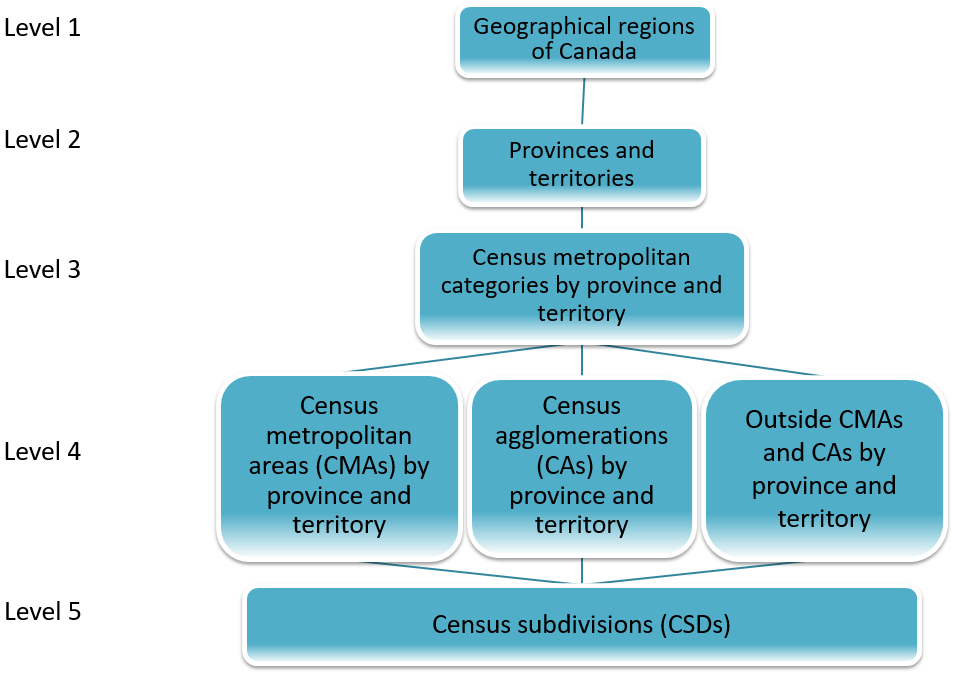
This allows for the classification of the census metropolitan categories, the census metropolitan areas, census agglomerations and census metropolitan influenced zones, by provincial and territorial parts. The hierarchical structure of the classification is shown in Figure 3.
Figure 3 Statistical Area Classification by Province and Territory - Variant of SGC 2021Description of Figure 3
Level 1 - Geographical regions of Canada
Level 2 - Provinces and territories
Level 3 - Census metropolitan categories by province and territory
Level 4 - Census metropolitan areas (CMAs) by province and territory, Census agglomerations (CAs) by province and territory, Outside CMAs and CAs by province and territory
Level 5 - Census subdivisions (CSDs)
A provincial or territorial part designation is included with the name of the census metropolitan category by province and territory. For example, under the province of Manitoba, the three categories of this level are:
Census metropolitan areas (Manitoba)
Census agglomerations (Manitoba)
Outside census metropolitan areas and census agglomerations (Manitoba)
Individual geographic units by province are presented for the census metropolitan areas (CMAs) and census agglomerations (CAs) by province. This is useful for the separate analysis of one CMA and three CAs that have provincial parts. The codes and names of the provincial parts of the CMAs and CAs are:
24 505 Ottawa–Gatineau (Quebec part)
35 505 Ottawa–Gatineau (Ontario part)
13 330 Campbellton (New Brunswick part)
24 330 Campbellton (Quebec part)
24 502 Hawkesbury (Quebec part)
35 502 Hawkesbury (Ontario part)
47 840 Lloydminster (Saskatchewan part)
48 840 Lloydminster (Alberta part)
The census metropolitan influenced zones by province and territory are also presented as provincial and territorial parts. For example, under the province of Quebec, the categories are:
The Statistical Area Classification (SAC) - Variant of SGC 2021 groups census subdivisions (CSDs) according to whether they are a component of a census metropolitan area (CMA), a census agglomeration (CA) or a census metropolitan influenced zone (MIZ).
CSDs form the lowest level of this classification variant. The next level of this classification variant consists of individual CMAs, CAs and MIZs. The highest level of this classification variant consists of three categories that cover all of the landmass of Canada:
CMAs (Canada)
CAs (Canada)
Outside CMAs and CAs, also known as the MIZs (Canada)
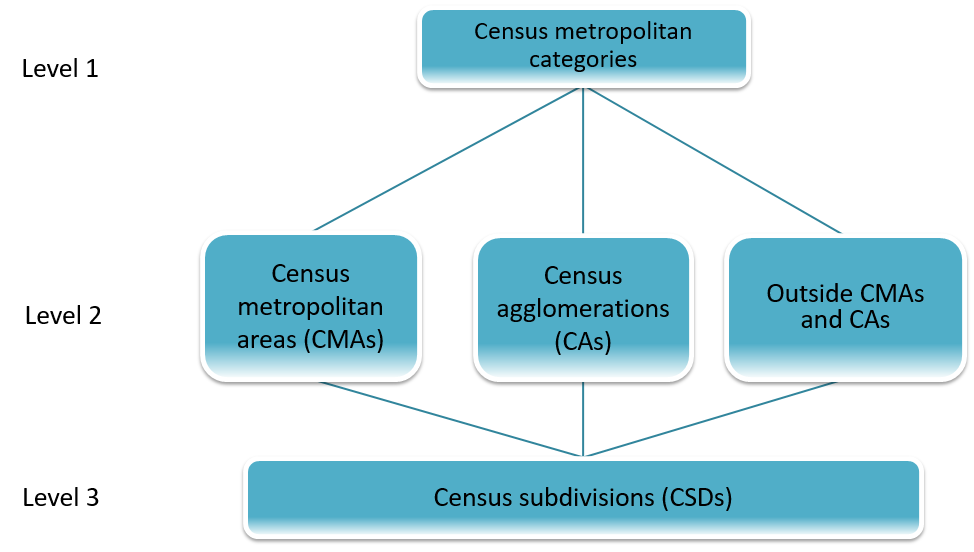
The SAC provides unique numeric identification (codes) for these hierarchically related geographic areas. It was established for the purpose of reporting statistics. The hierarchical relationship of the geographic areas is shown in Figure 2.
Figure 2 Statistical Area Classification - Variant of SGC 2021Description of Figure 2
Level 1 - Census metropolitan categories
Level 2 - Census metropolitan areas (CMAs), Census agglomerations (CAs), Outside CMAs and CAs
Level 3 - Census subdivisions (CSDs)
Census metropolitan area and census agglomeration
A Census metropolitan area (CMA) and census agglomeration (CA) is formed by one or more adjacent municipalities centred on a Population centre (POPCTR) (known as the core). A CMA must have a total population of at least 100,000, based on data from the current Census of Population Program, of which 50,000 or more must live in the core based on adjusted data from the previous Census of Population Program. A CA must have a core population of at least 10,000, also based on data from the previous Census of Population Program. To be included in the CMA or CA, other adjacent municipalities must have a high degree of integration with the core, as measured by commuting flows derived from data on place of work from the previous Census Program.
Census metropolitan influenced zone
The Census metropolitan influenced zone (MIZ) is a concept that geographically differentiates the area of Canada outside census metropolitan areas (CMAs) and census agglomerations (CAs). Census subdivisions (CSDs) within provinces that area outside CMAs and CAs are assigned to one of four categories according to the degree of influence (Strong, moderate, weak or no influence) that the CMAs or CAs have on them. CSDs within the territories that are outside CAs are assigned to a separate category.
All of the landmass of Canada outside CMAs and CAs are classified by the five MIZ in the classification variant. For example, all areas in Canada with no metropolitan influence are classified as "No metropolitan influenced zone (Canada)". Where "Canada" appears in brackets, it may be omitted when the context provides clarification.
The coding structure
Each of the three levels of the classification variant covers all of Canada. For the first level consisting of the census metropolitan categories, an alpha code has been introduced:
A: Census metropolitan areas (CMAs) (Canada)
B: Census agglomerations (CAs) (Canada)
C: Outside CMAs and CAs, also known as the census metropolitan influence zones (MIZs) (Canada)
In the second level, three-digit numeric codes are used for individual CMAs, CAs and MIZs.
The codes for a CMA, a CA and a MIZ are shown in the following illustration:
Codes for a CMA, a CA and a MIZ
Census metropolitan category
CMA/CA/MIZ code
Name
A
001
St. John's
B
015
Corner Brook
C
996
Strong metropolitan influenced zone (Canada)
The last level consists of the census subdivision codes as described in the classification version. Each census subdivision is part of a CMA, a CA or is categorized as part of a MIZ.
An Economic region (ER) is a grouping of complete Census division (CD) (with one exception in Ontario) created as a standard geographic unit for analysis of regional economic activity.
Such a unit is small enough to permit regional analysis, yet large enough to include enough respondents that, after data are screened for confidentiality, a broad range of statistics can still be released.
The regions are based upon work by Camu, Weeks and Sametz in the 1950s. At the outset, boundaries of regions were drawn in such a way that similarities of socio-economic features within regions were maximized while those among regions were minimized. Later, the regions were modified to consist of counties which define the zone of influence of a major urban centre or metropolitan area. Finally, the regions were adjusted to accommodate changes in CD boundaries and to satisfy provincial needs.
An ER is a geographic unit, smaller than a province, except in the case of Prince Edward Island and the Territories. The ER is made up by grouping whole CDs, except for one case in Ontario, where the city of Burlington, a component of Halton (CD 35 24), is excluded from the ER of Toronto (ER 35 30) and is included in the Hamilton–Niagara Peninsula ER (ER 35 50), which encompasses the entire census metropolitan area of Hamilton.
ERs may be economic, administrative or development regions. Within the province of Quebec, economic regions are designated by law (les régions administratives). In all other provinces, economic regions are created by agreement between Statistics Canada and the provinces concerned.
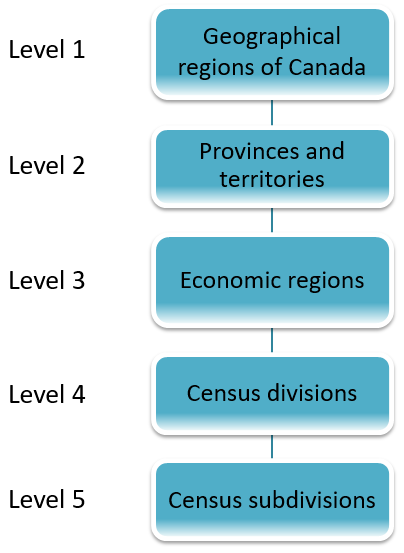
There were 76 ERs in 2021. ERs are listed with their component CDs.
Figure 4 Economic Regions - Variant of SGC 2021Description of Figure 4
Census agricultural regions (CARs) and Census consolidated subdivisions (CCSs) are used by the Census of Agriculture for disseminating agricultural statistics. A CAR is composed of groups of adjacent census divisions (CDs). A CCS is a group of adjacent census subdivisions (CSDs) within the same CD.
For 2021, two changes to the composition of CARs were made to allow for the creation of this variant:
CARs are now defined for the territories
In Saskatchewan, CARs now respect CD boundaries.
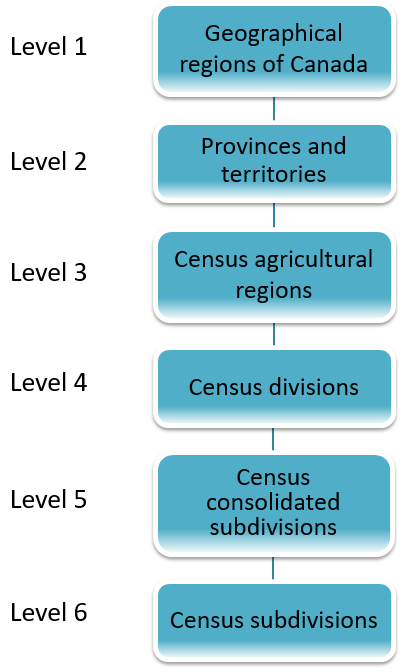
There were 72 CARs in 2021. CARs are listed with their component CDs.
For 2021, many smaller 2016 CCSs have been amalgamated in order to create contiguous areas and reduce data suppression. CCSs are listed with their component CSDs.
Figure 5 Agricultural Regions - Variant of SGC 2021Description of Figure 5
2021 marked the 355th anniversary of the first census
2A (short-form census): 75% of Canadian households received the short-form questionnaire, covering the following topics: age, sex at birth, gender, relationships of household members, marital status, language and Canadian military service.
2A-L (long-form census): 25% of Canadian households received the long-form questionnaire, covering the above-mentioned topics as well as activities of daily living, sociocultural information, mobility, education, and labour market activity.
Participating in the census
As in previous years, the 2021 Census was mandatory. All residents of Canada were legally required to complete a census questionnaire, in accordance with the provisions of the Statistics Act.
Major releases from the 2021 Census
Beginning February 9, 2022, there will be seven major 'themed' release dates for the dissemination of data from the 2021 Census of Population. Each major release by theme will be highlighted in The Daily, Statistics Canada's official release bulletin, and each major release will offer data, analytical, and reference products.
The next release, on April 27, 2022, will look at the pace of population aging and showcase Canada's oldest and youngest communities. For the first time, we will release census information about gender identity in Canada. We will also take a look at the living arrangements of young adults to see how they may have been affected by the pandemic. There are many other stories to come.
July 13 – Portrait of Canada's families and households
Canadian Military Experience
Income profile of Canadians;
August 27 – Linguistic diversity;
September 21 – First Nations people, Metis and Inuit in Canada;
Canada's housing portrait
October 26 – Ethnocultural and religious composition of our country
Portrait of citizenship and immigration in Canada
Ethnocultural and religious composition of the population
Mobility and migration
The final release on education, labour force and instruction in the official minority language will take place on November 30, 2022. Following the completion of the seven major releases, there will be further releases of new analysis and products (dates to be determined).
Why do we conduct the census?
The census paints a portrait of people in Canada and the places where they live.
The census provides high-quality information that is used by all levels of government, businesses, and various community and social services organizations.
Census data are used to administer government programs and plan daycare centres, schools, hospitals, housing, skills training for employment, public transportation and emergency services.
The census is also conducted to meet statutory requirements. The population counts from the census are used to adjust the population estimates, which—in turn—are used to determine representation in Parliament, calculate transfer payments between different levels of government and support various government programs across the country.
Census data are key during the pandemic since they are used for emergency response and preparedness purposes. Local-level census population, age, income and housing data are required by all levels of government to determine who is most vulnerable to the health and economic crisis underway. Furthermore, vaccine allocations have been conducted on a per capitabasis, based on census data.
Census data will help us better understand the impacts of the pandemic on different groups and communities, as well as their evolution since the last census in 2016. Moreover, data collected in the 2021 Census will inform many of the economic and health-related policy decisions that must be made by all levels of government in the coming months and years as the aftermath of the pandemic continues to impact Canadians.
How did we conduct the census?
Statistics Canada adapted to the reality of the pandemic to conduct a safe census that enabled Canadians to tell their story and provide vital information about our country and our communities.
Collection procedures for the census were redesigned to ensure respondents and census employees were safe by limiting the amount of contact needed to participate in this important exercise.
All dwellings were encouraged to complete the questionnaire online to promote as much as possible a contact-free approach to collecting census data.
No census employee from Statistics Canada was permitted to visit or enter institutional collective dwellings (e.g., seniors' homes, long-term care facilities).
Languages and alternate formats
The 2021 Census questions were available in 25 languages (13 Indigenous languages, 12 immigrant languages), in addition to English and French. The census questionnaire was available in only English and French, however, and had to be completed in either English or French.
Materials such as large-print questionnaires and braille, video and audio versions of the questions were available upon request by contacting the Census Help Line.
Content in the census
Statistics Canada undertook a rigorous consultation, testing, review and approval process to ensure that the questions on the 2021 Census respond to demands for key information.
The content proposed by Statistics Canada was submitted to Cabinet and the questions asked in the 2021 Census were prescribed by an Order in Council, as is required by the Statistics Act.
The 2021 Census of Population short form (2A) asked up to 17 questions on topics such as age, sex at birth, gender, relationships of household members, marital status, language and Canadian military service.
The 2021 Census of Population long form (2A-L) contained the same questions as those asked in the short form, but also featured some new and modified questions on ethnic or cultural origins, religion, citizenship and immigration, First Nations people, Métis and Inuit, labour and housing. These changes are outlined in topic-specific fact sheets available on the agency website.
Response rates
The national collection response rates for the Census of Population were as follows:
Note: ICD-O-3 refers to the International Classification of Diseases for Oncology, Third Edition.(5) ICD-10 refers to the International Statistical Classification of Diseases and Related Health Problems, Tenth Revision.(4) ICD-9 refers to the International Statistical Classification of Diseases and Related Health Problems, Ninth Revision.(3)
Throughout the pandemic, Statistics Canada has responded rapidly and with agility to the data needs of various users by developing many new products relevant to COVID-19 and its impacts on Canadians. While this response was agency-wide, this report focuses on two types of products that were developed in the context of the pandemic: 1) products derived from crowdsourcing and probability panels, and 2) specific COVID-19 related health statistics.
This evaluation was conducted by Statistics Canada in accordance with the Treasury Board Policy on Results and Statistics Canada's Risk-based Audit and Evaluation Plan (2020/2021 to 2024/2025). The objective of the evaluation was to provide a neutral, evidence-based assessment of Statistics Canada's data response to COVID-19. The evaluation aimed at providing valuable information about the timeliness, the relevance and the impact of these products. It also looked at some of the related challenges and opportunities faced by the divisions responsible for these products to inform future direction.
The evaluation methodology consisted of a document review, administrative reviews and key interviews with Statistics Canada professionals working in different divisions responsible for social statistics. Additionally, interviews were conducted with key users and partners external to Statistics Canada. The findings outlined in this report are based on the triangulation of these data collection methods.
Key findings and recommendations
Design and delivery
The evaluation reviewed organizational changes that were implemented to develop COVID-19 health and social statistical products. The evaluation found that Statistics Canada took rapid action by assessing and delivering products that shed light on issues of importance during the pandemic. Delivery of COVID-19 statistical products was facilitated by an organizational shift towards business agility, which included innovative approaches to manage resources and analyze data. The dedication of staff was instrumental in the successful release of those products. However, the sheer volume and push for expediency impacted staff well-being.
Responsiveness to users' needs
To inform Statistics Canada on the effectiveness of its response related to social statistical data needs during COVID-19, the evaluation assessed the extent to which the products released addressed the needs of key users. The majority of users considered the products released to be relevant, useful, timely, accessible and unique for providing a national perspective. Although some challenges were noted, users were also satisfied with the agency's level of engagement and the methodological information provided. Finally, users wanted more granular data, particularly regarding at-risk and marginalized populations.
Moving forward
The evaluation assessed the extent to which there is an ongoing need for COVID-19 social and health statistical products and the factors that must be taken into account going forward to deliver both those products and regular programs. Users indicated an ongoing need for health statistics related to the pandemic as well as for crowdsourcing and probability panel products. As the pandemic evolves, more disaggregated data on the differential impacts of COVID-19 on different populations will be needed. Forward approach needs to balance demands arising from emerging data needs, such as disaggregated data, ongoing pandemic information requirements and ongoing program delivery. Opportunities remain to fully explore the lessons learned from the pandemic.
Recommendation 1:
The Assistant Chief Statistician (ACS), Social, Health and Labour Statistics (Field 8), should ensure that a comprehensive strategy is developed to identify, prioritize and respond to emerging data needs (i.e., disaggregated data, ongoing pandemic information requirements and ongoing program delivery).
The strategy should consider the key enablers identified (i.e., prioritization of demands, human resources, ongoing innovation and data sources, user engagement, and internal collaboration), and include approaches and plans that set out how:
emerging data needs will be identified (e.g., stakeholder engagement approaches);
data gaps will be addressed;
data needs will be prioritized based on intended outcomes and resource capacity; and
ongoing monitoring of data needs will be carried out.
Recommendation 2:
The ACS, Social, Health and Labour Statistics (Field 8), should ensure that a lessons learned exercise from the COVID-19 pandemic is conducted to identify approaches that could be applied to respond to COVID-19 data needs and improve core activities going forward.
The lessons learned should be presented to a Tier 1 committee that will provide direction on their potential implementation across the agency, as applicable.
They should also be shared across the agency to foster innovation and continuous improvement in support of the agency-wide response to COVID-19.
Acronyms and abbreviations
ACS
Assistant Chief Statistician
CCAHS
Canadian COVID-19 Antibody and Health Survey
CCHS
Canadian Community Health Survey
CHMS
Canadian Health Measures Survey
CITF
COVID-19 Immunity Task Force
HR
Human resources
IT
Information technology
LFS
Labour Force Survey
NSO
National statistical office
PHAC
Public Health Agency of Canada
SCMH
Survey on COVID-19 and Mental Health
What is covered
The evaluation was conducted in accordance with the Treasury Board Policy on Results and Statistics Canada's Integrated Risk-based Audit and Evaluation Plan (2020/2021 to 2024/2025). In support of decision making, accountability and improvement, the objective of the evaluation was to provide a neutral, evidence-based assessment of Statistics Canada's data response to COVID-19.
Throughout the pandemic, Statistics Canada has responded rapidly and with agility to the data needs of various users by developing many new products relevant to COVID-19 and its impacts on Canadians. The evaluation focused on two types of products that were developed in the context of the pandemic: 1) products derived from crowdsourcing and probability panels, and 2) specific COVID-19 related health statistics. The evaluation aims to provide valuable information about the timeliness, the relevance and the impact of these products. It also looked at some of the related challenges and opportunities faced by the divisions responsible for these products to inform future decisions.
Crowdsourcing and probability panel products
To provide Canadians with the timely data and insight they need to respond to the COVID-19 pandemic, Statistics Canada leveraged two non-traditional methods of collecting information efficiently: crowdsourcing and probability panels.
Crowdsourcing involves collecting information from a large community of users. It relies on the principle that individual citizens are experts within their local environments. All Canadians were eligible to participate; there was no sample selection and participation was voluntary. Data collection was conducted exclusively online by participant self-completion of surveys in a crowdsourcing application. Demographic projections of the number of people by province and territory, sex and age group were used to calculate a benchmarking factor for every participant to compensate for over- and underrepresentation. Because crowdsourcing is non-probabilistic, it has potential selection bias. It is not statistically representative of the general population because it reflects only the views of those who responded.
Probability panels (probabilistic web panels) are a pooling tool that uses a sample of former respondents to the Labour Force Survey (LFS) who volunteer to take supplementary Internet surveys over a set period of time. Since the sample is derived from the LFS, results can be presented with statistical validity. While the panel offers the ability to collect data quickly, there is a greater risk of bias because of some aspects of the design and a lower response rate compared with traditional surveys. It excludes a small portion of the population (e.g., those without Internet access) and it cannot reflect all population groups and geographies.
Crowdsourcing and probability panels enabled Statistics Canada to rapidly gather data and produce analysis on how the COVID-19 pandemic was affecting the lives and well-being of different groups of Canadians. Products derived from both methods explored various dimensions of the COVID-19 impacts on Canadians (e.g., education, employment, mental health, child care, discrimination and stigma, substance abuse, community crime, safety and violence during the COVID-19 pandemic).
Specific COVID-19 related health statistics
In addition to its ongoing health statistics program, Statistics Canada worked closely with federal, provincial and territorial governments and organizations to provide specific COVID-19 related health statistics to Canadians. Those included in the scope of the evaluation encompass:
vital statistics
COVID-19 epidemiological reports
products from upcoming surveys.
To meet the need for more timely information on public health, Statistics Canada has been working collaboratively with its health partners since the beginning of the pandemic to release preliminary health statistics related to COVID-19. These include provisional figures on mortality for vital statistics and the preliminary number of confirmed cases via the COVID-19 epidemiological reports. To continue to provide relevant COVID-19 health data to Canadians, Statistics Canada was also working on two surveys at the time of the evaluation: the Canadian COVID-19 Antibody and Health Survey (CCAHS) and the Survey on COVID-19 and Mental Health (SCMH).
The Evaluation
The scope of the evaluation encompassed two types of products that were developed in the context of the pandemic: 1) products derived from crowdsourcing and probability panels, and 2) specific COVID-19 related health statistics. The scope was established in consultation with the divisions involved in these areas.
Although products derived from crowdsourcing and probability panels were labelled in their own category for the purpose of the evaluation, a number of products derived from these approaches targeted health issues and heavily involved the groups responsible for the specific COVID-19-related health statistics as well.
The evaluation was conducted from November 2020 to April 2021 and covered products listed in Appendix A.
The following issues and questions were identified for review.
Table 1 Evaluation issues & Evaluation questions
Evaluation issues
Evaluation questions
Design and delivery
What actions were taken by Statistics Canada in response to COVID-19 in regard to products derived from crowdsourcing and probability panels, and specific COVID-19 related health statistics?
Responsiveness to users' needs
To what extent did the products released address the needs of key users?
Engagement
Relevance and Utility
Clarity (of methodology)
Timeliness
Access
Moving forward
What factors should be taken into consideration moving forward?
Guided by a utilization-focused evaluation approach, the following quantitative and qualitative collection methods were used.
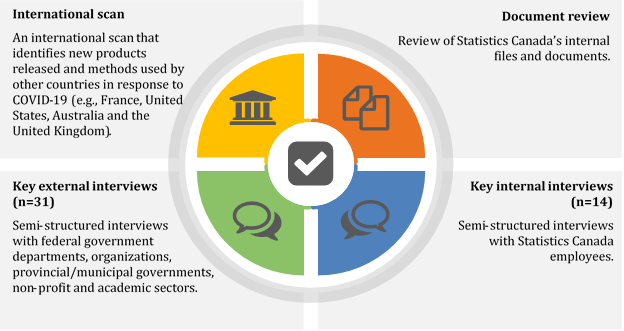
Quantitative and qualitative collection methods usedDescription - Quantitative and qualitative collection methods used
The figure depicts the four collection methods used for the evaluation: international scan, document review, key external interviews, and key internal interviews.
The international scan identified new products released and methods used by other countries in response to COVID-19 (e.g., France, United States, Australia and the United Kingdom).
The document review included a review of Statistics Canada's internal files and documents
The key external interviews included semi-structured interviews with: federal government departments, organizations, provincial and municipal governments, non-profit and academic sectors. There were 31 external interviews conducted.
The key internal interviews included semi-structured interviews with Statistics Canada employees. There were 14 internal interviews conducted.
Three main limitations were identified and mitigation strategies were employed:
Table 2 Limitations and mitigation strategies
Limitation
Mitigation strategy
Because of the large number of users and partners using data, the perspectives gathered through external interviews may not be fully representative.
External interviewees were selected using specific criteria to maximize a strategic reach for the interviews. Different types of organizations that use COVID-19-related data extensively from a wide range of locations across Canada were selected. Evaluators were able to find consistent overall patterns.
Interviews have the possibility of self-reported bias, which occurs when individuals who are reporting on their own activities portray themselves in a more positive light.
By seeking information from a maximized circle of stakeholders, evaluators were able to find consistent overall patterns.
Limited documentation was available on the projects sampled for the evaluation.
Key staff working on the relevant projects were interviewed and a strategy to gather additional documents during the interview sessions was put in place. Additional interviews were conducted as needed to fill the gaps.
What we learned
1. Design and delivery
Evaluation question
What actions were taken by Statistics Canada in response to COVID-19 in regard to crowdsourcing and probability panel products and specific COVID-19 related health statistics?
Summary
The evaluation reviewed organizational changes that were implemented to develop COVID-19 health and social statistical products. The evaluation found that Statistics Canada took rapid action by assessing and delivering products that shed light on issues of importance during the pandemic. Delivery of COVID-19 statistical products was facilitated by an organizational shift towards business agility, which included innovative approaches to manage resources and analyze data. The dedication of staff was instrumental in the successful release of these products; however, the sheer volume and push for expediency impacted staff well-being.
In response to COVID-19, Statistics Canada took rapid action to assess the impacts of the pandemic on Canadians by releasing various statistical products and using innovative approaches
The COVID-19 pandemic continues to have significant impacts on Canadians. During this crisis, timely and credible data has been crucial to understanding and managing the health and social effects of the pandemic. In response to COVID-19 data needs, Statistics Canada developed new products and adapted some of their regular products. These aimed at providing more timely and relevant data for monitoring the impacts of the pandemic on Canadians. Products were developed by the Census Subject Matter, Social Insights, Integration and Innovation Branch (Centre for Social Data Insights and Innovation Division and Centre for Social Data Integration and Development Division) and the Health, Justice, Diversity and Populations Branch (Centre for Population Health Data Division and Diversity and Sociocultural Statistics Division) under the Social, Health and Labour Statistics Field. Both branches worked in close collaboration, particularly on health data produced through crowdsourcing and probability panel approaches. Other divisions involved in various support functions (e.g., communications, information technology (IT), methodology, collection) also contributed significantly to the timely delivery of COVID-19 statistical products.
Crowdsourcing and probability panels
As part of Statistics Canada's modernization, crowdsourcing and probability panels have become innovative ways to collect information rapidly and efficiently for statistical purposes. During the early stages of the pandemic, Statistics Canada launched a series of online crowdsourcing and probability panel questionnaires to collect data on how Canadians were reacting. These alternative methods of collecting information enabled delivery of results within three weeks of collection.
Between the summer and fall of 2020, over 70 information products derived from crowdsourcing and probability panels were produced to inform Canadians. The products were disseminated through public use microdata files and communicated through releases in The Daily and other analytical products.
Specific COVID-19 related health statistics
Vital statistics
Vital statistics are gathered through an administrative survey that collects demographic and medical information (cause of death) annually and monthly from all provincial and territorial vital statistics registries on all deaths in Canada. In the context of the pandemic, the duration of data collection was shortened considerably. Since May 2020, Statistics Canada has been releasing provisional figures on excess mortality and causes of death, including deaths attributed to COVID-19. The data released were provisional as they were not based on all deaths that occurred during the reference period because of reporting delays and did not include the Yukon. These provisional death estimates were adjusted to account for incomplete data where possible and were revised monthly as new information became available.
COVID-19 epidemiological reports
As part of its continued commitment to provide Canadians with much-needed information during the pandemic, Statistics Canada partnered with the Public Health Agency of Canada (PHAC) to make preliminary information on the number of COVID-19 cases available to the public. Beginning in March 2020, epidemiological reports on detailed confirmed cases (preliminary data) were released on a weekly basis until July 2020, at which time the frequency was changed to biweekly. Aggregated datasets with preliminary case information across six dimensions were also released on an occasional basis. Given the rapidly evolving nature of the pandemic and the multi-tiered approach to data collection on case reporting, epidemiological reports were considered preliminary. Confirmed case data (laboratory-confirmed cases of COVID-19) were collected by PHAC from various sources, including provincial and territorial health ministries. These data were not considered comprehensive, given a possible time lag between when cases occur and when they are reported. Cases in this database may be revised as new information is captured related to a person's hospitalization status, intensive care unit admittance or death. Data were collected for all units of the target population (entire Canadian population); therefore, no sampling was done.
Upcoming surveys
The CCAHS is a voluntary survey to learn about how the COVID-19 virus impacts overall health, how it spreads and whether Canadians are developing antibodies against it. The content of the survey was developed by Statistics Canada with input from the COVID-19 Immunity Task Force (CITF) and in consultation with Health Canada and PHAC. The CCAHS is a unique survey that will collect information in two parts. The first part is an electronic questionnaire about general health and exposure to COVID-19. The second part is an at-home finger-prick blood test, which is sent to a lab to determine the presence of COVID-19 antibodies. The target population for the survey is people 1 year of age and older (children under 14 will have the questionnaire completed by a parent or guardian) living in the 10 provinces or 3 territorial capitals. Respondents will be contacted via mail and provided with a code to access an online questionnaire and a dried blood spot kit to collect their blood sample.
The SCMH collects data to assess the impacts of COVID-19 on the mental health and well-being of Canadians. The survey includes topics on behaviours and symptoms associated with depression, anxiety and post-traumatic stress disorder, suicide risk, pressure on parents, substance use, household violence, as well as general mental health. Participation is voluntary and the target population is non-institutionalized people aged 18 years or older, living in Canada's 10 provinces and 3 territorial capitals, who are not members of collectives or living on reserves.
Common approaches were used by other national statistical offices to develop products addressing COVID‑19 statistical data needs
In the early months of the pandemic, Statistics Canada faced similar challenges and constraints to those experienced by other national statistical offices (NSOs): lockdowns, deferral of regular activities, surging demands for disaggregated data and rapid statistics on the impacts of COVID-19. Within this context, Statistics Canada's approach to measuring the social impacts of COVID-19 generally aligned with that of other jurisdictions in terms of major themes covered, methodologies utilized and data disaggregation. The evaluation did not find major content gaps with respect to social and health surveys conducted in other jurisdictions. Statistics Canada's crowdsourcing and probability panel products explored very similar topics to panel surveys conducted by NSOs in Australia and the United States, both of which were developed in response to the pandemic, and the United Kingdom's omnibus survey, which was modified to increase frequency from monthly to weekly in response to COVID-19. The level of methodological detail provided by Statistics Canada also aligned with the type of information provided by other NSOs.
The main difference between Statistics Canada's approach and that of other NSOs was the agency's use of crowdsource questionnaires to explore the social impacts of COVID-19 (although France's public health agency employed a similar approach). Relative to other NSOs, Statistics Canada was one of the first to publish data in response to the pandemic.
Delivery of COVID-19 statistical products was facilitated by an organizational shift towards business agility and through the agency's modernization initiatives
Much of the agency's response to the pandemic was rolled up into a special project to ensure expediency and efficiency. As part of this special project, several initiatives that were already under development, such as crowdsourcing and probability panels, were accelerated, adapted and operationalized. To ensure the timely delivery of products related to COVID-19, changes were also made to organizational approaches and internal processes to increase agility.
Processes for crowdsourcing and probability panels were focused on expediency; an iterative approach led to shortened timelines. The processes were not fundamentally modified, but implemented at an accelerated pace with the objective of making improvements after each iteration. Because of the speed of response, there were some instances of data quality issues early on, as well as a need to educate some employees about the limits of these approaches in the beginning. However, these issues were addressed over time.
For COVID-19 related health statistics, process changes accelerated their development, analysis and release. For example, content development and analysis timelines were shortened by implementing quicker turnaround times. Some steps and subprocesses were accelerated and adapted even if the same overall process was followed. For example, editing or approval time was reduced for the SCMH and the CCAHS. For vital statistics, methodological changes were developed in collaboration with the Modern Statistical Methods and Data Science Branch and the Centre for Demography to produce provisional figures.
Changes in governance processes also accelerated decision-making and were generally seen as necessary and positive. Early in the pandemic, most existing oversight bodies halted operations, except the Strategic Management Committee, which continued to ensure alignment with strategic direction. The increased involvement of management in operational activities also presented opportunities to identify and approve process modifications to address challenges or bottlenecks.
In addition, existing and new bodies facilitated decision-making, action and implementation of response. For example, for crowdsourcing and probability panels, the new Social Impacts and New Data Development Working Group facilitated the agency's ability to collaborate and work horizontally, serving as the key body for planning and decision-making. For specific COVID-19 related health statistics, new and existing bodies (e.g., Centre for Social Data Insights and Innovation, CCAHS interdepartmental working group, CITF) enabled prioritization, increased awareness across participating divisions, and provided opportunities to solicit and share feedback from partners.
Statistics Canada's response was also facilitated by innovation projects and organizational culture shifts linked to its modernization agenda, which focused on the pillars of user-centric service delivery, leading edge methods and data integration, statistical capacity building and leadership, sharing and collaboration, and a modern and flexible workplace. For example, prior development of crowdsourcing and probability panel methods as part of the modernization initiative were integral in mounting a timely response. Electronic tools and processes (e.g., previously developed electronic questionnaires, system to collect vital statistics from provinces and territories) also facilitated increased speed of data collection and response. The modernization agenda also provided traction to further shift the organization towards innovation and collaboration which facilitated the agency's COVID-19 data response.
A flexible and dedicated workforce with a shared sense of purpose was instrumental in the successful release of products, though pace of work impacted staff well-being
At the onset of the pandemic in March 2020, Statistics Canada's primary focus was on maintaining its mission-critical programs and addressing data needs related to COVID-19. Within the Social, Health and Labour Statistics Field, virtually all other activities and initiatives (e.g., development of the Canadian Health Measures Survey [CHMS], mental health data strategy, opioid epidemic data acquisition) were put on hold, which provided flexibility in the reorganization of work and reassignment of employees. For instance, resources and expertise were shared across teams and reallocated to areas of priority. For example, staff working in areas that were temporarily put on hold, such as the CHMS, were redirected to work on the CCAHS.
The collective sense of urgency to meet the informational needs of Canadians drove decisions regarding content and timelines. Communication, coordination and collaboration between divisions within the Social, Health and Labour Statistics Field and across the agency were critical success factors that contributed to the timely release of COVID-19 products. Support provided by corporate partners (i.e., Communications Branch, Modern Statistical Methods and Data Science Branch, Collection and Regional Services Branch, Processing and Operations Branch) was also crucial in the production and dissemination of statistical information. Though program areas noted some opportunities to further increase efficiency (e.g., prioritizing demands, adopting leaner processes, improving IT infrastructure and tools), corporate partners were viewed as responsive and helpful in the face of tight timelines. Overall, the evaluation found that the successes and timeliness of the COVID-19 data response were greatly attributable to the dedication, expertise and flexibility of the workforce.
While employees' drive and adaptability were integral to the delivery of data, the increased workloads and tight timelines contributed to lower employee morale in some areas, as well as the delay of projects not related to the pandemic. Employees worked considerable overtime, frequently for a sustained period, to deliver on the COVID-19 products, often with limited available resources. Almost all internal key interviewees reported that the high volume of work and tight timelines increased stress and anxiety or otherwise negatively impacted the mental health and well-being of employees. They also discussed a reduction in work-life balance associated with workloads, coupled with external challenges such as increased family stress during the pandemic (e.g., because of senior or child care responsibilities). Additionally, some pointed out that certain employees with critical areas of expertise were especially overburdened with work and faced detrimental effects to their well-being. Challenges were largely mitigated by employees' hard work, enthusiasm and a shared sense of purpose in meeting the data needs of Canadians during a period of uncertainty. Further, internal interviewees noted that the adverse effects on employee well-being as a result of increased workloads and tight timelines were somewhat mitigated by recognition and appreciation of their hard work, as well as the support provided by their managers.
Finally, the evaluation found that heightened expectations of staff did not significantly lessen over time. Resource allocation to COVID-19 products delayed regular program activities or initiatives outside of mission-critical programs. Many internal interviewees found the impacts on staff well-being to be somewhat manageable early on in the pandemic response, when other work was largely on hold. As other work began to resume by fall 2020, however, continued resource allocation to COVID-19-specific products meant delays to numerous regular programs activities or initiatives, such as work on meeting users' needs for disaggregated data, development of the CHMS, and work on the Mental Health Data Strategy and Northern Data Strategy. There is some indication that these challenges will continue to hinder the response of program areas to emerging data demands going forward.
2. Responsiveness to users' needs
Evaluation question
To what extent did the products released address the needs of key users?
Engagement
Relevance and Utility
Clarity (methodology)
Timeliness
Access
Summary
To inform Statistics Canada on the effectiveness of its response related to social statistical data needs during the pandemic, the evaluation assessed the extent to which the released products addressed the needs of key users. The majority of users considered the products released to be relevant, useful, timely, accessible and unique for providing a national perspective. Although some challenges were noted, users were satisfied with the agency's level of engagement and the methodological information provided. Finally, users wanted more granular data, particularly related to at-risk and marginalized populations.
Statistics Canada received an influx of data demands primarily through informal channels; new bodies and mechanisms were used to manage these demands
In the spring of 2020, Statistics Canada faced significant challenges including adapting to telework and new internal processes, while at the same time contending with major shifts and increases in user demands for relevant COVID-19 data. Facing the influx of data demands, time constraints and decentralized mechanisms for gathering users' needs presented challenges at times. Internal interviewees emphasized that, during the early stages of the pandemic, the pressure to produce information fairly quickly left little or no time to proactively reach out to users about their data needs. It was also noted that, had time constraints been less urgent, it would have been advantageous to actively consult a broader base of users.
Nonetheless, the evaluation found that most users had opportunities to communicate their needs to Statistics Canada, particularly through their existing contacts within the agency and ad hoc correspondence (e.g., meetings, emails, phone calls) at all levels and areas of the organization. Well-established networks with health partners (e.g., partnerships in the production of vital statistics) and formal structures (e.g., at the same table, council) were also leveraged to share information on data needs.
Early in the pandemic, the emphasis on informal mechanisms to understand users' needs before and after product releases presented some challenges for information management and prioritization (e.g., survey content had to be revised after users reached out with demands to senior management, at times slowing work). Many of these challenges were mitigated through new bodies and mechanisms to manage users' demands, such as the Social Impacts and New Data Development Working Group. This working group was noted as a key factor in the successful delivery of COVID-19 products. It brought together assistant directors, directors and subject matter experts from across the organization to better identify and prioritize critical data needs about the social impacts of the pandemic, including health statistics that would be filled through crowdsourcing and probability panel methods. It served as a funnel to screen and prioritize users' demands, and communicate needs and decisions to users. This working group enabled processes to prioritize demands, raise awareness across participating divisions, and exploit opportunities to solicit and share feedback from partners.
As Statistics Canada's pandemic response evolved, more structured and proactive mechanisms were used to engage users (e.g., COVID-19 Social Impacts Network, CITF, presentations to users, interdepartmental working groups and committees). In regard to COVID-19 related health statistics, these mechanisms were used alongside ad hoc communication to engage more frequently with partners from provincial and territorial governments, partners at federal departments and experts within academia.
While most users were satisfied with the level of responsiveness and communication from Statistics Canada, some opportunities for improvement were noted
Based on external interviews, the majority of users and partners had the opportunity to share their needs with Statistics Canada and were satisfied with the agency's level of engagement. They were satisfied with the effectiveness of the well-established relationships with Statistics Canada and noted how fast and responsive the agency was to respond to their inquiries. Health partners, specifically, commonly discussed their strong and mutually beneficial relationship with Statistics Canada, the value of its expertise and an increase in the overall level of collaboration during the pandemic; they hoped the high level of responsiveness would continue in the future.
However, some challenges were identified by key users. For example, it was difficult at times to find the right contact or identify the right mechanism to communicate their needs to the agency, especially among those who did not have well-entrenched relationships with Statistics Canada. Additionally, though they acknowledged the time pressures, some users stated that they would have desired a more proactive, formalized and strategic approach to engagement. These users also pointed out that, rather than a one-time conversation, engagement and communication should be actively sought throughout product life-cycle, from content development, to proactive communications around product releases, to seeking feedback from users after product releases. A few of these users suggested that, going forward, an engagement strategy or a dedicated engagement group would be beneficial. Overall, there was a general sense from users that their expectations have been raised for the future.
Both internal and external interviewees highlighted that health information in Canada relies on a complex governance structure involving a number of players and stakeholders, of which Statistics Canada is one. Collaboration at the federal level plays a crucial role in Statistics Canada's production of health data via subject-matter knowledge sharing and funding of some data and surveys. The agency works in partnership with provincial and territorial vital statistics registrars and cancer registries, as well as data providers and users at the federal level (Health Canada and PHAC), provincial level (provincial ministries of health), regional level (health regions) and with many other partners (e.g., Canadian Institute for Health Information). Jurisdictional complexities and a fragmented data environment contribute to challenges in collaboration among Canadian health data partners.
Many interviewees noted that the production of COVID-19 data as a whole highlighted the need for a more coordinated approach in presenting public health data to Canadians. For instance, several federal health partners discussed how they would have benefited from clearer communication about products that were planned or being released by Statistics Canada. Partners suggested that this could prevent a duplication of efforts and give them an opportunity to provide the agency with more of their data needs as well as their subject-matter expertise. Moreover, several partners discussed challenges in clarifying roles and responsibilities between federal health partners in the production of pandemic-related health statistics. Additionally, most partners interviewed perceived missed opportunities for data sharing that would have enabled them to provide insights and receive more advanced notice prior to releases. Some expressed a continued need to improve governance processes around collaboration. For example, the need to address jurisdiction and data-sharing challenges, including those between Statistics Canada and other governmental departments. For instance, many internal and external interviewees discussed challenges pertaining to vital statistics data collected by provinces and territories and shared with federal partners, and the importance of strengthening these partnerships and improving IT infrastructure.
Statistics Canada played a key role in meeting evolving needs—products released were used for policy analysis, modelling, decision-making and the creation of knowledge products
The evaluation found that most users felt that the new products were useful, they filled information gaps, or otherwise strengthened the evidence base from which users could inform their work and make decisions. These products also provided an overall national picture of the impacts of the pandemic and allowed for comparisons across jurisdictions at a high level. Crowdsourcing and probability products were used for briefing purposes, policy research and analysis, program and service planning and decision-making, and to a lesser extent, for creating knowledge products and modelling. Key users of COVID-19 related health statistics also used the information for briefing purposes and for creating knowledge products for other audiences, modelling, and to a lesser extent, program and service planning, decision making and public health surveillance and health system monitoring.
Because the impacts of COVID-19 go beyond the effects of the virus, users wanted data on both the direct and indirect impacts of the pandemic, especially in relation to identity factors (e.g., ethnicity, gender) and intersectionality. Based on interviews, users were interested in products related to various health and social impacts of COVID-19, including vital statistics and mortality, mental health and well-being, impacts on families, impacts on health services and other unintended consequences of COVID-19 response measures (e.g., employment, school closures).
As depicted in Appendix B, webtrends data from the Statistics Canada website indicate that many of the topics that users' needed information on were well aligned with the most popular probability panel and crowdsourcing products. Additionally, these webtrends data also showed a significant increase in demand for vital statistics and mortality data, compared with historical use (these products made up 6 of the top 10 products from April 2020 to March 2021); COVID-19 epidemiological data were also highly viewed relative to other Statistics Canada data products.
Statistics Canada's products were largely considered unique by users; however, they wanted more granular data, particularly regarding at-risk and marginalized populations
The evaluation found that external users readily used Statistics Canada products and noted that they represented the best source of information available, particularly in the early days of the pandemic. While some complementary products were available from other organizations, Statistics Canada's new products served a unique purpose for most users. In some cases, users said new Statistics Canada information was used as a supplement to other sources (e.g., cross-referencing with member feedback, other studies) or incorporated into an index, suggesting relevance and usefulness even when alternatives existed.
Further, the evaluation found that users felt there was minimal duplication between information produced by Statistics Canada and that produced by other organizations. Many used the agency's products because they were the highest quality or the only information available, especially early on. Although health data are produced by a variety of jurisdictions, users noted the uniqueness and value of the national level COVID-19 related health statistics provided by Statistics Canada. Many external users from different types of organizations noted that they use new Statistics Canada information despite any limitations because it was the best source available or there were no alternatives.
However, the evaluation found that there were a number of areas in which external users sought additional data related to COVID-19. Even within the topics covered by Statistics Canada's products, many users identified areas in which they saw data gaps. For example, almost half of key users of COVID-19 related health statistics discussed gaps pertaining to impacts of the pandemic on subgroups (e.g., individuals with chronic conditions, seniors, caregivers). Users of probability panel and crowdsourcing products also highlighted gaps pertaining to the impacts on children and families in regard to learning, parenting, child care and violence at home.
Users frequently identified a desire for greater disaggregation to address their specific information needs, especially to conduct equity analyses as well as to support more local or population-specific program and service planning. Many users discussed the need to have more granular information for areas such as at-risk and marginalized populations (e.g., Indigenous groups), and in particular how COVID-19 was impacting these populations. Some also noted their understanding of the limited coverage on marginalized populations, partly because of the challenges in reaching some populations, particularly for crowdsourcing, which is open to the public but requires Internet access.
Additionally, some users were interested in more data that would track the impacts of the pandemic over time; several users mentioned a need for probability panel and crowdsourcing products to track trends over time and follow up on previous surveys. More generally, some users discussed a need for more data that track changes in social measures and well-being.
Methodologies used by Statistics Canada, as well as their related strengths and limitations, were understood by users; some opportunities for improvement were noted
The evaluation found that a majority of users consulted were aware of the strengths and limitations of crowdsourcing, probability panel and health statistics. Methodological information, including limitations, was documented and published in The Daily with the releases of the products. Users were also kept informed through their engagement with Statistics Canada's employees. Methodological information released by the agency was also included in briefings for decision-makers.
Some opportunities for improvement were noted regarding the communication of methodological information. Users desired more information about limitations in simple language, particularly about the lack of demographic disaggregation. It was also noted that methodological information for COVID-19 related health statistics was less apparent than usual and that labelling crowdsourcing as a "survey" created some confusion at the beginning.
A few users chose not to use crowdsourcing data because of a lack of representation, comparability and disaggregated data (e.g., limited coverage of marginalized populations, caused partly by challenges in reaching some populations with limited Internet access). Despite these limitations, the majority of users were satisfied overall with the crowdsourcing and probability panel methodologies used, given the lack of alternatives to produce similar data in a timely manner.
Based on the experience of using crowdsourcing data during the pandemic, users foresee value for the continued use of this approach. Although they would prefer an increased use of probabilistic samples where possible, many would consider continuing to use crowdsourcing for "pulse checks" and urgent informational needs. To increase the participation of marginalized populations in crowdsourcing, some users suggested a combined approach with a telephone option, as well as partnering with the organizations that serve marginalized populations to extend reach. In addition, users indicated that crowdsourcing could grow with more guidance and controls (e.g., when its use is most appropriate given the limitations). As a majority of users consulted were not able to comment extensively on probability panels, there may be an opportunity to raise awareness about this tool.
Generally, users were aware of Statistics Canada releases and satisfied overall with both the timeliness and the accessibility of data
Timeliness was of particular importance to users, given the need to rapidly adapt and respond to the uncertainty of the evolving landscape during the pandemic. The evaluation found that COVID-19 products were considered timely or at least somewhat timely, though health users wanted even timelier data. Almost all users acknowledged the fast turnaround of results and general timeliness of the agency's response. For health statistics, there was a high need and expectation for timely and frequent (even "real-time") health information. This was partially driven by users benchmarking against other data providers and statistical agencies. However, it is important to note that a key contributing factor beyond Statistics Canada's control was the delay in receiving data from provinces, territories and PHAC for vital statistics and epidemiological reports. Overall, users expressed gratitude for the fast turnaround of products.
Accessibility and product awareness were also important for users and most felt they had a good overall awareness of the data and found it accessible. Most users accessed the new products through the website and encountered no barriers, although several expressed a need for the improvement of website navigability.
Some health partners expressed a need for earlier and enhanced access to unpublished data through data-sharing agreements, especially those involved in the production of the data. These partners wanted improved and earlier communication about what products would be released and when.
3. Moving forward
Evaluation question
What factors should be taken into consideration moving forward?
Summary
The evaluation assessed the extent to which there is an ongoing need for COVID-19 social and health statistical products and the factors that must be taken into account going forward to deliver both those products and regular programs. Users indicated an ongoing need for health statistics related to COVID-19 as well as for crowdsourcing and probability panel products. As the pandemic evolves, more disaggregated data about the differential impacts of COVID-19 on different populations will be needed. The forward approach needs to balance demands arising from emerging data needs, such as disaggregated data, ongoing pandemic information requirements and ongoing program delivery. Opportunities remain to fully explore the lessons learned from COVID-19.
While users foresee a continued need for current COVID-19 products, their focus has started to shift towards data needs to monitor pandemic recovery
Key users indicated an ongoing need for health statistics related to COVID-19, such as vital statistics, and data on topics such as mental health, vaccines, immunity and impacts on health services (e.g., health workforce, wait times). They also foresaw a need for products deriving from crowdsourcing and probability panels as the pandemic evolves. Crowdsourcing in particular could be leveraged to fill urgent social data needs in the absence of probabilistic alternatives.
Key users identified the following emerging topics mainly focusing on some of the longer-term impacts of the pandemic and its recovery:
greater understanding of health impacts related to COVID-19, including long-haulers
information on COVID-19 vaccination including uptake, readiness and hesitancy
longer-term mental health outcomes and impacts
impacts on health services, including wait times, diagnoses and the health workforce
information on labour market changes, such as skills in demand and changes in location of work.
In addition, more disaggregated data on differential impacts of COVID-19 on different populations will be needed as the pandemic evolves; other methods, such as longitudinal studies and data linkage, could be leveraged to generate new insights.
Statistics Canada is aware of the current data needs and intends to fill some of these gaps with a number of initiatives (e.g., creation of the SCMH, adapting the Canadian Community Health Survey [CCHS] to the COVID-19 context, planning an omnibus survey, leveraging the Disaggregated Data Action Plan, ongoing discussions with different stakeholders).
Forward approach needs to balance demands arising from emerging data needs, such as disaggregated data, ongoing pandemic information requirements, and ongoing program delivery; several key enablers for success were identified
Statistics Canada's rapid response to COVID-19 underscored its ability to meet new data needs during an unprecedented period. The COVID-19 statistical products released were largely considered relevant, timely and useful. Releases of related health statistics were accelerated and experimental approaches (i.e., crowdsourcing and probability panels) were leveraged to deliver quick results. Overall, users were satisfied with these products given that they provided rapid information during a period of crisis.
To release the COVID-19 products in a timely manner, a significant increase in workload was necessary, which resulted in a sense of fatigue further exacerbated when work resumed for activities and initiatives previously put on hold. This sense of fatigue was also felt by corporate partners, given their essential supporting role in the rollout of the COVID-19 products. In addition to these and regular activities, a number of new initiatives (e.g., creation of the SCMH, adapting the CCHS to the COVID-19 context, planning an omnibus survey, leveraging the Disaggregated Data Action Plan) are at their initial stages which will further add to the workload of divisions, including supporting divisions of corporate partners.
In light of this context, the forward approach must balance demands arising from emerging data needs, such as disaggregated data, ongoing pandemic information requirements, and ongoing program delivery. It should also take into consideration the increased level of effort required by divisions and corporate partners supporting divisions. Prioritization of demands, human resources (HR), ongoing innovation and data sources, user engagement, and internal collaboration were identified as key enablers during internal interviews.
Chart 1: Key enablers to balance demands arising from emerging data needs
Prioritization of demands
As the pandemic evolves, user's data needs will also evolve (e.g., data to monitor recovery) and a robust approach to prioritization that effectively balances arising demands will be needed. The approach to prioritization will also need to consider the capacity of corporate partners (e.g., IT, methodology, collection and communications).
Human resources
HR management will be crucial to maintaining and enhancing staff expertise and skills. Timely delivery of relevant COVID-19 products was, in large part, attributable to the expertise of staff. A robust approach to HR management will be needed to build on new opportunities and approaches, such as access to a Canada-wide talent pool and the use of agency-wide resources for specific COVID-19 data projects. It will also be necessary to continue efforts targeting the well-being of staff and good mental health (e.g., recognition, work-life balance).
Ongoing innovation and data sources
Ongoing innovation and acquisition of new data sources to continue to meet the evolving needs of users will require that business processes and methods are revisited and streamlined to create efficiencies.
Modernization, machine learning and artificial intelligence should be considered to provide data to meet unpredictable and changing needs. The pandemic demonstrated the value of administrative and non-traditional data to increase timeliness and coverage.
User engagement
Key partners will need to be continuously engaged to ensure that they are given the opportunity to be informed during the data production process. It is necessary to ensure that users have opportunities through a variety of mechanisms to share their needs on an ongoing basis, including consultation after a product is released.
Internal collaboration
To build on the agency-wide successes in response to COVID-19, it is necessary to continue to collaborate, work horizontally and share knowledge across the agency to increase efficiencies and reduce duplication of work.
Opportunities remain to fully explore the lessons learned from the pandemic to date
Management has taken steps to leverage some lessons learned from the pandemic to drive their strategic objectives and priorities for the next year—for example, through annual planning exercises at branch levels. However, given that Statistics Canada is continuing to operate in an evolving pandemic, divisions involved in with products related to COVID-19 have not had the opportunity to conduct a full-fledged assessment of lessons learned, aimed at finding approaches to improve core activities and benefit the whole agency. Staff recognized the need to identify such lessons and find approaches to improve core activities to ensure that the organization as a whole builds on its pandemic-related experience to create synergies for the future. The identification of lessons learned related to HR management, supporting tools and resources as well as well-being of employees was identified as critical. Some preliminary key lessons learned in the areas of collaboration, engagement, innovation, process changes, resource allocation and future of work were identified during internal interviews, as follows:
Continued collaboration and coordination within the agency are important to ensure clear communication, direction, roles and responsibilities.
More active and ongoing engagement with external partners will be crucial to identifying outstanding and emerging information gaps and needs, and maintaining or establishing new collaborative relationships.
Innovation supports increased timeliness and responsiveness to needs, but better tools could further increase timeliness while reducing HR needs.
Process changes that removed lower value steps or allowed for reasonable risks are necessary to help increase timeliness and address resource constraints.
Teleworking has many benefits, such as increasing employee productivity and facilitating employee attraction and retention.
Flexible reallocation of resources to areas of priority allows the agency to be nimble in responding to pressing needs; however, considerations must be made for some of the limitations and challenges of this strategy (e.g., finding qualified candidates, competing for same candidates across the agency, time needed to train resources, overtime requirements).
Leveraging these lessons learned would help the organization further improve its COVID-19 data response and core activities. Lessons learned could also be shared across the agency to foster innovation and continuous improvement in support of the agency-wide response to the pandemic.
How to improve the program
Responsiveness to users' needs
Recommendation 1:
The Assistant Chief Statistician (ACS), Social, Health and Labour Statistics (Field 8), should ensure that a comprehensive strategy is developed to identify, prioritize and respond to emerging data needs (i.e., disaggregated data, ongoing pandemic information requirements and ongoing program delivery).
The strategy should consider the key enablers identified (i.e., prioritization of demands, human resources, ongoing innovation and data sources, user engagement, and internal collaboration) and include approaches and plans that set out how:
emerging data needs will be identified (e.g., stakeholder engagement approaches);
data gaps will be addressed;
data needs will be prioritized based on intended outcomes and resource capacity; and
ongoing monitoring of data needs will be carried out.
Moving forward
Recommendation 2:
The ACS, Social, Health and Labour Statistics (Field 8), should ensure that a lessons learned exercise from the COVID-19 pandemic is conducted to identify approaches that could be applied to respond to COVID-19 data needs and improve core activities going forward.
The lessons learned should be presented to a Tier 1 committee that will provide direction on their potential implementation across the agency, as applicable.
They should also be shared across the agency to foster innovation and continuous improvement in support of the agency-wide response to COVID-19.
Management response and action plan
Recommendation 1:
The Assistant Chief Statistician (ACS), Social, Health and Labour Statistics (Field 8), should ensure that a comprehensive strategy is developed to identify, prioritize and respond to emerging data needs (i.e., disaggregated data, ongoing pandemic information requirements and ongoing program delivery).
The strategy should consider the key enablers identified (i.e., prioritization of demands, human resources, ongoing innovation and data sources, user engagement, and internal collaboration), and include approaches or plans that set out how:
emerging data needs will be identified (e.g., stakeholder engagement approaches);
data gaps will be addressed;
data needs will be prioritized based on intended outcomes and resource capacity; and
ongoing monitoring of data needs will be carried out.
Management response
Management agrees with the recommendation.
Management will respond by strengthening its existing Field strategic plan and will also address the recommendation through the development of the Disaggregated Data Action Plan, Quality of Life Indicators Framework and the Health Care Access, Experiences and Resulting Outcomes Initiative.
The Field, and each centre of expertise within the Field, has a comprehensive, evergreen strategic plan updated annually for ongoing monitoring of data needs. These plans focus on the Field's four pillars to ensure emerging data needs are identified, addressed and prioritized based on outcomes and resource capacity. These strategies include:
A strategic engagement plan to ensure meaningful and purposeful outreach and engagement with stakeholders, experts and Canadians to better understand data needs;
Development of centres of expertise with an HR plan that ensures the centres have a vibrant and engaged subject matter workforce with the ability to prioritize needs and resources and can monitor the evolution of data needs;
A modernization strategy focused on the development of the new social data integration platform, including integration and onboarding of existing programs to the new platform, and the acquisition of new and alternative sources of data;
Expansion of "horizontal work" in order to address data gaps with the integration of data from multiple domains and the development of intersectional analyses to arrive at more comprehensive insights.
Deliverables and timelines
Updated Field 8 Strategic Plan (April 30, 2022).
Recommendation 2:
The ACS, Social, Health and Labour Statistics (Field 8), should ensure that a lessons learned exercise from the COVID-19 pandemic is conducted to identify approaches that could be applied to respond to COVID-19 data needs and improve core activities going forward.
The lessons learned should be presented to a Tier 1 committee that will provide direction on their potential implementation across the agency, as applicable.
They should also be shared across the agency to foster innovation and continuous improvement in support of the agency-wide response to COVID-19.
Management response
Management agrees with the recommendation.
Management will undertake discussions of lessons learned and documentation of follow-up actions, the results of which will be tabled at the Tier 1 committee and shared at field presentations across the agency.
The results of this exercise will be presented to the Modernization Management Committee to foster a fulsome discussion on these lessons learned and their potential implementation agency-wide.
Field 8 to tour the Field debriefs to present the new social data integration platform, which will include sharing of a use case on the development and implementation of web panels.
Deliverables and timelines
Results of lessons learned exercise presented to the Modernization Management Committee (April 30, 2022).
Field 8 presentations of the new social data integration platform, which will include sharing of a use case on the development and implementation of web panels, through field debriefs (July 31, 2022).
Appendix A – List products (and surveys) released
Crowdsourcing products
Date of release
Survey
Product and The Daily release(s)
October 8, 2020
Survey on how COVID-19 has impacted Canadians' experiences of discrimination, sense of belonging, trust in institutions and access to health care services (survey spans August 4, 2020, to August 24, 2020)
Survey on how COVID-19 has impacted the employment, household expenses and access to health services of Canadians living with a long-term condition or disability (survey spans June 23, 2020, to July 6, 2020)
Survey on COVID-19 and information on children's activities, child care and school, employment status and the concerns of Canadian parents for the overall well-being of their families during the COVID-19 pandemic
Survey on Canadians' trust in governments, public health authorities, businesses and others during the COVID-19 pandemic (survey spans May 26, 2020, to June 8, 2020)
Survey on Canadians' perceptions of crime, safety and violence in their community during the COVID-19 pandemic (survey spans May 12, 2020, to May 25, 2020)
symptoms associated with depression, anxiety and post-traumatic stress disorder
suicide risk
pressure on parents
substance use
household violence
To be determined
Appendix B: Webtrends
Figure 1: Crowdsourcing and probability panel products webtrends between April and December 2020Description - Figure 1: Crowdsourcing and probability panel products webtrends between April and December 2020
The figure depicts the total page views of crowdsourcing and probability panel analytical products from April to December 2020.
Economic impact of COVID-19 among visible minority groups: 6,737
Indigenous people and mental health during the COVID-19 pandemic: 5,179
Gender differences in mental health during the COVID-19 pandemic: 4,678
Food insecurity during the COVID-19 pandemic: 10,224
Mental health of Canadians during the COVID-19 pandemic:,7,263
Canadians report lower self-perceived mental health during the COVID-19 pandemic: 5,761
Based on total page views, crowdsourcing and probability panel analytical products that were the most viewed reflect the topics that were mentioned by users.
Figure 2: Vital statistics webtrends in 2020/2021
Rank in 2020/2021
Title
Page views in 2020/2021
Page views in 2019/2020
% increase in popularity
1
Population estimates, quarterly
489,857
115,815
423%
2
Leading causes of death, total population, by age group
451,415
115,890
390%
3
Population estimates on July 1, by age and sex
403,248
284,442
142%
5
Deaths, by month
319,175
39,173
815%
6
Deaths and mortality rates, by age group
254,569
50,605
503%
Vital statistics made up 6 of the top 10 most viewed data tables from Statistics Canada's website in 2020/2021.
Figure 3: COVID-19 epidemiological data webtrends in 2020/2021
Rank in 2020/2021
Title
Page views in 2020/2021
10
Detailed confirmed cases of coronavirus disease (COVID-19) (preliminary data), PHAC
143,148
(data only available for two months: April and May 2020)
20
Detailed preliminary information on confirmed cases of COVID-19 (revised), PHAC
87,010
23
Detailed confirmed cases of coronavirus disease (COVID-19) (preliminary data), Canada
72,728
(data only available for two months: April and May 2020)
COVID-19 epidemiological data were within the top 25 most viewed data tables from Statistics Canada's website in 2020/2021.
Volume II of the Standard Geographical Classification (SGC) 2021 provides a series of reference maps that show the boundaries, names and SGC codes of all census divisions (CDs) and census subdivisions (CSDs) in Canada, in effect on January 1, 2021. It also provides the names, codes and areal extent of census metropolitan areas (CMAs), census agglomerations (CAs), census metropolitan influenced zones (MIZs) and economic regions (ERs). Definitions for these terms are found in Volume I of the Standard Geographical Classification (SGC) 2021, Catalogue no. 12-571-X. Concordances between the 2021 classification and the 2016 classification as well as annual changes in the census subdivision names, types and codes are also available.
The maps in this volume are introduced by a set of four national maps, at a scale which permits Canada to fit on a single sheet (i.e., 1:7 500 000). Map A, illustrating the country's 293 census divisions, presents a numerical list of the census divisions by province and territory. Maps B shows the location (using dots) of the census metropolitan areas and census agglomerations of Canada and presents a numerical and alphabetical list of CMAs and CAs by province and territory. This map is designed to give a general idea of where CMAs and CAs are situated within a province or territory, with large dots designating CMAs and small dots designating CAs. Map C shows the Variant of Standard Geographical Classification (SGC) 2021 for Statistical area classification. This map illustrates the spatial distribution of CSDs among CMAs, CAs and MIZs. Map D shows the census division and economic region boundaries and codes within each province and territory. This is accompanied by a legend which lists the ER names in ER code order within which are listed (numerically) their component census division codes and names.
The next set of maps, the Census divisions - Census subdivisions (CD-CSD) maps, shows the location of census divisions and census subdivisions and their SGC codes as well as the CSD names. This set begins with an index map, which shows the areas covered by each map. The index map covers all of Canada and is presented on a single sheet. It may be used as a quick reference to determine the correct map number(s) for the area(s) of interest. There are 23 CD-CSD maps for the 10 provinces and 3 territories. These maps include, where applicable, the boundaries and codes for CMAs and CAs, and a list of the appropriate CD and CMA/CA names and codes (numerical and alphabetical order).
The maps were designed with the objective of permitting users to identify the general location, boundaries, names and codes of the geographic areas presented in Volume I of the SGC 2021. The maps are not intended to serve as detailed legal or cadastral representations of the geographic areas shown.
Technical information and data sources
The following are key technical points relating to the production of the maps:
The vector base map information (e.g., shorelines, rivers, and lakes) were taken from the CanVec Series – Hydrographic Features from Natural Resources Canada. The map series is represented in Lambert conformal conic projection. The standard parallels, central meridians and latitudes of origin are specific to each province and territory.
Geographic boundaries, names, types and codes were obtained from the Statistics Canada Spatial Data Infrastructure (SDI) June 2021 Geographic Frame. The reference date for all geographic areas is January 1, 2021. The naming of CSDs is a provincial/territorial responsibility. River and lake names were taken from the CanVec Series – Hydrographic Features from Natural Resources Canada. Names of geographic entities having 'pan-Canadian' significance, established by the Geographical Names Board of Canada (GNBC) for names of provinces, territories, major islands and major bodies of water are shown in both official languages.