
Archived - Statistics Canada's 2025-26 Departmental Plan
Archived information
Archived information is provided for reference, research or recordkeeping purposes. It is not subject to the Government of Canada Web Standards and has not been altered or updated since it was archived. Please contact us to request a format other than those available.
On this page:
- From the Minister
- From the Chief Statistician
- Plans to deliver on core responsibilities and internal services
- Planned spending and human resources
- Corporate information
- Supplementary information tables
- Federal tax expenditures
- Definitions
Copyright information
© His Majesty the King in Right of Canada, as represented by the Minister of Innovation, Science and Industry, 2025
Catalogue no. 11-635-X2025001
ISSN 2371-7718
From the Minister

The Honourable Mélanie Joly
Minister of Industry and Minister responsible for Canada Economic Development for Quebec Regions
It is our pleasure to present the 2025–26 Departmental Plan for Statistics Canada, which lays out the key priorities the agency is working to advance for the benefit of all Canadians.
In 2025–26, Innovation, Science and Economic Development Canada (ISED) will continue working with Statistics Canada and the other federal partners to bolster Canadian innovation by fostering competitive, sustainable and inclusive economic growth.
As Canada experiences shifts and changes in a complex and digital setting, Statistics Canada continues to play a crucial role in supporting our government's initiatives by providing reliable, accurate and timely data that is vital for policymaking and program development. The agency's work enhances our understanding and measurement of Canada's economic performance and societal changes, helping us shape strategies that drive growth and support inclusivity across the country.
Statistics Canada's data is essential in providing an accurate picture of the country's diverse landscape. In 2025-26, Statistics Canada will continue to focus on core programs that are critical for a functioning government and democracy. The agency will also ensure efficient data collection and integration among partner departments and organizations. This will allow Statistics Canada to continue to expand its data findings and fill in gaps in key areas such as climate change, health care, crime and safety and affordable housing. These activities will be instrumental in ensuring that all Canadians benefit from well-informed governmental strategies that reflect the diverse needs of our society.
We invite you to read this report to learn more about how Statistics Canada, along with its Portfolio partners, is supporting all Canadians to participate in and benefit from a competitive and growing economy.
The Honourable Mélanie Joly
Minister of Industry and Minister responsible for Canada Economic Development for Quebec Regions
From the Chief Statistician

André Loranger
Chief Statistician of Canada
At Statistics Canada, we are dedicated to providing Canadians with high-quality, timely data to inform and guide important decisions that impact the country. This commitment drives our ongoing modernization efforts to ensure the information we deliver upholds the highest standards of integrity and relevance. The 2025-26 departmental plan outlines our commitments and strategic initiatives focused on helping Canada enhance its prosperity, safety, and quality of life for everyone, through data.
Maintaining high-quality, reliable data remains crucial in the current digital landscape. With the accelerated pace of information-sharing and the increased prevalence of misinformation and disinformation, the agency remains dedicated to delivering trusted, reliable statistical insights that are critical to support Canadians in making informed decisions.
In 2025-26, we will continue to focus on strengthening our statistical programs. We will continue to improve our data collection, integration and modelling methods to deliver high-quality information while addressing gaps, streamlining our processes and increasing efficiencies. At the same time, we will expand our partnerships across governmental and non-governmental organizations to enrich the data ecosystem and harness synergies for better outcomes.
In our continuous effort to be at the forefront of innovation, we will focus our attention on modernizing statistical methods and analytical tools, optimizing cloud infrastructure, promoting leading edge technologies, accelerating methodological advancements, advancing data management and access, and ensuring we maintain a strong cyber security environment. This work will progress through the implementation of advanced open-source tools, new data management and analytical platforms and by supporting the effective and ethical use of artificial intelligence (AI) models. These innovations will improve our data collection and analysis capabilities, thereby increasing our agility and capacity to respond to the data needs of Canadians.
As we continue to navigate these changing times, maintaining and building the trust and confidence of Canadians in our work remains a significant priority. We are dedicated to maintaining trust through safeguarding the privacy and confidentiality of the data entrusted to us, and prioritizing transparency and accountability.
Guided by our Strategic Plan for 2023–2026, the agency has established a vision that focusses on enhancing data quality and advancing the next generation of statistical programs. As always, we will continue to focus on evaluating our statistical programs to ensure they deliver cost-effective, high-quality results. We will also remain aligned with the guidance and recommendations provided by the Canadian Statistics Advisory Council (CSAC), the Federal-Provincial-Territorial Consultative Council on Statistical Policy, the Advisory Council on Ethics and Modernization of Microdata Access, and our subject matter advisory groups. Additionally, we will continue our efforts to invest in our workforce, connect and engage with Canadians by prioritizing the accessibility of our data, and promoting data literacy.
Statistics Canada's objectives are beyond just numbers; we remain rooted and motivated by the impact the information we produce can have on the lives of Canadians and the crucial role it has in shaping a thriving, inclusive, and sustainable Canada. I am incredibly proud of our achievements, dedicated to responsibly and efficiently continuing our work, and I am excited about our future direction. As we progress, we remain guided by our mission to lead with facts, serve with integrity, and deliver impactful results.
André Loranger
Chief Statistician of Canada
Plans to deliver on core responsibilities and internal services
Core responsibilities and internal services
Core responsibility: Statistical information
In this section
Description
Statistics Canada's core responsibility is to produce objective, high-quality statistical information for the whole of Canada. The statistical information produced relates to the commercial, industrial, financial, social, economic, environmental and general activities and conditions of the people of Canada. Regardless of the topic, the agency aims for three broad results to measure the success of its activities:
- High-quality statistical information is available to Canadians.
- High-quality statistical information is accessed by Canadians.
- High-quality statistical information is relevant to Canadians.
In fulfilling its core responsibilities, Statistics Canada focuses on three fundamental areas.
- Providing vital data through statistical programs
- Upholding statistical standards
- Building trust in statistics and data ethics.
The role of the national statistical office: Statistical programs, standards and trust
The lives of Canadians are increasingly impacted by rapid changes in society, the economy and the environment. The population is growing quickly, becoming more diverse and aging. New technologies are changing how people work, produce and consume goods and services and interact with each other. Social and economic polarization is increasing while trust in governments, institutions and the media is declining. Canadians are also increasingly concerned about misinformation (Concerns with misinformation online). In this context, access to high-quality and trusted data is essential.
Statistics Canada's strategic plan for 2023 to 2026 outlines the broad directions that will enable the agency to meet the growing demand for reliable, timely data in a complex, digital environment, while focusing on modernizing processes and maintaining efficient operations. The plan reflects the agency's vision and provides a roadmap for continuing to meet the data needs of the country and maintaining its status as a world-class statistical organization. Guided by its strategic priorities, the agency will leverage cutting-edge tools and infrastructure and its skilled and diverse workforce to modernize its statistical programs and processes ensuring data quality and accessibility for generations to come.
For over 100 years, the agency has earned the trust of Canadians who provide information to our approximately 450 surveys. In return, the agency, commits to safeguarding their information and delivering timely and relevant insights on several important themes.
The information produced by Statistics Canada is utilized in several processes and programs that impact the delivery of services to Canadians. For example, economic indicators such as gross domestic product (GDP), the Consumer Price Index (CPI) and the unemployment rate inform employment programs and influence fiscal and monetary policy that impact Canadians. Other statistics pertaining to social and environmental issues influence decisions on infrastructure, public services and disaster preparedness that also positively impact the population. The agency also ensures that its data reflect the unique experiences of racialized, cultural, gender and Indigenous population groups to work towards a more inclusive and prosperous country through data.
Most of the agency's statistical programs are used to support legislation and policy direction. Four programs, highlighted below, have particular importance in the context of labour, fiscal and monetary policies.
Census of Population
Statistics Canada is legally required to conduct the Census of Population every five years, with the next census planned for 2026. The Census of Population provides a detailed picture of Canada's changing demographic mosaic at a very detailed geographic level. Accurate population counts are required by several laws and programs at various levels of government. For example, population counts are used in the Federal-Provincial Fiscal Arrangements Act to establish annual transfer payments to the provinces and territories. In addition, all per capita measures in fiscal policies, arrangements and other economic analyses are based on census information. The Census of Population also helps define and establish federal electoral districts every 10 years, playing a critical role in the constitutional amending formula.
Census data cover a wide range of demographic, social and economic conditions of the population, including specific groups such as immigrants; seniors; language groups; ethnic groups; and First Nations people, Métis and Inuit. This makes Census of Population data important for all communities since it is vital for effective planning and policy decisions that serve the Canadian population.
System of National Accounts
The System of National Accounts is the internationally agreed framework for measuring economic activity. Statistics Canada compiles these accounts on a monthly, quarterly or annual basis by combining data from various sources, including the agency's business surveys and administrative data. Key macroeconomic indicators, such as GDP, national wealth, the saving rate, investment and labour productivity are part of this framework. These indicators are essential inputs for monetary and fiscal policy and are the basis for budgeting at every level of government. National accounts data are also used to establish payments and disbursements, including government social programs (e.g., the Canada Health Transfer and the Canada Social Transfer), and form the basis of the revenue allocation formula for the harmonized sales tax program. The economic indicators from the national accounts are also used by credit rating agencies to assess credit risk of the various levels of government.
Labour Force Survey
The Labour Force Survey (LFS) is the cornerstone of Canada's labour market information. It is a monthly survey which measures the current state of the Canadian labour market and is the source of Canada's official unemployment rate.
LFS data are used in the administration of the Employment Insurance program, which is mandated under the Employment Insurance Act. It also informs the development of sound, evidence-based labour market policies by all levels of government. LFS data are widely used by the public, including job seekers, as a key source of insights on labour market conditions and contribute to job creation, education and training, retirement planning and income support.
Consumer Price Index
The CPI, measures changes in the prices of goods and services as experienced by Canadian consumers and is the standard measure of inflation in Canada. It is widely used to guide monetary policy and adjust wages, pensions, other contractual or legislated payments, and social program payments (e.g., Old Age Security and the Canada Pension Plan) in line with inflation. The CPI is key for adjusting income eligibility levels for government assistance, rent payments or income tax thresholds. Additionally, the CPI serves as an important input into the harmonized sales tax and Equalization programs for provinces and territories.
In recent years, the CPI has incorporated more data, including retailer scanner data (to improve the understanding of food price inflation, for example), telecommunications transaction data, and regulatory and administrative data. Annual updates to consumer spending patterns also ensure the CPI remains a high-quality inflation indicator, vital for the allocation of billions of dollars in government programs.
These advancements and increase in analysis and insights lead to a more informed population and better data for evidence-based planning for Canadians.
Upholding statistical standards
Statistics Canada's statistical programs are based on rigorous statistical standards that aim to ensure the information produced provides a consistent and coherent picture of Canada's economy, society and environment over time. Maintaining statistical standards also ensures that the agency's various data can be analyzed together and in combination with information from other sources. As such, statistical standards play a foundational role for growing statistical production and dissemination more widely.
Nationally, Statistics Canada has taken on a leadership role within the data and information governance structure of the 2023–2026 Data Strategy for the Federal Public Service. The agency also co-chairs the AI and Data Governance Standardization Collaborative to develop standardization strategies for data governance and artificial intelligence (AI) aligned with Canada's priorities.
Statistics Canada also plays a key role internationally. The agency constantly develops and updates statistical standards such as the North American Industry Classification System, North American Product Classification System and National Occupational Classification ensuring that these standards remain relevant and evolve over time. Standards related to concepts and variables (e.g., gender, population group and Indigenous group) and their associated classifications are also being updated regularly to align with the Census of Population cycles.
Statistics Canada is also active in the development of international data standards focusing on enhancing data management, usability and accessibility. The agency participates in various initiatives such as the Data Documentation Initiative, and Statistical Data and Metadata eXchange led by the United Nations and the Organization for Economic Cooperation and Development. Additionally, the agency continues to play a key role in updating various statistical frameworks, such as the System of National Accounts and the System of Environmental Economic Accounting. These efforts aim to ensure these frameworks accurately reflect changes in the economy and society and robust measurement of the relationship between the economy and the environment. Statistics Canada also contributes to the international guidance for the 2030 round of censuses.
Trust in statistics and the role of data ethics
In addition to upholding rigorous statistical standards, it is essential that Statistics Canada have the trust of its data providers and users. As the source of official statistics in Canada, the agency maintains this trust by ensuring that data are treated responsibly and ethically throughout its life cycle (i.e., gather, guard, grow and give). These actions are guided by international standards, best practices and transparency, such as the United Nations Fundamental Principles of Official Statistics and its own Quality Guidelines framework to ensure data are relevant, impartial and available to all.
Statistics Canada applies its Necessity and Proportionality Framework and ethical review process when acquiring data (survey or administrative data). This framework ensures that only essential data are obtained, while the ethical review process emphasizes the secure, private and responsible use of the data. This review is based on six principles, including using data to benefit Canadians, ensuring the transparency and accountability of data acquisition and processing methods, and safeguarding individual privacy throughout the process.
An important element of building trust is transparency. In addition to its robust frameworks and processes, Statistics Canada strives to further build and preserve the trust of Canadians by informing Canadians about data acquisitions, data projects and data privacy management. Users can access this information on Statistics Canada's Trust Centre.
Quality of life impacts
Statistics Canada plays a key role in measuring the quality of life of people in Canada. As the steward of the Quality of Life Framework for Canada, the agency measures a set of more than 90 indicators and uses these data to disseminate key insights on observable trends and between-group differences in the well-being of the population through the Quality of Life Hub. The framework's indicators are organized into a series of domains reflecting the key determinants of well-being: prosperity, health, society, environment and good governance. The framework also includes two cross-cutting lenses, which are applied across all domains: fairness and inclusion, and sustainability and resilience.
The data Statistics Canada produces on the quality of life of people in Canada are used to drive evidence-based budgeting and decision-making at the federal level. Since 2021, the Quality of Life indicators have been used across government to describe the expected impacts of new programs and policies included in the annual budget process. All federal departments and agencies now use Quality of Life data to monitor and report on their results to Parliament. Beyond these uses within the Government of Canada, other levels of government, communities, not-for-profits and Indigenous-led organizations increasingly rely on these data to guide their own efforts to improve the quality of life of their various constituencies.
Statistics Canada's leadership in the area of quality of life measurement is consistent with its core responsibility to produce objective, high-quality statistical information for Canadians. Statistical information produced by the Quality of Life Statistics Program, enables others to take data-driven approaches to their own mandates to improve the quality of life of people in Canada.
Indicators, results, and targets
This section presents details on the department's indicators, the actual results from the three most recently reported fiscal years, the targets and target dates approved in 2025-26 for statistical information. Details are presented by departmental result.
| Departmental Result Indicators | Actual Results | Target | Date to achieve target |
|---|---|---|---|
| Number of post-release corrections due to accuracy for mission critical programs |
|
0Footnote 1 | March 31, 2026 |
| Percentage of international standards with which Statistics Canada conforms |
|
90%Footnote 2 | March 31, 2026 |
| Number of statistical products available on the website |
|
54,106 | March 31, 2026 |
| Number of Statistics Canada data tables available on the Open Data Portal |
|
9,900 | March 31, 2026 |
|
|||
| Departmental Result Indicators | Actual Results | Target | Date to achieve target |
|---|---|---|---|
| Number of visits to Statistics Canada website |
|
31,500,000Footnote 3 | March 31, 2026 |
| Number of hits on Statistics Canada's Application Programming Interface (API) |
|
23,765,544 | March 31, 2026 |
| Percentage of website visitors that found what they were looking for |
|
78% | March 31, 2026 |
| Number of interactions on social media |
|
1,300,000 | March 31, 2026 |
|
|||
| Departmental Result Indicators | Actual Results | Target | Date to achieve target |
|---|---|---|---|
| Number of media citations on Statistics Canada data |
|
130,000 | March 31, 2026 |
| Number of journal citations |
|
38,000Footnote 4 | March 31, 2026 |
| Percentage of users satisfied with statistical information |
|
80% | March 31, 2026 |
|
|||
Additional information on the detailed results and performance information for the Statistics Canada's program inventory is available on GC InfoBase.
Plans to achieve results
Statistics Canada's planned activities for 2025-26 are aligned with its core responsibility to produce objective, high-quality statistical information for Canadians. The agency will continue to deliver regular data releases throughout the year, while also monitoring and responding to emerging challenges and opportunities in the overall statistical landscape.
Statistics Canada is guided by its 2023 to 2026 strategic plan, which articulates the agency's vision to drive its modernization journey forward by outlining key priorities. The plan builds on the agency's past successes and investments in areas such as data science, cloud technologies and other modern tools to continue improving processes, deliverables and outcomes, while remaining innovative and dedicated to creating efficiencies within programs and processes.
Several years ago, the agency embarked a modernization journey. The foundational elements of its modernization initiative, outlined below, are still relevant today and serve as guiding principles of the organization's strategic plan.
- Providing user-centric services
- Using leading-edge methods of data collection and integration
- Building statistical capacity and fostering data literacy
- Collaborating and engaging with partners
- Building an agile workforce and workplace
These pillars have informed the development of the three strategic priorities in the agency's current strategic plan, which will guide ongoing and new projects for the agency.
- Advancing the next generation of statistical programs and operations.
- Building a complete enabling infrastructure.
- Shaping a healthy, diverse and skilled workforce to meet the current and future needs of Canadians.
These strategic priorities will strengthen the agency's infrastructure and statistical programs. They will help ensure that the organization can adapt to a rapidly changing environment and continue to meet the evolving data needs of Canadians by leveraging innovative tools and processes. Aligned with the strategic priorities the specific planned activities for 2025-26 are presented in three sections that follow.
- The Censuses
- New data development in economic statistics
- New data development in social statistics
Statistics Canada aims to continue to produce high-quality statistical information that matters to Canadians. As such, the plans to achieve results for statistical information in 2025-26 focus on these key priority areas that will shape Canada's data landscape in the coming years.
The Censuses
The Censuses
To help provide a detailed and comprehensive statistical portrait of Canada, Statistics Canada conducts three censuses: the Census of Population, Census of Agriculture, and Census of Environment.
In preparation for the Census of Population and Census of Agriculture in May 2026, efforts are underway to improve data collection tools and communication technologies, while working with stakeholders to address potential data gaps. This work will ensure that census information will provide valuable insights to inform government priorities that impact the well-being of Canadians.
Similarly, the Census of Environment will deliver more information on the extent and condition of ecosystems across Canada. The program helps Canadians recognize the costs of environmental changes (including climate change), understand the benefits of maintaining healthy ecosystems, and ultimately make informed decisions to protect and rehabilitate the environment.
Census of Population
The Census of Population provides Canadians a detailed statistical portrait of Canada and its people by their demographic, social and economic characteristics. In 2025-26, Statistics Canada will continue to focus on innovating and improving collection and statistical processes and will rely on leading-edge methods, data science and modelling techniques to achieve these results. For instance, the agency will be implementing ways to improve service to Canadians by using chatbots or live chats, improving the census questionnaire, streamlining access codes, and expanding the safe and secure use of administrative data.
In 2025-26, the information collected as part of the 2024 Census Test will be used to prepare for the 2026 Census and finalize proposed questionnaire content changes. The earliest phases of census data collection will begin in early 2026, when enumeration begins in northern and remote parts of the country.
Census of Agriculture
The Census of Agriculture provides Canadians with a comprehensive and integrated profile of the physical, economic, social and environmental aspects of Canada's agriculture industry. It supports the Sustainable Canadian Agricultural Partnership, which includes several programs to strengthen the competitiveness, innovation and resilience of the agriculture, agri-food and agri-based product sectors. Census of Agriculture data also contribute to the National Agricultural Labour Strategy and are foundational to Gender-based Analysis Plus (GBA Plus) for the agriculture and agri-food sector.
In 2025-26, Statistics Canada will finalize the questionnaire content for the Census of Agriculture. The Census of Agriculture will pursue innovative methods to reduce response burden by strategically using alternative data sources and advanced methodologies to replace some questionnaire content.
Census of Environment
The Census of Environment—a joint effort between the agency and Environment and Climate Change Canada—tracks the area of various ecosystems, reports on their condition, and highlights the services and benefits these ecosystems provide to human well-being and the economy. By integrating data from multiple sources, including satellite-derived Earth observation data, the program aims to show how ecosystems (e.g., forests, rivers and urban areas) contribute to Canada's wealth and biodiversity.
In 2025-26, Statistics Canada will launch an interactive geospatial profile tool presenting data on precipitation and temperature, protected terrestrial areas, and estimates of GDP by ecological and hydrological area. The agency will release information on the valuation of priority ecosystem services and Canadian ecosystem types, while also refreshing as many disseminated products as possible, such as the land cover geospatial product and the ocean condition and sea ice extent accounts. The Census of Environment data support the Government of Canada's commitment to the Global Biodiversity Framework.
New data development in Economic Statistics
New data development in Economic Statistics
Collecting information and measuring economic indicators along with measuring the use of emerging technologies, specifically artificial intelligence (AI) are part of Statistics Canada's planned activities and priorities for 2025-26. New standards on measuring the contribution of business investments in data, as well as additional data on technology adoption by businesses, are some of the activities that will contribute to enhanced economic statistics.
Measuring the economy—updates to the System of National Accounts
As economies around the world evolve, the measurement framework for measuring the economy, the System of National Accounts (SNA), must also evolve. Statistics Canada will continue to be heavily involved in updating the framework. Areas of focus in the SNA update include expanded guidance on measuring priority areas such as globalization, digitalization, well-being and sustainability. To ensure comparability with the System of National Accounts, the Balance of Payments and International Investment Position Manual (BPM) will also be updated. Updated versions of these frameworks will be approved by the international statistical governing bodies (United Nations and International Monetary Fund) in 2025. As such, in 2025-26, the agency will begin planning the implementation to the new standards. Owing to new data requirements, the adoption of new concepts and methods, and to minimize disruption for users, the transition to the new standard will be phased in over a number of years.
Statistics Canada is well positioned to implement the new concepts and methods. As leaders in economic measurement, Statistics Canada lead or participated in the development of these revised frameworks and already has statistical programs that align well with the proposed standards. For example, Statistics Canada is a world leader in producing Distributions of household economic accounts (the timeliest in the world) and the estimation of timber resources, both important components of the well-being and sustainability priority area.
The updated guidance will be implemented in tandem with partner countries such as Australia, United Kingdom and the United States. In 2025-26, Statistics Canada will develop a robust outreach and engagement strategy with key users to ensure awareness while confirming an implementation timeline with partner countries.
Emerging technologies
Statistics Canada plans to continue to measure, analyze and report on the development, adoption and impact of emerging technologies (e.g., AI, quantum computing and clean technology) across Canadian businesses and society. During the next few years, the agency will target AI in its technology measurement programs. This aligns with government priorities to support AI research and innovation, build an AI-ready workforce, promote responsible and ethical AI, strengthen Canada's AI infrastructure, and encourage AI adoption in business and public services.
In 2025-26, the agency will collect data on how Canadian businesses are adopting AI, where they may encounter barriers and may need support, and how adoption affects their economic performance. Statistics Canada will also produce insights on the impact of AI on business performance. In addition, the agency will integrate data on the high-tech sector from various sources to provide an understanding of this sector's economic role in Canada.
New data development in Social Statistics
New data development in Social Statistics
In 2023, Canada's population expanded at its fastest annual pace in over six decades, driven almost entirely by increases in temporary and permanent immigration. As a result, immigration continues to play a vital role in shaping Canada's society and economy. Such population growth leads to strong demand for services such as housing, highlighting the need for more data on housing markets to assess how demographic shifts are influencing housing supply and demand, including affordability.
In addition, other social statistics programs, like those focusing on health and crime, are evolving to provide more granular information that speaks to a diversity of experiences, enhancing their relevance for stakeholders. This type of data becomes more relevant as the population of Canada continues to grow and diversify.
Affordable housing
In 2025-26, Statistics Canada will enhance its production of housing statistics and analytical products to provide valuable insights on Canada's housing market. The focus will be on supporting Canada's Housing Plan and addressing specific challenges related to housing affordability and supply at the provincial, territorial and municipal levels. The agency will align its programs to better examine the relationship between demographic changes and housing demand, with a particular emphasis on immigration and housing. Given rising homeownership and rental costs, Statistics Canada will use integrated data to further detail housing's effect on economic and social mobility.
In 2025-26, the agency will build on Budget 2024 investments and continue to improve the coverage, frequency and timeliness of information on housing stock, residential construction, and the price of owned and rented units. In partnership with Housing, Infrastructure and Communities Canada, the agency will also develop new data on the intersection of housing and infrastructure, including neighbourhood-level information on access to amenities. Additionally, Statistics Canada will continue its collaboration with the Canada Mortgage and Housing Corporation to create linked data on the outcomes of people who receive housing assistance and to identify the profile of those most at risk of homelessness and eviction.
Health care
Statistics Canada continues to increase and strengthen its Health Statistics Program to improve decision making on all aspects of health in Canada. In 2025-26, the agency will focus on expanding the types of data available on health care providers, services and patient characteristics, and provide timelier and more disaggregated population health data to Canadians.
The agency will begin collection for the new survey on the Use of Digital Technologies by Health Care Providers and will publish the data near the end of 2025. The objective of the survey is to identify areas of improvement to further assist in modernizing the health care system and improving health care services for Canadians, as set out in the Working Together to Improve Health Care for Canadians Plan.
In addition, in 2025-26, the agency will help the Public Health Agency of Canada with the breast cancer screening and prevention action plan by providing disaggregated data analyses. It will also expand the recently launched overdose crisis data program, which enables the Public Health Agency of Canada and Health Canada to access data on the circumstances, substances and sociodemographic characteristics of those experiencing fatal overdoses (including from opioids) to fill further information gaps.
Crime and safety
In recent years, interest in data on hate crimes has increased. In response, Statistics Canada will continue to release quarterly preliminary estimates on police-reported incidents, a practice that started in October 2024. A new hate crime dashboard is also planned for release in September 2025. Both activities will complement the annual police-reported data. Additionally, to address underreporting to the police, Statistics Canada will begin expanding its self-reported victimization program in 2025-26. The General Social Survey on Canadians' Safety will be conducted more frequently, every three years instead of every five. The sample for the 2025-26 cycle will select more racialized groups and communities in the North than before. This initiative aims to provide more timely and comprehensive data on hate crime, victimization, personal safety and experiences of discrimination.
Statistics Canada will also partner again with key departments to inform issues of gender-based violence and violence prevention. Results from the 2024 Survey of Safety in Public and Private Spaces are planned for release in 2025-26, which will provide information on whether gender-based and intimate partner violence has increased or decreased since 2018. The next three years will also see the release of gender-based violence statistics focused on disaggregated populations, including First Nations, Métis and Inuit people; racialized populations; gender diverse populations; and people living with disabilities.
Innovation in the collection of new information will also support communities and decision makers in terms of equity in the justice system and approaches to community safety for diverse populations. In 2025-26, Statistics Canada will expand information on the representation and outcomes of Indigenous and racialized populations in the criminal justice system. Recommendations on national data standards for police reports of missing people, including missing Indigenous women and girls and other vulnerable populations, will also be put forward.
Climate change
There is demand for information on the impacts of climate change and the risks associated with severe weather events. To address this, Statistics Canada is prioritizing data and insights that inform policies aimed at emission reduction, economic growth, resilience through adaptation, health mitigation and understanding community vulnerability to natural disasters.
In 2025-26, new indexes on social vulnerability and resilience at the community level will be introduced. These indexes will assist in the allocation of resources for disaster recovery and help understand factors related to resilience and recovery. This information can be used to address gaps in essential services, such as health care and transportation, and ensure that vulnerable populations are not left behind in the disaster recovery process. In addition, sector-specific analysis will focus on the transition to a low carbon economy by evaluating income losses among workers displaced from the coal mining and oil and gas sectors. Understanding the role of taxes and transfers in the economic stability of these workers will help identify pathways for recovery and support.
Key risks
Statistics Canada has implemented an integrated risk management process to identify, assess, prioritize and respond to risks related to its core responsibility. This approach informs the agency's business planning, ensuring that high-quality statistical information is made available, can be accessed and is relevant. Statistics Canada has identified, assessed and ranked six key corporate risksFootnote * and has developed tailored strategies to mitigate them.
1. Public trust
There is a risk that Statistics Canada may not be perceived as a trusted national statistical office. This risk is mitigated by ongoing communication with Canadians to build awareness and promote public trust.
2. Financial sustainability
There is a risk that Statistics Canada may not be able to effectively fulfill its mandate because of financial pressures. To mitigate this risk, the agency is strengthening financial management by investing in targeted managerial training, enhancing key financial processes, and focusing on strategic investments that foster accountability and fiscal responsibility. The agency is also ensuring active consultations with central agencies and Shared Services Canada to support the enterprise-wide cloud funding model and diversify cost-recovery streams. Additionally, the agency is improving multi-year financial planning capabilities and governance to address budgetary constraints and implement cost-optimization measures to safeguard essential services.
3. Organizational resilience
To thrive in a continuously changing environment, Statistics Canada must focus on both its workforce and operational capabilities. This involves reassessing its processes, implementing major transformational initiatives and evolving to support employees through people management strategies, while ensuring technological and infrastructure readiness. The risks associated with organizational resilience are the following:
- Empowering workforce excellence
There is a risk that Statistics Canada may face challenges in delivering its mandate effectively, as employee departures result in loss of skills and corporate memory. In addition, the evolving nature of work may create new skill gaps. Both issues affect the ability to maintain a high-performing, diverse and healthy workforce. To mitigate this risk, the agency is developing a renewed people management strategy that fosters trust and a positive work environment to continue building on a strong organizational culture and supporting employees through periods of change. Additionally, the strategy outlines enhancements in the areas of recruitment, learning and training development, recognition, management, and well-being of a diverse, skilled workforce, as well as measures to ensure an inclusive and accessible workplace. - Operational resiliency
There is a risk that Statistics Canada's programs and services delivery may fall behind and become obsolete if the agency does not transform its technology, infrastructure, business and strategic processes. Transformational initiatives related to technology, infrastructure, and business processes may impact the delivery of its programs and services. To minimize these risks the agency will continue to invest in transformational initiatives that are aligned with the agency's strategic plan, focusing on adopting emerging technologies, fostering innovation and upskilling employees. The agency is also investing in the next generation of statistical programs and operations by creating frameworks, adopting innovative digital solutions and collaborating with partners to bridge gaps in the agency's capabilities, ensuring Statistics Canada remains in line with latest advancements.
4. Privacy and confidentiality
There is a risk that Statistics Canada may experience a privacy breach or wrongful disclosure of information attributable to a variety of factors, including human error, changing security measures, cyber-attacks and gaps in data handling practices. To alleviate the likelihood of this risk, the agency ensures that the controls and safeguards to manage and protect the vast amount of confidential and sensitive information are in place and evolve continually. This is done while considering new technologies, continuing to integrate advanced cyber security and information management assessment processes, enhancing monitoring practices, strengthening the agency's data ethics and governance processes, and regularly assessing the agency's information security and information technology (IT) posture. Through training and awareness, the agency also promotes a culture of information management and cyber security awareness among staff to ensure adherence to security protocols and adapt to emerging cyber threats.
5. Relevance
There is a risk that Statistics Canada's statistical information and services may not meet the evolving needs and expectations of users. The agency reduces this risk by continuously strengthening statistical and IT infrastructures, closely monitoring internal and external environments, aligning statistical programs with evolving international standards, adapting to privacy legislation changes, and positioning the agency to deliver a unique value proposition to meet the evolving data requirements of external stakeholders. In addition, the agency continuously engages with policy makers to ensure the alignment of its statistical programs with policy shifts and regulatory updates.
6. Accuracy
There is a risk that Statistics Canada may not be able to release accurate statistics. This can be due to circumstances along the data life cycle, such as low response rate at the acquisition stage, or challenges arising during processing or dissemination. To mitigate this risk, the agency prioritizes the use of administrative and alternative data wherever possible. It also follows its Quality Assurance Framework, maintains instruments for validating methods and processes, ensures that sound management practices are integrated into processes, and investigates published errors to identify and address any deficiencies.
Planned resources to achieve results
| Resource | Planned |
|---|---|
| Spending | 728,582,988 |
| Full-time equivalents | 6,762 |
Complete financial and human resources information for the Statistics Canada's program inventory is available on GC InfoBase.
Related government priorities
Gender-based analysis plus
Gender-based analysis plus
Statistics Canada plays an important role in providing more detailed information on diverse groups of people to support GBA+ analysis. The Disaggregated Data Action Plan supports more representative data collection and enhances statistics on diverse populations, notably through increased sample sizes; integration with administrative data sources; the addition of new variables to existing surveys; and the creation of new surveys to collect information that allows further disaggregation on different issues, such as gendered and racialized issues. Moreover, key objectives include ensuring that these data and their analysis are easily accessible to Canadians.
The Gender, Diversity and Inclusion Statistics Hub serves as the primary platform for sharing disaggregated and intersectional data. In the fall of 2024, the hub was redesigned with a more user-centric approach, further enhancing its role as a vital resource for anyone seeking gender, diversity and inclusion statistics. The hub is now connected to 10 other data hubs at Statistics Canada, making it a comprehensive, one-stop area for related data, analysis and reference materials.
United Nations 2030 Agenda for Sustainable Development and the UN Sustainable Development Goals
United Nations 2030 Agenda for Sustainable Development and the UN Sustainable Development Goals
Statistics Canada is responsible for reporting on the Global Indicator Framework for Sustainable Development Goals (SDGs) for Canada. Over the 2025-26 period, Statistics Canada will pursue this work and implement changes to this framework based on the 2025 comprehensive review of the Global Indicator Framework, which is expected to be endorsed by the United Nations Statistical Commission in February 2025. As co-chair of the United Nations Inter-agency and Expert Group on SDG Indicators, Statistics Canada will remain active in helping countries implement the Global Indicator Framework and meeting the data challenges related to the SDG indicators.
Domestically, Statistics Canada is responsible for developing and reporting on the Canadian Indicator Framework for the SDGs. In 2025-26, the agency will examine ways to increase data disaggregation for the SDGs and support the localization of the SDGs. Several analytical studies are underway to better understand the interlinkages of the SDGs and how the SDG framework fits in with the various other statistical frameworks being reported on by the Government of Canada.
More information on Statistics Canada's contributions to Canada's Federal Implementation Plan on the 2030 Agenda and the Federal Sustainable Development Strategy can be found in the Departmental Sustainable Development Strategy.
Innovation
Innovation
As part of Statistics Canada's plans to continue to innovate and evolve its operations, the agency will focus on building a strengthened infrastructure to meet the increasingly complex and diverse information needs of Canadians.
Statistics Canada's infrastructure transformation is driven by optimizing processes and realizing efficiencies by accelerating technological change, decreasing response rates, increasing data proliferation, and expanding opportunities for more data integration and linkage. Most importantly, a strengthened infrastructure will keep protecting sensitive data and ensure the agency's operations are secure and resilient. In 2025-26 and future years, Statistics Canada will prioritize several key areas of infrastructure and technological capabilities:
Accelerating methodological advancements
Statistics Canada is committed to using rigorous statistical methods to produce objective, high-quality statistical information for Canadians.
As society evolves, new measurement challenges arise, requiring adjustments to methods. To address emerging issues like potential declining survey response rates, the need for more timely and granular data, and advancements in data science, the agency developed a Methodological Acceleration initiative, which aims to develop innovative methods with an emphasis on cost effectiveness, timeliness and statistical soundness.
In 2025-26, the agency will:
- implement new open-source tools and advanced methods for modelling, predicting and validating data in economic statistics programs;
- introduce and apply, in selected statistical programs, a modernized edit and imputation system, which leverages open-source tools and advanced imputation methodologies, improving timeliness and efficiency;
- initiate person-level sampling to reduce sample sizes and response burden while improving quality through better stratification and nonresponse adjustments;
- conduct new research and development to better assess the quality of statistical outputs from non-traditional data integration, modelling and machine learning.
By continuously adopting cutting-edge statistical methods, Statistics Canada continues to ensure its data remain impartial, high-quality and relevant, adhering to the highest scientific and ethical standards.
Advancing data management and access
Statistics Canada's data management infrastructure and expanded virtual access are central to modernizing its operations, supporting data standards and security, enhancing the agency's ability to integrate and analyze existing data holdings, and broadening access to Canadians.
In 2025-26, the agency will implement data management and analytical platforms, which will serve as the foundation for the agency's operations, offering scalable and secure cloud storage solutions. The platform will ensure data governance and privacy through strict access policies, enhance transparency with regular audits, and improve data integration. This will enable Statistics Canada to merge and cross-reference multiple data sources, leading to deeper, more detailed insights from existing data. Similarly, the analytical platform will equip teams with tools for data analysis, visualization and reporting, which will allow business areas to analyze data quickly and more efficiently for faster decision making.
In 2025-26, Statistics Canada's Virtual Research Data Centre (vRDC) and improvements to the agency's website are expected to significantly advance data access. The vRDC, set to launch in 2025, is a major initiative to enhance access to Statistics Canada's secure and confidential microdata for academic researchers nationwide. It will modernize the agency's IT infrastructure and data access practices, optimizing technical efficiencies and providing advanced computing power for large data analysis. Developed in collaboration with the Canadian Research Data Centre Network, the vRDC aims to broaden research opportunities for Canadian academics by leveraging the strengths of both organizations.
Statistics Canada will also focus on improving the user-centric design of its website. In 2025-26, the agency will conduct public consultations to gather feedback on users' experience with the website. These consultations will inform improvements to its design, navigation, information architecture and search functionality, making it easier for more Canadians to find, access and use the agency's extensive data resources.
Optimizing cloud infrastructure
The cloud infrastructure offers Statistics Canada a scalable environment for managing digital workloads, data and applications, allowing for optimization of resources. In 2025-26, the agency will continue to capitalize on the cloud's benefits and capabilities by migrating more of its infrastructure, in preparation for the 2026 Census to be cloud-based.
To ensure costs are managed properly, in 2025-26, Statistics Canada will refine the process of cloud financial management, allowing the agency to get maximum business value from its cloud investments. Additionally, the agency will leverage Shared Services Canada's long-term sustainable investments in cloud infrastructure to mitigate its own future cloud expenses.
Modernizing statistical methods and analytical tools
A key infrastructure priority for Statistics Canada is to establish an enabling infrastructure that enhances operational efficiency and adaptability to change, fosters innovation, and facilitates the development of new statistical methods to better serve Canadians. This transformation involves moving toward a modern, cloud-based infrastructure supported by integrated business workspaces and IT platforms. In 2025-26, the ongoing project will focus on enhancing data management, workflow orchestration and analytical tools.
A fundamental transformation within the agency is the shift toward open-source technology for software tools. In 2025-26, Statistics Canada will continue to work towards training and adopting modern open-source tools such as R and Python to improve data processing, visualization and analysis. This transition will be supported by the implementation of the strategy on open-source technology in 2025-26, which will provide a framework to promote a culture of openness, encouraging the sharing of code, data and best practices among employees.
Promoting leading-edge technologies
Many technologies, including AI and machine learning, have the potential to automate complex tasks, minimize errors, provide valuable insights and enhance efficiency. In alignment with the Government of Canada's digital objectives and AI strategy, Statistics Canada will focus on the following key areas in 2025-26:
- organize, identify and make data accessible to support effective use of AI models;
- develop methods to automate the development, testing and deployment of AI models;
- establish robust processes that improve communication and collaboration across teams involved in AI and machine learning projects.
The agency will also scale up and optimize its leading generative AI and machine learning applications (e.g., AI-powered chatbots, AI-enhanced searches and machine learning-based classification of data), as well as be active in leading-edge AI research and development.
In preparation for the 2026 Census of Population, for example, the agency is developing an AI-based translator to expedite translations between French and English. Additionally, a new tool that leverages generative AI to search Statistics Canada publications will be tested with Canadians in 2025-26 to assess its potential.
Ensuring cyber security
Canadians, businesses and all levels of government entrust Statistics Canada with very sensitive information. In 2025-26, the agency's cyber security program will keep evolving to protect the agency's infrastructure and data by focusing on four objectives:
- articulate cyber security risk to support effective, action-oriented and accountable decision making;
- prevent and resist cyber attacks to enhance the protection of data holdings;
- strengthen response and recovery capabilities to proactively build resilience to cyber events;
- foster a security-minded workforce by developing the necessary skills, knowledge and culture within the agency to strengthen overall security.
These objectives will be achieved by modernizing the Security Assessment and Authorization process, implementing new cloud-focused enterprise security services for data protection, conducting regular tabletop exercises to enhance response and recovery capabilities, and providing targeted security awareness training for employees.
The cyber security program will remain aligned with Government of Canada enterprise initiatives, such as the Government of Canada's Enterprise Cyber Security Strategy and Secure Cloud Enablement and Defence project.
Program inventory
Statistical information is supported by the following programs:
- Economic and Environmental Statistics
- Socio-economic Statistics
- Censuses
- Cost-recovered Statistical Services
- Centres of Expertise.
Additional information related to the program inventory for statistical information is available on the Results page on GC InfoBase.
Internal services
In this section
Description
Internal services are the services that are provided within a department so that it can meet its corporate obligations and deliver its programs. There are 10 categories of internal services:
- management and oversight services
- communications services
- legal services
- human resources management services
- financial management services
- information management services
- information technology services
- real property management services
- materiel management services
- acquisition management services
Plans to achieve results
For Statistics Canada, the focus on internal services is aligned with one of the agency's strategic priorities: creating a healthy, diverse and skilled workforce to support the agency's mission and serving Canadians effectively and efficiently.
Statistics Canada is dedicated to creating a healthy and supportive work environment that fosters an inclusive, accessible and ethical workplace while enhancing the skills and capabilities of its workforce. Moreover, in this digital age, it is vital to provide the workforce with efficient IT support and services that keep pace with technological advancements. A healthy, effective and efficient workforce plays a crucial role in supporting the agency's mission and serving Canadians well. The following are key areas that guide internal services at Statistics Canada:
Equity, diversity and inclusion
Statistics Canada's 2021-2025 Equity, Diversity and Inclusion Action Plan, while in its final year, will continue to advance work to create a workplace that is inclusive and respectful and that reflects the identities, abilities, backgrounds, cultures, skills, perspectives and experiences of Canada's increasingly diverse population. In 2025-26, the agency will focus its efforts on increasing the percentage of employees who self-identify (83.1% in October 2024), closing diversity gaps, and building and maintaining a diverse workforce and an inclusive workplace.
Statistics Canada's sustained progress toward a diverse workforce and an inclusive workplace is achieved through collaboration with the agency's employment equity networks and champions, stakeholder engagement, concrete and evidence-based actions driven by data and insights, and measurement of progress at regular intervals.
Preparations are underway to develop the 2025-2028 Equity, Diversity and Inclusion Action Plan, including consultations with employees across the agency, the employment equity networks and bargaining agents. In addition, efforts are being made to further enhance the plan and create a more inclusive workplace that includes the pilot of the Privy Council Office's inclusion framework.
Accessibility action plan
In compliance with the Accessible Canada Act, Statistics Canada continues to implement its 2023 to 2025 accessibility action plan, as it seeks to build an accessibility-confident culture and a solid foundation, where products, programs, services, and the workplace and workspaces are accessible by design. This plan aims to ensure that all Statistics Canada employees are supported in a barrier-free environment, where their accessibility needs are met. The agency will begin preparing for the next iteration of the action plan in 2025-26.
Since launching the plan, the agency has continued to raise awareness about disability and accessibility and has undertaken efforts to meet the varying needs of employees and Canadians who use its products and services. To ensure that Canadians can access its data with ease, Statistics Canada will keep providing, leveraging and integrating accessible formats, such as American Sign Language and web accessibility for screen readers.
Values and ethics
The Integrity and Respect Program at Statistics Canada is a comprehensive initiative designed to offer advice, recommendations and guidance on key topics such as values and ethics, conflict of interest, political activities, internal disclosure, and harassment and violence prevention and resolution. The program features 14 integrity and respect awareness officers across the agency and will continue to serve as a safe and supportive space for employees at all levels.
To strengthen values and ethics within the agency, in 2025-26 the Integrity and Respect Program will develop key messages for all employees and tailored communications for executives addressing critical topics related to values and ethics.
Statistics Canada is dedicated to its ongoing response to the Deputy Ministers' Task Team on Values and Ethics Report to the Clerk of the Privy Council and the Call to Action on Anti-Racism, Equity, and Inclusion in the Federal Public Service. For example, all employees are required to complete mandatory training—on values and ethics, the prevention of harassment and violence in the workplace, diversity, inclusion, and Indigenous reconciliation—which will be tracked to ensure ongoing compliance.
Capacity building
Statistics Canada's strong culture of learning has always been an asset critical to retention, succession and employee well-being. Investments in learning have shaped today's leadership, transformed the culture and nurtured professional networks across generations of colleagues. By investing in continuous skill development, the agency aims to build a workforce proficient in advanced statistical methods and data integration techniques, adaptable to the evolving demands of the digital age.
Building the next generation of data leaders, Statistics Canada will continue to develop modern skill sets, focusing on analytical skills, advanced statistical methods and data integration techniques. Recruits will spend anywhere from several weeks to a few months in full-time data-driven training offerings, graduating from recruitment programs with greater technical skills and deep subject-matter expertise, while also fostering their community of peers.
Greater access to specialized training will help nurture subject-matter and methodological experts. For example, training on the System of National Accounts will ensure sustained production of high-quality data on economic growth and composition. Statistics Canada is also implementing learning pathways to guide employees so they can leverage open-source tools and contribute to the adoption of an open-source and innovation-forward corporate culture.
In 2025-26, Statistics Canada will implement new coaching and leadership programs and expand access to middle managers. The objective is to cultivate resilient and adaptable leaders and empower all employees to reach their full potential. Renewing its commitment to learning, Statistics Canada will ensure equitable access to official languages training and build communities of practice that shape future leaders better equipped to act on modernization efforts.
Employee wellness
The agency's wellness activities aim to address the evolving needs of employees while ensuring inclusivity. A primary goal in 2025-26 is to finalize an updated wellness strategy that aligns with the agency's objectives and values, offering a variety of resources to meet the diverse needs of the workforce. This strategy will cover physical, psychological and emotional wellness, with formalized governance structures for effective implementation.
Given the evolving work environment, the updated wellness strategy will emphasize providing resources and support tailored to this new environment. An equity, diversity and inclusion lens will be applied to ensure services are meaningful, safe and culturally appropriate. The strategy will be data-driven, using insights from the Public Service Employee Survey and Employee Wellness Survey.
The agency will analyze these survey data to identify trends, support targeted actions, measure the impact of wellness initiatives, and set clear and measurable goals. These efforts are designed to proactively address potential issues, enhance the effectiveness of wellness programs and ensure ongoing improvement, ultimately fostering a workplace where all employees can thrive.
Information technology services
Effective IT services are critical to the success of any workplace. Statistics Canada will emphasize improving the user experience and promoting an agile, inclusive and well-equipped workforce through its digital solutions program. The agency will also lead digital talent strategies, collaborating with the Treasury Board of Canada Secretariat and broader digital talent initiatives to build a workforce ready for digital-first delivery. Efforts to recruit Indigenous people and people with disabilities will continue, ensuring diverse representation in the digital talent pool.
In addition, Statistics Canada will enhance its IT services to support its programs and projects, focusing on creating cost-effective and comprehensive digital tools that align with the Policy on Service and Digital. In 2025-26, the agency will prioritize the modernization and optimization of its digital assets, establishing a multi-year implementation plan with clear roadmaps for all statistical programs and their supporting infrastructure. This plan will ensure that operational efficiency and the needs of statistical processes are central to the digital transformation.
Planned resources to achieve results
| Resource | Planned |
|---|---|
| Spending | 99,325,542 |
| Full-time equivalents | 718 |
Complete financial and human resources information for the Statistics Canada's program inventory is available on GC InfoBase.
Planning for contracts awarded to Indigenous businesses
Government of Canada departments are to meet a target of awarding at least 5% of the total value of contracts to Indigenous businesses each year. This commitment is to be fully implemented by the end of 2024-25.
Statistics Canada incorporates Indigenous businesses as part of its procurement strategy. This includes using voluntary and conditional Procurement Strategy for Indigenous Business set-asides when qualified Indigenous suppliers are identified in the market, raising awareness about the initiative with each requisition, and enhancing internal expertise through training sessions hosted by Indigenous Services Canada. The agency's forecasted targets were developed through consultation with key internal stakeholders, such as Security and Facilities Management, as well as an analysis of historical procurement data to identify commodities previously sourced by Indigenous businesses.
Statistics Canada's deputy head has approved an exception for software renewal contracts and specific software needs to support business objectives, including the Census of Population. While there may be an opportunity to open the software solution to competitive bidding when the contract expires, maintenance and support for software are limited by intellectual property and interoperability constraints. As a result, the mitigation strategy to reduce recurrence focuses on maximizing capacity with the Indigenous businesses.
Statistics Canada will track progress toward meeting the 5% target and will adjust its procurement strategies as needed.
| 5% Reporting Field | 2023-24 Actual Result | 2024-25 Forecasted Result | 2025-26 Planned Result |
|---|---|---|---|
| Total percentage of contracts with Indigenous businesses | 2.75% | 5.1% | 5.1% |
Planned spending and human resources
This section provides an overview of Statistics Canada's planned spending and human resources for the next three fiscal years and compares planned spending for 2025-26 with actual spending from previous years.
Spending
This section presents an overview of the department's actual and planned expenditures from 2022-23 to 2027-28.
Budgetary performance summary
| Core responsibilities and Internal services | 2022-23 Actual Expenditures | 2023-24 Actual Expenditures | 2024-25 Forecast Spending |
|---|---|---|---|
| Statistical Information | 731,447,169 | 784,946,138 | 765,817,193 |
| Internal services | 110,581,024 | 88,762,478 | 97,787,088 |
| Total gross | 842,028,193 | 873,708,616 | 863,604,281 |
| Respendable revenue | -159,349,013 | -132,999,612 | -125,654,055 |
| Total net | 682,679,180 | 740,709,004 | 737,950,226 |
Analysis of the past three years of spending
Statistics Canada is funded by two sources: direct parliamentary appropriations and cost-recovery activities. It has the authority to generate $120 million annually in respendable revenue, related to two streams: statistical surveys and related services, and custom requests and workshops. If exceeded, a request can be made to increase the authority, as was the case in the last few years.
In recent years, respendable cost-recovery revenue has contributed between $120 million and $159 million annually to the agency's total resources. A large portion of this respendable revenue comes from federal departments to fund specific statistical projects. Respendable revenue increased in 2022-23 relative to previous years because of additional work associated with extra demands following the slowdown during the pandemic and the 2021 Census.
Internal services spending in 2022-23 includes resources from temporary funding approved in 2018–19 to migrate the agency's infrastructure to the cloud. The peak in spending during 2022–23 is attributed to the completion of the workload migration initiative to the cloud. Following the migration, cloud-related spending is now allocated to all programs for 2023-24 and 2024-25.
The increase in internal services forecasted spending in 2024-25 relative to 2023-24 actual expenditures is largely attributable to how the agency strategically manages its investments. The agency leverages the operating budget carry-forward mechanism to manage the cyclical nature of program operations and investments in the agency's strategic priorities. Additionally, in 2024-25, Statistics Canada has allocated investments to accessibility initiatives and the modernization of its offices across the country.
More financial information from previous years is available on the Finances section of GC Infobase.
| Core responsibilities and Internal services | 2025-26 Planned Spending | 2026-27 Planned Spending | 2027-28 Planned Spending |
|---|---|---|---|
| Statistical Information | 848,582,988 | 1,106,278,364 | 724,030,308 |
| Internal services | 99,325,542 | 93,405,369 | 92,692,974 |
| Total gross | 947,908,530 | 1,199,683,733 | 816,723,282 |
| Respendable revenue | -120,000,000 | -120,000,000 | -120,000,000 |
| Total net | 827,908,530 | 1,079,683,733 | 696,723,282 |
Analysis of the next three years of spending
Spending will continue to ramp up and peak in 2026-27 when the 2026 Census of Population and 2026 Census of Agriculture are conducted. This is typical for the agency because of the cyclical nature of the Census Program.
Reflected in planned spending are resources for new initiatives, including funding to support Canada's Action Plan on Combatting Hate, funding for the Clean Technology Data Strategy, and funding to modernize and enhance the collection and dissemination of housing data, supporting Canada's Housing Plan.
After successfully transitioning the agency's IT infrastructure from data centers to the cloud, funding to continue to operate on the cloud is not included in the planned spending starting in 2026-27 as an enterprise-wide funding model is pending.
More detailed financial information on planned spending is available on the Finances section of GC Infobase.
| Core responsibilities and Internal services | 2025-26 Gross planned spending (dollars) | 2025-26 Planned revenues netted against spending (dollars) | 2025-26 Planned net spending (authorities used) |
|---|---|---|---|
| Statistical Information | 848,582,988 | -120,000,000 | 728,582,988 |
| Internal services | 99,325,542 | 0 | 99,325,542 |
| Total | 947,908,530 | -120,000,000 | 827,908,530 |
Analysis of budgetary gross and net planned spending summary
Statistics Canada has the authority to generate $120 million annually in respendable revenue, which is reflected in the 2025-26 planned revenues netted against spending.
Information on the alignment of Statistics Canada's spending with Government of Canada's spending and activities is available on GC InfoBase.
Funding
This section provides an overview of the department's voted and statutory funding for its core responsibilities and for internal services. For further information on funding authorities, consult the Government of Canada budgets and expenditures.
Graph 1 summarizes the department's approved voted and statutory funding from 2022-23 to 2027-28.
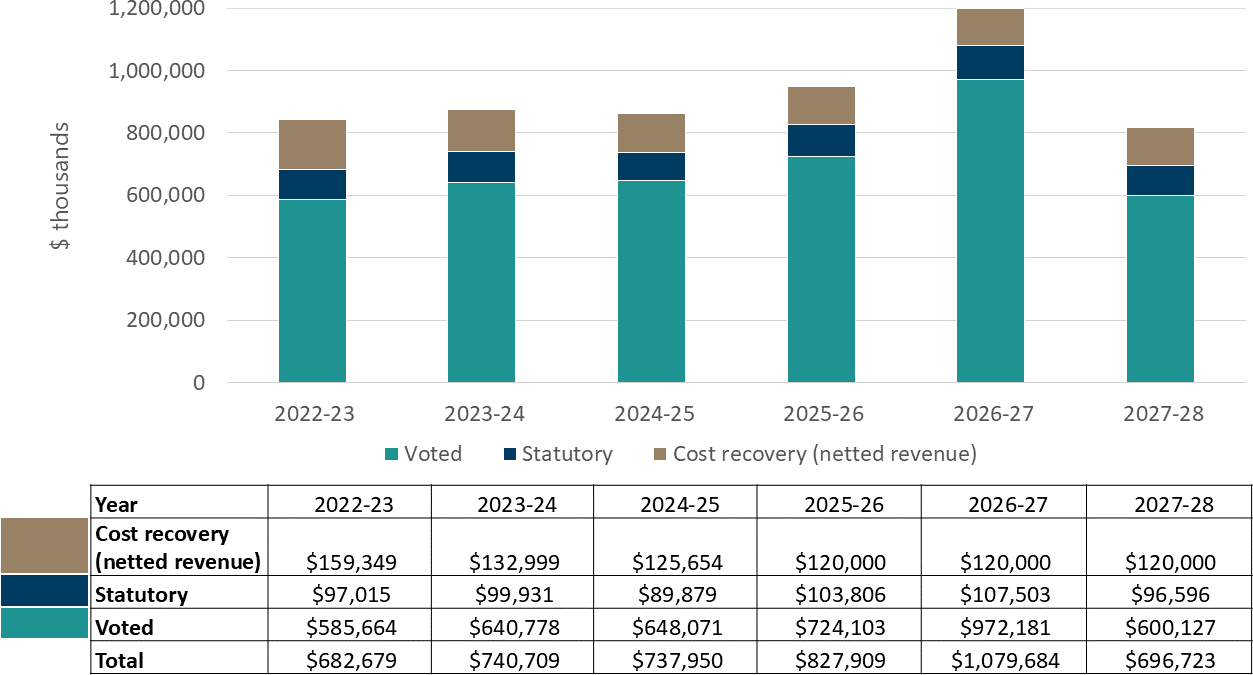
Text description of graph 1
| Fiscal year | Total | Voted | Statutory | Cost recovery (netted revenue) |
|---|---|---|---|---|
| 2022-23 | 682,679 | 585,664 | 97,015 | 159,349 |
| 2023-24 | 740,709 | 640,778 | 99,931 | 132,999 |
| 2024-25 | 737,950 | 648,071 | 89,879 | 125,654 |
| 2025-26 | 827,909 | 724,103 | 103,806 | 120,000 |
| 2026-27 | 1,079,684 | 972,181 | 107,503 | 120,000 |
| 2027-28 | 696,723 | 600,127 | 96,596 | 120,000 |
Analysis of statutory and voted funding over a six-year period
The graph above shows that planned spending is ramping up and will peak in 2026-27, when the 2026 Census of Population and 2026 Census of Agriculture are conducted. This is followed by a significant decrease in subsequent years as these activities wind down. This pattern is typical for the agency because of the cyclical nature of the Census Program.
For further information on Statistics Canada's departmental appropriations, consult the 2025-26 Main Estimates.
Future-oriented condensed statement of operations
The future-oriented condensed statement of operations provides an overview of Statistics Canada's operations for 2024-25 to 2025-26.
| Financial information | 2024-25 Forecast results | 2025-26 Planned results | Difference (planned results minus forecasted) |
|---|---|---|---|
| Total expenses | 984,303,645 | 1,128,270,699 | 143,967,054 |
| Total revenues | 125,654,055 | 120,000,000 | -5,654,055 |
| Net cost of operations before government funding and transfers | 858,649,590 | 1,008,270,699 | 149,621,109 |
Analysis of forecasted and planned results
The difference between 2024-25 forecast results and 2025-26 planned results is primarily due to increased spending on the Census program and the agency's use of the operating budget carry-forward mechanism to manage the cyclical nature of its operations. This increase is partially offset by funding for cloud operations that is not included in the planned spending starting in 2025-26 because the enterprise-wide funding model is being developed. In the absence of an enterprise-wide funding model, funding will be sourced by Treasury Board of Canada Secretariat resources through an in-year transfer in 2025-26.
Statistics Canada has the authority to generate $120 million annually in respendable revenue, related to two streams: statistical surveys and related services, and custom requests and workshops. This amount may vary from year to year based on demand and the cyclical nature of our cost recovered services.
A more detailed Future-Oriented Statement of Operations and associated Notes for 2025-26, including a reconciliation of the net cost of operations with the requested authorities, is available on Statistics Canada's website.
Human resources
This section presents an overview of the department's actual and planned human resources from 2022-23 to 2027-28.
| Core responsibilities and internal services | 2022-23 Actual full-time equivalents | 2023-24 Actual full-time equivalents | 2024-25 Forecasted full-time equivalents |
|---|---|---|---|
| Statistical Information | 7,005 | 6,291 | 6,297 |
| Internal services | 833 | 619 | 707 |
| Total gross | 7,838 | 6,910 | 7,004 |
| Respendable revenue | -1,795 | -1,373 | -1,222 |
| Total net | 6,043 | 5,537 | 5,782 |
Analysis of human resources over the last three years
Respendable revenue in 2022–23 included full-time equivalents resources for additional work associated with extra demands following the slowdown during the COVID-19 pandemic, as the easing of restrictions allowed collection of statistical information to resume. It was also associated with an increase in demands related to the 2021 Census.
Resources fluctuations in internal services are largely attributable to how the agency strategically manages its investments. The agency leverages the operating budget carry-forward mechanism to manage the cyclical nature of program operations and investments in the agency's strategic priorities. Additionally, internal services resources in 2022–23 included resources from temporary funding related to an initiative approved in 2018–19 to migrate the agency's infrastructure to the cloud.
| Core responsibilities and internal services | 2025-26 Planned full-time equivalents | 2026-27 Planned full-time equivalents | 2027-28 Planned full-time equivalents |
|---|---|---|---|
| Statistical Information | 6,762 | 7,091 | 6,149 |
| Internal services | 718 | 690 | 682 |
| Total gross | 7,480 | 7,781 | 6,831 |
| Respendable revenue | -1,169 | -1,169 | -1,169 |
| Total net | 6,311 | 6,612 | 5,662 |
Analysis of human resources for the next three years
Overall, Statistics Canada is expecting to maintain its capacity for delivering ongoing statistical programs in future years. Similar to trends seen in planned spending, changes in full-time equivalents from year to year are largely explained by the cyclical nature of the Census Program. Activity will begin to ramp up and will peak in 2026-27, when the 2026 Census of Population and 2026 Census of Agriculture are conducted.
The human resources for the next three years include planned full-time equivalents for several new initiatives including funding to support Canada's Action Plan on Combatting Hate, funding for the Clean Technology Data Strategy, and funding to modernize and enhance the collection and dissemination of housing data, supporting Canada's Housing Plan.
Resources fluctuations in internal services are largely attributable to how the agency strategically manages its investments. The agency leverages the operating budget carry-forward mechanism to manage the cyclical nature of program operations and investments in the agency's strategic priorities.
Corporate information
Departmental profile
Departmental profile
Appropriate minister:
The Honourable Mélanie Joly, P.C., M.P.
Institutional head:
André Loranger
Ministerial portfolio:
Innovation, Science and Economic Development
Enabling instruments:
Year of incorporation / commencement:
The Dominion Bureau of Statistics was established in 1918. In 1971, with the revision of the Statistics Act, the agency became Statistics Canada.
Other:
Under the Statistics Act, Statistics Canada is required to collect, compile, analyze, abstract and publish statistical information relating to the commercial, industrial, financial, social, economic and general activities and condition of the people of Canada.
Statistics Canada has two primary objectives:
- provide statistical information and analysis on the economic and social structure and functioning of Canadian society, as a basis for developing, operating and evaluating public policies and programs; for public and private decision making; and for the general benefit of all Canadians
- promote the quality, coherence and international comparability of Canada's statistics through collaboration with other federal departments and agencies, with the provinces and territories, and in accordance with sound scientific standards and practices.
Statistics Canada's head office is in Ottawa. There are regional offices across the country in Halifax, Sherbrooke, Montréal, Toronto, Sturgeon Falls, Winnipeg, Edmonton and Vancouver, with more temporary offices opening in 2025-26 in preparation for the 2026 Census. There are also 35 research data centres located throughout the country in academic institutions. In addition, there are five secure rooms available for access by employees of federal departments and selected provincial ministries. These centres provide researchers with access to microdata from population and household survey programs in a secure setting. Virtual secure access for the researchers of both types of centres from other authorized workspaces (e.g., office locations and home offices) will be launched in 2025. Canadians can also follow the agency on Facebook, Instagram, LinkedIn, Reddit, X (formerly Twitter) and YouTube.
Departmental contact information
Departmental contact information
Mailing address:
Statistics Canada
150 Tunney's Pasture Driveway
Ottawa, Ontario
K1A 0T6
Telephone:
Toll-free: 1-800-263-1136
International: 1-514-283-8300
TTY:
1-800-363-7629
Fax:
1-514-496-4879
Email:
Website:
Supplementary information tables
The following supplementary information tables are available on Statistics Canada's website:
Information on Statistics Canada's departmental sustainable development strategy can be found on Statistics Canada's website.
Federal tax expenditures
Statistics Canada's Departmental Plan does not include information on tax expenditures.
The tax system can be used to achieve public policy objectives through the application of special measures such as low tax rates, exemptions, deductions, deferrals and credits. The Department of Finance Canada publishes cost estimates and projections for these measures each year in the Report on Federal Tax Expenditures.
This report also provides detailed background information on tax expenditures, including descriptions, objectives, historical information and references to related federal spending programs as well as evaluations and GBA Plus of tax expenditures.
Definitions
List of terms
- appropriation (crédit)
- Any authority of Parliament to pay money out of the Consolidated Revenue Fund.
- budgetary expenditures (dépenses budgétaires)
- Operating and capital expenditures; transfer payments to other levels of government, departments or individuals; and payments to Crown corporations.
- core responsibility (responsabilité essentielle)
- An enduring function or role performed by a department. The intentions of the department with respect to a core responsibility are reflected in one or more related departmental results that the department seeks to contribute to or influence.
- Departmental Plan (plan ministériel)
- A report on the plans and expected performance of an appropriated department over a three-year period. Departmental Plans are usually tabled in Parliament each spring.
- departmental result (résultat ministériel)
- A consequence or outcome that a department seeks to achieve. A departmental result is often outside departments' immediate control, but it should be influenced by program-level outcomes.
- departmental result indicator (indicateur de résultat ministériel)
- A quantitative measure of progress on a departmental result.
- Departmental Results Framework (cadre ministériel des résultats)
- A framework that connects the department's core responsibilities to its departmental results and departmental result indicators.
- Departmental Results Report (rapport sur les résultats ministériels)
- A report on a department's actual accomplishments against the plans, priorities and expected results set out in the corresponding Departmental Plan.
- full-time equivalent (équivalent temps plein)
- A measure of the extent to which an employee represents a full person-year charge against a departmental budget. For a particular position, the full-time equivalent figure is the ratio of the number of hours the person actually works divided by the standard number of hours set out in the person's collective agreement.
- Gender-based Analysis Plus (GBA Plus) (analyse comparative entre les sexes plus [ACS Plus])
- An analytical tool used to support the development of responsive and inclusive policies, programs and other initiatives. GBA Plus is a process for understanding who is impacted by the issue or opportunity being addressed by the initiative, identifying how the initiative could be tailored to meet the diverse needs of the people most impacted, and anticipating and mitigating any barriers to accessing or benefitting from the initiative. GBA Plus is an intersectional analysis that goes beyond biological (sex) and sociocultural (gender) differences to consider other factors, such as age, disability, education, ethnicity, economic status, geography (including rurality), language, race, religion and sexual orientation.
Using GBA Plus involves taking a gender- and diversity-sensitive approach to the agency's work. Considering all intersecting identity factors as part of GBA Plus, not only sex and gender, is a Government of Canada commitment. - government priorities (priorités gouvernementales)
- For the purpose of the 2025-26 Departmental Plan, government priorities are the high-level themes outlining the government’s agenda in the most recent Speech from the Throne.
- horizontal initiative (initiative horizontale)
- An initiative where two or more federal departments are given funding to pursue a shared outcome, often linked to a government priority.
- Indigenous business (entreprise autochtones)
- For the purpose of the Directive on the Management of Procurement, Appendix E: Mandatory Procedures for Contracts Awarded to Indigenous Businesses, and the Government of Canada's commitment that a mandatory minimum target of 5% of the total value of contracts be awarded to Indigenous businesses that meet the definition and requirements in the Indigenous Business Directory.
- non‑budgetary expenditures (dépenses non budgétaires)
- Non-budgetary authorities that comprise assets and liabilities transactions for loans, investments and advances, or specified purpose accounts, that have been established under specific statutes or under non-statutory authorities in the Main Estimates and elsewhere. Non-budgetary transactions are those expenditures and receipts related to the government's financial claims on, and obligations to, outside parties. They consist of transactions in loans, investments and advances; in cash and accounts receivable; in public money received or collected for specified purposes; and in all other assets and liabilities. Other assets and liabilities not specifically defined in G to P authority codes are to be recorded to an R authority code, which is the residual authority code for all other assets and liabilities.
- performance (rendement)
- What a department did with its resources to achieve its results, how well those results compare with what the department intended to achieve and how well lessons learned have been identified.
- performance indicator (indicateur de rendement)
- A qualitative or quantitative means of measuring an output or outcome, with the intention of gauging the performance of a department, program, policy or initiative respecting expected results.
- plan (plan)
- The articulation of strategic choices, which provides information on how a department intends to achieve its priorities and associated results. Generally, a plan will explain the logic behind the strategies chosen and tend to focus on actions that lead to the expected result.
- planned spending (dépenses prévues)
- For Departmental Plans and Departmental Results Reports, planned spending refers to those amounts presented in the Main Estimates.
A department is expected to be aware of the authorities that it has sought and received. The determination of planned spending is a departmental responsibility, and departments must be able to defend the expenditure and accrual numbers presented in their Departmental Plans and Departmental Results Reports. - program (programme)
- Individual or groups of services, activities or combinations thereof that are managed together within the department and focus on a specific set of outputs, outcomes or service levels.
- program inventory (répertoire des programmes)
- Identifies all the department's programs and describes how resources are organized to contribute to the department's core responsibilities and results.
- result (résultat)
- A consequence attributed, in part, to a department, policy, program or initiative. Results are not within the control of a single department, policy, program or initiative; instead, they are within the area of the department's influence.
- statutory expenditures (dépenses législatives)
- Expenditures that Parliament has approved through legislation other than appropriation acts. The legislation sets out the purpose of the expenditures and the terms and conditions under which they may be made.
- target (cible)
- A measurable performance or success level that a department, program or initiative plans to achieve within a specified time period. Targets can be either quantitative or qualitative.
- voted expenditures (dépenses votées)
- Expenditures that Parliament approves annually through an appropriation act. The vote wording becomes the governing conditions under which these expenditures may be made.