
Canada's Quality of Life Hub is currently in development. We need your help! If you have ideas or thoughts for what you'd like to see on the Hub, Statistics Canada would love to hear about it. Your input is invaluable as we continue to develop the Quality of Life Hub.

Air quality
Domain
Environment
Subdomain
Environment and people
Indicator
Air quality
Note: This indicator is a headline indicator. Headline indicators are intended to provide a high-level assessment of overall quality of life in Canada.
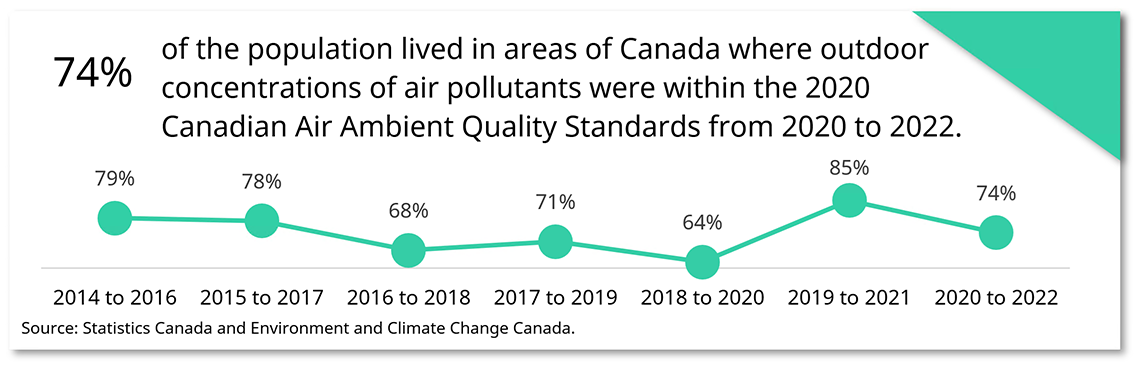
Data Table
| Percentage of the population within air quality standards | |
|---|---|
| 2014 to 2016 | 79% |
| 2015 to 2017 | 78% |
| 2016 to 2018 | 68% |
| 2017 to 2019 | 71% |
| 2018 to 2020 | 64% |
| 2019 to 2021 | 85% |
| 2020 to 2022 | 74% |
| 2021 to 2023 | 74% |
Sources: Statistics Canada and Environment and Climate Change Canada. Population exposure to outdoor air pollutants - Canada.ca.
Definition
Percentage of the population living in areas where air pollutant concentrations are less than or equal to the 2020 Canadian Ambient Air Quality Standards (CAAQS).
Measurement
This indicator monitors general improvements to air quality using the 2020 Canadian Ambient Air Quality Standards (CAAQS). More specifically, it tracks the percentage of the population living in areas where outdoor concentrations of air pollutants were less than or equal to the 2020 standards.
This indicator is calculated based on air pollutant concentration data and population statistics. The air pollutant concentration data are taken from Environment and Climate Change Canada's Canada-wide Air Quality Database. The population data were retrieved from Statistics Canada's demographic statistics. It is calculated by comparing the spatially averaged pollutant concentration for each geographical area with the respective 2020 Canadian Ambient Air Quality Standards. The total population of all geographical areas where the average concentrations for all pollutants are less than or equal to the respective standards are compared to the national population.
For information on the Canadian Ambient Air Quality Standards, please refer to the report Canada's Air from the Canadian Council of Ministers of the Environment.
For more information on this indicator and its measurement, please refer to Population exposure to outdoor air pollutants from Environment and Climate Change Canada.
Data sources
For key results on air quality, please refer to Population exposure to outdoor air pollutants from Environment and Climate Change Canada.
Data tables and analysis
For products related to air quality, including data tables, data visualizations, articles, and other product types see Analytical releases: Air quality or view all analytical releases.
Frameworks
This indicator aligns with the following frameworks:
- The Canadian Indicator Framework for the Sustainable Development Goals
- Sustainable Development Goals (SDGs)
- Federal Sustainable Development Strategy (FSDS)
- FSDS Goal 11 – Improve access to affordable housing, clean air, transportation, parks, and green spaces, as well as cultural heritage in Canada
- FSDS Contextual Indicator – Air quality
- FSDS Contextual Indicator – Emissions of harmful substances to air
- FSDS Target Indicator – Population exposure to outdoor air pollutants
- FSDS Goal 11 – Improve access to affordable housing, clean air, transportation, parks, and green spaces, as well as cultural heritage in Canada
- Canadian Environmental Sustainability Indicators (CESI)
Additional information
Canadians are exposed to air pollutants on a daily basis, and this exposure can result in adverse health effects. Exposure to some air pollutants, even at low levels, has been linked to increased heart and respiratory problems, leading to increased hospitalization, emergency room visits and premature death.
- Date modified: