
Canada's Quality of Life Hub is currently in development. We need your help! If you have ideas or thoughts for what you'd like to see on the Hub, Statistics Canada would love to hear about it. Your input is invaluable as we continue to develop the Quality of Life Hub.

Climate change adaptation
Domain
Environment
Subdomain
Environment and people
Indicator
Climate change adaptation
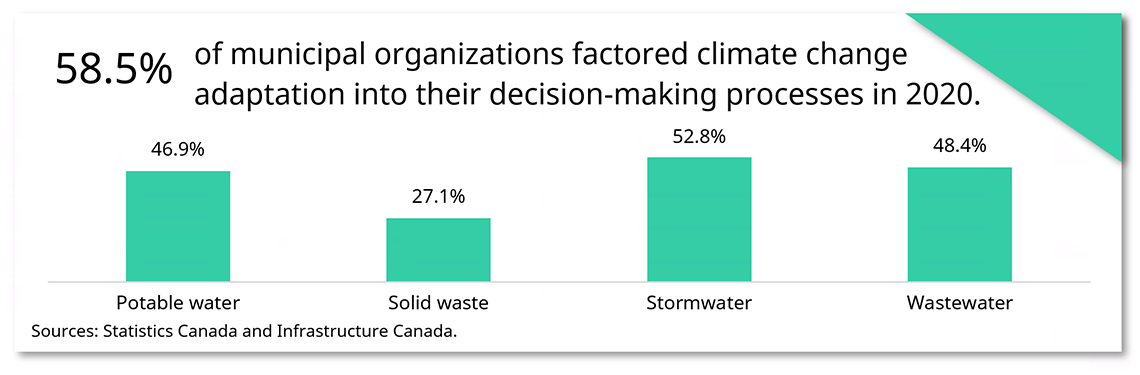
Description - Percentage of core public infrastructure owners who factored climate change adaptation into their decision-making process
| 2020 | 2022 | |
|---|---|---|
| Potable and wastewater | 13.2% | 12.9% |
| Stormwater | 15.4% | 14.6% |
| Solid waste | 6.2% | 4.4% |
| Public transit | 5.6% | 6.2% |
| Roads, bridges and tunnels | 13.4% | 10.1% |
| Culture, recreation and sports facilities | 8.6% | 6.7% |
Source: Statistics Canada, Table 34-10-0290-01 Asset management practices of core public infrastructure.
Definition
Proportion of core public infrastructure owners who factored climate change adaptation into their decision-making process.
Measurement
This indicator measures the proportion of core public infrastructure owners that factored climate change adaptation into decision-making processes, by core infrastructure asset, by type of owner, by urban and rural municipalities, and by size of municipality. It is measured using data from Canada's Core Public Infrastructure Survey (CCPI).
Climate change is a long-term shift in weather conditions identified by changes in temperature, precipitation, winds, and other indicators. Climate change can involve both changes in average conditions and changes in variability, including for example, extreme events.
Climate change adaptation involves planning for and acting on the anticipated impacts of climate change. It involves making changes to how people live and what can be done before climate change impacts happen (anticipatory) as well as being ready to respond to increasingly likely and frequent extreme events (reactive).
Data sources
Data tables and analysis
For products related to climate change adaptation, including data tables, data visualizations, articles, and other product types see Analytical releases: Climate change adaptation or view all analytical releases.
Frameworks
This indicator aligns with the following frameworks:
- The Canadian Indicator Framework for the Sustainable Development Goals
- Sustainable Development Goals (SDGs)
- SDG Goal 13 – Climate action
- SDG Indicator 13.1.2 – Has Canada adopted and implemented national disaster risk reduction strategies in line with the Sendai Framework for Disaster Risk Reduction 2015-2030
- SDG Indicator 13.1.3 – Proportion of local governments that adopt and implement local disaster risk reduction strategies in line with national disaster risk reduction strategies
- SDG Indicator 13.2.1 – Number of countries with Nationally Determined Contributions (NDCs), long-term strategies, national adaptation plans, strategies as reported in adaptation communications and national communications
- SDG Goal 13 – Climate action
- Federal Sustainable Development Strategy (FSDS)
- FSDS Goal 13 – Take action on climate change and its impacts
- FSDS Target Indicator – Proportion of electricity generated from renewable and non-greenhouse gas-emitting sources
- FSDS Target Indicator – Total annual energy savings resulting from adoption of energy efficiency codes, standards, and practices
- FSDS Target Indicator – Percentage increase in clean fuels production
- Goal 7: Increase Canadians' access to clean energy
- FSDS Contextual Indicator – Proportion of municipal organizations who factored climate change adaptation into decision-making processes
- FSDS Goal 13 – Take action on climate change and its impacts
This indicator does not align directly with the following framework, however, it also addresses climate change adaptation:
- Canadian Environmental Sustainability Indicators (CESI)
- Climate indicators
- Greenhouse gas emissions
- Greenhouse gas emissions from large facilities
- Land-based greenhouse gas emissions and removals
- Greenhouse gas emissions projections
- Global greenhouse gas emissions
- Greenhouse gas concentrations
- Greenhouse gas emissions from a consumption perspective
- Temperature change in Canada
- Precipitation change in Canada
- Sea ice in Canada
- Snow cover
- Extreme heat events
- Climate indicators
Additional information
- Urban heat islands tools and resources from Health Canada
- Climate Lens from Infrastructure Canada (updated periodically)
The Climate Lens is intended to incent behavioral change and consideration of climate impacts into the planning of infrastructure projects with a view to implementing Canada's mid-century goals of a clean growth low-carbon economy. - Canada's National Adaptation Strategy (2021) from Environment and Climate Change Canada
As part of the strengthened climate plan, A Healthy Environment and a Healthy Economy (December 2020), the Government of Canada committed to develop Canada's first National Adaptation Strategy with provincial, territorial and municipal governments, Indigenous Peoples, and other key partners.
- Date modified: