
Canada's Quality of Life Hub is currently in development. We need your help! If you have ideas or thoughts for what you'd like to see on the Hub, Statistics Canada would love to hear about it. Your input is invaluable as we continue to develop the Quality of Life Hub.

Adolescent skills
Domain
Prosperity
Subdomain
Skills and opportunity
Indicator
Adolescent skills
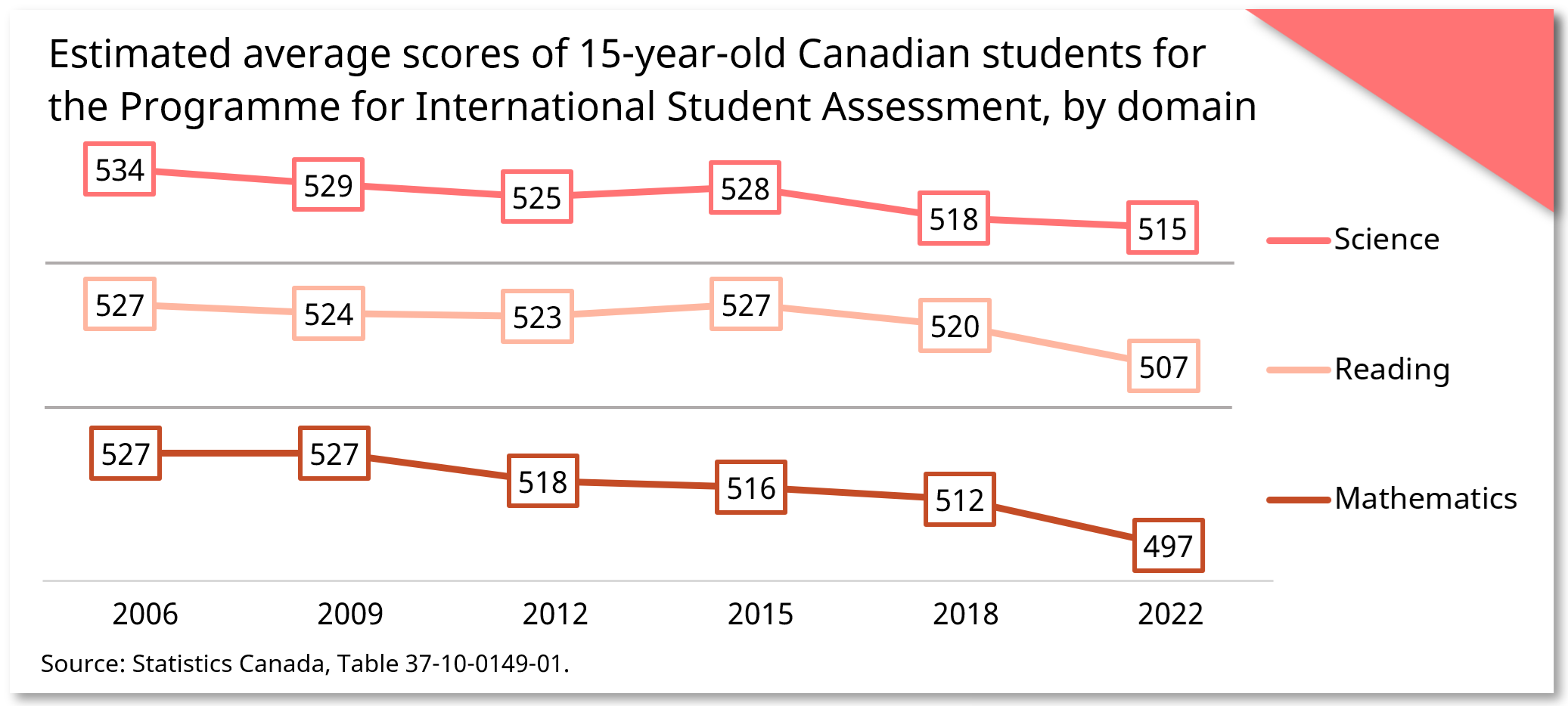
Data Table
| Reading | Mathematics | Science | |
|---|---|---|---|
| 2006 | 527 | 527 | 534 |
| 2009 | 524 | 527 | 529 |
| 2012 | 523 | 518 | 525 |
| 2015 | 527 | 516 | 528 |
| 2018 | 520 | 512 | 518 |
| 2022 | 507 | 497 | 515 |
Source: Statistics Canada. Table 37-10-0149-01 Estimated average scores of 15-year-old students for the Programme for International Student Assessment, by gender and domain.
Definition
This concept is assessed through several multiple sub-indicators.
- Proportion of 15 year olds by level of mathematic proficiency.
- Proportion of 15 year olds by level of reading proficiency.
- Proportion of 15 year olds by level of science proficiency.
Measurement
Each component of this indicator is measured differently by the Programme for International Student Assessment (PISA). The competencies assessed in the PISA are understood as involving a continuum of proficiency.
Proportion of 15 year olds by level of mathematic proficiency
This indicator is measured by the Programme for International Student Assessment (PISA). Mathematical literacy is an individual's capacity to reason mathematically and to formulate, employ, and interpret mathematics to solve problems in a variety of real-world contexts. It includes concepts, procedures, facts and tools to describe, explain and predict phenomena. It helps individuals to make informed decisions and judgements which are essential for being constructive and engaged citizen in the 21st century.
To learn more about the definitions used in PISA, visit the OECD Mathematics literacy topic page.
PISA tests adolescents on their mathematical abilities in four domains: numbers and operations, geometry and measurement, patterns and relationships, data management and probability. Scores are rated on an eight-level proficiency scale, in which tasks at the low end of the scale (Levels 1a–1c) are deemed easier and less complex than other tasks at the high end (Level 6).
For a complete breakdown of the levels and their meaning, see Table 1.3 (PISA 2022 mathematics proficiency levels – summary description) in the CMEC report Measuring Up: Canadian Results of the OECD PISA 2022 Study.
Proportion of 15 year olds by level of reading proficiency
This indicator is measured by the Programme for International Student Assessment (PISA). Reading literacy is understanding, using, evaluating, reflecting on and engaging with texts in order to achieve personal objectives, enhance knowledge and capabilities, and contribute to society. In the 21st century, reading extends to digital platforms, and requires triangulating different sources, navigating through ambiguity, distinguishing between fact and opinion, and constructing knowledge.
To learn more about the definitions used in PISA, visit the OECD Reading literacy topic page.
PISA tests adolescents on their reading abilities in four domains: understanding texts, interpreting texts, responding personally to texts, and responding critically to texts. Scores are rated on an eight-level proficiency scale, in which tasks at the low end of the scale (Levels 1a–1c) are deemed easier and less complex than other tasks at the high end (Level 6).
For a complete breakdown of the levels and their meaning, see Table 3.1 (PISA 2022 reading proficiency levels – summary description) in the CMEC report Measuring Up: Canadian Results of the OECD PISA 2022 Study.
Proportion of 15 year olds by level of science proficiency
This indicator is measured by the Programme for International Student Assessment (PISA). Science literacy involves actively participating in informed discussions about science, sustainability and technology to guide decision-making and action. This requires the ability to explain phenomena scientifically, design and assess scientific enquiry, and research and interpret data and evidence critically.
To learn more about the definitions used in PISA, visit the OECD Science literacy topic page.
PISA tests adolescents on their science abilities in four domains: physical, life, and earth and space sciences. Scores are rated on an eight-level proficiency scale, in which tasks at the low end of the scale (Levels 1a–1c) are deemed easier and less complex than other tasks at the high end (Level 6).
For a complete breakdown of the levels and their meaning, see Table 3.2 (PISA 2022 science proficiency levels – summary description) in the CMEC report Measuring Up: Canadian Results of the OECD PISA 2022 Study.
Why this indicator is important
Canada invests significant resources in the provision of elementary and secondary education, and Canadians are concerned about the quality of education provided by schools. The skills acquired by the end of secondary school are the essential foundation for further learning and for meeting the social and economic challenges of the future. PISA examines the level of achievement of 15 year olds and provides an indication of the knowledge and skills they have acquired—as well as their preparedness for continuing their studies or entering the workforce.
Results from PISA are valuable to educators, governments, social-policy analysts, and advocacy groups. Comparative information, both internationally and over time, helps in the evaluation of the effectiveness of existing programs and practices, as well as in the understanding of the influences of socioeconomic and other factors for educational success.
Data sources
Proportion of 15 year olds by level of mathematic proficiency
Programme for International Student Assessment (PISA)
- Figure 1.2 – Percentage of students at each proficiency level in mathematics in CMEC report Measuring Up: Canadian Results of the OECD PISA 2022 Study
- Table 37-10-0149-01 – Estimated average scores of 15-year-old students for the Programme for International Student Assessment, by gender and domain
Proportion of 15 year olds by level of reading proficiency
Programme for International Student Assessment (PISA)
- Figure 3.1 – Percentage of students at each proficiency level in reading in CMEC report Measuring Up: Canadian Results of the OECD PISA 2022 Study
- Table 37-10-0149-01 – Estimated average scores of 15-year-old students for the Programme for International Student Assessment, by gender and domain
Proportion of 15 year olds by level of science proficiency
Programme for International Student Assessment (PISA)
- Figure 3.2 – Percentage of students at each proficiency level in science in the CMEC report Measuring Up: Canadian Results of the OECD PISA 2022 Study
- Table 37-10-0149-01 – Estimated average scores of 15-year-old students for the Programme for International Student Assessment, by gender and domain
Data tables and analysis
For products related to adolescent skills, including data tables, data visualizations, articles, and other product types, see Analytical releases: Adolescent skills or view all analytical releases.
Additional information
The Council of Ministers of Education, Canada (CMEC) is currently responsible for the PISA. Prior to the 2015 PISA, Statistics Canada was responsible.
More information on education, training and learning statistics can be found at The Canadian Centre for Education Statistics.
The Pan-Canadian Assessment Program (PCAP) also measures the skills of students in 8th grade (in Quebec, Secondary II) in science, mathematics, and reading. The assessment is run every three years and focuses on one of these subjects as their major subject area, but also assesses two other subject areas.
- Table 37-10-0229-01 – Mean scores of Grade 8 students, Pan-Canadian Assessment Program reading, science and mathematics assessment
- Table 37-10-0230-01 – Mean scores of Grade 8 students on the Pan-Canadian Assessment Program mathematics subdomains assessments
- Table 37-10-0238-01 – Mean scores of Grade 8 students on the Pan-Canadian Assessment Program reading subdomains assessments
- Table 37-10-0236-01– Mean scores of Grade 8 students on the Pan-Canadian Assessment Program science subdomains assessments
- Date modified: