
Canada's Quality of Life Hub is currently in development. We need your help! If you have ideas or thoughts for what you'd like to see on the Hub, Statistics Canada would love to hear about it. Your input is invaluable as we continue to develop the Quality of Life Hub.

Employment
Domain
Prosperity
Subdomain
Employment and job quality
Indicator
Employment
Note: This indicator is a headline indicator. Headline indicators are intended to provide a high-level assessment of overall quality of life in Canada.
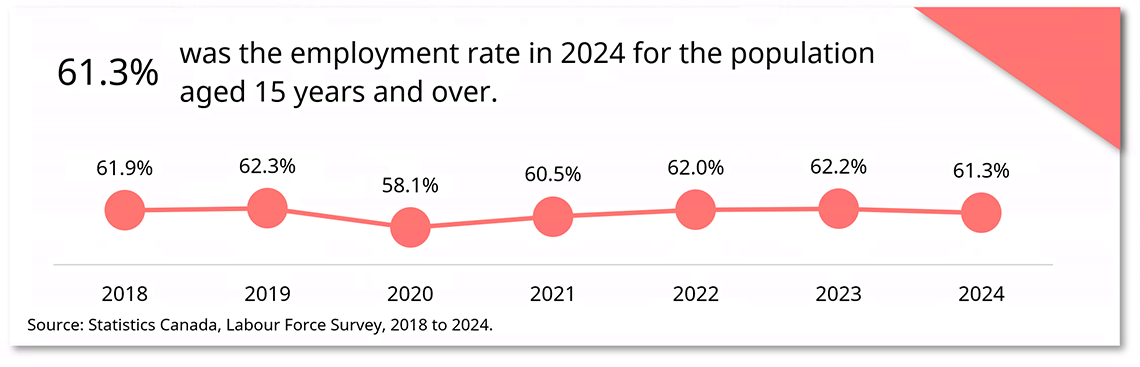
Data Table
| Employment rate | |
|---|---|
| 2018 | 61.9% |
| 2019 | 62.3% |
| 2020 | 58.1% |
| 2021 | 60.5% |
| 2022 | 62.0% |
| 2023 | 62.2% |
| 2024 | 61.3% |
| 2025 | 60.8% |
Source: Statistics Canada. Table 14-10-0375-01 Employment and unemployment rate, annual.
Definition
- Employment rate: percentage of the population who are employed.
- Unemployment rate: percentage of the labour force who are unemployed.
- Participation rate: percentage of the population who are in the labour force.
Measurement
This indicator is measured in the Labour Force Survey (LFS).
Survey respondents are asked a number of questions about their labour force activity during the reference week of the monthly survey. A labour force status (employed, unemployed or not in the labour force) is assigned to each respondent aged 15 years and over, according to their responses.
Employed persons are those who, during the reference week, did any work for pay or profit or had a job and were absent from work. The employment rate is the number of employed persons expressed as a percentage of the population aged 15 years and over.
Unemployed persons are those who, during reference week, were without work, were available for work and were either on temporary layoff, had looked for work in the past four weeks or had a job to start within the next four weeks. The unemployment rate is the number of unemployed persons expressed as a percentage of the labour force.
The labour force refers to the civilian non-institutional population 15 years of age and over who, during the survey reference week, were employed or unemployed. The participation rate is the total labour force expressed as a percentage of the population aged 15 years and over.
For more information on measurement of this indicator in the LFS, please refer to Guide to the Labour Force Survey.
This indicator is also measured in the Census of Population. For more information on the measurement of this indicator in the Census of Population, please refer to Dictionary, Census of Population, 2021 – Labour force status. While the Census concepts of the employment rate, unemployment rate and participation rate are largely the same as in the LFS, there are a number of differences between the Census and the LFS affecting the comparability of estimates between the two sources as detailed in Dictionary, Census of Population, 2016 – Appendix 6.1.
Data sources
Data tables and analysis
For products related to employment, including data tables, data visualizations, articles, and other product types see Analytical releases: Employment or view all analytical releases.
Frameworks
This indicator aligns with the following frameworks:
- Canadian Indicator Framework (CIF) for the Sustainable Development Goals
- Sustainable Development Goals (SDGs)
- Goal 8 – Decent work and economic growth
- SDG Indicator 8.5.2 – Unemployment rate, by sex, age and persons with disabilities
- Goal 8 – Decent work and economic growth
- Social inclusion indicators for Canada's ethnocultural groups
- Participation in the labour market
- Employment rate
- Unemployment rate
- Participation rate
- Participation in the labour market
- Gender Results Framework (GRF)
- Economic participation and prosperity
- GRF Indicator 2.1.1 – Labour force participation rate
- GRF Indicator 2.1.2 – Employment rate
- Economic participation and prosperity
- Date modified: