
Canada's Quality of Life Hub is currently in development. We need your help! If you have ideas or thoughts for what you'd like to see on the Hub, Statistics Canada would love to hear about it. Your input is invaluable as we continue to develop the Quality of Life Hub.

Core housing need
Domain
Prosperity
Subdomain
Economic security and deprivation
Indicator
Core housing need
Note: This indicator is a headline indicator. Headline indicators are intended to provide a high-level assessment of overall quality of life in Canada.
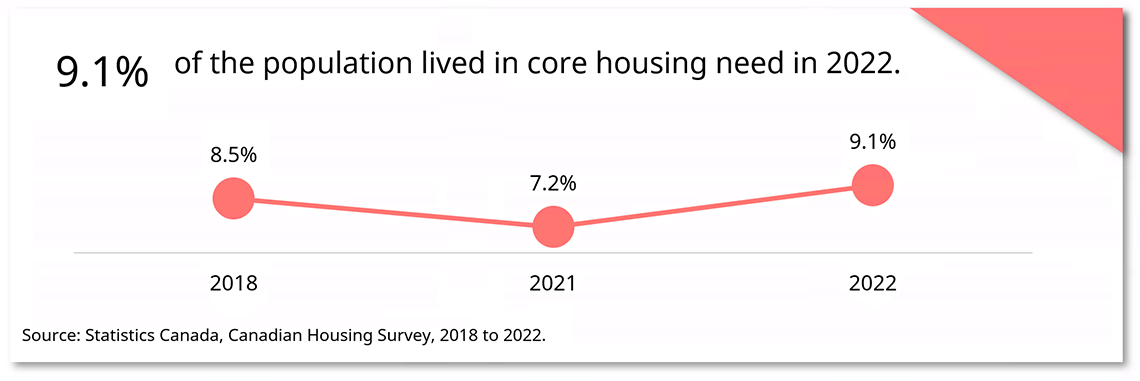
Description - Core housing need over time
9.1% of the population lived in core housing need in 2022.
| Living in core housing need | |
|---|---|
| 2018 | 8.5% |
| 2021 | 7.2% |
| 2022 | 9.1% |
Source: Statistics Canada, Canadian Housing Survey, 2018 to 2022.
Definition
- Proportion of the population in core housing need.
Measurement
This indicator is measured using the Canadian Housing Survey (CHS) and the Census of Population. Statistics are derived based on information respondents provide about their household's composition, the number of bedrooms in their household's dwelling and whether the dwelling needs repairs, their household's shelter costs as well as income information based on a combination of administrative and survey data.
Core housing need refers to whether a household's housing falls below at least one of the indicator thresholds for housing adequacy, affordability or suitability, and would have to spend 30% or more of its total before-tax income to pay the median rent of alternative local housing that is acceptable (attains all three housing indicator thresholds).
Housing indicator thresholds are defined as follows:
- Adequate housing is reported by their residents as not requiring any major repairs.
- Affordable housing has shelter costs equal to less than 30% of total before-tax household income.
- Suitable housing has enough bedrooms for the size and composition of resident households according to the National Occupancy Standard (NOS), conceived by the Canada Mortgage and Housing Corporation and provincial and territorial representatives.
Only private, non-farm, non-reserve and owner- or renter-households with incomes greater than zero and shelter-cost-to-income ratios less than 100% are assessed for “core housing need.”
Non-family households with at least one maintainer aged 15 to 29 attending school are considered not to be in “core housing need” regardless of their housing circumstances. Attending school is considered a transitional phase, and low incomes earned by student households are viewed as being a temporary condition.
Data sources
This indicator is measured through more than one Statistics Canada survey. Estimates can vary between data sources due to differences in reference periods, targeted or sampled populations, data collection and other methodology.
Data tables and analysis
For products related to core housing need, including data tables, data visualizations, articles, and other product types see Analytical releases: Core housing need or view all analytical releases.
Frameworks
This indicator aligns with the following framework:
- The Canadian Indicator Framework for the Sustainable Development Goals
- Sustainable Development Goals (SDG)
- SDG Goal 11 – Sustainable cities and communities
- SDG Indicator 11.1.1.PR – Proportion of urban population in core housing need
- SDG Goal 11 – Sustainable cities and communities
- Social inclusion indicators for Canada's ethnocultural groups
- Basic needs and housing
- Population living in core housing need
- Basic needs and housing
- Federal sustainable development strategy (FSDS)
- FSDS Goal 11 – Improve access to affordable housing, clean air, transportation, parks, and green spaces, as well as cultural heritage in Canada
- FSDS Target Indicator – Households whose housing need was reduced or eliminated
- FSDS Goal 11 – Improve access to affordable housing, clean air, transportation, parks, and green spaces, as well as cultural heritage in Canada
- Gender Results Framework (GRF)
- Poverty reduction, health and well-being
- GRF Indicator 5.3.1 – Proportion of the population in core housing need, by economic family type
- Poverty reduction, health and well-being
Additional information
Core housing need can be measured at the household level or person level. The household-level indicator measures the proportion of households in core housing need, whereas the person-level indicator measures the proportion of people in core housing need. For the purposes of the Quality of Life Framework, the focus of this indicator is to assess the living situation of people, so the person-level measurement is used.
Statistics Canada's Housing statistics
For additional information on housing indicators from the Census of Population, including core housing need, please refer to:
- 2021 Census Topic: Housing (Topics, 2021 Census, September 21, 2022)
- Housing Characteristics Reference Guide, Census of Population, 2021 (Reference materials, 2021 Census, March 30, 2022)
- Core housing need (Dictionary, 2021 Census of Population, November 17, 2021)
- Date modified: