
Canada's Quality of Life Hub is currently in development. We need your help! If you have ideas or thoughts for what you'd like to see on the Hub, Statistics Canada would love to hear about it. Your input is invaluable as we continue to develop the Quality of Life Hub.

Trust in others
Domain
Society
Subdomain
Social cohesion and connections
Indicator
Trust in others
Note: This indicator is a headline indicator. Headline indicators are intended to provide a high-level assessment of overall quality of life in Canada.
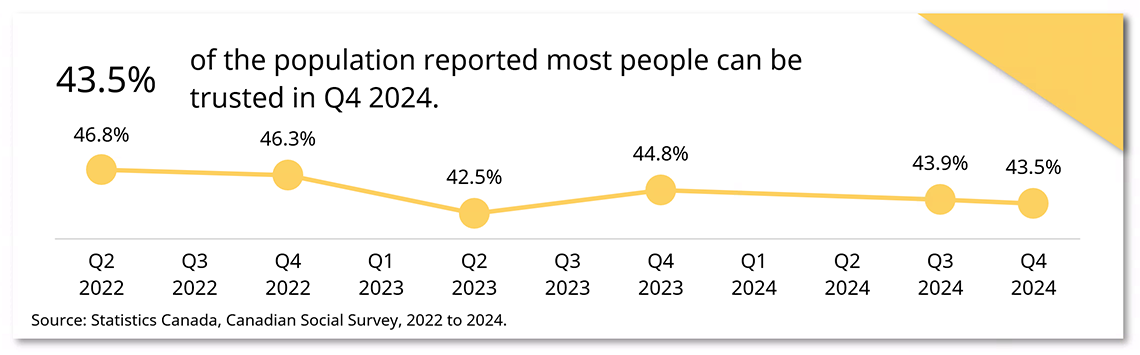
Description - Trust in others over time
43.5% of the population reported most people can be trusted in Q4 2024.
| People who say that most people can be trusted | |
|---|---|
| Q2 2022 | 46.8% |
| Q3 2022 | .. |
| Q4 2022 | 46.3% |
| Q1 2023 | .. |
| Q2 2023 | 42.5% |
| Q3 2023 | .. |
| Q4 2023 | 44.8% |
| Q1 2024 | .. |
| Q2 2024 | .. |
| Q3 2024 | 43.9% |
| Q4 2024 | 43.5% |
| .. Not available for this reference period | |
Source: Statistics Canada, Canadian Social Survey, 2022 to 2024.
Definition
Proportion of the population by trust in others.
Measurement
This indicator is measured in the General Social Survey (GSS) - Social Identity, the Canadian Social Survey (CSS), and the Survey Series on People and their Communities (SSPC). Survey respondents are asked:
Generally speaking, would you say that most people can be trusted or that you cannot be too careful in dealing with people?
- Most people can be trusted
- You cannot be too careful in dealing with people
Using a scale of 1 to 5, where 1 means "Cannot be trusted at all" and 5 means "Can be trusted completely", what is your level of trust in each of the following groups of people?
- People in your family
- People in your neighbourhood
- People you work with
- People you go to school with
- People who speak a different language than you
- People with a different religion than you
- People with a different ethnic or cultural background than you
- Strangers
The GSS Social Identity and selected iterations of the CSS also ask:
How many people do you trust in your neighbourhood?
Is it:
- Most of the people
- Many of the people
- A few of the people
- Nobody
The Impacts of COVID-19 on Canadians: Data Collection Series collected information from crowdsourcing participants on trust in others during the pandemic in an iteration that ran from May 26 to June 8, 2020 entitled Impacts of COVID-19 on Canadians - Trust in Others. Respondents were asked:
Generally speaking, would you say that most people can be trusted or most people can't be trusted?
- Most people can be trusted
- Most people can't be trusted
Unlike other surveys conducted by Statistics Canada, crowdsourcing data are not collected under a design using probability-based sampling. Therefore, caution should be exercised when interpreting the findings, and no inferences about the overall Canadian population should be made based on these results.
Data sources
Data tables and analysis
For products related to trust in others, including data tables, data visualizations, articles, and other product types see Analytical releases: Trust in others or view all analytical releases.
Frameworks
This indicator aligns with the following framework:
- Social inclusion indicators for Canada's ethnocultural groups
- Social connections and personal networks
- Most people can be trusted in general
- Social connections and personal networks
Additional information
The GSS on social identity asks respondents this related question:
If you lost a wallet or purse that contained two hundred dollars, how likely is it to be returned with the money in it, if it was found:
- By a neighbour
- By a police officer
- By a stranger
- Very likely
- Somewhat likely
- Not at all likely
- Date modified: