

Shelters mandated to provide services to victims of abuse are an important resource for many people experiencing violence. In 2022/2023, there were 96 such shelters operating across Canada that had ties to First Nations, Métis or Inuit communities or organizations, representing 17% of all shelters providing these services in Canada. These shelters primarily serve individuals from Indigenous communities throughout the country and play an important role for victims of abuse by offering them a safe environment and basic living needs, as well as various types of support and outreach services.
The Juristat article released today, "Shelters for victims of abuse with ties to Indigenous communities or organizations in Canada, 2022/2023," uses data from the 2022/2023 cycle of the Survey of Residential Facilities for Victims of Abuse to present information on Indigenous shelters in Canada. It also presents information on the characteristics of these facilities, as well as details about their residents.
Admissions to Indigenous shelters lower than prior to the COVID-19 pandemic
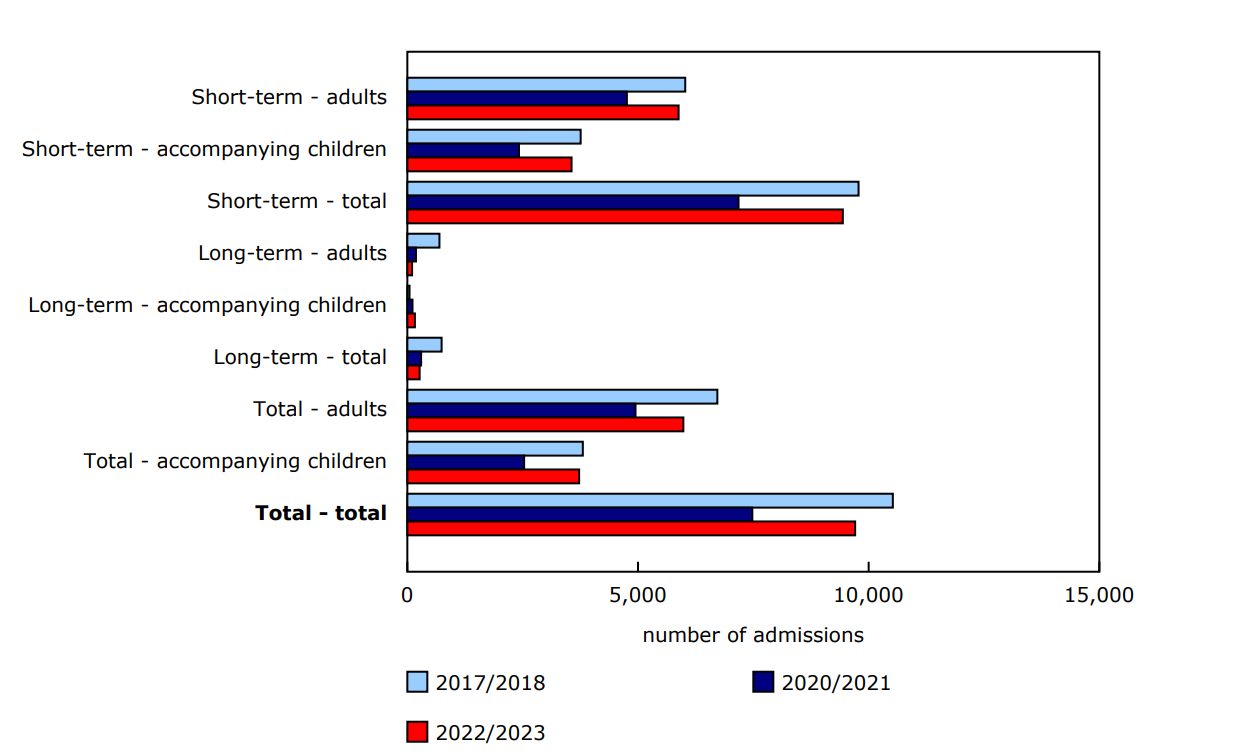
In 2022/2023, there were 9,707 admissions to Indigenous shelters for victims of abuse. Women (61%) and children who accompanied their parent (38%) made up virtually all of these admissions. The number of admissions to Indigenous shelters in 2022/2023 was 30% higher than that recorded in 2020/2021, the period which covered the beginning of the COVID-19 pandemic. However, there were fewer admissions (-8%) in 2022/2023 than what was recorded in the last full period prior to the pandemic (2017/2018). Non-Indigenous shelters reported experiencing a similar increase in admissions from 2020/2021 (+34%) and a similar decrease from 2017/2018 (-8%).
About 7 in 10 funded beds in short-term Indigenous shelters were occupied on the survey snapshot date
Both Indigenous and non-Indigenous shelters for victims of abuse reported experiencing higher occupancy rates on the survey snapshot date in 2023 than in 2021. On the snapshot date in 2023, short-term Indigenous shelters (those providing accommodation for less than three months) reported that 69% of their funded beds were occupied, up from 41% in 2021, and 24% of all short-term Indigenous shelters were considered full, up from 12% in 2021. Similarly, on the snapshot date in 2023, short-term non-Indigenous shelters reported that 78% of their funded beds were occupied, up from 57% in 2021, and 36% of facilities were considered full, up from 17% in 2021.
Although most facilities were not considered full, there were 198 individuals turned away from Indigenous shelters on the snapshot date in 2023, the majority (82%) of whom were women. The most common reason why a woman was turned away from both Indigenous (76%) and non-Indigenous (84%) shelters was because the shelter was at full capacity.
Indigenous women and children overrepresented in shelters for victims of abuse
On the survey snapshot date in 2023, there were 972 individuals staying in Indigenous shelters for victims of abuse, nearly all of whom were women (52%) and children who accompanied their parent (45%).
Relative to their representation in the overall Canadian population, First Nations, Métis and Inuit women and children represented a large proportion of the residents in both Indigenous and non-Indigenous shelters for victims of abuse. On the survey snapshot date in 2023, 81% of women and 57% of children who accompanied their parent in Indigenous shelters, and about one-fifth of women (22%) and children who accompanied their parent (20%) in non-Indigenous shelters, were First Nations people, Métis or Inuit. In comparison, according to the 2021 Census of Population, 4.7% of women and 8.2% of children living in Canada were Indigenous.
More than half of women residents in Indigenous shelters on the survey snapshot date were repeat clients
More than half (52%) of women residents in Indigenous shelters on the survey snapshot date in 2023 had been served by the same facility more than once in the preceding year. This is double the proportion that was recorded among women residents in non-Indigenous shelters (26%). More specifically, 42% of women staying in Indigenous shelters on the survey snapshot date in 2023 had previously received services as a resident, while 10% of women had previously received services on an outreach basis only.
Chart 1: Admissions to Indigenous shelters for victims of abuse, by type of shelter, Canada, 2017/2018, 2020/2021 and 2022/2023
Description - Chart 1
Note: An admission refers to the official acceptance of a person into the shelter with the allocation of a bed, child's bed, crib, bedroom or bedroom unit, or apartment. The total number of admissions is based on all admissions for a 12-month reference period and includes people who may have been admitted more than once. Each shelter visit is counted as a separate admission. For example, the same person being admitted to a shelter three times in a year would count as three admissions. Accompanying children include adult children (typically aged 18 years and older) accompanying a parent or caregiver, such as adult children with disabilities and those who are caretakers of a parent experiencing abuse. Shelters are defined by their mandated expected length of stay, regardless of practice. Short-term shelters include shelters with an expected length of stay of less than three months, and that typically provide individual beds to residents, as opposed to separate apartments or units. Long-term shelters include shelters with an expected length of stay of three months or longer, and that typically provide residential units (e.g., apartments) to residents. Indigenous shelters for victims of abuse include shelters that are part of an Indigenous organization, are located in an Indigenous community, are located on a reserve, or are owned or operated by a First Nations government (band council).
Source: Survey of Residential Facilities for Victims of Abuse (3328).
Note to readers
This study was carried out as part of the Transformational Approach to Indigenous Data with the goal of building Indigenous data capacity and improving the visibility of Indigenous People in Canada's National Statistics.
This Juristat article uses data from the Survey of Residential Facilities for Victims of Abuse (SRFVA). The SRFVA is a census of Canadian shelters (residential facilities) that are primarily mandated to serve victims of abuse. The SRFVA collected annual (2022/2023 fiscal year) and snapshot date (April 13, 2023) information from shelters.
The snapshot date is a predetermined business day meant to represent a typical day of operations for shelters across Canada.
Shelters were asked to report the type of facility they operated based on the expected length of stay provided in their service mandate, regardless of practice. They were grouped into two categories:
- Short-term shelters include those with a general policy of providing accommodation for less than three months and that typically provide individual beds to residents.
- Long-term shelters include those with a general policy of providing accommodation for three months or more and that typically provide residential units (such as apartments or houses) to residents.
Shelters were identified as Indigenous or non-Indigenous based on the responses provided to five SRFVA questions that specifically relate to their association with Indigenous communities or organizations:
- Is your shelter an Indigenous organization?
- Is your shelter located in a First Nations, Métis or Inuit community?
- Is your shelter located on a reserve?
- Is your shelter owned by a First Nations government (band council)?
- Is your shelter operated by a First Nations government (band council)?
A shelter was defined as Indigenous if it responded yes to at least one of these questions. A non-Indigenous shelter was defined as such if it responded no to at least one of the questions and did not respond yes to any of the questions. In addition, historical imputation was used to identify some Indigenous and non-Indigenous shelters using data from previous cycles of the SRFVA.
An admission refers to the official acceptance of a person into the shelter with the allocation of a bed, child's bed, crib, bedroom or bedroom unit, or apartment. The total number of admissions is based on all admissions during a 12-month reference period and includes people who may have been admitted more than once. Each shelter visit is counted as a separate admission. For example, the same person being admitted to a shelter three times in a year would count as three admissions.
Throughout the Juristat article, analyses exclude shelters that did not provide a response to the specific question being discussed. At the national level, this includes 24% to 32% of all shelters and 17% to 24% of all women and children who accompanied their parent for analysis based on number of residents. The percentage of excluded shelters or residents varies by question and by region and by Indigenous and non-Indigenous shelters. For questions where there was an unknown answer category, calculations include these unknown responses.
The occupancy rate is calculated by dividing the total number of residents on a given day by the total number of funded beds, multiplied by 100. The occupancy rate provides an indicator of the total bed space being used at a given point in time. According to the SRFVA definition, a shelter is considered full if 90% or more of the funded beds are occupied.
Reference
Definitions, data sources and methods: survey number 3328
Previous release: Study: Shelters for victims of abuse with ties to Indigenous communities or organizations in Canada, 2017/2018
Contact information
For more information, or to enquire about the concepts, methods or data quality of this release, contact us (toll-free 1-800-263-1136; 514-283-8300; infostats@statcan.gc.ca) or Media Relations (statcan.mediahotline-ligneinfomedias.statcan@statcan.gc.ca).