
Gross domestic product declines in the environmental and clean technology products sector, while overall economy growth slows
The real gross domestic product (GDP) generated by the environmental and clean technology products sector declined by 1.0% in 2023, following gains of 2.6% in 2022 and 2.0% in 2021. The decline in national GDP of this sector in 2023 was driven by decreases in Manitoba (-6.6%), Quebec (-3.9%) and British Columbia (-2.6%). Although the GDP growth rate for the overall economy slowed in 2023 compared with the previous two years, it still maintained positive growth (+1.6%).
While goods-producing industries faced challenges in 2023, their impact on the overall economy was offset by higher output in the services-producing industries in 2023 in most provinces and territories. Similarly, in the environmental and clean technology products sector, GDP generated by goods declined 5.1%, but the increase generated by services (+2.5%) was not enough to offset the overall decline in this sector. In 2023, clean technology products (50.3%) and environmental products (49.7%) equally contributed to the sector's gross value added.
For a comprehensive overview of the annual changes in the environmental and clean technology products sector, refer to the data visualization tools entitled "Gross Domestic Product and trade in Canada's environmental and clean technology products sector," "Employment and compensation of employees in Canada's environmental and clean technology products sector" and "Energy use and greenhouse gas emissions associated with various aspects of the Canadian economy."
Chart 1: Composition of national gross domestic product from environmental and clean technology products
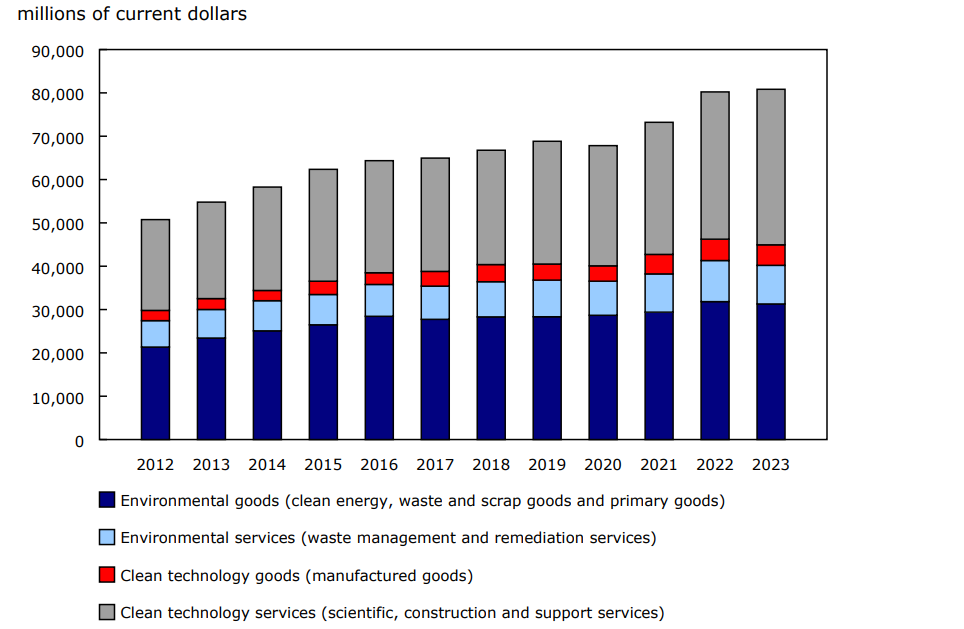
Description - Chart 1
Data table: Composition of national gross domestic product from environmental and clean technology products
Notes: Primary goods: goods that do not require any further manufacturing after extraction or growth. Estimates of 2022 and 2023 are preliminary.
Source: Table 36-10-0627-01.
Dry weather conditions contribute to declines in the environmental and clean technology products sector gross domestic product
The decline in the GDP generated by electricity from renewable sources (-6.8%), which includes hydroelectricity, contributed to the decline in the GDP of the sector in 2023. Quebec, Manitoba and British Columbia are significant contributors to Canada's hydroelectricity production, but a hot summer and low precipitation in 2023 resulted in all three provinces reporting lower hydroelectricity generation for the year.
Job growth in the environmental and clean technology products sector surpasses job growth in the economy overall
An estimated 354,257 jobs were attributable to the environmental and clean technology products sector in 2023, up for the third consecutive year (+4.3% from 2022), accounting for 1.7% of all jobs in Canada in 2023. By comparison, total jobs in Canada increased 3.0% over the same period.
The national average annual compensation per environmental and clean technology job, including benefits, increased 2.4% from 2022 to $105,768 in 2023, compared with an economy-wide average of $76,213 (+3.4% from 2022).
Energy use and greenhouse gas emissions slowly pick up in 2021
The 2.0% increase in national GDP for the environmental and clean technology products sector in 2021 coincided with both a 2.7% increase in direct energy use and a 2.9% increase in greenhouse gas (GHG) directly emitted during production. These trends aligned with the 6.0% increase in Canada's overall GDP that year.
In 2021, decreased energy demand in the construction services (-4.4%), scientific and research and development services (-2.0%), and support services (-0.8%) subsectors were not enough to offset significant increases in demand by the waste management and remediation services (+15.6%), waste and scrap goods (+8.8%) and biofuels and primary goods (+8.5%) subsectors. These factors contributed to the overall increase in GHG emissions by the sector in 2021.
Chart 2: National environmental-economic trends for the environmental and clean technology products sector, indexed
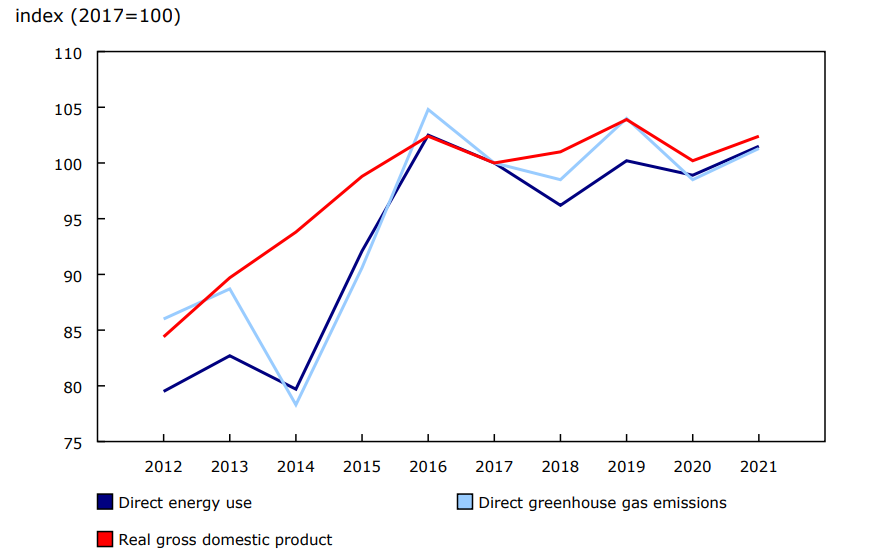
Description - Chart 2
Data table: National environmental-economic trends for the environmental and clean technology products sector, indexed
Notes: Direct energy use and emissions are those associated with the industry's own production; indirect energy use and emissions are those associated with the production of the goods and services that are used by the industry.
Sources: Tables 36-10-0630-01 and 38-10-0139-01.
Note to readers
The Environmental and Clean Technology Products Economic Account (ECTPEA) measures the economic contribution of environmental and clean technology products in terms of output, value added—defined as gross domestic product (GDP)—, employment (number of jobs) and other economic variables. Estimates are directly comparable with national results for the Canadian economy. Estimates of GDP referred to in this release are measured at basic prices.
Estimates for 2022 and 2023 are preliminary and will be revised when updated data become available, including the supply and use tables for those reference years.
Environmental and clean technology products are defined as any process, product or service that reduces environmental impacts through any of the following three strategies: environmental protection activities that prevent, reduce or eliminate pollution or any other degradation of the environment; resource management activities that result in the more efficient use of natural resources, thus safeguarding against their depletion; and the use of goods that have been adapted to be significantly less energy or resource intensive than the industry standard.
Two broad categories of environmental and clean technology products are recognized: environmental goods and services (including clean electricity, biofuels and primary goods, and waste management and remediation services) and clean technology goods and services (including manufactured goods, scientific and research and development services, construction services and support services). The products follow the Supply and Use Product Classification used in the Canadian System of Macroeconomic Accounts.
As part of the Government of Canada's initiative to develop the Clean Technology Data Strategy, the ECTPEA provides comprehensive measures of the supply and use of environmental and clean technology products in the Canadian economy. The ECTPEA has a broader scope than the Survey of Environmental Goods and Services because it captures all economy-wide transactions in the environmental and clean technology products sector, including elements such as clean energy and scrap goods. The government and non-profit sectors are also fully covered in the ECTPEA.
The compilation of the ECTPEA draws on a variety of data sources, including Statistics Canada's supply and use tables, detailed import and export statistics released in Canada's balance of international payments and the Survey of Environmental Goods and Services. The data on the energy use and GHG emissions result from the linkage of the ECTPEA with Statistics Canada's Physical Flow Account on energy use and GHG emissions, which is undertaken in collaboration with the Canadian Centre for Energy Information.
Examples of environmental goods and services and clean technologies are available in the publication Clean technologies and the Survey of Environmental Goods and Services: A technical reference guide (16-511-X).
Reference
Data tables: Access the latest tables.
- Note: some data tables may best be viewed on desktop.
Definitions, data sources and methods: survey numbers 1901 and 5115.
Previous release: Environmental and Clean Technology Products Economic Account, 2022.
Contact information
For more information, or to enquire about the concepts, methods or data quality of this release, contact us (toll-free 1-800-263-1136; 514-283-8300; infostats@statcan.gc.ca) or Media Relations (statcan.mediahotline-ligneinfomedias.statcan@statcan.gc.ca).