
Utilizing data from the 2022 Canadian Survey on Disability, this infographic highlights the trends and experiences of persons with seeing disabilities. This release is part of a series of infographics that focus on specific disability types.
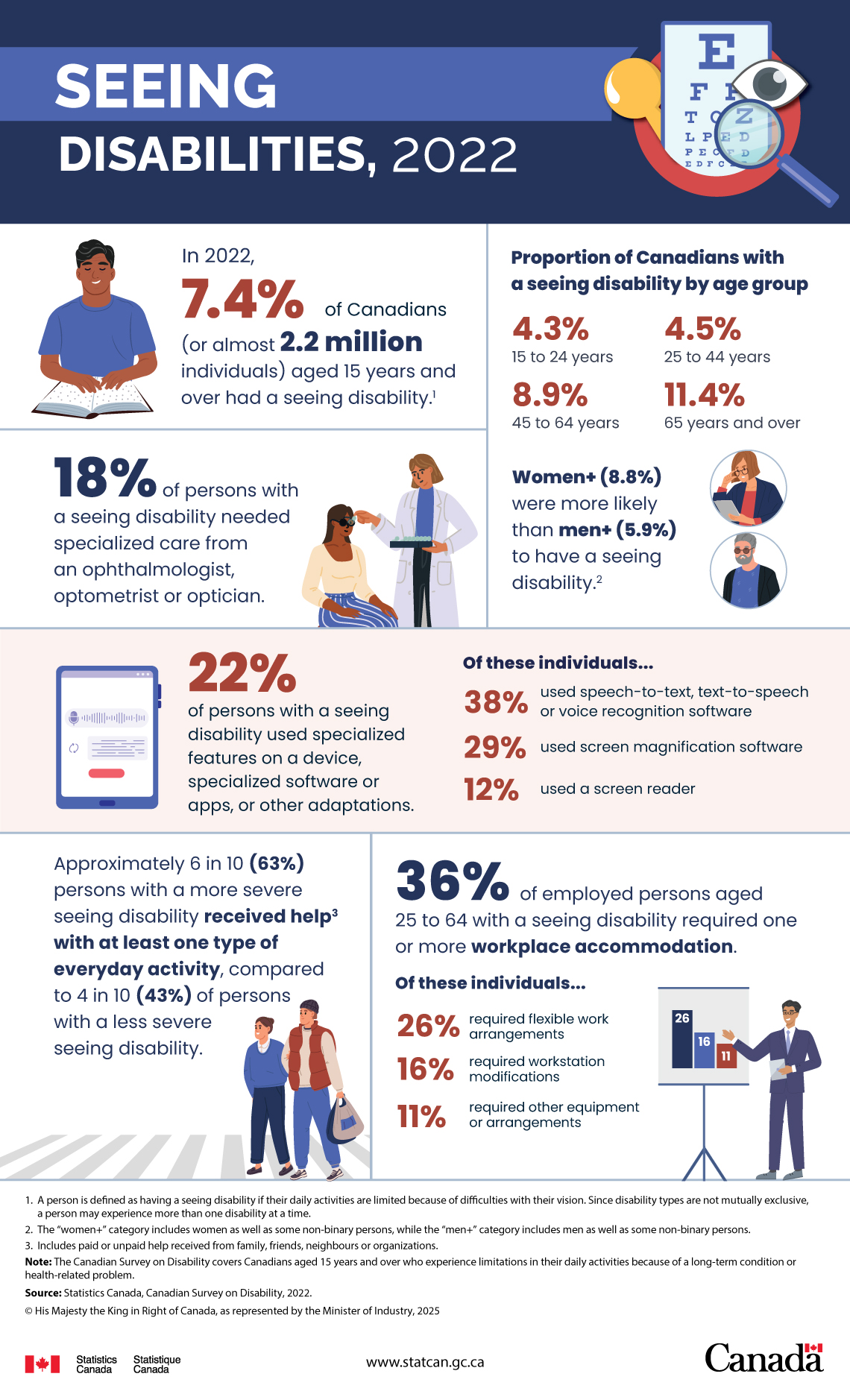
Description - Seeing disabilities, 2022
- In 2022, 7.4% of Canadians (or almost 2.2 million individuals) aged 15 years and over had a seeing disability.1
- Proportion of Canadians with a seeing disability by age group:
- 15 to 24 years: 4.3 %
- 25 to 44 years: 4.5%
- 45 to 64 years: 8.9%
- 65 years and over: 11.4%
- Women+ (8.8%) were more likely than men+ (5.9%) to have a seeing disability.2
- 18% of persons with a seeing disability needed specialized care from an ophthalmologist, optometrist, or optician.
- 22% of persons with a seeing disability used specialized features on a device, specialized software or apps, or other adaptations. Of these individuals…
- 38% used speech-to-text, text-to-speech or voice recognition software
- 29% used screen magnification software
- 12% used a screen reader
- Approximately 6 in 10 (63%) persons with a more severe seeing disability received help3 with at least one type of everyday activity, compared to 4 in 10 (43%) of persons with a less severe seeing disability.
- 36% of employed persons with a seeing disability, aged 25 to 64, required one or more workplace accommodations. Of these individuals...
- 26% required flexible work arrangements
- 16% required workstation modifications
- 11% required other equipment or arrangements
Note: The Canadian Survey on Disability covers Canadians aged 15 years and over who experience limitations in their daily activities because of a long-term condition or health-related problem.
Source: Statistics Canada, Canadian Survey on Disability, 2022.
Notes
- Footnote 1.
-
Persons with a seeing disability are identified as persons whose daily activities are limited because of difficulties with their ability to see. Since disability types are not mutually exclusive, a person may experience more than one co-occurring disability at a time.
- Footnote 2.
-
The “women+” category includes women as well as some non-binary persons while the “men+” category includes men as well as some non-binary persons.
- Footnote 3.
-
“Help” includes help received from family, friends, neighbours and from organizations, whether paid or unpaid.
Contact information
For more information, or to enquire about the concepts, methods or data quality of this release, contact us (toll-free 1-800-263-1136; 514-283-8300; infostats@statcan.gc.ca) or Media Relations (statcan.mediahotline-ligneinfomedias.statcan@statcan.gc.ca).