
Highlights
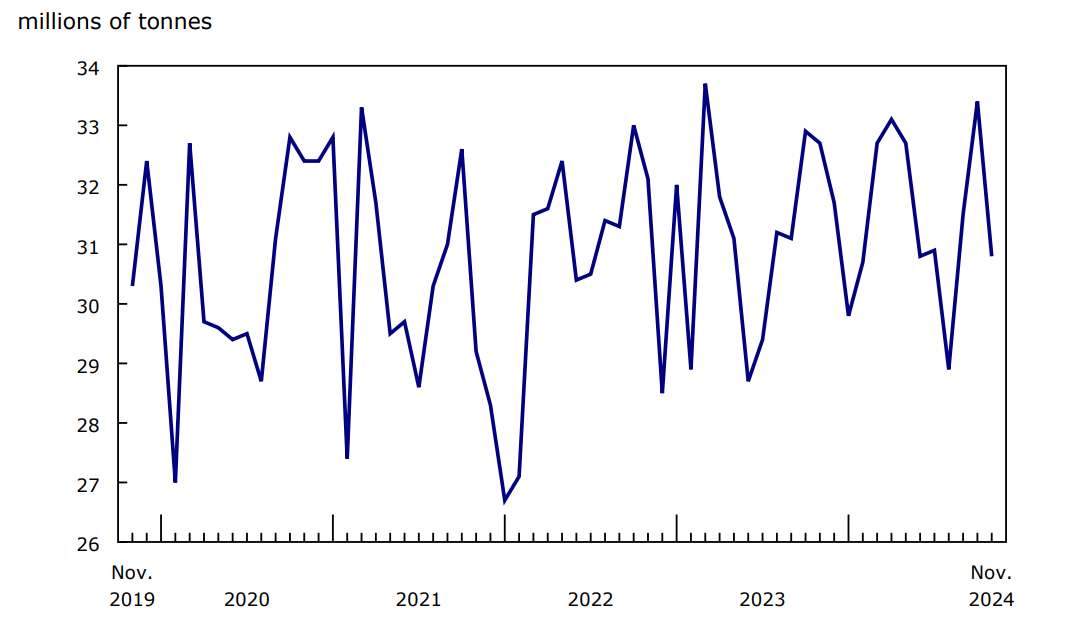
In November, the volume of cargo carried by Canadian railways reached 30.8 million tonnes, down 5.8% from November 2023, and slightly below the five-year average (31.3 million tonnes) for the month.
Large declines in shipments of potash and coal compared to November 2023 were tempered by increased carloadings of grains.
To further explore the latest data and historical trends in an interactive format, please visit the "Monthly Railway Carloadings: Interactive Dashboard."
Chart 1: Railway carloadings, total tonnage
Description - Chart 1
Data table: Railway carloadings, total tonnage
Source: Table 23-10-0216-01.
The decrease in total freight carried in November was due to a lower volume of domestic loadings, both non-intermodal loadings (mainly commodities) and intermodal loadings (mainly containers) as well as reduced traffic from US connections.
Potash and coal lead decline
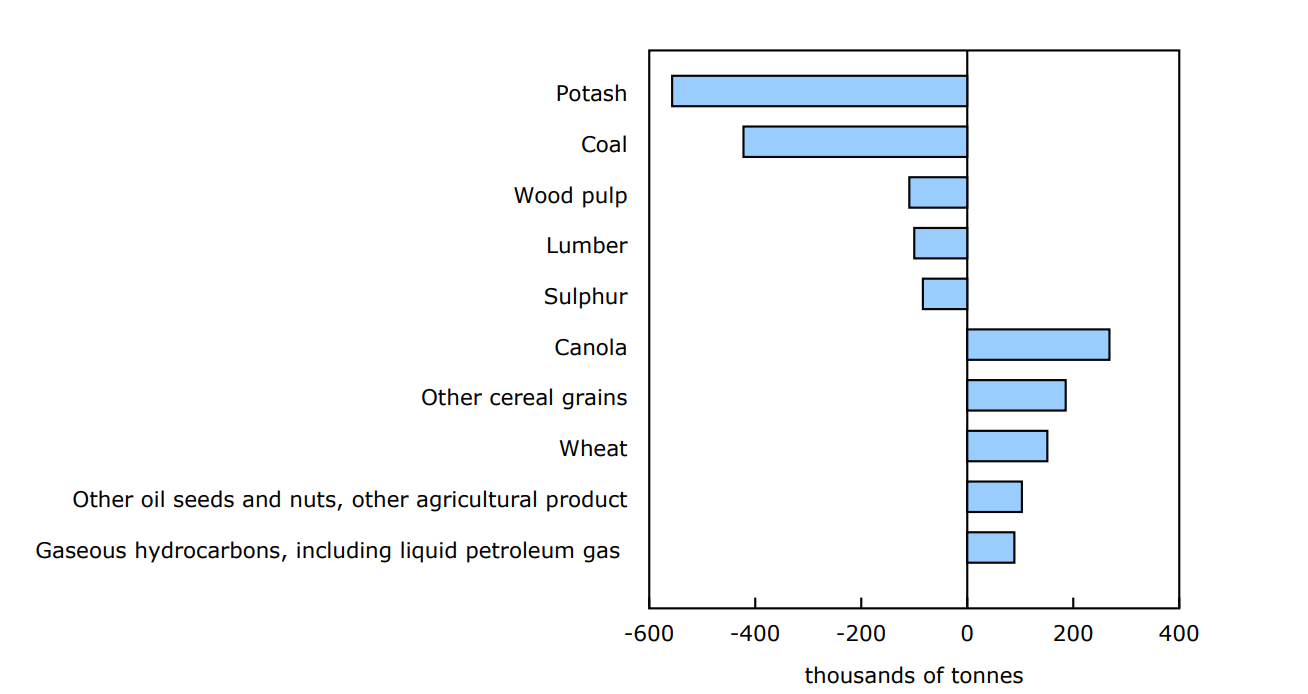
Domestic non-intermodal freight traffic was down 3.4% year over year to 25.2 million tonnes in November. The decline was led by potash, which fell 23.2% (-557 000 tonnes) from the same month a year earlier. This marks the fourth consecutive month of year-over-year decline and the largest decline since November 2019. Meanwhile, loadings of coal decreased by 12.7% (-422 000 tonnes) from November 2023 levels.
Chart 2: Railway carloadings, largest commodity differences, November 2023 to November 2024
Description - Chart 2
Data table: Railway carloadings, largest commodity differences, November 2023 to November 2024
Source: Table 23-10-0216-02.
Carloadings of some agricultural products increase
Increases in the loadings of some agricultural and food products—most notably grains—helped to partially offset these declines. The increase in grain traffic in November, compared to the same month in 2023, reflects the higher production of field crops during the 2024 crop year.
Loadings of canola have risen each month since April 2024 and grew 46.4% (+268 000 tonnes) in November from the same month in 2023.
Another notable increase was reported for other cereal grains, with loadings rising by 61.8% (+186 000 tonnes) in November compared with November 2023. Meanwhile, loadings of wheat increased by 5.8% (+151 000 tonnes) from November 2023 levels.
Intermodal traffic down
In November 2024, intermodal shipments—mainly containers—originating in Canada also contributed to the overall decline in railway carloadings, decreasing 15.1% year over year to 2.5 million tonnes.
American freight traffic down
Freight loadings from US rail connections totalled 3.2 million tonnes in November, a decline of 15.6%, or 584 000 tonnes, from the same month a year earlier. This was the lowest level recorded for the month of November in four years.
Note to readers
The Monthly Railway Carloadings Survey collects data on the number of rail cars, tonnage, units and 20-feet equivalent units from railway transporters operating in Canada that provide for-hire freight services.
Cargo loadings from Armstrong, Ontario, to the Atlantic Coast are classified to the eastern division (Eastern Canada), while loadings from Thunder Bay, Ontario, to the Pacific Coast are classified to the western division (Western Canada).
Survey data are revised on a monthly basis to reflect new information.
The data in this release are not seasonally adjusted.
The Transportation Data and Information Hub provides Canadians with online access to comprehensive statistics and indicators for the country's transportation sector, including a new table featuring Canadian international merchandise trade by mode of transport.
Reference
Data table : 23-10-0216-01.
- Note: some data tables may best be viewed on desktop.
Definitions, data sources and methods: survey number 2732.
Previous release: Railway carloadings, October 2024.
Contact information
For more information, or to enquire about the concepts, methods or data quality of this release, contact us (toll-free 1-800-263-1136; 514-283-8300; infostats@statcan.gc.ca) or Media Relations (statcan.mediahotline-ligneinfomedias.statcan@statcan.gc.ca).