

Modern economies make major investments in intangible knowledge assets such as data assets, research and development and brand equity. These investments lack solid physical forms. Nevertheless, they are crucial to modern business performance and create assets that are used repeatedly in production processes for many years.
A new study, titled "Data, Intangible Capital and Economic Growth in Canada," shows that intangible investments were important for labour productivity growth in Canada from 2000 to 2019, but their contribution was lower than that in the United States and Europe.
Productivity growth is essential for improving living standards. Labour productivity, which measures the output of the economy per hour worked, can increase from firms' investments in tangible and intangible assets, upgrading workers' skills, and multifactor productivity growth (that is, innovation and technological progress that are not embodied in investments).
Intangible investments make significant contribution to labour productivity growth
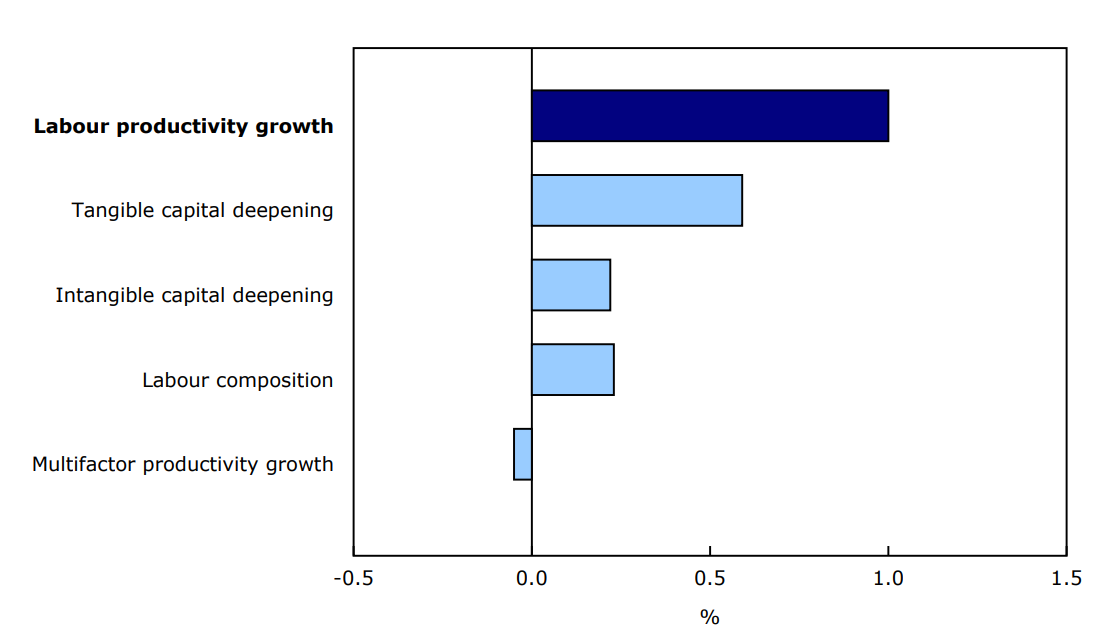
For the period from 2000 to 2019, labour productivity rose by 1.00% per year in the Canadian business sector (Chart 1). About one-fifth (0.22 percentage points) of annual labour productivity growth was from investment in intangible assets.
Chart 1: Sources of annual average labour productivity growth in the business sector in Canada, 2000 to 2019
Description - Chart 1
Data table: Sources of annual average labour productivity growth in the business sector in Canada, 2000 to 2019
Source: Special tabulation.
The remaining portion of labour productivity growth (0.78 percentage points) was attributable to investments in tangible assets (+0.59 percentage points), changes in labour composition toward more skilled workers (+0.23 percentage points) and growth in multifactor productivity (-0.05 percentage points).
Across industries in Canada, the largest contribution of intangible assets to labour productivity growth was in services-producing industries, such as wholesale trade, information and cultural industries, and professional and scientific services.
Intangible investments grow faster than tangible investments
From 2000 to 2019, investment in intangible assets (+2.58% per year) grew faster than investment in tangible assets (+2.02% per year), such as machinery and equipment or structures in the Canadian business sector. During this period, intangible assets rose from being 73% as large as tangible investments to being 83% as large.
The increase in the importance of intangible assets came from the rise of digital technology and knowledge-based production systems.
Intangible assets contribute less to labour productivity growth in Canada than in the United States and Europe
The study adopts an internationally accepted methodology for measuring intangible assets to support comparability with the United States and Europe.
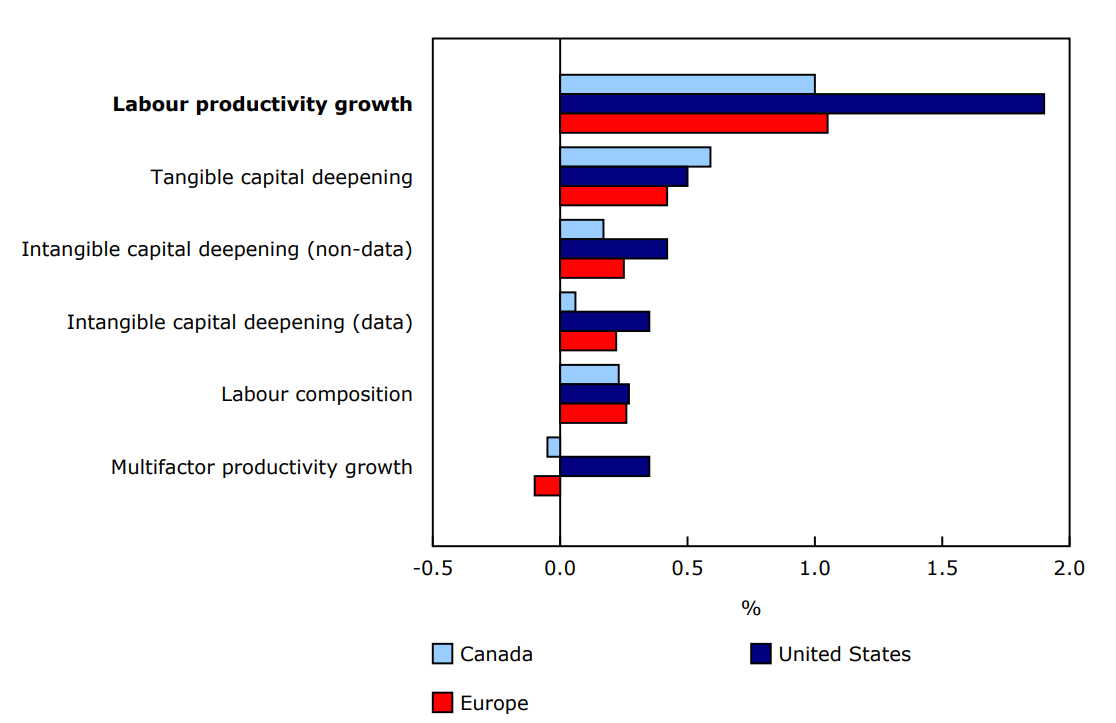
When labour productivity is adjusted to account for intangible assets, intangible assets' contribution to labour productivity growth in Canada was 0.55 percentage points lower than that in the United States from 2000 to 2019 (Chart 2).
Chart 2: Sources of annual average labour productivity growth in the business sector, Canada, the United States and Europe, 2000 to 2019
Description - Chart 2
Source: Special tabulation.
Canada had a similar contribution to labour productivity growth from investment overall as Europe, but Canada relied more on tangible assets, while Europe relied more on intangible assets.
Contact information
For more information, or to enquire about the concepts, methods or data quality of this release, contact us (toll-free 1-800-263-1136; 514-283-8300; infostats@statcan.gc.ca) or Media Relations (statcan.mediahotline-ligneinfomedias.statcan@statcan.gc.ca).