

Latest trends of the entry into and exit from self-employment and business ownership in Canada
Entrepreneurial activity has long been recognized as a key driver of innovation, job creation and productivity growth. A new study, released today, examines how the significant economic shifts and challenges Canada has faced since the mid-2000s—such as the global oil price drop beginning in 2014, the proliferation of online platforms and the COVID-19 pandemic—have influenced turnover in both unincorporated self-employment and incorporated business ownership.
The study "Update on the Entry into and Exit from Self-employment and Business Ownership in Canada" found there was a higher percentage of entries (number of newly self-employed individuals as a share of active self-employment) and exits (number of individuals who leave self-employment as a share of active self-employment) among unincorporated self-employed individuals from 2006 to 2020 than among incorporated business owners. Over this period, entry and exit rates for business ownership steadily declined, pointing to declining business dynamism. For example, the entry rate into business ownership dropped from over 15% in 2006 to 12% in 2020 (Chart 1). This declining business dynamism is often thought to be associated with Canada's slowing productivity growth. However, the business ownership entry rate increased in 2020 compared with 2019, partly due to government business support programs implemented during the pandemic.
Trends by sociodemographic characteristics
Over the period from 2006 to 2020, trends of entry and exit rates varied significantly across different sociodemographic groups. Women, young people (aged 15 to 34 years), recent immigrants (in Canada for five years or less) and business owners with fewer employees (five employees or fewer) experienced higher entry and exit rates. On average, the entry rate into self-employment was 21% for women (compared with 17% for men), 33% for young people (compared with 14% for those aged 55 years and older) and 37% for recent immigrants (compared with 17% for Canadian-born individuals).
Trends by sector
Major economic disruptions also shaped the patterns in entry and exit rates. The mining, quarrying, and oil and gas extraction sector saw a sharp decline in entry rates into self-employment and business ownership, as well as an increase in exit rates, following the oil price drop in 2014. In contrast, self-employment in the transportation and warehousing sector expanded, with the entry rate rising from 15% in 2014 to 26% in 2020, likely reflecting the growth of the gig economy.
Effects of the pandemic
The pandemic had distinct effects on self-employment and business ownership. Compared with 2019, net self-employment income declined in 2020 for most individuals, excluding those in the top 10% of the income distribution. Meanwhile, business income rose for more than half of business owners. The pandemic also led to a decrease in the entry rate and an increase in the exit rate for unincorporated self-employment. However, for incorporated business ownership, both entry and exit rates rose; the increase in entries surpassed that of exits, resulting in a net entry rate of 2%. Unlike self-employed individuals, who typically do not hire employees, business owners faced high closure costs, but they benefitted from government business support programs that helped cover payroll and other expenses and reduce their risk of closure.
These findings shed light on the evolving nature of entrepreneurship in Canada and its implications for economic growth and productivity. Understanding these trends is crucial for policymakers and business leaders aiming to foster a more resilient and innovative economy. These insights can help inform targeted policies and support programs that encourage business formation, reduce barriers to entrepreneurship and enhance the growth of small businesses in Canada.
Chart 1: Entry rates to unincorporated self-employment and incorporated business ownership
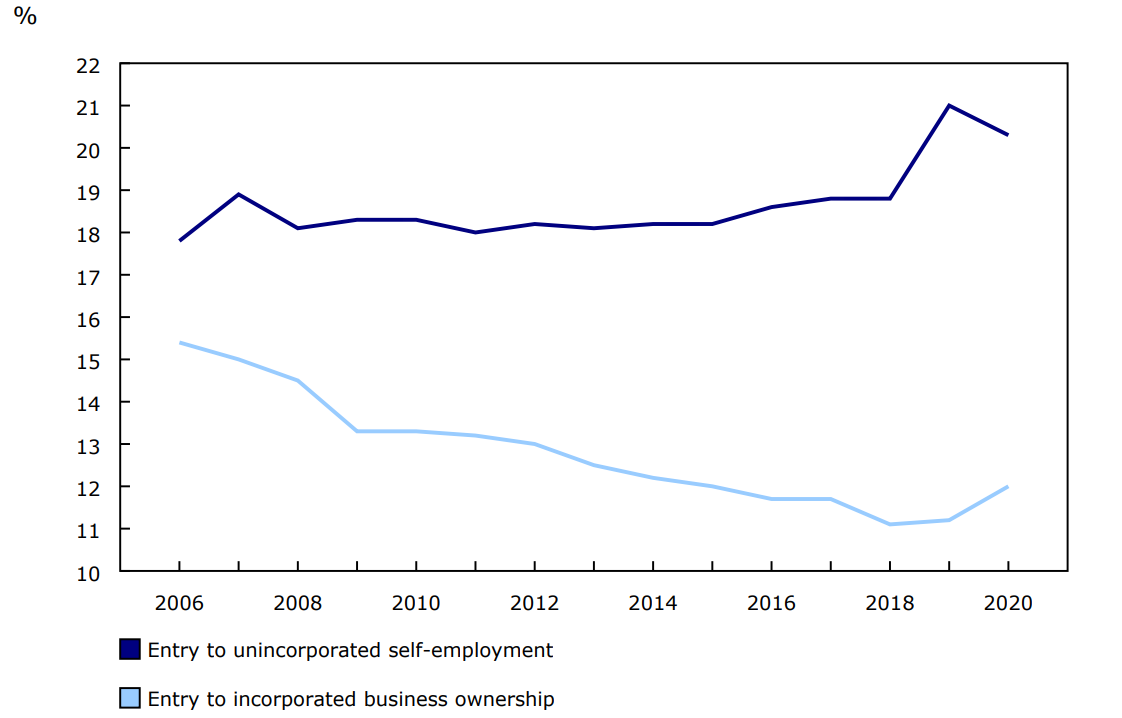
Description - Chart 1
Data table: Entry rates to unincorporated self-employment and incorporated business ownership
Source: Canadian Employer–Employee Dynamics Database.
Contact information
For more information, or to enquire about the concepts, methods or data quality of this release, contact us (toll-free 1-800-263-1136; 514-283-8300; infostats@statcan.gc.ca) or Media Relations (statcan.mediahotline-ligneinfomedias.statcan@statcan.gc.ca).