

Multifactor productivity (MFP) in the business sector declined by 1.7% in 2023, following a 0.6% increase in 2022. In 2023, MFP in the business sector declined in every province except Saskatchewan.
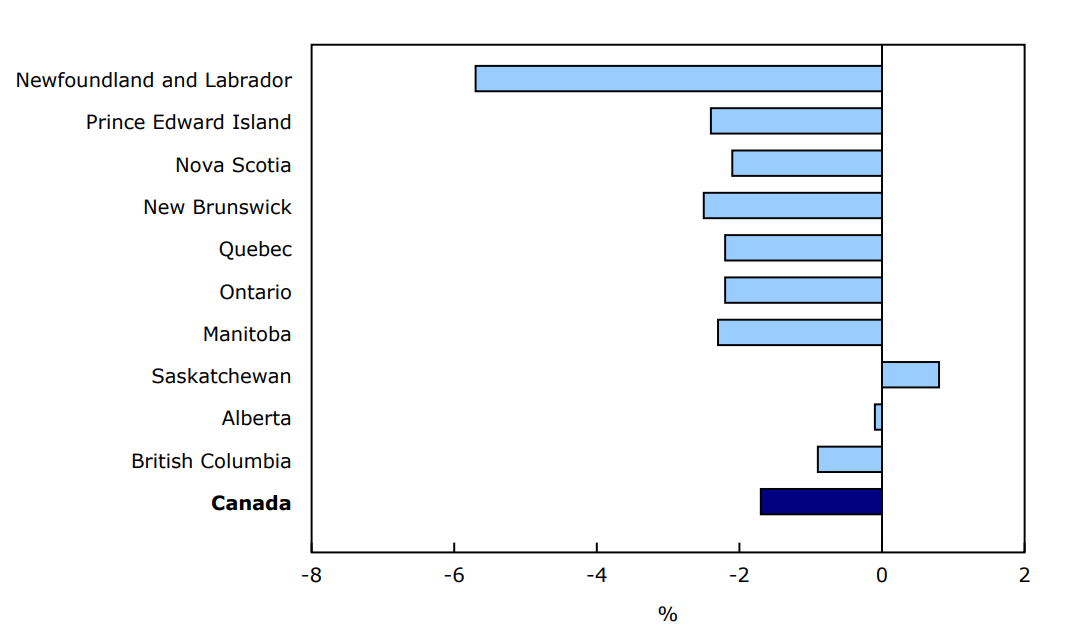
In 2023, the largest decrease in MFP was recorded in Newfoundland and Labrador (-5.7%), while six provinces saw declines ranging from 2.1% to 2.5%. MFP edged down in Alberta (-0.1%) and British Columbia (-0.9%) (Chart 1).
Chart 1: Multifactor productivity in the business sector, by province, 2023
Description - Chart 1
Data table: Multifactor productivity in the business sector, by province, 2023
Sources: Tables 36-10-0211-01 and 36-10-0208-01.
MFP is one of the three components of labour productivity, which drives Canada's living standards. The other two components are capital intensity and labour skill upgrading. Capital intensity is a measure of the amount of capital available per hour worked, and it contributes to labour productivity growth through a firm's investment in equipment, structures and intellectual property.
Skill upgrading refers to shifts in labour composition toward more educated and experienced workers, capturing the effect of increases in worker skills on labour productivity. The residual portion of labour productivity growth that is not attributable to increases in input intensity and labour skill upgrading is called growth in MFP.
Widespread decline in multifactor productivity and capital intensity contribute to lower labour productivity
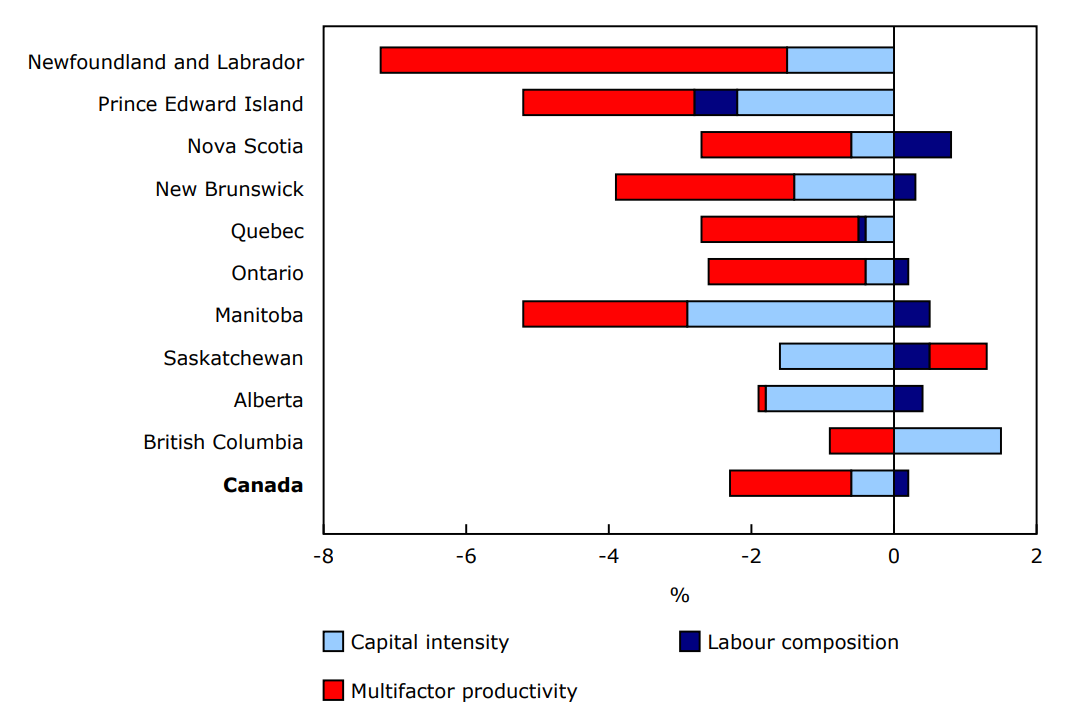
Labour productivity in the business sector declined in every province in 2023. MFP and capital intensity both declined in most provinces, contributing to the decline in labour productivity during the year (Chart 2).
Chart 2: Contributions to labour productivity growth in the business sector, by province, 2023
Description - Chart 2
Data table: Contributions to labour productivity growth in the business sector, by province, 2023
Sources: Tables 36-10-0211-01 and 36-10-0208-01.
However, across provinces, the decline in MFP and the decline in capital intensity did not have the same relative importance for the overall drop in labour productivity in 2023.
The decline in MFP drove the drop in labour productivity in all provinces in 2023, except Manitoba, Saskatchewan and Alberta, where the decline in capital intensity drove the decline in labour productivity.
In 2023, labour skill upgrading made a small positive contribution to the growth in labour productivity in six provinces, while it had little effect in British Columbia and Newfoundland and Labrador. Labour skill upgrading had a negative contribution to labour productivity in Prince Edward Island and Quebec.
Note to readers
This release covers the database on provincial multifactor productivity and related variables for business sector industries from 1997 to 2023. Data include multifactor productivity, value added, capital input and labour input in the aggregate business sector and major subsectors.
This database is constructed using a methodology that is similar to the one used to construct the multifactor productivity estimates at the national level released in The Daily on April 7, 2025.
Data in this release reflect data on fixed capital for 2023 published in The Daily on November 14, 2024, and data on hours worked and labour productivity in the provinces for 2023 published in The Daily on February 10, 2025.
Multifactor productivity measures at Statistics Canada are derived from a growth accounting framework that allows analysts to isolate the effects of increases in input intensity and skill upgrading on the growth in labour productivity. The residual portion of labour productivity growth that is not attributable to increases in input intensity and labour skill upgrading is called growth in multifactor productivity. It measures the efficiency with which inputs are used in production. Growth in this area is often associated with technological progress, organizational innovations or economies of scale.
Reference
Data table: 36-10-0211-01.
- Note: some data tables may best be viewed on desktop.
Definitions, data sources and methods: survey number 1402.
Previous release: Estimates of multifactor productivity growth in the provinces, 2022.
Contact information
For more information, or to enquire about the concepts, methods or data quality of this release, contact us (toll-free 1-800-263-1136; 514-283-8300; infostats@statcan.gc.ca) or Media Relations (statcan.mediahotline-ligneinfomedias.statcan@statcan.gc.ca).