

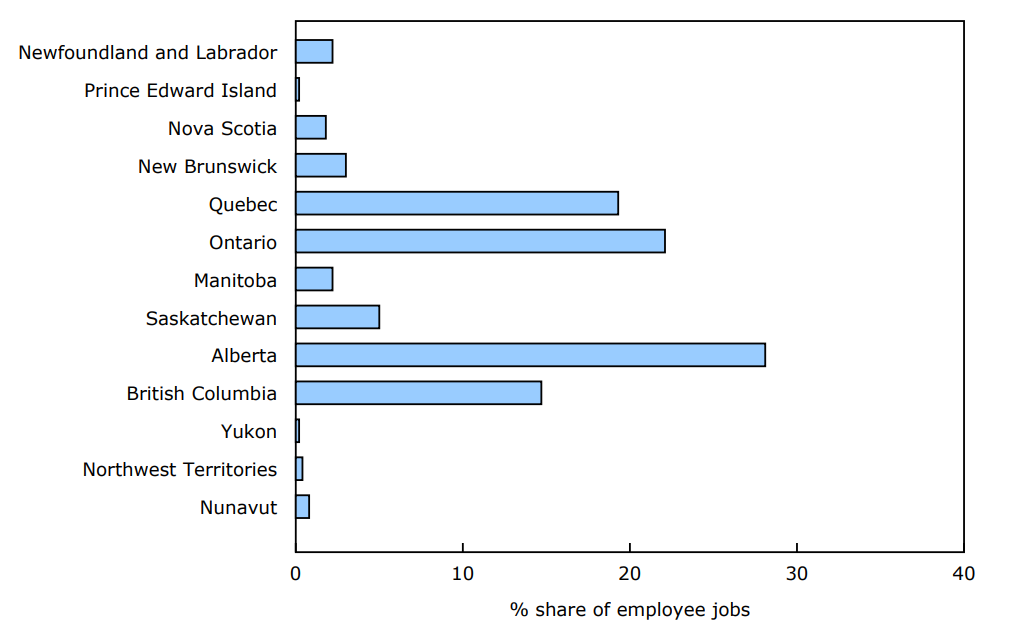
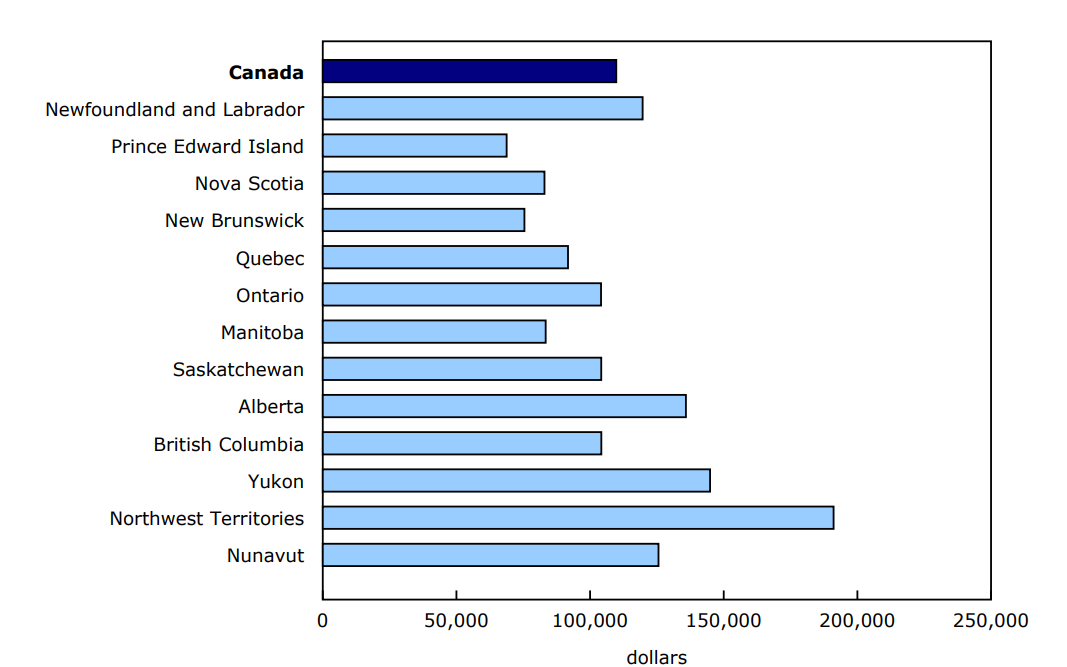
In 2023, the natural resources sector generated over 656,000 paid jobs, representing 3.4% of all employee jobs in the country. Most of the employee jobs in the natural resources sector were in Alberta (28.1%), followed by Ontario (22.1%) and Quebec (19.3%). In 2023, the average annual wages and salaries per job in the natural resources sector was $110,000, compared with an economy-wide average of $66,000.
Chart 1: Percentage of Canadian natural resources jobs, 2023
Description - Chart 1
Data table: Percentage of Canadian natural resources jobs, 2023
Source: Table 36-10-0654-01.
Women hold one-fifth of paid worker jobs in the natural resources sector
In 2023, 20.9% of employee jobs in the natural resources sector were held by women, ranging from a high of 35.2% in the hunting, fishing and water subsector, to a low of 16.0% in the mineral and mining subsector. On average, the annual wages and salaries received by women in the sector was over $88,000, while for men, the average was over $115,000. This difference is partially explained by women's jobs recording fewer hours worked per year than men's jobs.
Chart 2: Average annual salaries, Canada, provinces and territories, 2023
Description - Chart 2
Data table: Average annual salaries, Canada, provinces and territories, 2023
Source: Table 36-10-0654-01.
Share of jobs held by employees with university degree and higher edges up
In 2023, 24.0% of paid worker jobs in the natural resources sector were held by those with a university degree and higher, a slight increase over 23.5% in 2022. By comparison, 35.7% of the jobs were held by employees with a high school diploma or less in 2023, a small decrease over the previous year. The forestry subsector had the largest proportion of paid worker jobs held by individuals with a high school diploma or less (50.4%), while the energy subsector had the largest share of jobs held by employees with a university degree and higher (33.0%).
Decreasing share of jobs occupied by workers in the youngest and oldest age groups
In recent years, the age composition of employees in the natural resources sector has been shifting, with a decreasing share of paid worker jobs occupied by individuals in the youngest and oldest age groups. In 2023, paid worker jobs occupied by individuals in the 15-to-24 age range represented 6.9% of employee jobs in the natural resources sector, while the 55 and older cohort represented 24.3%. Both values have been trending downwards in recent years. By comparison, in 2023, nearly half the paid worker jobs in the natural resources sector were occupied by individuals aged 35 to 54 years old.
Share of paid worker jobs occupied by visible minorities and immigrant employees stabilizing
While the natural resources workforce has become increasingly diverse over the last decade, the trend has been slowing in recent years. In 2023, 18.7% of paid worker jobs in the natural resources sector were occupied by individuals identifying as a visible minority, representing a slight decrease from the previous year (18.8%).
At the same time, the share of paid jobs held by immigrants represented 14.6% of natural resources jobs in 2023, unchanged from the previous year. Of all the subsectors in the natural resources sector, the energy subsector had the largest share of immigrant jobs at 17.4%. In comparison, the downstream sector, which includes secondary and tertiary processing of natural resource products, had proportionally more immigrant jobs at 29.5% in 2023.
Note to readers
Human resource module (HRM) data for 2023 have been released along with the revised data from 2018. The revisions are primarily due to the incorporation of revised estimates from the Human Resource Module of the Canadian Economy, which provides annual estimates for the years 2010 up to 2023, including provincial and territorial estimates.
For more statistics on the human resource dimension of the Canadian economy, please consult table 36-10-0689-01: Labour statistics consistent with the System of National Accounts, by employee characteristics and industry.
The Natural Resources Satellite Account (NRSA) contains information on the number of jobs generated by the sector at the national, provincial and territorial level. The detailed information in the HRM complements and enhances the analytical capacity of the NRSA. The wages and salaries figures quoted here do not include supplementary labour income and income from self-employment.
Additional information is presented in the articles, "The Natural Resources Satellite Account: Feasibility Study" and "The Natural Resources Satellite Account – Sources and Methods," which are part of the Income and Expenditure Accounts Technical Series (13-604-M) and are available from the "Browse by key" resource module of our website, under "Publications."
For analytical purposes, secondary and tertiary processing for the forestry and minerals and mining subsectors are identified separately as "downstream" sectors.
Core natural resources: the NRSA defines natural resource activities as those that result in goods and services originating from naturally occurring assets used in economic activity, as well as their initial processing (primary manufacturing).
Downstream activities: although not part of the core account, natural resources have important downstream effects on other sectors. In general, this production uses a large portion of primary manufactured products as inputs.
Reference
Data tables: 36-10-0653-01 and 36-10-0654-01.
- Note: some data tables may best be viewed on desktop.
Definitions, data sources and methods: survey number 1901.
Previous release: Natural Resources Satellite Account: Human Resource Module, 2012 to 2021.
Contact information
For more information, or to enquire about the concepts, methods or data quality of this release, contact us (toll-free 1-800-263-1136; 514-283-8300; infostats@statcan.gc.ca) or Media Relations (statcan.mediahotline-ligneinfomedias.statcan@statcan.gc.ca).